NICL Assistant Cut Off 2026, Check Previous Year Qualifying Marks

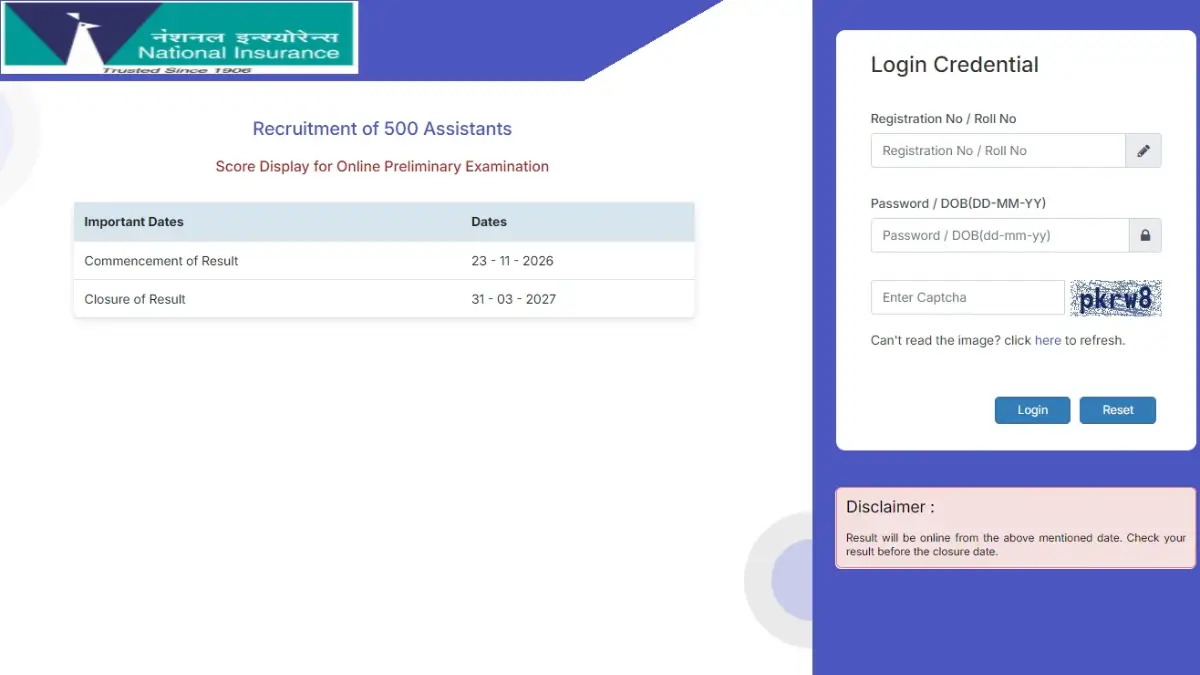
The NICL Assistant Cut Off 2026 will be released by the National Insurance Company Limited (NICL) along with the Prelims Exam result or through a separate scorecard update. Candidates who have checked their NICL Assistant Prelims Score Card 2026 can review their marks and evaluate their performance in the examination. The cut-off marks will determine the minimum qualifying scores required to proceed to the next stage of the selection process.

NICL Assistant Cut Off 2026

The NICL Assistant Cut Off 2026 will be released state-wise and category-wise, providing candidates with the minimum marks required to qualify for the Mains Examination. The cut-off may vary depending on the state, category, number of vacancies and overall examination performance. Candidates can check the NICL Assistant Cut Off 2026 for their respective state and category once officially released by NICL.

Also Read, NICL Assistant Prelims Score Card 2026 Out

NICL Assistant Prelims Expected Cut Off 2026

These are expected cut-off ranges, not official cut-offs. The estimates have been prepared by considering the 2024 state/category-wise cut-offs, 2026 vacancy distribution and the relatively easy level of the 27 August Shift 1 paper. States with fewer vacancies, such as Himachal Pradesh, Kerala, West Bengal, Delhi and Jammu & Kashmir, may see comparatively higher cut-offs because of the limited number of seats and state-wise competition.

State/UT SC ST OBC EWS UR
Andhra Pradesh 78–82 — 80–84 80–84 80–84
Arunachal Pradesh — 78–82 — — 81–85
Assam — 75–79 75–79 79–83 80–84
Bihar 80–84 — 81–85 82–86 82–86
Chhattisgarh 79–83 76–80 79–83 81–85 81–85
Goa — — — — 79–83
Gujarat 78–82 74–78 78–82 79–83 79–83
Haryana 77–81 — — — 80–84
Himachal Pradesh — — — — 84–88
Jharkhand 77–81 77–81 78–82 78–82 79–83
Karnataka 74–78 74–78 74–78 74–78 74–78
Kerala 82–86 — 85–89 80–84 86–90
Madhya Pradesh 81–85 77–81 82–86 83–87 83–87
Maharashtra 82–86 81–85 82–86 82–86 83–87
Meghalaya — — — — 56–62
Mizoram — — — — 79–83
Nagaland — — — — 80–84
Odisha 81–85 — 81–85 82–86 84–88
Punjab — — 72–76 76–80 82–86
Rajasthan 81–85 75–79 81–85 82–86 82–86
Sikkim — — — — 81–85
Tamil Nadu — — 75–79 52–56 75–79
Telangana 72–76 72–76 72–76 72–76 72–76
Tripura — — — — 84–88
Uttar Pradesh — — 82–86 82–86 83–87
Uttarakhand 81–85 — 79–83 — 82–86
West Bengal 81–85 75–79 80–84 79–83 87–91
Chandigarh (UT) 83–87 — 73–77 — 83–87
Delhi (UT) 84–88 — 84–88 84–88 85–89
Jammu & Kashmir — — 65–69 — 85–89
Puducherry (UT) — — — — 78–82

How to Check NICL Assistant Cut Off 2026?

Candidates can follow the steps below to check the NICL Assistant Prelims Cut Off 2026 once it is officially released:

  1. Visit the official website of National Insurance Company Limited.
  2. Navigate to the Recruitment or Careers section.
  3. Find the NICL Assistant Recruitment 2026 notification or result link.
  4. Click on the NICL Assistant Prelims Cut Off 2026 link.
  5. Download the cut-off PDF.
  6. Check the state-wise and category-wise qualifying marks.

NICL Assistant Prelims Cut Off 2024

The Prelims Cut Off is state-wise and category-wise, reflecting variations in competition across regions. It is influenced by factors such as exam difficulty, number of candidates, and available vacancies in each state.

State/Union Territory SC ST OBC EWS UR
ANDHRA PRADESH – 79.25 82.00 82.00 82.00
ARUNACHAL PRADESH – – – – 82.50
ASSAM 79.00 76.50 74.50 80.25 81.25
BIHAR – – – 83.00 83.00
CHHATTISGARH 80.25 76.75 – 82.75 82.75
GOA – – – – 80.50
GUJARAT 79.25 75.00 79.25 79.25 79.25
HARYANA – – – – 79.50
HIMACHAL PRADESH – – 75.00 – 85.00
JHARKHAND 77.50 78.25 79.50 79.50 79.50
KARNATAKA 73.25 73.25 73.25 73.25 73.25
KERALA 83.00 – 86.50 59.25 86.50
MADHYA PRADESH – 77.75 84.50 84.50 84.50
MAHARASHTRA 83.00 82.25 83.00 83.00 83.00
MANIPUR – – – – 81.25
MEGHALAYA – – – – 56.00
MIZORAM – – – – 80.00
NAGALAND – – – – 81.75
ORISSA 82.25 74.00 – 83.75 85.25
PUNJAB – – 73.25 77.00 83.25
RAJASTHAN 82.25 76.00 82.50 82.50 82.50
SIKKIM – – – – 82.00
TAMIL NADU – – 76.00 52.00 76.00
TELANGANA 73.25 73.25 73.25 73.25 73.25
TRIPURA – – – – 85.00
UTTAR PRADESH – – 83.50 83.50 83.50
UTTARAKHAND 82.50 – 80.50 81.00 82.75
WEST BENGAL 81.50 76.50 80.75 79.00 87.25
ANDAMAN & NICOBAR ISLANDS – – – – 81.25
CHANDIGARH (UT) – – 73.25 – 84.25
DELHI (UT) 84.75 76.50 84.75 84.75 84.75
JAMMU AND KASHMIR – – 66.25 – 85.75
LADAKH – – – – 61.50
PONDICHERRY (UT) – – – – 79.00

nicl prelims cut off

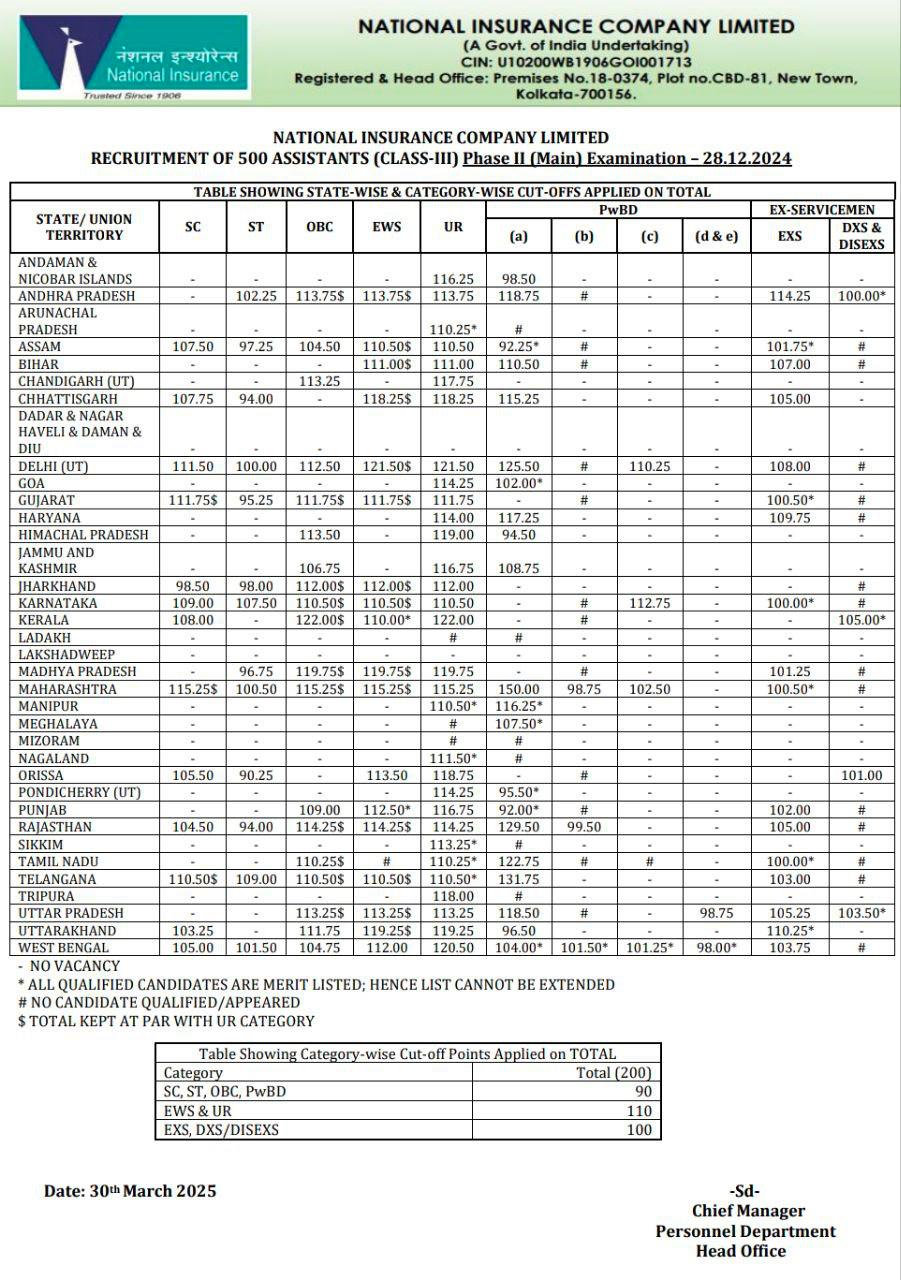
NICL Assistant Mains Cut Off 2024

The Mains Cut Off is usually higher than prelims and plays a decisive role in final selection. It is determined by overall performance in the mains examination and varies depending on the number of vacancies and candidate performance.

STATE/ UNION TERRITORY SC ST OBC EWS UR
ANDAMAN & NICOBAR ISLANDS – – – – 116.25
ANDHRA PRADESH – 102.25 113.75 113.75 113.75
ARUNACHAL PRADESH – – – – 110.25*
ASSAM 107.5 97.25 104.5 110.50 110.5
BIHAR – – – 111.00 111
CHANDIGARH (UT) – – 113.25 – 117.75
CHHATTISGARH 107.75 94 – 118.25 118.25
DADAR & NAGAR HAVELI & DAMAN & DIU – – – – –
DELHI (UT) 111.5 100 112.5 121.50$ 121.5
GOA – – – – 114.25
GUJARAT 111.75$ 95.25 111.75$ 111.75$ 111.75
HARYANA – – – – 114
HIMACHAL PRADESH – – 113.5 – 119
JAMMU AND KASHMIR – – 106.75 – 116.75
JHARKHAND 98.5 98 112.00$ 112.00$ 112
KARNATAKA 109 107.5 110.50$ 110.50$ 110.5
KERALA 108 – 122.00$ 110.00* 122
LADAKH – – . – #
LAKSHADWEEP – – – – –
MADHYA PRADESH – 96.75 119.75$ 119.75$ 119.75
MAHARASHTRA 115.25$ 100.5 115.25$ 115.25$ 115.25
MANIPUR – – – – 110.50*
MEGHALAYA – – – – #
MIZORAM – – – – #
NAGALAND – – – – 111.50*
ORISSA 105.5 90.25 – 113.5 118.75
PONDICHERRY (UT) – – – – 114.25
PUNJAB – – 109 112.50* 116.75
RAJASTHAN 104.5 94 114.25$ 114.25$ 114.25
SIKKIM – – – – 113.25*
TAMIL NADU – – 110.25$ # 110.25*
TELANGANA 110.50$ 109 110.50$ 110.50$ 110.50*
TRIPURA – – . – 118
UTTAR PRADESH – – 113.25$ 113.25$ 113.25
UTTARAKHAND 103.25 – 111.75 119.25$ 119.25
WEST BENGAL 105 101.5 104.75 112 120.5

NICL Assistant Mains Cut Off

Factors Affecting NICL Assistant Cut Off 2026

There are various factors that affect the cutoff marks of the exam. Some of the important factors responsible for determining the NICL Assistant cutoff are as follows:

  • Number of Vacancies: If the recruitment offers a significant number of positions, which may slightly lower the cut-off compared to limited recruitment cycles.
  • Exam Difficulty Level: If the Phase 1 exam has tougher questions, the cut-off is likely to be lower, and vice versa.
  • Number of Candidates: The larger the number of applicants, the higher the competition, potentially raising the cut-off.
  • Sectional Performance: NICL exams usually have sectional cut-offs, meaning candidates need to secure minimum marks in each section to qualify.
  • Normalization Process: Since the exam is conducted in multiple shifts, a normalization process will be applied to ensure fairness, impacting the final cut-off scores.

Does Normalization Affect NICL Assistant Cut Off?

Yes, normalization can impact the NICL Assistant Cut Off when the exam is held in multiple shifts. It adjusts scores to account for differences in difficulty levels across shifts.

  • Different Difficulty Levels: Normalization balances variations in question difficulty between shifts.
  • Fair Evaluation: It ensures candidates across different shifts are assessed on a comparable scale.
  • Impact on Cut Off: Normalized scores may affect the final cut-off marks.
  • Raw vs Normalized Score: The final score considered for qualifying may differ from the candidate’s raw marks.

How to Utilize Cut-Off Marks to Prepare?

Candidates can use the NICL Assistant previous year cut-off marks as a benchmark to plan a smarter and more targeted preparation strategy.

  • Compare previous year cut-offs to understand the level of competition.
  • Set a target score that is comfortably higher than the expected cut-off.
  • Focus on maximizing accuracy to avoid losing marks due to negative marking.
  • Strengthen weak sections while maintaining performance in strong subjects.
  • Take full-length mock tests and compare your scores with previous cut-off trends.
  • Analyze mock test performance regularly and work on improving speed and time management.
  • Prioritize high-scoring topics that frequently appear in the examination.
  • Stay updated with the latest exam pattern and difficulty level to adjust your preparation accordingly.
Related Posts
NICL Assistant Syllabus NICL Assistant Salary
NICL Assistant Previous Year Paper

UP Cooperative Bank Result 2026 Out at upcisb.upsdc.gov.in, Direct Link to Download PDF

The UP Cooperative Bank Result 2026 for the Assistant/Cashier (Banking Assistant/Clerical Staff), Category-3 post has been released on 23 November 2026 by the Uttar Pradesh Cooperative Institutional Service Board (UPCISB), Lucknow. The final merit list includes 57 selected candidates against 57 vacancies across 15 District Cooperative Central Banks (DCCBs) in Uttar Pradesh. 

UP Cooperative Bank Result 2026 Out

The document contains district-wise merit lists for 15 District Cooperative Central Banks, including the names, roll numbers, registration numbers, ranks and selection categories of successful candidates. Candidates can download the result PDF and search for their roll numbers in the respective district bank’s merit list to confirm their selection status.

UP Cooperative Bank Result 2026: Click here to Download PDF

Have You Cleared The UP Cooperative Bank Exam 2026???

UPCISB Result 2026: Overview

Candidates can check the important details of the UP Cooperative Bank Result 2026 in the table below.

Particulars Details
Organisation Uttar Pradesh Cooperative Institutional Service Board
Recruitment UP Cooperative Bank Recruitment 2026
Advertisement Number A-1/S.R./2026
Post Name Assistant/Cashier (Banking Assistant/Clerical Staff)
Category Category-3
Examination Dates 7 and 8 September 2026
Latest Result Date 23 November 2026
Result Status Released
Total Vacancies 57

How to Download UPCISB Result 2026 PDF?

Candidates can follow the steps below to download the UPCISB Result 2026:

  1. Visit the official website at upcisb.upsdc.gov.in.
  2. Navigate to the latest recruitment or result notifications.
  3. Find the notice related to Advertisement No. A-1/S.R./2026.
  4. Click on the result PDF dated  24 November 2026.
  5. Download and open the PDF.
  6. Search for your roll number in the relevant post-wise list.
  7. Save the PDF for future reference.

Details Mentioned in UP Cooperative Bank Result PDF

The final merit list contains the following information:

  • Candidate’s Name
  • Roll Number
  • Registration Number
  • Merit Rank
  • Category
  • Category Selected Under
  • Gender
  • Applicable Reservation Details

UP Cooperative Bank Final Merit List 2026: District-Wise Details

The official merit list covers 15 District Cooperative Central Banks across Uttar Pradesh. Candidates have been selected against the vacancies available in the respective banks. The district-wise merit lists are provided for the following banks:

  1. Bijnor
  2. Ghaziabad
  3. Muzaffarnagar
  4. Lalitpur
  5. Unnao
  6. Barabanki
  7. Pratapgarh
  8. Hamirpur (Mahoba)
  9. Fatehgarh (Farrukhabad)
  10. Shahjahanpur
  11. Aligarh
  12. Mainpuri
  13. Azamgarh
  14. Bahraich
  15. Gorakhpur

What After the UP Cooperative Bank Result 2026?

Candidates whose roll numbers appear in the provisional shortlist should prepare for the next stage of the recruitment process. The Board will communicate further instructions regarding document verification and related formalities through its official website and the prescribed communication channels.

  • Check Shortlist Status: Verify your roll number in the relevant post-wise list.
  • Prepare Documents: Keep educational certificates, identity proof, category certificates (if applicable) and other relevant documents ready.
  • Check Official Communication: Follow the Board’s instructions regarding document verification and the next stage.

CDB Recruitment 2026 Notification Out for LDC, Clerk and Various Posts, Check Details

The Coconut Development Board Recruitment 2026 Notification has been released for 35 vacancies across various Group A, Group B and Group C posts. The recruitment includes positions such as Lower Division Clerk (LDC), Assistant, Stenographer Grade II, Data Entry Operator, Field Officer, Development Officer and other posts. Candidates with qualifications ranging from Class 12th to postgraduate degrees, along with the prescribed professional experience, can apply for the respective positions.

CDB Recruitment 2026 Out

Eligible candidates will be able to submit their applications online through the official website once the application link is activated. Candidates interested in CDB Recruitment 2026 should carefully review the official notification to understand the post-wise vacancy distribution, educational qualifications, experience requirements, age limit, salary structure and application fee before applying.

CDB Recruitment 2026: Notification PDF

Coconut Development Board Reruitment 2026 Overview

Candidates can check the important details of the Coconut Development Board Recruitment 2026 in the table below.

Particulars Details
Organization Coconut Development Board (CDB)
Ministry Ministry of Agriculture and Farmers Welfare
Recruitment Name CDB Recruitment 2026
Post Name LDC, Assistant, Field Officer and Various Posts
Total Vacancies 35
Recruitment Type Direct Recruitment
Job Category Central Government Job
Pay Level Level 2 to Level 11
Application Mode Online
Application Fee ₹300 (where applicable)
Job Location Across India
Official Website coconutboard.gov.in

CDB Recruitment 2026 Important Dates

The Coconut Development Board has announced the recruitment notice dated 6 November 2026. Candidates should keep track of the following important dates to avoid missing any recruitment-related deadlines.

Events Dates
Notification Date 20 November 2026
Online Application Starts Starting Soon
Last Date to Apply Online To be announced
Examination Date To be announced
Interview Date To be announced

CDB Vacancy 2026: Post-wise Vacancy Details

The Coconut Development Board has announced 35 vacancies for various Group A, B and C posts. These positions include administrative, accounts, technical, translation and clerical roles. The post-wise vacancy distribution is given below.

Post Name Vacancies
Deputy Director (Development) 4
Assistant Director (Development) 1
Administrative Officer 1
Accounts Officer 1
Development Officer 2
Development Officer (Technology) 2
Assistant 1
Auditor 1
Junior Translation Officer 1
Stenographer Grade II 2
Field Officer 5
Data Entry Operator 1
Lower Division Clerk (LDC) 13
Total 35

CDB Recruitment 2026 Apply Online

The application window for CDB Recruitment 2026 will remain open from 21 November to 21 December 2026. Candidates who meet the eligibility requirements can apply online through the official Coconut Development Board website. Applicants should keep their necessary documents ready and complete the registration before the deadline.

CDB Recruitment 2026: Apply Online Link Will be Active Soon

Steps to Apply for CDB 2026

  1. Visit the official website of the Coconut Development Board at coconutboard.gov.in.
  2. Navigate to the Vacancy section on the homepage.
  3. Find the CDB Recruitment 2026 notification dated 6 November 2026.
  4. Click on the Apply Online link once it is activated.
  5. Complete the registration process by entering the required details.
  6. Fill in the application form with personal, educational and professional information.
  7. Upload the photograph, signature and other required documents in the prescribed format.
  8. Pay the application fee of ₹300, if applicable, through SBI Collect.
  9. Review all the details entered in the application form.
  10. Submit the application and download the confirmation page for future reference.

Coconut Development Board 2026 Eligibility Criteria

Candidates applying for Coconut Development Board Recruitment 2026 must fulfil the educational qualification, professional experience and age requirements prescribed for their respective posts. The eligibility criteria vary according to the responsibilities and pay level of each position.

Educational Qualification

The post-wise educational qualifications and experience requirements are provided below.

Post Name Educational Qualification Experience / Skill Requirement
Deputy Director (Development) Master’s degree in Horticulture, Agriculture or Plant Sciences 5 years at Pay Level 10 or equivalent, or 7 years at Pay Level 7 or equivalent, in agriculture development of plantation tree or horticulture crops
Assistant Director (Development) Master’s degree in Horticulture, Agriculture or Plant Science 3 years at Pay Level 7 or equivalent, or 5 years at Pay Level 6 or equivalent, preferably in plantation tree or horticulture crops
Administrative Officer Master’s degree from a recognised university 5 years of experience in administration and establishment matters at Pay Level 6 or equivalent in a government office, autonomous body, statutory body or PSU
Accounts Officer Associate of ICAI or ICMAI; alternatively, Master’s degree in Commerce with the prescribed Intermediate examination qualification from ICAI or ICMAI 5 years of accounting experience in a government office, PSU, autonomous body, statutory body or recognised organisation, as specified in the notification
Development Officer Bachelor’s degree in Agriculture or Horticulture 2 years of experience in Agriculture or Horticulture Development activities in a recognised institute
Development Officer (Technology) B.Tech in Food Processing/Food Technology or equivalent, or Master’s degree in Food and Nutrition or equivalent 2 years of experience in food processing in a recognised institute
Assistant Bachelor’s degree in Arts, Science or Commerce 3 years of experience in a government office, autonomous body, statutory body or PSU
Auditor Master’s degree in Commerce or Intermediate examination passed from ICAI/ICMAI
5 years of experience in audit work in a government office, PSU or autonomous body
Junior Translation Officer Master’s degree in Hindi with English as a compulsory/elective subject or medium of examination at degree level, along with a postgraduate diploma in Translation
2 years of Hindi-English and English-Hindi translation experience in Central/State Government offices, including Government of India undertakings
Stenographer Grade II Bachelor’s degree
Shorthand speed of 120 words per minute and typing speed of 45 words per minute
Field Officer Intermediate or Class 12th pass with Science, along with a diploma/certificate in Agriculture or Horticulture or equivalent qualification
No prior work experience specified
Data Entry Operator Bachelor’s degree from a recognised university or institute
Computer speed test of 15,000 key depressions per hour
Lower Division Clerk (LDC) Higher Secondary/Class 12th pass
Typing speed of 35 words per minute in English or 30 words per minute in Hindi on a computer

Age Limit

The maximum age limit differs according to the post. Candidates must satisfy the prescribed age criteria as on the closing date of the online application.

Post Name Maximum Age Limit
Deputy Director (Development) 40 Years
Assistant Director (Development) 35 Years
Administrative Officer to Junior Translation Officer 30 Years
Stenographer Grade II 30 Years
Field Officer 27 Years
Data Entry Operator 27 Years
Lower Division Clerk (LDC) 27 Years

Age Relaxation

The Coconut Development Board will provide age relaxation to eligible candidates according to the applicable Government of India rules. The category-wise relaxation mentioned in the recruitment details is as follows:

  • SC/ST Candidates: 5 years
  • OBC Candidates: 3 years
  • PwBD Candidates: 10 years
  • Government Employees: As per the applicable recruitment rules.

CDB 2026 Salary

Candidates selected under Coconut Development Board Recruitment 2026 will receive salaries according to the 7th Central Pay Commission Pay Matrix. The advertised posts carry Pay Levels 2, 4, 6, 7, 10 and 11. The post-wise basic pay scales are given below.

Post Name Pay Level Basic Pay Scale
Deputy Director (Development) Level 11 ₹67,700–₹2,08,700
Assistant Director (Development) Level 10 ₹56,100–₹1,77,500
Administrative Officer Level 7 ₹44,900–₹1,42,400
Accounts Officer Level 7 ₹44,900–₹1,42,400
Development Officer Level 7 ₹44,900–₹1,42,400
Development Officer (Technology) Level 7 ₹44,900–₹1,42,400
Assistant Level 6 ₹35,400–₹1,12,400
Auditor Level 6 ₹35,400–₹1,12,400
Junior Translation Officer Level 6 ₹35,400–₹1,12,400
Stenographer Grade II Level 6 ₹35,400–₹1,12,400
Field Officer Level 4 ₹25,500–₹81,100
Data Entry Operator Level 4 ₹25,500–₹81,100
Lower Division Clerk (LDC) Level 2 ₹19,900–₹63,200

CDB 2026 Application Fee

Candidates applying for the Coconut Development Board vacancies must pay the prescribed application fee according to their category. The fee details are given below.

Category Application Fee
General ₹300
OBC ₹300
EWS ₹300
SC Nil
ST Nil
PwBD Nil
Ex-Servicemen Nil
Women Candidates Nil

How to Choose the Right Post?

Candidates should not select a post only by looking at its salary or pay level. The educational qualification, work experience, age limit and job responsibilities are equally important factors.

  • For 12th-pass candidates: Check Field Officer and LDC eligibility.
  • For graduates: Explore Assistant, Stenographer Grade II and Data Entry Operator posts, subject to their additional requirements.
  • For agriculture graduates: Consider Development Officer positions.
  • For postgraduate candidates: Check Deputy Director and Assistant Director eligibility.
  • For experienced professionals: Administrative Officer, Accounts Officer and Auditor positions may be relevant.

CDB Recruitment 2026 Selection Process

The selection process for Coconut Development Board Recruitment 2026 will depend on the post applied for. Candidates may be required to participate in different stages to establish their eligibility and suitability for the advertised position. The possible selection stages include:

  1. Written Examination: Candidates may have to appear for a written examination to assess their subject knowledge and relevant abilities.
  2. Skill Test / Typing Test: Candidates applying for LDC, Stenographer Grade II and Data Entry Operator posts may be required to qualify for the prescribed skill or typing test.
  3. Interview: An interview may be conducted for posts where applicable.
  4. Document Verification: Shortlisted candidates will have to produce their original educational, experience and category-related documents for verification.

Posts With Skill and Typing Requirements in CDB Recruitment 2026

CDB Recruitment 2026 includes certain posts that require specific computer, typing or shorthand skills. Candidates applying for clerical and data-entry positions should carefully check these requirements, as meeting the educational qualification alone may not be sufficient.

Post Name Required Skill
Stenographer Grade II Shorthand speed of 120 words per minute and typing speed of 45 words per minute.
Data Entry Operator Computer data-entry speed of 15,000 key depressions per hour.
Lower Division Clerk (LDC) English typing speed of 35 WPM or Hindi typing speed of 30 WPM on a computer.

CDB Recruitment 2026: Which Posts Require Work Experience?

Under Coconut Development Board Recruitment 2026, the work experience requirement varies according to the post. While some positions require candidates to have relevant professional experience, others are open to candidates who meet the prescribed educational and technical qualifications.

Post Name Required Work Experience
Deputy Director (Development) Relevant experience in the prescribed field
Assistant Director (Development) Relevant experience in the prescribed field
Administrative Officer 5 years in administration and establishment matters
Accounts Officer 5 years of relevant accounts experience
Development Officer 2 years of relevant experience
Development Officer (Technology) 2 years of relevant experience
Assistant 3 years of relevant experience
Auditor 5 years of audit experience
Junior Translation Officer 2 years of translation experience

CDB Recruitment 2026 Job Profile and Responsibilities

Under CDB Recruitment 2026, selected candidates will be assigned responsibilities according to their respective posts and departments. The vacancies cover development, administration, accounts, technical operations and clerical work. The broad nature of work associated with these positions is outlined below:

  • Deputy Director (Development): Overseeing development-related activities, coordinating agricultural programmes and supervising plantation and horticulture development work.
  • Assistant Director (Development): Assisting in planning, monitoring and implementing development programmes related to agriculture and plantation crops.
  • Administrative Officer: Managing office administration, establishment matters, staff-related activities and official records.
  • Accounts Officer: Handling financial records, accounting operations, budget-related work and financial reporting.
  • Development Officer: Supporting agricultural and horticultural development activities and coordinating field-level programmes.
  • Development Officer (Technology): Working on food processing and technology-related activities, including technical support and processing operations.
  • Assistant: Handling general office administration, documentation, correspondence and routine departmental work.
  • Auditor: Examining financial records, checking accounts and assisting with audit-related activities.
  • Junior Translation Officer: Translating official documents and communications between Hindi and English.
  • Stenographer Grade II: Providing stenography, typing and secretarial assistance during meetings and official correspondence.
  • Field Officer: Assisting with field-level agricultural and horticultural activities, surveys and programme implementation.
  • Data Entry Operator: Maintaining digital records, entering information and managing computer-based data.
  • Lower Division Clerk (LDC): Performing clerical duties, maintaining files, preparing documents and handling routine office correspondence.

SBI Clerk Mains Exam Date 2026 Out, Check Complete Schedule

The SBI Clerk Mains Exam Date 2026 has been scheduled for 26 and 27 November 2026 by the State Bank of India (SBI). The SBI Clerk Mains Examination will be conducted online in two days at various examination centres across the country. The SBI Clerk Mains Admit Card 2026 has also been released, and candidates can download it from the official website.

SBI Clerk Mains Exam Date 2026

Candidates shortlisted for the Mains examination must appear for this stage as part of the recruitment process. The online examination comprises four sections: General/Financial Awareness, General English, Quantitative Aptitude, and Reasoning Ability & Computer Aptitude. Candidates should download their admit cards and verify their examination date, reporting time, shift details and allotted examination centre to avoid any last-minute confusion

Home_8.1

SBI Clerk Mains Admit Card 2026 Update

The SBI Clerk Mains Admit Card 2026 will be released on the official website of the State Bank of India. Candidates appearing for the Mains examination will be able to download their call letters using their registration number or roll number and password or date of birth.

  • Candidate’s name and roll number
  • Examination date and shift
  • Reporting time and examination timing
  • Examination centre name and address
  • Candidate’s photograph and signature
  • Important examination-day instructions

How to Download SBI Clerk Mains Admit Card 2026?

Candidates can follow the steps given below to download the SBI Clerk Mains Admit Card 2026:

  1. Visit the official website of the State Bank of India.
  2. Navigate to the Careers section.
  3. Click on the Current Openings option.
  4. Find the Recruitment of Junior Associates (Customer Support & Sales) 2026 link.
  5. Click on the SBI Clerk Mains Admit Card 2026 link.
  6. Enter your registration number or roll number and password or date of birth.
  7. Submit the login details.
  8. Your admit card will appear on the screen.
  9. Download and print the call letter for future reference.

SBI Clerk Mains Exam Pattern 2026

The SBI Clerk Mains examination consists of four sections carrying a total of 200 marks. The examination is conducted online, with a total duration of 2 hours and 40 minutes. Each section has a separate time limit.

Sections Questions Marks Duration
General/Financial Awareness 50 50 35 minutes
General English 40 40 35 minutes
Quantitative Aptitude 50 50 45 minutes
Reasoning Ability & Computer Aptitude 50 60 45 minutes
Total 190 200 160 minutes

SBI Clerk Mains Shift Timings 2026

Candidates will be allotted a shift according to the examination schedule released by the State Bank of India. The reporting time, exam commencement time and other shift-related details will be mentioned on the individual admit cards.

Shift Reporting Time Exam Timing
Morning Shift 7:30 AM 8:30 AM – 11:10 AM
Afternoon Shift 12:30 PM 1:30 PM – 4:10 PM

SBI Clerk Mains Preparation Tips 2026

With the SBI Clerk Mains Exam Date 2026 announced, candidates should focus on their final revision and practise questions regularly. Here are some important preparation tips:

  1. Revise General and Financial Awareness: Focus on recent current affairs, banking awareness, financial updates, RBI announcements and government schemes.
  2. Practise Quantitative Aptitude: Give special attention to Data Interpretation, Arithmetic, Simplification and other important topics. Practise questions with a timer to improve calculation speed.
  3. Strengthen Reasoning Ability: Regularly practise puzzles, seating arrangements, input-output, logical reasoning and other important topics.
  4. Improve English Language: Revise Reading Comprehension, Cloze Test, Error Detection, Para Jumbles and vocabulary-based questions.
  5. Attempt Full-Length Mock Tests: Take regular SBI Clerk Mains mock tests to understand the examination pattern, improve speed and identify weak areas.
  6. Analyse Your Performance: Analyse every mock test to identify mistakes, understand time-consuming questions and work on weaker topics before the examination.

How Many Questions Should You Attempt in SBI Clerk Mains 2026?

There is no fixed number of questions that candidates must attempt to score well in the SBI Clerk Mains Exam 2026. The ideal number of attempts depends on the difficulty level of the paper, accuracy and the candidate’s preparation. Candidates should avoid spending too much time on lengthy or confusing questions. They should first attempt questions they can solve confidently and then move towards moderate-level questions if time permits.

A few important points to consider are:

  • Prioritise Accuracy: Avoid blind guessing, as incorrect answers attract a penalty of one-fourth of the marks assigned to that question.
  • Choose Questions Wisely: Attempt easy and familiar questions first instead of getting stuck on lengthy calculations or puzzles.
  • Maintain Sectional Balance: Give sufficient time to all four sections according to their difficulty and individual strengths.
  • Avoid Unnecessary Risk: Do not attempt questions just to increase the total number of attempts if you are unsure of the answers.
  • Practise with Mock Tests: Analyse your mock test performance to identify a realistic attempt range based on accuracy and speed.

Documents Required for SBI Clerk Mains Exam 2026

Candidates appearing for the SBI Clerk Mains Examination 2026 must carry the required documents to the examination centre for verification. It is important to arrange all necessary documents in advance to avoid any last-minute inconvenience. Candidates should carefully follow the instructions mentioned on their admit cards. Documents to Carry:

  • SBI Clerk Mains Admit Card 2026 (printed copy).
  • Original valid photo identity proof, such as Aadhaar Card, PAN Card, Voter ID, Passport or Driving Licence.
  • Photocopy of the same photo ID proof.
  • Recent passport-size photographs, if specified in the admit card instructions.

Qualifying Marks for SBI Clerk Mains 2026

The SBI Clerk Mains Qualifying Marks 2026 depend on factors such as the number of vacancies, exam difficulty level, candidates’ performance and category-wise competition. Based on various coaching institute estimates, the expected cut-off for the General category may range between 80 and 90 marks out of 200. The category-wise expected cut-off ranges are given below:

Category Expected Cut-Off (Out of 200)
General 80–90
OBC 75–86
EWS 78–88
SC 68–78
ST 60–72
PwBD 55–65

SBI Clerk Mains Marking Scheme 2026

Understanding the marking scheme is important for candidates to plan their attempts and maintain accuracy during the examination. The SBI Clerk Mains examination carries 200 marks, distributed across four sections. Important points regarding the marking scheme include:

  • Each correct answer is awarded marks according to the question’s weightage.
  • There is a negative marking of one-fourth of the marks assigned to a question for every incorrect answer.
  • No marks are deducted for unanswered questions.
  • Candidates should avoid random guessing and focus on maintaining accuracy.
  • The final score is calculated according to the applicable examination and evaluation rules.

SBI Clerk Mains Exam Day Guidelines 2026

Candidates appearing for the SBI Clerk Mains Examination 2026 should follow all the exam-day instructions to ensure a smooth examination experience. It is important to reach the examination centre on time and carry all the required documents. Candidates should keep the following guidelines in mind before appearing for the examination:

  1. Reach the Exam Centre on Time: Candidates should reach the examination centre before the reporting time mentioned on their SBI Clerk Mains Admit Card 2026.
  2. Carry Your Admit Card: Bring a printed copy of the SBI Clerk Mains Admit Card 2026, as it is mandatory for entry into the examination hall.
  3. Bring a Valid Photo ID: Carry an original photo identity proof, such as an Aadhaar Card, PAN Card, Voter ID, Passport or Driving Licence, along with a photocopy if required.
  4. Follow Photograph Instructions: Carry recent passport-size photographs if specified in the admit card or official examination instructions.
  5. Avoid Prohibited Items: Electronic gadgets such as mobile phones, smartwatches, calculators, Bluetooth devices and other restricted items should not be carried inside the examination hall.
  6. Read Admit Card Instructions: Carefully check all the guidelines printed on the call letter regarding entry, identity verification, attendance and examination procedures.


Daily Current Affairs Quiz 24th November, 2026 for Banking & Competitive Exams

Daily Current Affairs: 24 November 2026

Q1. Prime Minister Narendra Modi and Prime Minister of Nepal Balendra Shah jointly flagged off the new weekly train service between Ayodhya (Uttar Pradesh) and Janakpur Dham (Nepal) covering a distance of 604 km. What is the name of this newly introduced train service?

(a) Ramayana Setu Express

(b) Saryu-Kamala Express

(c) Mithila-Awadh Express

(d) Janaki-Ram Express

(e) Bharat-Nepal Maitri Express

Answer: b

Solution:

  • Prime Minister Narendra Modi and Nepal’s Prime Minister Balendra Shah jointly flagged off a new weekly train service between Ayodhya in Uttar Pradesh and Janakpur Dham in Nepal through video conferencing from New Delhi.
  • The train service, named Saryu-Kamala Express, has been introduced by Indian Railways and began its inaugural journey from Ayodhya Dham Railway Station.
  • The train service establishes an important railway connection between two destinations associated with the Ramayana tradition. Janakpur Dham is revered as the birthplace of Mata Sita, while Ayodhya is regarded as the birthplace of Lord Shri Ram.
  • The train will cover a distance of approximately 604 kilometres and pass through important towns and cities of Uttar Pradesh and Bihar.
  • The major stoppages of the train include Gorakhpur, Basti, Raxaul, Sitamarhi, Madhubani and Jaynagar.
  • The new railway service is expected to facilitate religious journeys between Ayodhya and Janakpur, promote tourism circuits associated with the Ramayana and improve connectivity for people travelling for education, business and family-related purposes.
  • The Saryu-Kamala Express will operate once a week, with its originating days being Monday from Ayodhya Cantt. and Saturday from Janakpur Dham.

 Q2. Where did the Maintenance Command of the Indian Air Force (IAF) organise the two-day ‘Air Fest 2026’ on 21 and 22 November 2026, featuring performances by the Surya Kiran Aerobatic Team, Sarang Helicopter Display Team, and Akash Ganga Skydiving Team?

(a) Yelahanka Air Force Station, Bengaluru

(b) Vayusena Nagar, Nagpur

(c) Hindon Air Force Station, Ghaziabad

(d) Jodhpur Air Force Station, Jodhpur

(e) Sulur Air Force Station, Coimbatore

Answer: b

Solution:

  • The Indian Air Force (IAF) organised a two-day Air Fest 2026 at Vayu Sena Nagar in Nagpur, Maharashtra, on 21 and 22 November 2026.
  • The festival was organised by the Maintenance Command of the Indian Air Force.
  • The event attracted an enthusiastic response from the public and aimed to inspire the younger generation by familiarising them with the capabilities and operations of the Indian Air Force.

Q3. Who clinched the men’s and women’s singles titles, respectively, at the 82nd Senior National Squash Championships 2026, which concluded at the Otters Club in Mumbai on 22 November 2026?

(a) Abhay Singh and Akanksha Salunkhe

(b) Saurav Ghosal and Joshna Chinappa

(c) Velavan Senthilkumar and Anahat Singh

(d) Ramit Tandon and Tanvi Khanna

(e) Veer Chotrani and Sunayna Kuruvilla

Answer: a

Solution:

  • Abhay Singh and Akanksha Salunkhe won the men’s and women’s singles titles, respectively, at the National Squash Championships 2026.
  • The championship concluded on 22 November 2026 at the Otters Club in Mumbai, Maharashtra.
  • The tournament was the 82nd edition of the Senior National Squash Championships.
  • Abhay Singh secured the men’s singles title, while Akanksha Salunkhe emerged as the women’s singles champion

Q4. Union Home Minister Amit Shah inaugurated the newly constructed campus of the 12th Battalion of the National Disaster Response Force (NDRF) at Hollongi, near Itanagar, in which state?

(a) Assam

(b) Meghalaya

(c) Arunachal Pradesh

(d) Nagaland

(e) Sikkim

Answer: c

Solution:

  • Union Home Minister and Minister of Cooperation Amit Shah inaugurated the campus of the 12th Battalion of the National Disaster Response Force (NDRF) at Hollongi, near Itanagar in Arunachal Pradesh.
  • The new campus aims to strengthen disaster management infrastructure and improve the preparedness and response capabilities of the NDRF in Arunachal Pradesh and other parts of the Northeast.
  • The facility is expected to enhance the region’s ability to respond effectively to natural disasters and other emergencies.

Q5. According to the Lowy Institute’s Asia Power Index 2026—which evaluates 27 countries and territories across 131 indicators—what is India’s overall power rank in Asia, and what is its overall power score?

(a) 2nd rank; Score: 52.4

(b) 3rd rank; Score: 43.8

(c) 4th rank; Score: 38.9

(d) 3rd rank; Score: 70.3

(e) 3rd rank; Score: 40.5

Answer: e

Solution:

  • According to the Asia Power Index 2026, released by the Lowy Institute, India has maintained its position as the third-most powerful country in Asia.
  • The report described India as a major regional powerhouse.
  • Prime Minister Narendra Modi was ranked the second-most effective regional leader, after Chinese President Xi Jinping.

India’s Performance in the Asia Power Index 2026:

  • India’s overall power score increased by 0.5 points to 40.5 in 2026.
  • The gap between India and China narrowed to its lowest level since the index was introduced in 2018.
  • India’s growing regional influence was supported by increased defence engagement and BrahMos missile sales to Southeast Asian countries.
  • Stable trade and investment relationships also helped India maintain its economic connections at a time when several other countries experienced weakening economic relationships.
  • India’s diplomatic influence remained strong, with experts ranking Prime Minister Narendra Modi as the second-most effective regional leader after Xi Jinping.
  • However, India’s relatively low profile during the Gulf conflict negatively affected assessments of the Prime Minister’s global leadership.

India’s Improvement Across Different Parameters:

Parameter Change in Score
Cultural Influence +2.3 points
Defence Networks +2.1 points
Future Resources +1.2 points
Military Capability +0.5 points
Economic Capability -0.7 points
  • India’s score in economic capability stood at 26.4, while its cultural influence score was 43.8 and its diplomatic influence score was 70.3.
  • India’s scores for resilience, economic relationships and diplomatic influence remained unchanged.

Top Countries in Asia Power Index 2026:

Rank Country Power Score
1 United States 78.9
2 China 73.6
3 India 40.5

Important Findings of the Report:

  • The 2026 edition of the Asia Power Index assessed 27 countries and territories across 131 indicators to measure their power and influence in the Asian region.
  • The power gap between the United States and China narrowed to just 5.3 points, the smallest difference since the index was launched in 2018.
  • The United States’ diplomatic influence score declined by six points to 76.7, marking its steepest decline and the fourth consecutive annual fall.
  • The report attributed the decline in US diplomatic influence to factors such as the Iran war, punitive tariffs and calls to reduce military exercises with South Korea.
  • Despite changes in regional power dynamics, the report concluded that the United States and China continue to dominate Asia’s regional balance of power.

Q6. The Sri Lankan leg of ‘Maitri Setu Yatra’—the 3,500-km India–Sri Lanka National Cadet Corps (NCC) cycling expedition flagged off from Galle Face in Colombo on 15 November 2026—concluded in Jaffna before continuing from Karaikal to New Delhi. In which month and year is the expedition scheduled to culminate in New Delhi?

(a) December 2026

(b) January 2027

(c) February 2027

(d) March 2027

(e) April 2027

Answer: b

Solution:

  • The Maitri Setu Yatra, an India-Sri Lanka NCC cycling expedition for 2027, completed its Sri Lankan leg in Jaffna.
  • The expedition was flagged off from Galle Face in Colombo on 15 November 2026.
  • During the Sri Lankan leg, the cyclists covered approximately 500 kilometres, passing through Kurunegala, Dambulla, Anuradhapura, Vavuniya and Kilinochchi before reaching Jaffna.
  • The Sri Lankan leg forms part of an approximately 3,500-kilometre expedition.
  • After reaching Karaikal, the cyclists will continue their journey across India and cover approximately 3,000 kilometres to New Delhi.
  • The expedition is expected to conclude in Delhi in January 2027.
  • The initiative aims to strengthen friendship between India and Sri Lanka through youth engagement, discipline and endurance.
  • It also draws inspiration from the shared historical, cultural and Buddhist heritage of the two countries.

Q7. Recently, in November 2026, India successfully test-fired ‘JWALA MK-1’, the country’s first indigenous autonomous Counter-Unmanned Aircraft System (CUAS) micro-missile system with an operational range of up to 5 km, at the Pokhran test range in Rajasthan. Which Indian defence technology company developed JWALA MK-1?

(a) Bharat Dynamics Limited (BDL)

(b) IG Defence

(c) Solar Industries

(d) Tata Advanced Systems Limited (TASL)

(e) Paras Defence and Space Technologies

Answer: b

Solution:

  • India successfully test-fired JWALA MK-1, an indigenous autonomous counter-drone micro-missile system, at the Pokhran Test Range in Rajasthan on 23 November 2026.
  • The system was developed by Indian defence technology company IG Defence.
  • It is described as India’s first autonomous Counter-Unmanned Aircraft System (CUAS) micro-missile system.

Capabilities and Technology:

  • JWALA MK-1 has a stated operational range of up to 5 kilometres.
  • It is designed to detect, identify and neutralise hostile drones.
  • The system uses a dual-pulse solid rocket motor.
  • It combines micro-missile technology with GRID, an Artificial Intelligence-powered mission management platform.
  • GRID acts as the intelligence backbone of the system and manages the sequence from threat detection to engagement.
  • According to IG Defence founder and CEO Bodhisattwa Sanghapriya, GRID manages the complete operational sequence required for engaging hostile aerial threats.

Q8. The Gulf of Finland—the easternmost extension of the Baltic Sea where a Russian cargo vessel bound for Kaliningrad was recently hit by a drone attack—is bordered by which three countries?

(a) Finland, Sweden, and Russia

(b) Estonia, Latvia, and Russia

(c) Finland, Poland, and Russia

(d) Finland, Russia, and Estonia

(e) Sweden, Estonia, and Latvia

Answer: d

Solution:

  • A Russian cargo vessel travelling towards Russia’s Baltic exclave of Kaliningrad was reportedly hit by a drone attack in the eastern Gulf of Finland in November 2026.
  • The Gulf of Finland is the easternmost extension of the Baltic Sea and is located in Northern Europe.
  • It is one of the largest brackish-water bodies in the world.

Geographical Features of the Gulf of Finland:

  • Finland borders the gulf in the north, Russia in the east and Estonia in the south.
  • The Finnish capital, Helsinki, and the Estonian capital, Tallinn, are situated along its shores.
  • The Russian city of St. Petersburg is located at the eastern end of the gulf.
  • The gulf has relatively low salinity because of the substantial inflow of freshwater from rivers and limited exchange with the more saline waters of the North Sea.
  • The Neva River flows into the Gulf of Finland near St. Petersburg.
  • The gulf is also connected to Lake Saimaa, Finland’s largest lake, through the Saimaa Canal.
  • The region experiences a humid continental climate, with hot summers and relatively harsh winters.

Q9. Union Health Secretary Punya Salila Srivastava inaugurated India’s first dedicated Human Metabolic Chamber Facility—established jointly by the Tata Institute of Fundamental Research (TIFR) and Christian Medical College (CMC)—at which location in November 2026?

(a) Mumbai, Maharashtra

(b) Vellore, Tamil Nadu

(c) Hyderabad, Telangana

(d) Bengaluru, Karnataka

(e) Pune, Maharashtra

Answer: b

Solution:

  • Union Health Secretary Smt. Punya Salila Srivastava inaugurated India’s first dedicated Human Metabolic Chamber Facility at Christian Medical College (CMC), Vellore, Tamil Nadu in November 2026.
  • The facility has been jointly established by the Tata Institute of Fundamental Research (TIFR) and CMC Vellore.
  • It aims to strengthen research in human metabolism, nutrition, diabetes, obesity and other metabolic conditions.
  • The initiative is aligned with the vision of strengthening preventive healthcare and building a healthy and developed India.

About the Human Metabolic Chamber:

  • A Human Metabolic Chamber is a room-sized calorimeter that measures oxygen consumption and carbon dioxide production while a volunteer lives, eats and sleeps inside the facility for 24 hours or longer.
  • These measurements help researchers determine a person’s total energy expenditure and understand how the body uses fats and carbohydrates.
  • The facility enables researchers to study energy utilisation during meals, physical activity and sleep.
  • It complements ARUMDA’s National Analytical Facility for Nutrition and Metabolism Research, which was established in the previous year.
  • Together, these facilities will help researchers connect molecular and biochemical measurements with the body’s energy utilisation.

Q10. According to the NSO’s Quarterly Bulletin on Unincorporated Sector Enterprises (QBUSE) for July–September 2026, how many unincorporated non-agricultural establishments were estimated in India during the quarter (reflecting an 18.81% YoY growth)?

(a) 7.97 crore

(b) 8.54 crore

(c) 9.47 crore

(d) 12.86 crore

(e) 15.03 crore

Answer: c

Solution:

  • The National Statistical Office (NSO) released the Quarterly Bulletin on Unincorporated Sector Enterprises (QBUSE) for the period July–September 2026.
  • The bulletin provides quarterly estimates of the unincorporated non-agricultural sector and represents the quarterly edition of the Annual Survey of Unincorporated Sector Enterprises (ASUSE).
  • It provides important information about establishments, employment, workforce composition, digital adoption and formalisation in the unincorporated sector.

Growth in the Number of Establishments:

  • The unincorporated non-agricultural sector recorded year-on-year growth of 18.81% in the number of establishments during July–September 2026.
  • The estimated number of establishments reached 9.47 crore, compared with 7.97 crore during the corresponding quarter of the previous year.
  • Urban areas recorded growth of 22.05%, while rural areas registered growth of 16.05%.
  • The five major industrial sectors recording the highest year-on-year growth were retail trade, repair and maintenance services, land transport activities, personal service activities and manufacturing of wearing apparel.

Employment Trends:

  • Employment in the unincorporated non-agricultural sector reached an estimated 15.03 crore during July–September 2026.
  • This represented year-on-year growth of 16.86% compared with the corresponding quarter of the previous year.
  • The services sector emerged as an important driver of employment growth, recording an increase of more than 33% in its estimated workforce.
  • Working owners continued to account for the largest share of the workforce, representing 61.99% of total workers during July–September 2026.
  • Their share had increased from 59.98% during the corresponding quarter of the previous year.
  • Although the share of hired workers in total employment declined, their overall number increased by approximately 5%.
  • Rural employment growth stood at 17.52%, slightly higher than the urban employment growth of 16.30%.

Sector-wise Growth:

  • The Other Services sector recorded the highest year-on-year growth among the broad activity categories.
  • The number of establishments in Other Services increased by 29%, while employment increased by 33%.
  • The Trading sector recorded growth of 11.70% in establishments and 8.36% in employment.
  • The Manufacturing sector recorded growth of 10.55% in establishments and 3.52% in employment.
Sector Growth in Establishments Growth in Employment
Other Services 29% 33%
Trading 11.70% 8.36%
Manufacturing 10.55% 3.52%

Women’s Participation in Employment:

  • Women accounted for more than 31% of total employment in the unincorporated non-agricultural sector during July–September 2026.
  • This was higher than the corresponding share of 28.70% recorded during July–September 2025.
  • The increase highlights the role of the unincorporated sector in expanding employment opportunities for women and supporting inclusive economic growth.

Digital Adoption and Formalisation:

  • Nearly 84% of establishments in the unincorporated non-agricultural sector used the internet for entrepreneurial purposes.
  • Nearly 80% of establishments adopted cashless modes of transactions, including online banking, UPI, Point of Sale (POS) devices and other digital payment mechanisms.
  • The share of establishments reporting some form of registration stood at 43.28%.
  • This was more than six percentage points higher than the corresponding quarter of the previous year, indicating an increasing trend towards the formalisation of enterprises.

SIDBI Grade B Salary 2026, Pay Scale, In-Hand Salary & Job Profile

The SIDBI Grade B Salary 2026 has been revised, making the Manager Grade B (Specialist Stream) position more attractive for aspirants. The initial basic pay has increased to ₹78,450, along with an improved overall salary structure. Officers are also entitled to various allowances and benefits as per SIDBI norms. Candidates should understand the revised pay scale, approximate in-hand salary and job profile before applying for the recruitment.

SIDBI Grade B Salary 2026

The SIDBI Grade B initial gross monthly salary of a SIDBI Grade B Manager (Specialist Stream) is approximately ₹1,45,000. The revised pay scale starts at ₹78,450 and provides periodic increments over a span of 16 years, subject to the Efficiency Bar. In addition to financial benefits, the job profile enables Managers to contribute significantly to the MSME sector, making it an excellent choice for those passionate about supporting small and medium enterprises.

SIDBI Grade B Pay Scale 2026

The revised pay scale for Manager Grade ‘B’ – Specialist Stream starts at ₹78,450 and progresses through annual increments over a period of 16 years. The detailed pay structure is provided below.

Pay Scale: ₹78,450 – 4,050 (9) – ₹1,14,900 – EB – 4,050 (2) – ₹1,23,000 – 4,650 (4) – ₹1,41,600

SIDBI Grade B Pay Scale 2026
Period Basic Pay Increments
Initial Basic Pay ₹78,450 –
After 9 years ₹1,14,900 ₹4,050 × 9
After 11 years ₹1,23,000 ₹4,050 × 2
After 15 years ₹1,41,600 ₹4,650 × 4

SIDBI Grade B In-Hand Salary 2026

The initial gross monthly salary of a SIDBI Grade B Manager is approximately ₹1,45,000, while the actual in-hand salary will depend on applicable deductions and allowances. The major salary-related components include:

  • Basic Pay: Initial basic pay of ₹78,450 per month.
  • Dearness Allowance (DA): Provided as per the applicable rates.
  • House Rent Allowance (HRA): Applicable as per SIDBI rules and accommodation facilities.
  • Special Allowances: Additional allowances and benefits as admissible to officers.
  • Other Benefits: Applicable perquisites and reimbursements as per the organisation’s policies.
  • Deductions: The final take-home salary is affected by applicable tax, provident fund and other deductions.

SIDBI Grade B Job Profile 2026

The role of a Grade B Manager in SIDBI is multi-faceted, with responsibilities varying depending on the stream of specialisation (General, Legal, or IT). Below is an outline of duties for each stream:

a) Manager Grade ‘B’ (Hindi Stream)

The SIDBI Grade B Manager (Hindi Stream) is responsible for implementing the Bank’s Rajbhasha Policy and promoting the use of Hindi in official communication through the following activities:

  • Implementing and monitoring the Bank’s Official Language (Rajbhasha) Policy across offices and ensuring compliance with government guidelines.
  • Translating and reviewing official documents, circulars, reports, agreements, manuals and website content between Hindi and English.
  • Organising Hindi workshops, training programmes, competitions, Hindi Pakhwada and Hindi Day celebrations.
  • Preparing compliance reports, conducting inspections and guiding different departments on the use of Hindi in official work.
  • Developing Hindi terminology and managing Hindi content across the Bank’s website, digital platforms, publications and other communication channels.

b) Manager Grade ‘B’ (Legal Stream)

Legal Managers handle a range of legal and compliance-related duties crucial to SIDBI’s operations. Their responsibilities include:

  • Legal Compliance and Support: Drafting and reviewing legal documents, handling litigation, providing legal opinions on property securities and supervising the creation and enforcement of security interests.
  • Case Handling: Managing cases related to debt recovery, Insolvency and Bankruptcy Code (IBC) applications and disputes under various banking-related laws.
  • Recovery and SARFAESI Act Proceedings: Managing asset disposals, securing properties and overseeing legal compliance under the SARFAESI Act and DRT.
  • Stakeholder Collaboration: Coordinating with law enforcement and regulatory bodies for dispute resolution and recovery processes.

c) Manager Grade ‘B’ (IT Stream)

SIDBI offers IT Managers specialized roles in areas like Artificial Intelligence, Machine Learning (AI/ML), Application Development, Security and Network Infrastructure. Key responsibilities based on these skill sets include:

AI/ML Automation:

  • Developing data models, implementing machine learning algorithms and optimizing models for data accuracy.
  • Conducting analytics and generating insights to support SIDBI’s decision-making.

Full Stack Application Development:

  • Designing and developing complex web applications and front-end modules and ensuring secure coding practices.
  • Maintaining coding standards and resolving application-level issues.

Security:

  • Creating secure IT architecture, implementing security solutions and conducting audits to ensure data integrity and compliance with regulatory standards.
  • Incident management and collaborating with various teams to ensure SIDBI’s security resilience.

Infrastructure and Network Management:

  • Overseeing IT infrastructure, managing network configurations and ensuring the efficient functioning of data centres.
  • Ensuring IT systems’ high availability and conducting business continuity (BCP) and disaster recovery (DR) drills.

SIDBI Grade B Manager Promotion

SIDBI offers a well-defined career path for Grade B Managers with opportunities for timely promotions and leadership roles. Promotions are based on a combination of seniority, performance, and internal assessments. A Grade B Manager can move up to Assistant General Manager (Grade C) and further to Deputy General Manager, General Manager, and higher positions. The promotion structure supports both regular career progression and merit-based fast-track promotions, with opportunities for training and deputation to organisations like RBI, NABARD, or international financial institutions.

Career Growth for SIDBI Grade B Managers

SIDBI offers structured career progression opportunities, allowing Grade B Managers to advance based on performance, experience and skills. Promising candidates can expect promotions to senior managerial roles in SIDBI’s hierarchy. Additionally, the hands-on experience in critical areas such as MSME financing, legal affairs and IT innovations adds significant value to the Manager’s profile, enhancing their career prospects within the banking sector.

Related Posts
SIDBI Grade A and B Syllabus SIDBI Grade A Previous Year Paper

Daily Current Affairs and GK Updates (23rd November, 2026)

National News

BRIC Targets $300 Billion Bioeconomy by 2030 and $1 Trillion by 2047

  • Union Minister Dr. Jitendra Singh announced India’s bioeconomy targets at BRIC’s Fourth Annual General Meeting on November 21, 2026.

  • The targets are USD 300 billion by 2030 and USD 1 trillion by 2047.

  • India’s bioeconomy has grown from approximately USD 10 billion to over USD 195 billion.

  • More than 11,000 biotechnology startups are supporting the sector’s growth.

  • The meeting highlighted research commercialisation, biomanufacturing, industry partnerships and shared research infrastructure.

  • Key Fact: India’s bioeconomy target for 2047 is USD 1 trillion.

NCG VISHWAS Launched to Improve Cancer Awareness Through AI Videos

  • Union Health Secretary Punya Salila Srivastava launched NCG VISHWAS on November 21, 2026, in Mumbai.

  • NCG VISHWAS stands for Videos to Support Health, Wellness, Awareness and Self-care.

  • The AI-enabled initiative aims to improve awareness of breast, cervical and oral cancers.

  • It provides educational videos in Hindi, Marathi, Tamil and English.

  • The videos cover cancer prevention, diagnosis, treatment and long-term care.

  • Key Fact: NCG VISHWAS was launched at the National Cancer Grid Annual Meeting.

Nayi Chetna 5.0 Campaign to Promote Women’s Empowerment and Equality

  • The Ministry of Rural Development will launch the fifth edition of Nayi Chetna – Pahal Badlav Ki on November 25, 2026.

  • The campaign will continue until December 23, 2026, under DAY-NRLM.

  • Its theme is “From Access to Agency: Empowering Women through Livelihoods and Equal Opportunities for a Viksit Bharat”.

  • It focuses on women’s economic participation, asset ownership, safe mobility and equal distribution of unpaid care work.

  • Major initiatives include Violence-Free Villages and Gender Resource Centres, supported by a joint advisory involving 15 ministries.

  • Key Fact: Nayi Chetna 5.0 is implemented under DAY-NRLM.

FSSAI Sanctions Prosecution Against Bisleri Over Unsafe Water Sample

  • The Food Safety and Standards Authority of India (FSSAI) sanctioned prosecution against Bisleri International Pvt Ltd.

  • The action followed an unsafe packaged drinking water sample collected from the company’s Goa facility.

  • The initial laboratory test detected bromate at 12 micrograms per litre against the prescribed limit of 10 micrograms per litre.

  • A referral laboratory subsequently detected polynuclear aromatic hydrocarbons (PAHs).

  • The matter falls under the Food Safety and Standards Act, 2006, while Bisleri disputed aspects of the findings.

  • Key Fact: The prescribed bromate limit is 10 micrograms per litre.

PANI Project to Strengthen Digital Connectivity in Andaman and Nicobar Islands

  • The Central Government is considering the Port Alternative Network for Islands (PANI) project.

  • The proposed submarine optical fibre cable will originate from Puri, Odisha, and connect eight islands.

  • It will provide an alternative route to the existing Chennai–Andaman cable network.

  • The project aims to improve internet reliability, emergency communication and digital inclusion.

  • The 4G Saturation Scheme aims to cover 87 uncovered villages, while revised BharatNet targets fibre-to-the-home connectivity in 174 villages.

  • Key Fact: PANI stands for Port Alternative Network for Islands.

Delhi Airport Ranks 38th in TIME’s World’s Best Airports 2027

  • Delhi’s Indira Gandhi International (IGI) Airport was the only Indian airport included in TIME’s World’s Best Major Airports 2027 ranking.

  • It secured 38th position among 47 airports with a score of 84.96 points.

  • Singapore’s Changi Airport topped the ranking with 91.74 points.

  • Guangzhou Baiyun and Beijing Daxing airports of China secured the second and third positions, respectively.

  • TIME and Statista prepared the ranking based on passenger experience and operational performance.

  • Key Fact: India’s IGI Airport ranked 38th in the list.

State News

Nitish Setu: Bihar Opens 19.7-Km Six-Lane Ganga Bridge

  • Prime Minister Narendra Modi inaugurated Nitish Setu in Bihar on November 21, 2026.

  • The 19.7-km-long six-lane bridge has been constructed at an estimated cost of ₹4,280 crore.

  • The Kachchi Dargah-Bidupur project connects Patna and Vaishali districts through Raghopur Diara.

  • It includes a 9.7-km main bridge and approximately 10 km of approach roads.

  • Built using extradosed cable-stayed technology, it is expected to improve connectivity and reduce congestion on existing bridges.

  • Key Fact: Nitish Setu is a 19.7-km-long bridge over the Ganga River.

Arunachal Pradesh Police Becomes 17th Force to Receive President’s Colour

  • Union Home Minister Amit Shah presented the President’s Colour to Arunachal Pradesh Police in Itanagar on November 21, 2026.

  • With this recognition, it became the 17th police force in India to receive the honour.

  • The award recognises distinguished service, courage, discipline and professional excellence.

  • The force was established in 1971 when the region was known as the North-East Frontier Agency (NEFA).

  • It has over 16,000 personnel, 29 police districts and four ranges.

  • Key Fact: Arunachal Pradesh Police became the 17th police force to receive the President’s Colour.

Lonar Lake Recognised Among Third 100 IUGS Geological Heritage Sites

  • Lonar Lake in Maharashtra’s Buldhana district was included in the Third 100 List of Geological Heritage Sites released by IUGS in 2026.

  • The Geological Survey of India (GSI) nominated the site.

  • The approximately 12,000-year-old crater was formed by a meteorite impact on the basalt rocks of the Deccan Traps.

  • It has a diameter of 1.88 km and is among the world’s few high-velocity impact craters formed in basalt.

  • The Third 100 List features 100 geological sites across 47 countries.

  • Key Fact: Lonar Lake is located in Buldhana district, Maharashtra.

International News

India Announces IIT Campus and Innovation Initiatives in Nepal

  • Prime Minister Narendra Modi announced an offshore IIT campus, a startup incubator and an innovation hub in Nepal.

  • The announcement followed talks with Nepalese Prime Minister Balendra Shah in New Delhi on November 23, 2026.

  • The initiatives form part of the India-Nepal Joint Vision Document.

  • India will expand scholarships for Nepali students in law and technology and support agro-industrial and sports infrastructure.

  • India also announced a development cooperation package of 24,000 crore Nepali rupees for reconstruction and long-term development.

  • Key Fact: India’s development cooperation package for Nepal is 24,000 crore Nepali rupees.

Lowy Institute Asia Power Index 2026 Ranks India Third Overall

  • The Lowy Institute’s Asia Power Index 2026 ranked India third among 27 countries and territories.

  • India secured 40.5 points, an increase of 0.5 points from 2025.

  • The United States topped the index with 78.9 points, followed by China with 73.6 points.

  • Japan secured fourth position.

  • India’s strongest performance was in Diplomatic Influence, with 70.3 points, while Cultural Influence improved by 2.3 points to 43.8.

  • Key Fact: India ranked third with 40.5 points in the Asia Power Index 2026.

First SCO Civilisational Dialogue Forum Releases Indraprastha Communique

  • The first Shanghai Cooperation Organisation (SCO) Civilisational Dialogue Forum concluded in New Delhi on November 22, 2026.

  • The three-day event was held at Purana Qila from November 20 to 22.

  • Delegates from SCO member countries and dialogue partners participated in the forum.

  • The Indraprastha Communique called for equal respect for all civilisations and protection of cultural heritage.

  • It also supported the constructive use of artificial intelligence and joint nominations for UNESCO heritage recognition.

  • Key Fact: The forum released the Indraprastha Communique.

COP31 Climate Talks End Without Agreement Over Fossil Fuels

  • The United Nations Climate Change Conference (COP31), held in Antalya, Türkiye, ended without an overarching agreement.

  • The negotiations extended nearly 48 hours beyond the scheduled deadline and became the longest COP on record.

  • Countries failed to reach consensus on the final agreement, known as the cover decision.

  • Disagreements centred on fossil fuels and climate finance.

  • The European Union and several countries opposed the proposed deal for not explicitly mentioning fossil fuels, while major oil-producing nations resisted their inclusion.

  • Key Fact: COP31 was held in Antalya, Türkiye.

Saryu Kamala Express Connects Ayodhya with Janakpur Dham

  • The Saryu Kamala Express will directly connect Ayodhya in Uttar Pradesh with Janakpur Dham in Nepal from November 28, 2026.

  • The weekly service will cover approximately 604 km in around 19 hours.

  • Train No. 15596 will depart Ayodhya Cantt every Monday, while Train No. 15595 will leave Janakpur every Saturday.

  • The route will have 10 stoppages and operate without requiring passengers to change trains.

  • The service is expected to promote the Ramayana Circuit, religious tourism, cross-border trade and employment.

  • Key Fact: The train will cover approximately 604 km between Ayodhya and Janakpur Dham.

Awards News

Meera Mukherjee Book Wins Oxford Bookstore Art Book Prize

  • From the Depth of the Mould: Meera Mukherjee (1923–1998), A Centenary Tribute won the fourth Oxford Bookstore Art Book Prize on November 19, 2026.

  • The book was edited by art historian Tapati Guha Thakurta.

  • It was published by Jadavpur University Press and Galerie 88.

  • The award ceremony took place at the Royal Norwegian Embassy in New Delhi.

  • The book explores Mukherjee’s artistic contributions through archival photographs, personal writings and critical essays, including her work in Dhokra bronze casting.

  • Key Fact: The prize carries ₹1 lakh, a trophy and a certificate.

17-Year-Old Pooja Pal Develops Low-Cost Dust-Free Threshing Device

  • Seventeen-year-old Pooja Pal from Agehra village in Barabanki district, Uttar Pradesh, developed a water-based dust-control device for agricultural threshing.

  • The prototype costs approximately ₹3,000 and uses a fan, mesh and water-based mechanism.

  • It aims to capture airborne dust and reduce health risks for farmers and agricultural workers.

  • Her innovation received recognition under the INSPIRE Awards–MANAK programme of the Department of Science and Technology.

  • The Ministry of Science and Technology is providing patent-related support for the device.

  • Key Fact: The dust-free threshing device was developed at an estimated cost of ₹3,000.

Global Peace Honours 2026 Recognises Contributions to Peace and Humanity

  • The Global Peace Honours 2026 was held at Mumbai’s Gateway of India on November 21.

  • The event was organised by the Divyaj Foundation, founded by Amruta Fadnavis.

  • The ceremony recognised individuals associated with peace, courage and humanitarian work and paid tribute to terrorism victims.

  • Sachin Tendulkar was honoured for his philanthropic work through the Sachin Tendulkar Foundation.

  • Shah Rukh Khan presented an honour to 26/11 survivor Devika Rotawan, while Sadhguru also received recognition.

  • Key Fact: The Global Peace Honours 2026 was organised by the Divyaj Foundation.

Defense News

Adani Defence Demonstrates Bagheera AT1 Anti-Tank Missile System in Rajasthan

  • Adani Defence & Aerospace demonstrated its vehicle-mounted Bagheera AT1 anti-tank guided missile system at Pokhran, Rajasthan, on November 20, 2026.

  • Developed in 18 months, the system is designed to target tanks and armoured vehicles.

  • It has an operational range of up to 8 km and uses laser beam-riding guidance.

  • The system features thermal imaging and day-and-night targeting capabilities.

  • Mounted on a 4×4 high-mobility armoured vehicle, it carries four ready-to-fire missiles and eight additional reloads.

  • Key Fact: Bagheera AT1 has a maximum range of 8 km.

Sports News

3rd All India Police Badminton Cluster Championship Underway in Gujarat

  • The 3rd All India Police Badminton Cluster 2026–27 is being held at Veer Savarkar Sports Complex in Naranpura, Ahmedabad.

  • Gujarat Police is hosting the six-day championship, which will conclude on November 24.

  • More than 1,150 police personnel representing 38 teams are participating.

  • The teams include representatives from 24 states, four Union Territories and 10 Central Armed Police Forces.

  • A total of 328 matches are scheduled, including 90 badminton and 238 table tennis matches.

  • Key Fact: The championship features 1,150+ police personnel and 38 teams.

Max Verstappen Wins 2026 Las Vegas Grand Prix for Third Time

  • Max Verstappen of Red Bull Racing won the 2026 Las Vegas Grand Prix on November 22.

  • He completed the 50-lap race at the Las Vegas Strip Circuit in 1:27:39.624.

  • Verstappen finished 0.639 seconds ahead of McLaren’s Lando Norris, while Oscar Piastri secured third place.

  • It was his third victory at the Las Vegas venue.

  • The race witnessed 35 lead changes, while Lewis Hamilton and Charles Leclerc received separate 10-second penalties.

  • Key Fact: Max Verstappen secured his third Las Vegas Grand Prix victory.

Rishabh Pant Sets Historic SENA Test Century Record

  • Rishabh Pant became the first Asian wicketkeeper and sixth Indian batter to score Test centuries in all four SENA countries.

  • SENA refers to South Africa, England, New Zealand and Australia.

  • He achieved the milestone with 128 runs off 153 balls against New Zealand at Wellington on November 22, 2026.

  • His ninth Test century helped India establish a 352-run lead after declaring at 720/9.

  • India also registered its highest overseas Test score and the highest Test total on New Zealand soil.

  • Key Fact: Pant became the first Asian wicketkeeper to score Test centuries in all four SENA countries.

KL Rahul Becomes First Indian Opener With SENA Centuries

  • KL Rahul became the first Indian opener to score Test centuries in all four SENA countries.

  • He achieved the milestone with his 13th Test hundred against New Zealand at Wellington.

  • Rahul scored 100 runs off 207 deliveries in the first Test on November 22, 2026.

  • He became the eighth Asian batter and fifth Indian to achieve the overall SENA century milestone.

  • Pakistan’s Saeed Anwar is the only other opener mentioned to have scored centuries in all four countries while opening the batting.

  • Key Fact: KL Rahul became the first Indian opener with centuries in all four SENA countries.

Carlos Alcaraz Defeats Alexander Zverev to Win First ATP Finals

  • Carlos Alcaraz won his maiden Nitto ATP Finals title on November 22, 2026.

  • He defeated Alexander Zverev 6-2, 7-6(6) in the final in Turin, Italy.

  • The 23-year-old Spaniard completed an unbeaten 5-0 campaign.

  • He became the third Spanish player to win the year-end championship after Manuel Orantes and Alex Corretja.

  • The victory was his sixth title of the season and 30th career title.

  • Key Fact: Alcaraz received a record champion’s payout of $5.171 million.

Obituaries News

Former Bvlgari Chairman Paolo Bulgari Dies at Age 89

  • Italian businessman and jewellery designer Paolo Bulgari, former chairman of Bvlgari, died at the age of 89.

  • The company announced his death on November 21, 2026.

  • Born in Rome in 1937, he was the grandson of Bvlgari founder Sotirio Bulgari.

  • He joined the family business in 1960 and became chairman of the Bvlgari Group in 1984.

  • After LVMH acquired Bvlgari in 2011, Bulgari continued supporting young designers and established the Paolo Bulgari Foundation in Rome in November 2019.

  • Key Fact: Paolo Bulgari became chairman of the Bvlgari Group in 1984.

Current Affairs Today | 22 – 23 November 2026 | Daily Current Affairs | By Ashish Gautam

NICL Assistant Prelims Score Card 2026 Out, Direct Link To Check Marks

The National Insurance Company Limited (NICL) has released the NICL Assistant Score Card 2026 on 23 November 2026. Candidates who appeared for the Preliminary Examination under the Recruitment of 500 Assistants can now check their marks online. The score display facility allows candidates to review their individual performance in the prelims examination. They can access their marks through the official NICL website.

NICL Assistant Score Card 2026 Out

The NICL Assistant score card has been released for the Online Preliminary Examination conducted on 27 August 2026 as part of the recruitment process for 500 Assistant posts. Candidates can use their login credentials to access their marks. The important details regarding the score card release are provided below.

NICL Assistant Score Card 2026 Download Link

NICL has activated the score display facility for candidates who appeared in the Online prelims Examination for the Recruitment of 500 Assistants. Candidates can visit the official recruitment portal and look for the notice titled “Recruitment of 500 Assistants – Score Display for Online Preliminary Examination”. They should use the score display link provided under the relevant recruitment section to access their marks.

NICL Assistant Score Card 2026: Click here to Check

How to Check NICL Assistant Prelims Score Card 2026?

Candidates can follow the steps below to check their NICL Assistant Preliminary Examination marks. They should keep their login credentials ready before accessing the score display facility.

  • Visit the official NICL website at nationalinsurance.nic.co.in.
  • Open the Recruitment section on the homepage.
  • Find the notice titled “Recruitment of 500 Assistants – Score Display for Online Preliminary Examination”.
  • Click on the score display link provided in the notice.
  • Enter the required login credentials, such as registration/roll number and password or date of birth, as requested on the login page.
  • Submit the details to view the NICL Assistant Prelims Score Card 2026.
  • Check the marks displayed and save a copy for future reference.

Details Mentioned on NICL Assistant Score Card 2026

The score card allows candidates to check their performance in the Prelims Examination. Candidates should carefully review the information displayed after logging in and retain a copy for their records.

The score display may include details such as:

  • Candidate’s name
  • Registration number or roll number
  • Examination name
  • Marks obtained
  • Section-wise marks, if displayed
  • Overall score

NICL AO 2026: Over 1.42 Lakh Applications Received, Check Discipline-Wise Competition

The National Insurance Company Limited (NICL) has received 1,42,579 applications for the Administrative Officer (AO) Recruitment 2026 against 321 announced vacancies. The recruitment includes 200 Generalist and 121 Specialist posts across different disciplines. Generalist has recorded the highest number of applications, with 1,14,514 candidates applying for the post. The application figures provide an overview of the competition across disciplines and categories.

NICL AO 2026: Over 1.42 Lakh Applications Received

As per the details shared with reference to the detailed advertisement dated 7 October 2026, NICL received a total of 1,42,579 applications across eight disciplines. The 321 vacancies include 200 Generalist posts and 121 Specialist posts. Among the Specialist disciplines, Risk Engineers has the highest number of vacancies, with 28 posts, while Company Secretaries has the fewest, with 2 posts.

NICL AO 2026: Discipline-Wise Applications and Vacancy Details

The table below presents the discipline-wise and category-wise distribution of applications received, along with the vacancies announced under NICL AO Recruitment 2026. Candidates can also check the indicative number of applications received per vacancy to understand the competition across different disciplines.

Discipline SC ST OBC EWS UR Total Applications Vacancies
Generalist 29,459 12,376 31,243 6,319 35,117 1,14,514 200
Finance (CA & CMA) 99 29 256.00$ 33 593 1,010 20
Legal 1,235 386 1,344 300 2,945 6,210 20
Information Technology 1,801 665 2,127 329 3,265 8,187 11*
Automobile Engineers 232 59 358 29 238 916 20
Risk Engineers 869 328 1,232.00$ 216 975 3,620 28
Company Secretaries 7 2 13 1 64 87 2
Agriculture 1,801 668 3,152 555 1,859 8,035 20
Total 35,503 14,513 39,725 7,782 45,056 1,42,579 321

NICL AO 2026: Which Discipline Received the Highest Applications?

Generalist received the highest number of applications, accounting for 1,14,514 out of the total 1,42,579 applications. Against 200 vacancies, the discipline recorded approximately 573 applications per post. Among the Specialist disciplines, Information Technology received 8,187 applications against 11 vacancies, resulting in approximately 744 applications per post. Agriculture also recorded a high number of applications, with 8,035 candidates applying for 20 vacancies.

NICL AO Applications per Vacancy

Discipline Total Applications Vacancies Applications per Vacancy (Approx.)
Generalist 1,14,514 200 573
Finance (CA & CMA) 1,010 20 51
Legal 6,210 20 311
Information Technology 8,187 11* 744
Automobile Engineers 916 20 46
Risk Engineers 3,620 28 129
Company Secretaries 87 2 44
Agriculture 8,035 20 402
Total 1,42,579 321 – 

NICL AO 2026: What Do the Application and Vacancy Figures Indicate?

The overall figures indicate approximately 444 applications per vacancy across all disciplines. Information Technology has the highest indicative applications-per-vacancy ratio among the listed disciplines, followed by Agriculture and Generalist. However, the number of applications alone does not establish the actual selection ratio, as eligibility conditions, category-wise vacancies and the number of candidates appearing for the examination also influence the selection process. These figures provide an indication of applicant interest and the distribution of competition across NICL AO 2026 disciplines.

IBPS RRB PO Mains Exam Date 2026 Out, Check Exam Schedule

The IBPS RRB PO Mains Exam Date 2026 has been scheduled for 20 December 2026 under the CRP RRBs-XV recruitment cycle. Candidates appearing for the Officer Scale 1 recruitment can check the announced examination date and plan their preparation accordingly. The IBPS RRB PO Mains Examination 2026 will be conducted online for candidates shortlisted through the Prelims.

IBPS RRB PO Mains Exam Date 2026 Out

Candidates can check the complete IBPS RRB PO Exam Schedule 2026, important dates, examination details, selection process and preparation guidelines below. They should also keep checking the official IBPS website for updates regarding the Mains admit card and other examination-related announcements.

IBPS RRB PO Mains Exam Date 2026: Overview

The Institute of Banking Personnel Selection (IBPS) conducts the RRB PO examination to recruit candidates for Officer Scale 1 positions in Regional Rural Banks across India. The Mains examination is the second stage of the selection process, followed by the Interview. Candidates can check the key details of the IBPS RRB PO Mains Exam 2026 below.

Particulars Details
Exam Name IBPS RRB PO 2026
Conducting Body Institute of Banking Personnel Selection
Recruitment Cycle CRP RRBs-XV
Post Name Officer Scale 1
Examination Stage Mains
IBPS RRB PO Prelims Exam Date Conducted
IBPS RRB PO Mains Exam Date 20 December 2026
Exam Mode Online
Mains Admit Card To be announced
Selection Process Prelims, Mains and Interview
Official Website https://www.ibps.in/

IBPS RRB PO Mains Admit Card 2026

The IBPS RRB PO Mains Admit Card 2026 will be released after the declaration of the Preliminary Exam result. Candidates who qualify for the Prelims will be eligible to appear for the Mains examination scheduled for 20 December 2026 Candidates are advised to regularly check the official. website for the latest updates regarding the Mains call letter.

  1. Visit the official IBPS website at ibps.in.
  2. Navigate to the CRP RRBs section on the homepage.
  3. Click on the IBPS RRB PO Mains Admit Card 2026 link.
  4. Enter your registration number or roll number and password or date of birth.
  5. Submit the login details and view your admit card.
  6. Download and print the call letter for examination purposes.

IBPS RRB PO Mains Exam Pattern 2026

Candidates preparing for the examination should understand the IBPS RRB PO Mains Exam Pattern 2026 to plan their preparation effectively. The examination consists of five sections, covering Reasoning, Quantitative Aptitude, General Awareness, Computer Knowledge and English or Hindi Language.

The section-wise distribution is given below:

Subjects Number of Questions Maximum Marks
Reasoning 40 50
Computer Knowledge 40 20
General Awareness 40 40
English/Hindi Language 40 40
Quantitative Aptitude 40 50
Total 200 200

IBPS RRB PO Selection Process 2026

The IBPS RRB PO Selection Process 2026 consists of three stages. Candidates must qualify for the Preliminary Examination to appear for the Mains examination. Those who clear the Mains stage are shortlisted for the Interview. The three stages are explained below:

  1. Preliminary Examination: The first stage assesses candidates’ Reasoning Ability and Quantitative Aptitude. Candidates must secure the required qualifying marks to proceed to the next stage.
  2. Mains Examination: Candidates shortlisted from the Prelims appear for the Mains examination, which evaluates their knowledge across five subjects.
  3. Interview: Candidates qualifying in the Mains examination are shortlisted for the Interview. The final selection is made according to the prescribed merit and weightage criteria.

How to Prepare for IBPS RRB PO Mains Exam 2026?

With the IBPS RRB PO Mains Exam scheduled for 20 December 2026, candidates should focus on revision, mock tests and improving their overall accuracy. A well-planned strategy can help candidates utilise their remaining preparation time effectively.

  • Practise Full-Length Mock Tests: Attempt regular Mains-level mock tests to understand the exam pattern and improve time management.
  • Revise Banking Awareness: Cover banking news, RBI updates, financial awareness, government schemes and important economic developments.
  • Focus on Quantitative Aptitude: Practise Data Interpretation, arithmetic and calculation-based questions to improve speed and accuracy.
  • Strengthen Reasoning Ability: Revise puzzles, seating arrangements, syllogism, inequalities and other important topics.
  • Prepare General Awareness: Focus on current affairs, particularly important national and international events from the recent months.
  • Improve Computer Knowledge: Revise computer fundamentals, operating systems, networking, hardware and software concepts.
  • Analyse Mock Tests: Identify weak areas, review incorrect answers and work on avoiding repeated mistakes.