
Daily Current Affairs: 29 November 2026
Q1. For which country was the maiden ‘Global Leadership Programme in Defence Governance and Public Administration for Emerging Leaders’—conducted by the Defence Headquarters Training Institute (DHTI), Ministry of Defence, with its first phase concluding at Lami, Suva on 27 November 2026—organised for the first time?
(a) Maldives
(b) Fiji
(c) Mauritius
(d) Sri Lanka
(e) Seychelles
Answer: b
Solution:
- The first phase of the maiden Global Leadership Programme in Defence Governance and Public Administration for Emerging Leaders, organised by the Defence Headquarters Training Institute (DHTI), Ministry of Defence, India, concluded at Lami, Suva, Fiji, on 27 November 2026.
- The programme was organised for officers of the Ministry of Defence and Veteran Affairs of Fiji.
- The programme covered various aspects of defence governance and public administration, including good governance, defence procurement, ethics in governance, talent management and capacity building.
- Other important topics covered during the programme included administrative law, citizen-centric governance, modernisation of the defence audit framework, artificial intelligence for digital transformation, purpose-driven leadership, strategic communication and emotional intelligence for leaders in the defence sector.
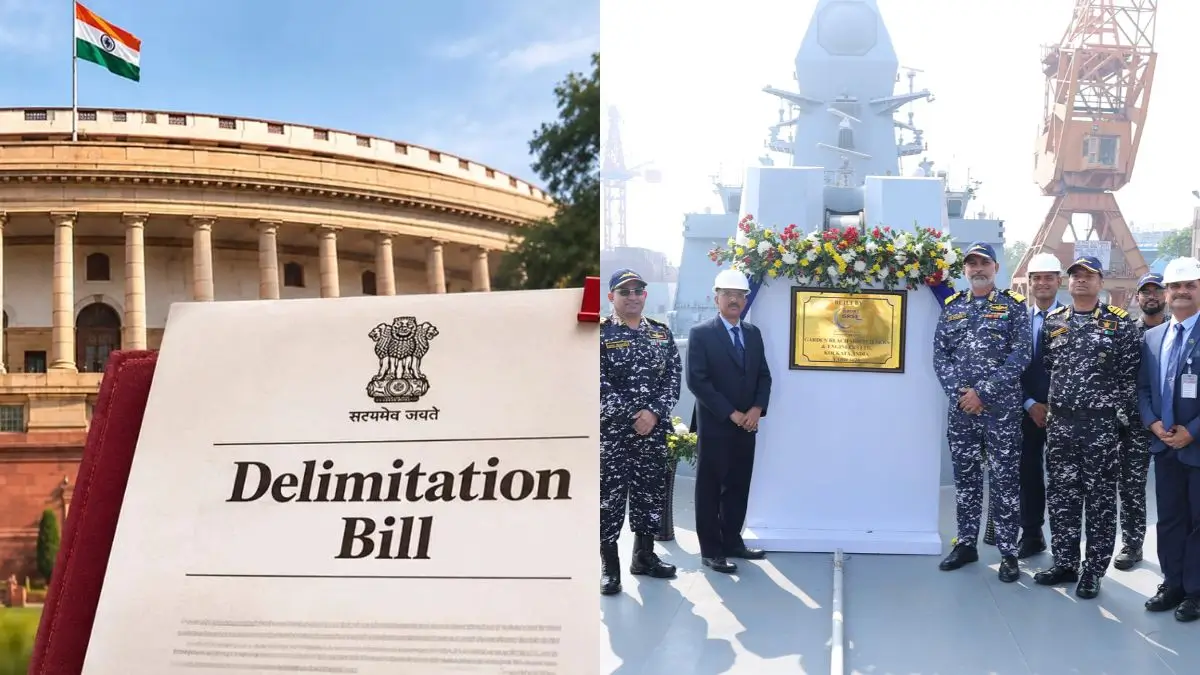
Q2. Which shipyard indigenously built ‘Vindhyagiri’ (Yard 3024)—the seventh and final ship of the Nilgiri-class (Project 17A) frigates—delivered to the Indian Navy on 27 November 2026?
(a) Mazagon Dock Shipbuilders Limited (MDL), Mumbai
(b) Garden Reach Shipbuilders and Engineers Ltd (GRSE), Kolkata
(c) Cochin Shipyard Limited (CSL), Kochi
(d) Goa Shipyard Limited (GSL), Vasco da Gama
(e) Hindustan Shipyard Limited (HSL), Visakhapatnam
Answer: b
Solution:
- The Indian Navy received Vindhyagiri (Yard 3024), the seventh and final ship of the Nilgiri class under Project 17A, on 27 November 2026.
- The ship was delivered by Garden Reach Shipbuilders and Engineers Limited (GRSE) at Kolkata, marking the successful completion of Project 17A ship deliveries.
- Vindhyagiri is the third ship of the Nilgiri class built by GRSE.
- The delivery marks a significant milestone in India’s efforts towards achieving self-reliance in warship design and construction.
About Vindhyagiri
- The ship has been named after the Vindhyagiri mountain range in Karnataka.
- Vindhyagiri is a reincarnation of the erstwhile INS Vindhyagiri, a Leander-class frigate that served in the Indian Navy from 8 July 1981 to 11 June 2012, completing 31 years of service.
- The new Vindhyagiri is a state-of-the-art frigate that represents a significant advancement in naval design, stealth, firepower, automation and survivability.
- Project 17A frigates are versatile, multi-mission platforms designed to address present and future challenges in the maritime domain.
Technical Features of Project 17A Frigates
- Project 17A frigates have been designed by the Warship Design Bureau (WDB) and are overseen by the Warship Overseeing Team (Kolkata).
- These frigates represent a generational advancement in indigenous ship design, stealth, survivability and combat capabilities.
- Project 17A ships are equipped with an advanced weapons and sensors suite compared to the earlier Project 17 (Shivalik) class.
- These ships use a Combined Diesel or Gas (CODOG) propulsion system, consisting of a diesel engine and a gas turbine that drive a Controllable Pitch Propeller (CPP) on each shaft.
- The frigates are also equipped with a modern Integrated Platform Management System (IPMS).
- Their advanced weapons and sensors significantly enhance their multi-dimensional warfare capabilities in anti-surface, anti-air and anti-submarine warfare.
Q3. At the 45th India International Trade Fair (IITF) 2026 (held from 14 to 27 November 2026 at Bharat Mandapam, New Delhi, under the theme “Vikas aur Virasat”), which medal did CBIC’s ‘GST & Customs Pavilion’ win for display on 27 November 2026?
(a) Gold Medal
(b) Silver Medal
(c) Bronze Medal
(d) Special Commendation Trophy
(e) Platinum Award
Answer: c
Solution:
- The GST and Customs Pavilion of the Central Board of Indirect Taxes and Customs (CBIC) won the Bronze Medal for Display at the 45th India International Trade Fair (IITF) 2026.
- The award was presented on 27 November 2026 at Bharat Mandapam, New Delhi, in recognition of the pavilion’s sustained public outreach efforts, engaging public-facing formats and citizen-centric communication.
- CBIC showcased its flagship GST and Customs Pavilion at IITF 2026 from 14 to 27 November 2026.
- The pavilion was inaugurated on 16 November 2026 by Vivek Chaturvedi, Chairman of CBIC, in the presence of Board Members and senior officers.
- The pavilion was aligned with the theme of the fair, “Vikas aur Virasat”.
- The pavilion focused on creating public awareness about the Next-Gen GST Process Reforms, updated Baggage Rules, 2026 and CBIC’s digital initiatives.
- It was designed as an interactive and educational space that provided a single-point public interface for taxpayers, traders, exporters, importers, students, travellers and other citizens.
- The pavilion helped visitors understand recent changes in tax and customs procedures and the benefits available to them.
Q4. To ease banking system liquidity pressures, the Reserve Bank of India (RBI) reduced the minimum daily maintenance of the Cash Reserve Ratio (CRR) from 99% to what percentage, effective from the fortnight beginning 1 December 2026?
(a) 90%
(b) 85%
(c) 80%
(d) 92%
(e) 95%
Answer: a
Solution:
- Amid liquidity pressures in the banking system, the Reserve Bank of India (RBI) reduced the minimum daily maintenance requirement of the Cash Reserve Ratio (CRR) from 99% to 90%.
- The RBI announced this decision through a notification issued on 27 November 2026, based on an assessment of the current and evolving macroeconomic situation and liquidity conditions.
- The revised requirement will become effective from the fortnight beginning 1 December 2026.
- The decision comes after banking system liquidity turned into a deficit for the first time in five months, mainly due to Goods and Services Tax (GST) outflows and the RBI’s interventions in the foreign exchange market.
About Cash Reserve Ratio (CRR)
- The Cash Reserve Ratio (CRR) is the percentage of a bank’s total deposits that it is required to maintain as cash reserves with the Reserve Bank of India.
- Banks cannot use the amount maintained as CRR for lending or investment purposes.
- The RBI does not pay any interest on the CRR balances maintained by banks.
- Under the Reserve Bank of India Act, 1934, scheduled commercial banks are required to maintain CRR with the RBI.
- Scheduled commercial banks include public sector banks, private sector banks, foreign banks, regional rural banks and cooperative banks.
- Non-Banking Financial Companies (NBFCs) are outside the purview of this reserve requirement.
Calculation of CRR
- CRR is calculated as a percentage of a bank’s Net Demand and Time Liabilities (NDTL).
- NDTL represents the aggregate demand and time liabilities of a bank, including savings account balances, current account balances and fixed deposits.
- The CRR percentage is determined by the RBI and can be changed by the central bank from time to time.
Q5. Under the ‘Reserve Bank of India (White Label ATM Operators) Directions, 2026’—issued and effective on 27 November 2026—what is the minimum net worth that non-bank entities must maintain at all times to operate White Label ATMs (WLAs)?
(a) ₹25 crore
(b) ₹50 crore
(c) ₹200 crore
(d) ₹100 crore
(e) ₹500 crore
Answer: d
Solution:
- The Reserve Bank of India (RBI) issued the Reserve Bank of India (White Label ATM Operators) Directions, 2026, on 27 November 2026.
- The directions came into effect immediately and consolidated the regulatory framework governing non-bank entities operating ATMs in India.
Eligibility and Authorisation
- Non-bank entities intending to set up, own and operate White Label ATMs (WLAs) must obtain authorisation under the RBI’s Master Direction on Authorisation to Operate a Payment System, dated 15 June 2026.
- Such entities must maintain a minimum net worth of ₹100 crore at all times.
ATM Deployment Requirements
- White Label ATM Operators (WLAOs) must maintain a minimum ATM deployment ratio of 1:2:3 across metropolitan or urban, semi-urban and rural centres, respectively.
- The RBI will review compliance with the prescribed deployment ratio at least once every six months.
- White Label ATM Operators are not permitted to take over existing bank-operated ATMs.
- WLAOs cannot charge bank customers directly for ATM usage, although they may receive fees from banks for the use of their ATMs.
Q6. Under the RBI’s amended Know Your Customer (KYC) directions for payment banks—taking effect from 1 July 2027 (or earlier if adopted)—how many calendar days are account holders given to submit an explanation and supporting documents after a debit hold is placed on a suspicious transaction or account?
(a) 3 calendar days
(b) 5 calendar days
(c) 21 calendar days
(d) 15 calendar days
(e) 7 calendar days
Answer: e
Solution:
- The Reserve Bank of India (RBI) issued amended Know Your Customer (KYC) directions for payment banks on 27 November 2026.
- The amended directions introduce a uniform and time-bound Standard Operating Procedure (SOP) for identifying and restricting highly suspicious transactions and accounts associated with money mule activities, cyber-enabled financial frauds and terrorist financing.
- The new directions will come into effect from 1 July 2027, or on an earlier date if a bank decides to implement the SOP before that date.
Key Provisions of the Amended KYC Directions
- Banks are required to deploy suitable technological and other solutions to identify highly suspicious transactions and accounts using objective parameters while minimising the possibility of wrongly identifying genuine accounts as suspicious.
- Banks may impose debit holds on highly suspicious transaction amounts or accounts, subject to approval from an appropriately higher authority within the bank.
- The RBI has directed banks to avoid the mechanical application of debit holds at the entire account level.
- After imposing a debit hold, banks must promptly notify customers through digital channels or, through other communication methods, by the end of the next working day.
- The notification must clearly mention the reasons for imposing the restriction, the procedure for removing it and the contact details of the concerned officer.
- Customers will be provided seven calendar days to submit their explanations and supporting documents against the imposed debit hold.
- Banks must examine the explanation and supporting documents submitted by customers and take a decision promptly, but not later than seven calendar days from the date of receiving the explanation.
- Based on its assessment, the bank may either remove the debit hold or continue the restriction and report the matter to the jurisdictional police authority.
- If no instruction to continue the debit hold is received from the competent authority within 30 calendar days of reporting the matter, the bank must remove the restriction on the 31st day, provided it is satisfied with the enhanced due diligence of the account.
- Payment banks must appoint nodal officers for grievance redressal and prominently display their contact details on their websites and at all branches.
- Banks are required to acknowledge customer complaints upon receipt and resolve them within 30 calendar days.
- Banks must maintain records of debit holds, the reasons for imposing and removing restrictions, and correspondence with customers and police authorities for five years.
Q7. Under the consolidated card-based digital payments framework issued by the RBI on 27 November 2026 (Digital Payments-Card-based transaction Directions, 2026), contactless payments up to what per-transaction limit are exempt from additional authentication requirements?
(a) ₹1,000
(b) ₹2,000
(c) ₹5,000
(d) ₹10,000
(e) ₹15,000
Answer: c
Solution:
- The Reserve Bank of India (RBI) consolidated its earlier circulars relating to card-based digital payments, ATM withdrawals, transaction charges, payment security and customer protection into two separate regulatory frameworks on 27 November 2026.
- The RBI issued the Reserve Bank of India (Digital Payments–Card-based Transaction) Directions, 2026 and the Reserve Bank of India (Cash Withdrawal Transactions through Automated Teller Machines and Point of Sale Terminals) Directions, 2026.
- Both regulatory directions came into effect immediately.
- The card-based payment directions consolidate 25 earlier circulars, while the cash withdrawal framework consolidates 17 earlier circulars, including specified provisions of a circular relating to prepaid payment instruments.
- RBI Digital Payments–Card-based Transaction Directions, 2026
- Under the new framework, contactless card payments of up to ₹5,000 per transaction are exempt from additional authentication requirements.
- Contactless transactions exceeding ₹5,000 will require additional authentication, and customers will be required to use contact-based payments with additional authentication.
- Customers can also choose PIN-based payments irrespective of the transaction amount.
- The RBI has clarified that customers cannot be compelled to make payments through the contactless mode.
- Card issuers must provide customers with 24×7 facilities to enable or disable domestic, international, online and contactless transactions.
- Customers must also be provided with the facility to modify their card transaction limits.
- Credit card issuers are required to offer eligible customers a choice of card networks.
- The directions restrict entities other than card issuers and card networks from storing actual card details for transactions in which the card is not physically present.
- RBI Cash Withdrawal Transactions Directions, 2026
- Savings bank account holders are entitled to five free transactions every month at their own bank’s ATMs, including both financial and non-financial transactions.
- Customers using ATMs of other banks are entitled to three free transactions per month in metropolitan cities and five free transactions per month in non-metropolitan locations, subject to an overall limit of five transactions.
- Cash withdrawals from ATMs of other banks are subject to a maximum limit of ₹10,000 per transaction.
- Banks can charge customers up to ₹23 per transaction, plus applicable taxes, for transactions beyond the prescribed free transaction limits.
- Banks must establish suitable mechanisms to alert customers about the number of free transactions already used during a month and the charges applicable to subsequent transactions.
- Failed ATM transactions caused by technical issues, non-availability of cash, invalid PIN validation and other specified reasons will not be counted towards the free transaction limits and will not attract charges.
- The framework also covers cash withdrawals at designated merchant outlets through debit cards, eligible prepaid payment instruments and UPI.
- Such cash withdrawals are subject to a limit of ₹2,000 per transaction and ₹10,000 per month.
- Customer charges for cash withdrawals at designated merchant outlets cannot exceed 1% of the transaction amount.
Legal Framework
- Both directions have been issued under the provisions of the Payment and Settlement Systems Act, 2007.
- The directions form part of the RBI’s broader regulatory consolidation exercise.
Q8. According to EY’s Economy Watch report (November 2026), citing IMF projections, India’s general government debt-to-GDP ratio is projected to decline from 84.3% in 2025 to what percentage by 2031?
(a) 79.4%
(b) 77.2%
(c) 75.1%
(d) 72.8%
(e) 70.5%
Answer: c
Solution:
- According to EY’s Economy Watch Report for November 2026, India’s general government debt-to-GDP ratio is projected to decline from 84.3% in 2025 to 75.1% by 2031.
- The projections are based on estimates of the International Monetary Fund (IMF).
- India is expected to remain an exception among major emerging economies, where government debt relative to GDP is largely projected to increase over the medium term.
- India’s general government debt-to-GDP ratio is expected to decline by 9.2 percentage points between 2025 and 2031.
Comparison with Other Major Economies
- The debt-to-GDP ratio of emerging market and developing economies is projected to increase from 73.7% in 2025 to 84.2% by 2031, largely due to rising government debt in China.
- China’s debt-to-GDP ratio is projected to increase from 98.6% in 2025 to 122.1% by 2031.
- The United States’ debt-to-GDP ratio is projected to increase from 124.4% in 2025 to 145% by 2031.
India’s Economic and Fiscal Outlook
- EY projected that India’s real GDP growth in the second quarter of FY 2026–27 could range between 7.5% and 7.7%, while nominal GDP growth could remain close to 11%.
- Higher nominal GDP growth could support the government’s tax revenue collections.
- However, persistent inflationary pressures may increase government expenditure on major subsidies related to food, fertilisers and petroleum products.
- During the first half of FY 2026–27, the Centre’s gross tax revenues increased by 6.1%, while total government expenditure increased by 10.7%.
- Government expenditure on major subsidies increased by 10.1% during the first half of FY 2026–27.
- Retail inflation increased to 6.1%, while wholesale inflation reached 12.3% in October 2026.
- In view of inflationary pressures, EY recommended an increase in the RBI’s policy rate at its December 2026 monetary policy meeting.
- The report also highlighted India’s progress in reducing poverty and inequality while maintaining relatively high economic growth.
Poverty and Inequality in India
- According to World Bank estimates cited in the EY report, India’s extreme poverty rate declined from 27.1% in 2011 to an estimated 2.3% in 2024.
- The extreme poverty rate was measured using a purchasing power parity-adjusted poverty threshold of USD 3 per day.
- The report also highlighted a decline in inequality in per capita consumption expenditure over time.
- EY emphasised the need for the government to maintain momentum in capital expenditure to support domestic demand during the remaining months of the financial year while adhering to fiscal consolidation targets.
Q9. The Appointments Committee of the Cabinet (ACC) approved the appointment of Sandeep Sarkar—a 1995-batch Indian Defence Accounts Service (IDAS) officer—as Secretary of which statutory vigilance body?
(a) Central Bureau of Investigation (CBI)
(b) Central Vigilance Commission (CVC)
(c) Lokpal of India
(d) Enforcement Directorate (ED)
(e) National Investigation Agency (NIA)
Answer: b
Solution:
- The Appointments Committee of the Cabinet (ACC) approved the appointment of Sandeep Sarkar as the Secretary of the Central Vigilance Commission (CVC).
- Sandeep Sarkar is a 1995-batch Indian Defence Accounts Service (IDAS) officer.
- Before his appointment, he was serving as Additional Secretary and Financial Adviser in the Department of Agricultural Research and Education (DARE).
- He will assume the new position in the rank and pay of Additional Secretary to the Government of India.
About the Central Vigilance Commission (CVC)
- The Central Vigilance Commission (CVC) is the apex vigilance institution responsible for exercising superintendence over vigilance administration in organisations to which the executive powers of the Government of India extend.
- The CVC is an apex integrity institution that enjoys independence and autonomy in the performance of its functions.
- The CVC was established in 1964 through a resolution of the Government of India on the recommendations of the Committee on Prevention of Corruption, headed by K. Santhanam.
- The CVC was granted statutory status through the Central Vigilance Commission Act, 2003.
- The CVC is not controlled by any ministry or department and is responsible to the Parliament.
Important Provisions of the Central Vigilance Commission Act, 2003
Composition:
– The CVC is a multi-member commission consisting of one Central Vigilance Commissioner (Chairperson) and not more than two Vigilance Commissioners (Members).
Organisation:
– The CVC has its own Secretariat, the Chief Technical Examiners’ Wing (CTE) and a wing of Commissioners for Departmental Inquiries (CDI).
Appointment:
– The Central Vigilance Commissioner and other Vigilance Commissioners are appointed by the President of India on the recommendations of a committee consisting of the Prime Minister as Chairperson, the Union Minister of Home Affairs and the Leader of the Opposition in the Lok Sabha.
Tenure:
– The Central Vigilance Commissioner and Vigilance Commissioners hold office for a term of four years or until they attain the age of 65 years, whichever is earlier.
Q10. In a circular issued in November 2026 (effective 1 June 2027), the Securities and Exchange Board of India (SEBI) permitted Foreign Portfolio Investors (FPIs) to participate in which segment of non-agricultural commodity derivatives?
(a) Cash-settled agricultural commodity futures
(b) Physically (non-cash) settled non-agricultural commodity derivatives (excluding options in goods)
(c) Sovereign gold exchange-traded options
(d) Weather derivatives on monsoon rainfall
(e) Unlisted commodity forward contracts
Answer: b
Solution:
- The Securities and Exchange Board of India (SEBI) has permitted Foreign Portfolio Investors (FPIs) to participate in physically settled, or non-cash-settled, non-agricultural commodity derivative contracts.
- The decision aims to deepen institutional participation and improve liquidity in India’s commodity derivatives market.
- Previously, FPIs were permitted to participate in the commodity derivatives segment of recognised stock exchanges only through cash-settled non-agricultural commodity derivative contracts.
- Under the new framework, FPIs can participate in physically settled non-agricultural commodity derivative contracts, excluding options in goods, subject to specified safeguards.
Key Provisions of the New Framework
- FPIs can hold positions in physically settled commodity derivative contracts only until the commencement of the tender or staggered delivery period.
- FPIs must close their open positions or roll them over before the beginning of the delivery period.
- SEBI has also introduced a safeguard mechanism for situations in which FPIs fail to voluntarily close or roll over their open positions.
- The new framework will come into effect from 1 June 2027.







 Daily Current Affairs and GK Updates (28...
 Daily Current Affairs Quiz 28th November...
 Daily Current Affairs and GK Updates (27...