
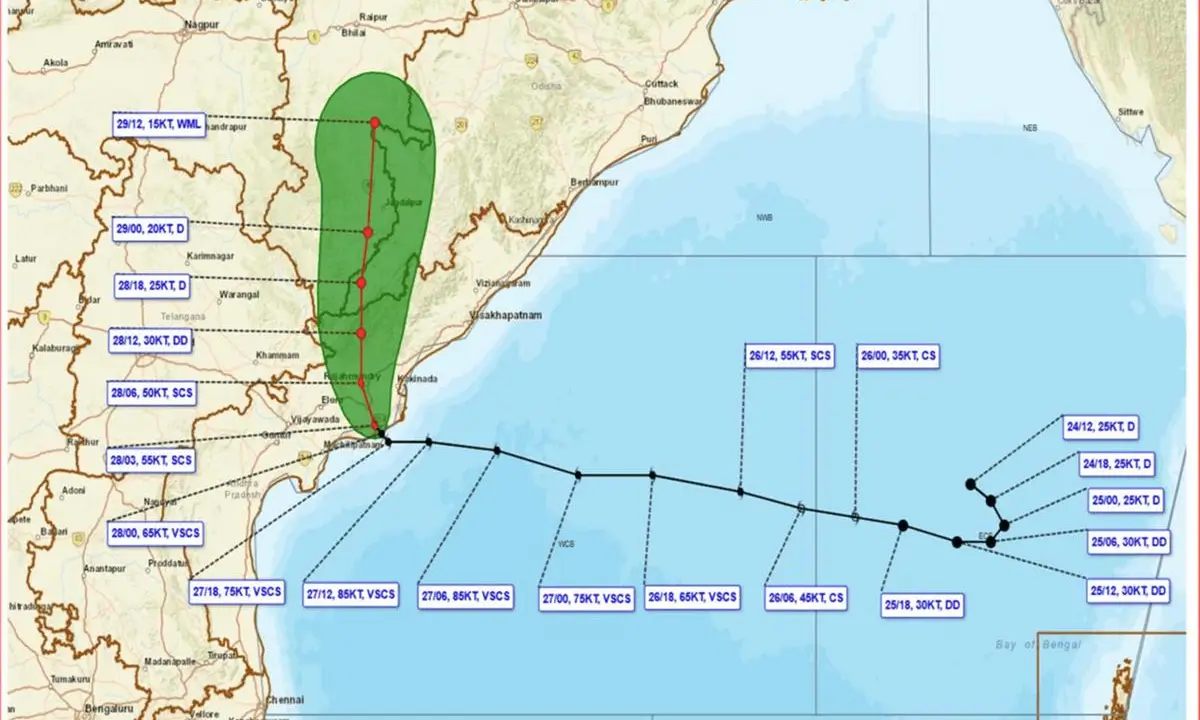
Cyclone Arnab 2026 formed over the eastern Bay of Bengal on 24 October and made landfall in Andhra Pradesh on 28 October. It intensified into a very severe cyclonic storm, causing heavy rainfall, flooding and disruption. Named by Bangladesh, Arnab weakened inland, while Murasu, proposed by India, is the next name on the cyclone list.
Who Named Cyclone Arnab and What Does It Mean?
Bangladesh proposed the name Arnab under the regional tropical cyclone naming system maintained by the WMO/ESCAP Panel on Tropical Cyclones. The name Arnab means “ocean” or “sea” in Bengali and is associated with the Sanskrit word Arnav, which has a similar meaning. Its official pronunciation is “Ornab”.
Cyclone names are selected from a predetermined list submitted by participating countries. The country that proposes a name does not determine where the cyclone will make landfall. The naming system is designed to make storm identification, communication and public warnings easier across the region.
Cyclone Arnab 2026: Formation and Development
Cyclone Arnab originated as a low-pressure area over the eastern Bay of Bengal on 24 October 2026. The system gradually strengthened and developed into a named cyclonic storm on 26 October. Its rapid intensification continued, and it reached very severe cyclonic storm status within approximately 18 hours.
The cyclone attained its peak intensity on 27 October. According to a cyclone-tracking source, its estimated maximum wind speed reached approximately 222 km/h, with a central pressure of around 940 mb. These figures represent estimates at peak intensity and should not be confused with the wind speeds reported during landfall.
Cyclone Arnab Landfall in Andhra Pradesh
- Cyclone Arnab crossed the Andhra Pradesh coast early on Wednesday, 28 October 2026, with reported landfall wind speeds of up to 135 km/h. Before its arrival, the India Meteorological Department (IMD) had forecast that the cyclone would cross the coast between Bapatla and Visakhapatnam, near Yanam.
- Authorities initiated large-scale preparedness and evacuation measures to minimise the impact on coastal communities. Approximately 89,000 to 1.36 lakh people were evacuated, according to reports published at different stages of the operation. More than 2,000 relief shelters were also established across Andhra Pradesh.
- Railway services were affected, with at least 53 trains cancelled as a precaution. After crossing the coast, the cyclone weakened from a very severe cyclonic storm to a severe cyclonic storm as it moved inland. By 29 October, it had weakened into a tropical depression approximately 135 km south-southeast of Raipur, Chhattisgarh, and was subsequently reported as dissipated.
Impact of Cyclone Arnab on India
Cyclone Arnab affected several areas through strong winds, heavy rainfall and flooding. Andhra Pradesh experienced the most significant reported impact, while weather-related disruptions were also reported in other regions. The major consequences of the cyclone included:
- Casualties: At least three deaths were reported in connection with the cyclone’s landfall in Andhra Pradesh. Separate reports mentioned additional rain- and storm-related deaths in Uttar Pradesh and Bihar, but these figures remain unconfirmed.
- Flooding in Andhra Pradesh: Heavy rainfall caused the Nagavali, Vamsadhara and Cheyyeru rivers to overflow, resulting in flooding in several areas, particularly in Srikakulam district.
- Infrastructure Damage: Strong winds uprooted trees and blocked highways, affecting road connectivity. Power supply was also disrupted in several locations.
- Evacuation and Relief Operations: Authorities moved thousands of residents from vulnerable coastal areas to safer locations. More than 2,000 shelters were arranged to provide temporary accommodation.
- Railway Disruptions: At least 53 trains were cancelled to reduce risks to passengers and railway operations during the severe weather conditions.
- Weather Alerts in Nepal: Nepal issued warnings for tourists visiting high-altitude regions, highlighting the possibility of heavy rainfall, snowfall, snowstorms and avalanches.
How Are Cyclones Named in the Indian Ocean?
The North Indian Ocean cyclone naming system began in September 2004. The latest regional naming list was adopted in April 2020 by the WMO/ESCAP Panel on Tropical Cyclones. It contains 169 names contributed by 13 member countries, with each country submitting 13 names. The India Meteorological Department (IMD) acts as the Regional Specialized Meteorological Centre and is responsible for assigning names to eligible cyclonic storms in this region. A weather system receives a name only after reaching cyclonic storm intensity, which requires sustained wind speeds of at least 62 km/h. The following rules are considered while selecting cyclone names:
- Names must be neutral in terms of politics, religion, culture and gender.
- Each name must contain no more than eight letters.
- Names should be simple, easy to pronounce and culturally acceptable.
- Names must not have offensive or controversial meanings.
- Once a name is used, it is not repeated in the regional naming list.
What Is the Next Cyclone Name After Arnab?
Murasu, proposed by India, is the next name on the North Indian Ocean cyclone naming list after Arnab. The word Murasu refers to a traditional Tamil drum and is part of the list of names submitted by India.
The name will be assigned to a future cyclonic storm when a weather system develops over the region and reaches the required intensity. Its position on the naming list does not indicate that another cyclone is already developing or that a new storm will necessarily form immediately.
Is Another Cyclone Expected After Arnab?
Following Arnab’s weakening, an individual forecaster suggested that another low-pressure area could develop over the Bay of Bengal and approach the Odisha coast around 1–2 November 2026.
However, this assessment should not be treated as an official IMD forecast. The formation and movement of another weather system will depend on prevailing atmospheric and oceanic conditions. Residents in coastal regions should follow official IMD bulletins for updated weather information.



 NICL AO 2026: 1.84L Applications Receive...
 JAIIB Admit Card 2026 Out for November C...
 RBI Grade B Generalist Mains & Inter...