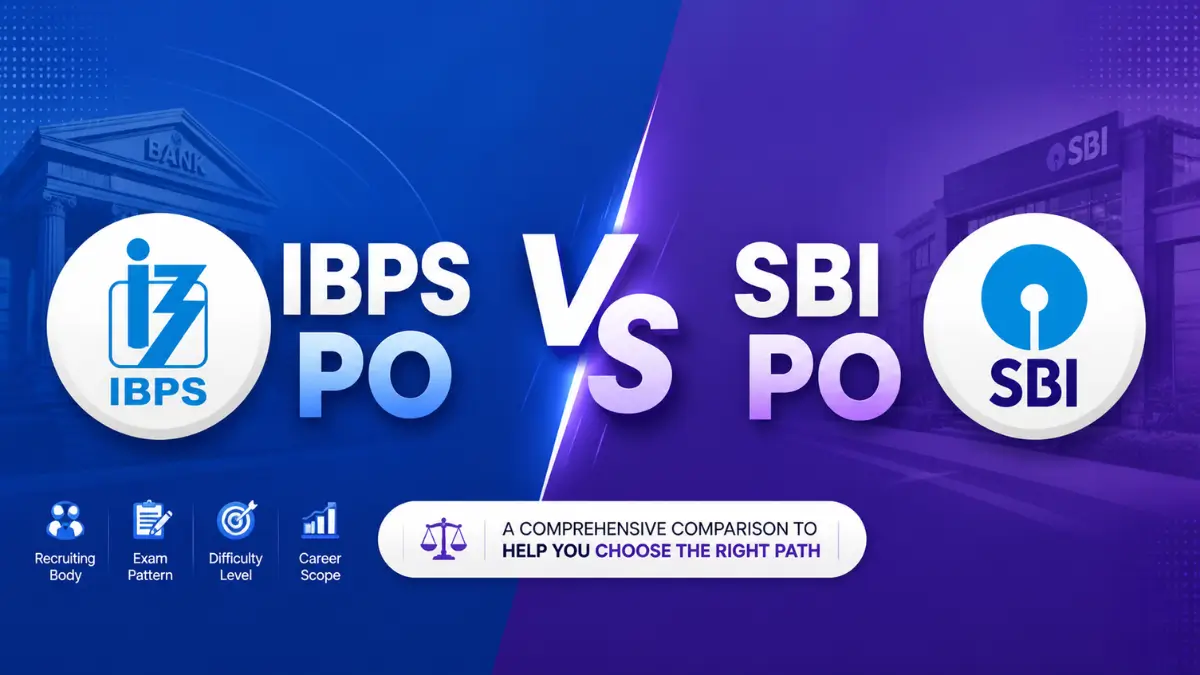
Both IBPS PO (for Probationary Officer posts via IBPS CRP) and SBI PO are prestigious banking careers. They involve similar roles but differ in many details, like exam pattern, vacancies, and career paths. This article compares them in depth – from eligibility to salary – to help aspirants decide.
IBPS PO vs SBI PO
At a glance, SBI PO is a role specifically in the State Bank of India, whereas IBPS PO placement can be in any of 11 public sector banks. SBI conducts its own recruitment with three stages (Prelims, Mains, Phase-III, including psychometric/GD/interview). IBPS PO also has three phases (Prelims, Mains, Interview).
| Attribute | IBPS PO (CRP PO/MT) | SBI PO |
| Conducting Body | IBPS (for 11 PSU banks) | State Bank of India |
| Vacancies (recent) | ~5,200 | ~2,000 |
| Age Limit | 20–30 years (General) | 21–30 years (General) |
| Nationality | Indian citizens, Nepal/ Bhutan/ Tibetan refugee allowed | Only Indian citizens |
| Education | Any graduate (Final year ok) | Any graduate (Final year ok) |
| Attempts Limit | No limit (within age) |
No official cap (general often 4 trials unofficially)
|
| Prelims Pattern | 100 marks: Eng 30+QA 35+Reasoning 35; 60 min |
100 marks: QA 35 + Reasoning 35 + Eng 30; 60 min
|
| Mains Pattern | 225 marks: 4 sects (Reasoning 60 + Eng 40 + DAI 50+GA 50) + Descriptive 25 |
250 marks: 4 sects (DA 60 + Reasoning 60 + Eng 40 + GA 40) + Descriptive 50
|
| Phase-III | Interview only (100 marks, 20% weight) |
Psychometric + GD (20) + Interview (30) [Total 50]
|
| Selection Score | Mains (225) 80% + Interview 20% |
Mains (250) 75% + GD/Interview (50) 25%
|
| Application Fee | ₹850 (Gen/OBC/EWS), ₹175 (SC/ST/PwBD) |
₹750 (Gen/OBC/EWS), ₹0 (SC/ST/PwBD)
|
| Probation | ~2 years (varies by bank) | 2 years |
| Service Bond | None (may repay training costs) | ₹2 lakh bond for 3 years service |
| Basic Pay | ₹48,480 |
₹48,480 (with 4 increments to ₹56,480)
|
| In-hand Salary | ~₹72k–80k (depending on city) | ~₹72k–85k (depending on city) |
| Posting Locations | Any of 11 PSU banks, pan-India |
Pan-India (State Bank of India branches)
|
| Transfer Policy | As per the bank (typically 3+ yrs) |
SBI policy (min 5 yrs in one circle, typically)
|
| Career Path | JMGS-I → MMGS-II → MMGS-III → SMGS → TEGS → etc. |
JMGS-I → MMGS-II → MMGS-III → SMGS-IV → TEGS etc.
|
| Work-Life | Fixed hours, paid leaves | Fixed hours, paid leaves |
| Job Role | Branch manager trainees, loans, accounts, compliance |
Similar branch management duties
|
Exam Pattern Comparison
The exam structure of IBPS PO and SBI PO may look similar at first glance, but the depth and unpredictability vary quite a lot. SBI tends to introduce more analytical and unconventional questions, especially in the Mains exam, making it slightly tougher compared to IBPS.
Prelims (Both Exams)
- English Language
- Quantitative Aptitude
- Reasoning Ability
Mains Differences
- IBPS PO: Structured and predictable sections
- SBI PO: Includes Data Analysis, Decision Making, and descriptive tests with higher complexity
Additional Stage
- SBI PO includes Group Discussion (GD)
- IBPS PO does not have GD
Difficulty Level
SBI PO is widely considered more difficult due to its dynamic question patterns and higher level of reasoning-based questions. IBPS PO, on the other hand, follows a relatively stable pattern, making it slightly easier to prepare for if one focuses on previous year trends. The unpredictability of SBI often tests conceptual clarity rather than just speed and accuracy.
Salary Structure, In-hand Pay and CTC
Basic Pay: Both IBPS PO and SBI PO start at ₹48,480 basic at entry in JMGS-I. SBI quotes it as ₹48,480 plus four advance increments (cumulative ₹56,480). IBPS PO (in joining bank) basic is same ₹48,480.
Allowances: Both receive allowances atop basic:
- Dearness Allowance (DA): ~19–47% of basic (rising quarterly).
- House Rent Allowance (HRA): Depends on city (e.g. 9%–24% of basic).
- City Compensatory Allowance (CCA): 3–4% of basic.
- Transport/Medical/Furniture/Other: As per bank rules (e.g. SBI lists various fixed allowances).
Work Culture and Job Profile
IBPS PO officers are placed in various banks, and the work culture depends on the specific bank allotted. Some banks may offer better work-life balance, while others may have heavier workloads. In contrast, SBI has a more structured yet demanding work environment, often involving higher pressure but also better exposure and learning opportunities. SBI POs are frequently posted in rural as well as urban areas, which enhances versatility but can also be challenging.
IBPS PO
- Bank-specific culture varies
- Slightly balanced workload in some banks
- Transfers depend on bank policies
SBI PO
- High workload and targets
- More frequent transfers
- Greater exposure to diverse banking operations
Syllabus Topics and Weightage
IBPS PO Prelims: Three sections – Reasoning (35 Q), Quantitative Aptitude (35 Q), English Language (30 Q). Key topics: puzzles, syllogisms, seating (Reasoning); arithmetic, number series (Quant); reading comprehension, cloze, errors (English). Each section has 20 min. (Sectional cut-off applies.)
SBI PO Prelims: Similar three sections – Quantitative Aptitude (35 Q/35m), Reasoning (35 Q/35m), English (30 Q/30m)– in 20 min each. Topics are comparable (QC Math, puzzles, RC, etc.).
IBPS PO Mains: Four objective sections + descriptive essay/letter. Reasoning/CA (40 Q/60m), English (35 Q/40m), Data Analysis (35 Q/50m), GA/Banking (35 Q/50m). Topics include data interpretation, advanced reasoning, computer knowledge, current affairs (especially RBI policy), and grammar. Descriptive requires a 25-mark essay and a letter (30 min).
SBI PO Mains: Four objective sections + descriptive (2 Q, 50m)
. Data Analysis (35 Q/60m), Reasoning (45 Q/60m), English (35 Q/40m), General/Banking Awareness (40 Q/40m). There is a heavy focus on banking awareness/current affairs in GA. The descriptive writing tasks also carry 50 marks.
Career Progression / Promotion
Both careers have fast-tracked growth along similar officer scales. Generally:
- Entry Rank: Both start at Scale I (JMGS-I) as Probationary Officer/Assistant Manager.
- Scale II (MMGS-II): Typically Deputy Manager (in SBI) or Manager (in IBPS banks) after ~3–4 years and clearing internal tests.
- Scale III (MMGS-III): Manager (SBI) or Senior Manager (IBPS banks) in ~8–12 years.
- Scale IV (SMGS-IV): Chief Manager in SBI / equivalent in other banks.
- Scale V/VI (Top grades): AGM, DGM, CGM in banks.
IBPS PO vs SBI PO: Which Is Better?
This is the question everyone asks. Here is an honest answer:
- If salary and prestige are your priority → SBI PO wins clearly
- If you want the maximum number of opportunities → IBPS PO gives you 11+ banks in one exam
- If you want faster posting confirmation → IBPS PO (you know which bank you are joining earlier in the process)
- If long-term career growth is your focus → Both are excellent; SBI has a slight edge in the highest leadership positions
- If you are a first-time aspirant → Prepare for both. Do not choose one and skip the other.
The smartest strategy is not “IBPS PO or SBI PO.” It is “IBPS PO and SBI PO.” These are two of the finest career opportunities in Indian public sector banking — and with the right preparation, you can compete seriously in both.






 IBPS Clerk Prelims Exam Analysis 2026 (1...
 Daily Current Affairs and GK Updates (9t...
 PNB Promotion Exam Notification 2026 Out...