
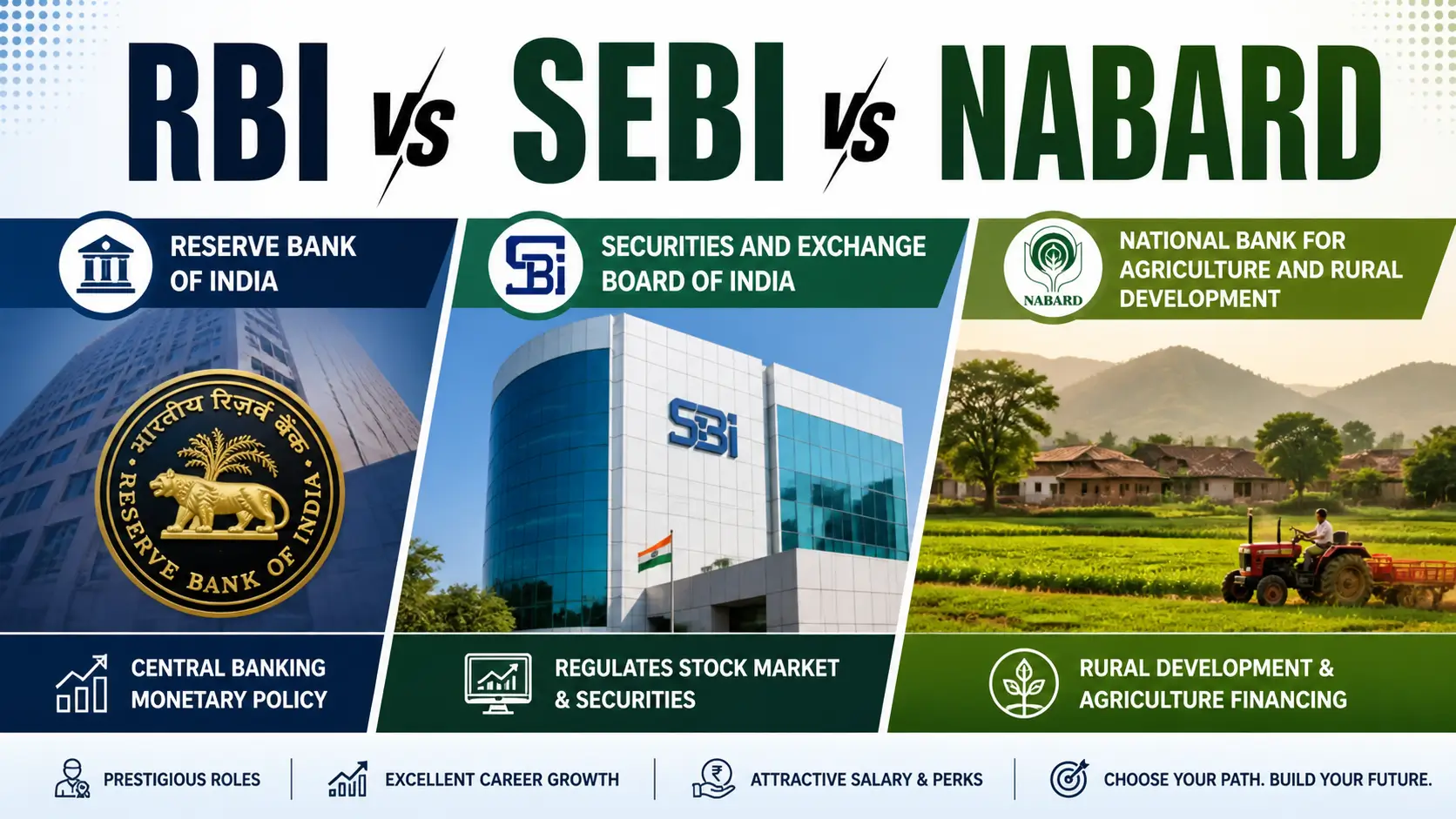
Choosing between top regulatory bodies like Reserve Bank of India (RBI), Securities and Exchange Board of India (SEBI), and National Bank for Agriculture and Rural Development (NABARD) is a common dilemma for serious government exam aspirants. All three offer prestigious roles, excellent salary packages, and long-term career growth but the right choice depends on your interest, strengths, and career vision.
RBI vs SEBI vs NABARD
There is no single best option among RBI, SEBI, and NABARD. Each organization offers a unique career path. Instead of following trends, focus on where your interest lies and what kind of work excites you.
RBI vs SEBI vs NABARD: Salary, Work & Selection, Full Comparison
All three organizations Reserve Bank of India (RBI), Securities and Exchange Board of India (SEBI), and National Bank for Agriculture and Rural Development (NABARD) are among the most prestigious jobs in the regulatory sector. Because of their reputation, salary, and career growth, most aspirants often find themselves confused about which one is the best and which exam they should choose.
| Feature | RBI | SEBI | NABARD |
| Full Form | Reserve Bank of India | Securities and Exchange Board of India | National Bank for Agriculture and Rural Development |
| Primary Role | Central banking, monetary policy | Regulates stock market & securities | Rural development & agriculture financing |
| Focus Area | Banking & Economy | Capital Markets | Agriculture & Rural Economy |
| Exam Phases | Phase 1, Phase 2, Interview | Phase 1, Phase 2, Interview | Prelims, Mains, Interview |
| Phase 2 Subjects | ESI, FM, English | Accounts, Finance, Management, Law, Economics | ESI, ARD, English |
| Difficulty Level | High | Moderate to High | Moderate |
| Vacancies | Very Low (Highly Competitive) | Low | Moderate |
| Job Nature | Policy making, economic analysis | Market regulation, compliance | Field + policy-based rural development |
| Posting | Mostly Metro Cities | Metro Cities (Mumbai major) | Across India (including rural areas) |
| Salary (Approx.) | ₹1.5 L/month | ₹1.5–1.8 L/month | ₹90K–1.1 L/month |
Core Difference Between RBI vs SEBI vs NABARD
At a glance, all three may look similar but their work domains are completely different:
- RBI is the backbone of India’s financial system. If you’re interested in macroeconomics, policy-making, and national-level financial decisions, RBI is the top choice.
- SEBI deals with the stock market and investments. It’s ideal for candidates who have an interest in finance, law, and capital markets.
- NABARD focuses on rural India and agriculture financing. If you want to contribute to grassroot development and rural economy, NABARD is highly rewarding.
Exam Pattern & Preparation Strategy
While all three exams have a similar 3-stage process (Prelims/Phase 1 → Mains/Phase 2 → Interview), the syllabus focus differs significantly:
RBI Grade B: Emphasis on Economic & Social Issues (ESI) and Finance & Management (FM). Requires strong conceptual clarity.
SEBI Grade A: More technical. Covers Accounts, Finance, Law, Management, and Economics making it slightly diverse and specialized.
NABARD Grade A: Focuses on ESI + Agriculture & Rural Development (ARD), making it unique among the three.
Note:
- If you’re from a commerce/economics background, RBI or SEBI may feel more comfortable.
- If you have an agriculture or rural studies inclination, NABARD will suit you better.
Difficulty Level & Competition Between RBI vs SEBI vs NABARD
- RBI is considered the toughest due to very limited vacancies and high competition.
- SEBI also has low vacancies, but the competition is slightly more specialized.
- NABARD offers relatively more vacancies, making it slightly more accessible but still competitive.
RBI vs SEBI vs NABARD Salary & Perks
- RBI and SEBI offer top-tier salaries (~₹1.5 lakh+ per month), along with excellent perks.
- SEBI can slightly exceed RBI in compensation depending on allowances.
- NABARD offers a decent salary (~₹1 lakh/month) with strong job satisfaction, especially for those interested in rural impact.
RBI vs SEBI vs NABARD Job Profile & Work-Life
- RBI Officers: Engage in policy-making, research, and financial regulation. Work is mostly office-based in metro cities.
- SEBI Officers: Handle market surveillance, compliance, and investor protection. Mostly desk jobs in financial hubs like Mumbai.
- NABARD Officers: A mix of fieldwork and office roles, including rural visits and development projects.
Which One Should You Choose?
Your ideal choice depends on your interest and long-term goal, not just salary:
- Choose RBI if you aim for prestige, policy-making, and economic influence.
- Choose SEBI if you are inclined toward finance, stock markets, and regulatory frameworks.
- Choose NABARD if you want a meaningful role in rural and agricultural development.










 CWC Recruitment 2026 Notification Out fo...
 NICL Assistant Mains Admit Card 2026 Out...
 UIIC AO Prelims Expected Cut Off 2026, C...