
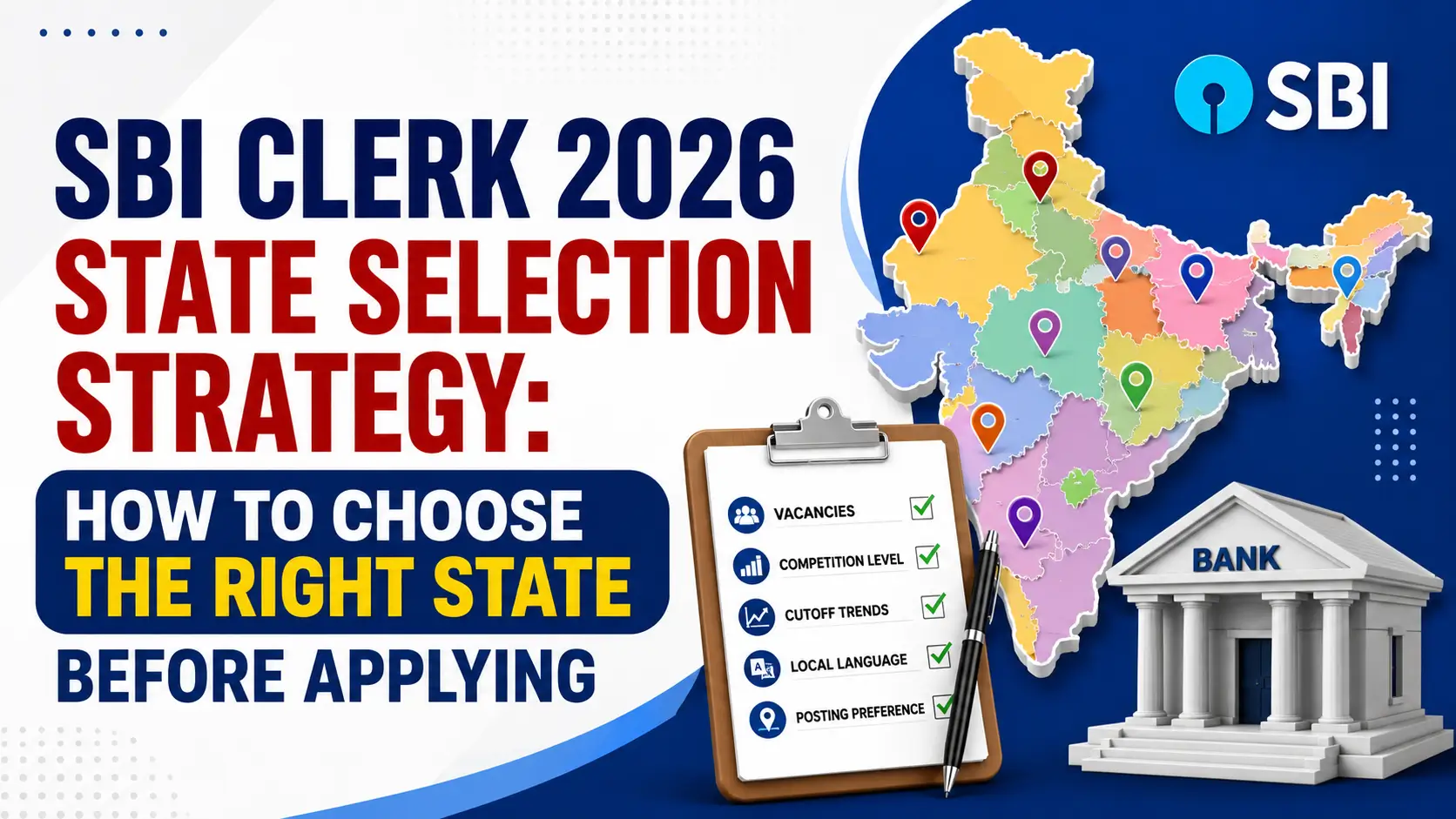
The SBI Clerk 2026 State Selection is an important decision before submitting the application form. With 9,766 regular vacancies and 1,538 backlog vacancies, candidates have multiple State/UT options. Category-wise vacancies, local language, previous cutoff trends, expected score and posting preference should all be considered.
Why State Selection Matters in SBI Clerk 2026
SBI Clerk recruitment is conducted on a State/UT-wise and category-wise basis. Therefore, the vacancy and competition in your selected State/UT matter. For example, Maharashtra has 1,718 regular vacancies, while Tamil Nadu and Odisha have 1,410 and 1,100, respectively. But a higher vacancy number does not automatically mean a lower cutoff because competition can also be higher.
How to Choose the Right State for SBI Clerk 2026
First, shortlist states where you satisfy the language requirement. Then compare vacancies available for your category and evaluate your expected Mains score against previous cutoff trends. Follow this order while selecting your State/UT:
Local Language → Category-Wise Vacancy → Previous Cutoff → Expected Score → Competition → Posting Preference
Check Local Language Eligibility Before Choosing a State
Local language should be your first filter. Candidates must satisfy the prescribed language requirement for the State/UT they apply for. Therefore, do not select a state simply because it has a large vacancy pool. If you are not comfortable with the required language, the apparent vacancy advantage may not be useful.
SBI Clerk 2026 States With the Highest Regular Vacancies
These states can be considered by eligible candidates, but vacancy size should not be the only deciding factor. The major regular vacancy pools are:
- Maharashtra – 1,718
- Tamil Nadu – 1,410
- Odisha – 1,100
- Karnataka – 760
- West Bengal – 555
- Rajasthan – 350
- Gujarat – 330
- Chhattisgarh – 287
- Telangana – 260
- Uttar Pradesh – 250
Common Mistakes to Avoid While Choosing an SBI Clerk State
The 1,538 backlog vacancies should also be considered separately because their availability depends on the applicable category and recruitment conditions. Candidates should avoid these common mistakes:
- Choosing a state only because it has the highest vacancy.
- Ignoring the local language requirement.
- Comparing total vacancies instead of category-wise vacancies.
- Treating previous cutoff as a guaranteed 2026 cutoff.
- Counting every backlog vacancy as personally available.
- Following social-media claims about the “lowest cutoff state”.
- Choosing a state without considering the likely posting.








 Daily Current Affairs and GK Updates (27...
 Decode Your Personality Type for SBI PO ...
 Is RBI Grade B Exam Difficult? How to Cr...