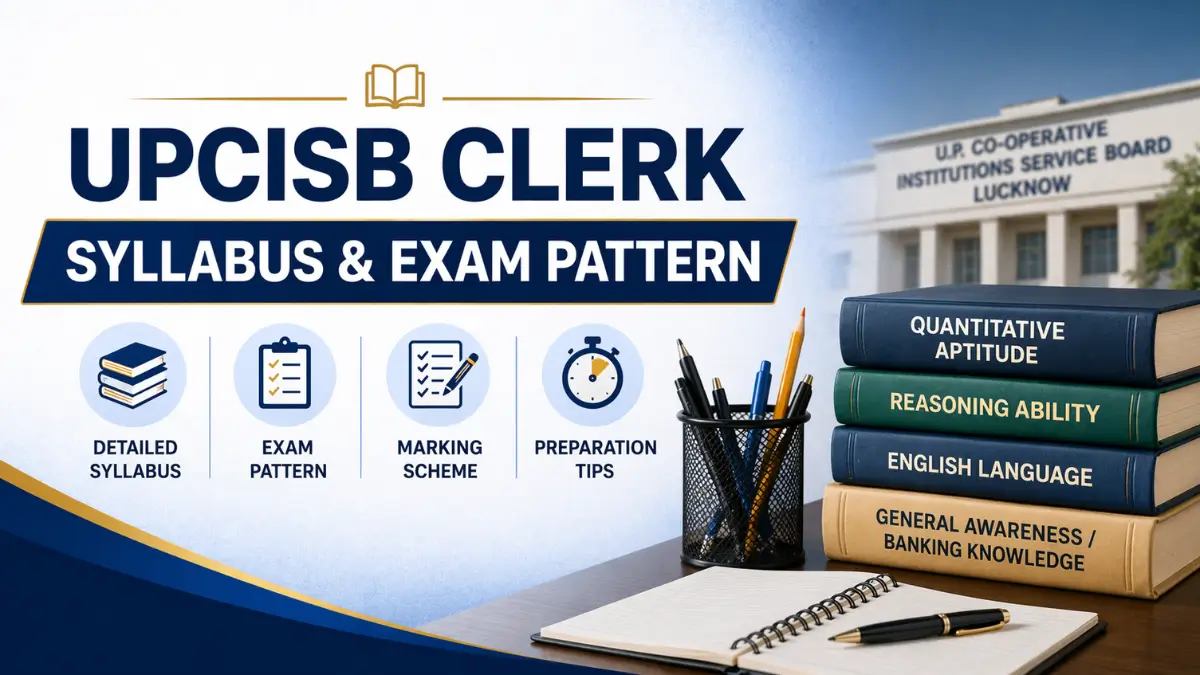
The UPCISB Clerk Exam 2026 is an important opportunity for candidates aiming to secure a clerical position in cooperative banks across Uttar Pradesh. Understanding the syllabus and exam pattern is crucial to plan an effective preparation strategy. The exam is conducted in online mode and focuses on testing candidates’ aptitude, reasoning ability, language skills, and general awareness.
UPCISB Clerk Syllabus & Exam Pattern 2026
The UPCISB Clerk Syllabus & Exam Pattern 2026 gives candidates a clear understanding of the subjects, marking scheme, and overall structure of the examination. The exam is conducted in online mode with objective-type questions and may be held in one or two stages, depending on the number of applicants. It includes sections such as Reasoning, Quantitative Aptitude, Language, General Awareness, Co-Operative and Computer Knowledge, designed to test both aptitude and practical skills.
UPCISB Clerk Exam Pattern 2026
The UPCISB Clerk examination follows a two-stage selection process:
UP Co-operative Prelims Exam
If the number of applications exceeds a specified limit, a Preliminary Exam will be conducted:
| Section | Questions | Marks | Duration |
| Numerical Ability/ Quantitative Aptitude | 35 | 35 | 90 Minutes (1.5 Hours) |
| Reasoning Ability/ Mental Ability | 35 | 35 | |
| Hindi Language | 20 | 20 | |
| General English/ English Language | 20 | 20 | |
| Co-operative | 10 | 10 | |
| Total | 100 | 100 |
UP Co-operative Mains Exam
The Main Examination is the decisive stage for final selection:
| Section | Questions | Marks per Question | Total Marks | Duration |
| Reasoning Ability/ Mental Ability | 20 | 2 | 40 | 120 Minutes (2 Hours) |
| Numerical Ability/ Quantitative Aptitude | 20 | 2 | 40 | |
| Computer | 20 | 2 | 40 | |
| General Awareness | 20 | 2 | 40 | |
| Language (Hindi & English) | 10 | 2 | 20 | |
| Co-operative | 20 | 1 | 20 | |
| Total | 120 | – | 200 |
Negative marking: 0.25 marks (25%) deducted for each wrong answer
Syllabus for UPCISB Clerk 2026
The syllabus covers multiple subjects that require both conceptual understanding and regular practice.
Reasoning Ability/ Mental Ability
- Alphabetical order and miscellaneous series
- Coding-Decoding
- Direction and Distance
- Blood Relation
- Order and Ranking
- Sitting Arrangement
- PuzzleData Sufficiency
- Syllogism
- Input-Output
- Data Inequality
- Decision Making
- Problem and Course of Action
- Statement and Assumption
- Cause and Effect
- Statement and Argument
- Combined logical reasoning
- ClockCalendar
- Figure Series
- Odd one Out Figure
- Images and Water images
- Figure Matrix
- Paper Folding, Cutting, unfolding
- Non-Verbal reasoning
- Cube and Dice
Numerical Ability/ Quantitative Aptitude
- Simplification
- Number Series
- Percentage
- Profit and Loss, Discount
- Simple Interest and Compound Interest
- Average
- Ratio and Proportion
- Problems on Ages
- Partnership
- Mixture and Allegation
- Time and Work
- Speed, Time and Distance
- Pipe and Cistern
- Problems based on Trains
- Boat and Stream
- Inequality (Mathematical)
- Permutation and Combination
- Probability
- Mensuration (Cone, Sphere, Cylinder)
- Data Sufficiency
- Data Interpretation (Bar graph, Pie Chart, Line Chart, Tabular)
- Quadratic Equation
- Basic Algebra
- Basic Trigonometry
- Measure of Central Tendency
- Indices and Logarithms
Computer Knowledge
- Basics of Hardware and Software
- Operating System
- Internet and Associated Topics
- Microsoft Office and Other Word Processing
- History of the Computer
- Basic Computer Networking
- Basics of Databases
General Awareness
- Structure/Role/Development of Co-operative Bank in UP
- Reserve Bank of India and Monetary Policies
- NPA and Basel Standards
- Inflation, National Income
- Indian Money Market and Capital Markets
- Foreign Trade & Foreign Regulations
- Financial Planning
- Contemporary Welfare Schemes
- Insurance & Miscellaneous
- General Information related to Uttar Pradesh
- Indian History
- Indian Polity and Constitution
- General Science
- Current Affairs (National and International)
- Geography of India
Language (Hindi & English)
Hindi Language Topics:
- व्याकरण (Grammar)
- अलंकार (Figures of Speech)
- समास (Compound Words)
- sandhi (Euphonic Combination)
- मुहावरे और लोकोक्तियाँ (Idioms and Proverbs)
- पर्यायवाची शब्द (Synonyms)
- विलोम शब्द (Antonyms)
- अनेकार्थी शब्द (Words with Multiple Meanings)
- तत्सम और तद्भव शब्द
- वर्तनी (Spelling)
- वाक्य अशुद्धि (Sentence Correction)
- पद परिचय (Word Analysis)
- अव्यय (Indeclinables)
- उपसर्ग और प्रत्यय (Prefixes and Suffixes)
- वाक्य रूपांतरण (Sentence Transformation)
- रस, छंद, अलंकार (Literary Devices)
English Language Topics:
- Vocabulary
- Tenses Rules
- Grammar
- Idioms & Phrases
- Fill in the Blanks
- Spotting Errors
- Cloze Test
- Para Jumbles
- Synonyms
- Antonyms
- Sentence Correction
- Sentence Improvement
- Para/Sentence Completion
Co-operative
- Origin and Development of Cooperatives
- National Level Important Cooperatives (e.g., Amul, IFFCO, KRIBHCO)
- Formation of the Union Ministry of Cooperation
- Prosperity through Co-operation
- Development of Cooperatives in Uttar Pradesh
- Top Co-operative Societies in Uttar Pradesh
- Innovations in Cooperatives



 LIC HFL Apprentice Syllabus and Exam Pat...
 SBI Clerk Syllabus 2026 (Prelims and Mai...