

Directions (1-5): Study the following digit-letter-symbol sequence carefully and answer the questions given below:
S ¥ U H L 2 © D $ M # 8 C % B * V 5 & A W 4 P E + Q @ 7 F 6
Q1. How many such number are there in the above sequence, each of which is immediately preceded by a consonant and immediately followed by a symbol?
(a) None
(b) One
(c) Two
(d) Four
(e) None of these
Q2. Which of the following is 5th to the left of 17th element from the left?
(a) %
(b) C
(c) M
(d) #
(e) 8
Q3. If all the numbers are dropped in the given series, then which element will be at 10th position from right end?
(a) M
(b) V
(c) B
(d) %
(e) C
Q4. If the first fifteen elements in the above sequence are written in reverse order, then which of the following element will be 22nd from the right end?
(a) 2
(b) D
(c) P
(d) ©
(e) B
Q5. What should come in place of question mark in the following on the basis of above sequence?
U©L $C# B&V ?
(a) W+P
(b) WEQ
(c) E@7
(d) W+E
(e) None of these
Directions (6-10): Study the following information carefully and answer the questions given below:
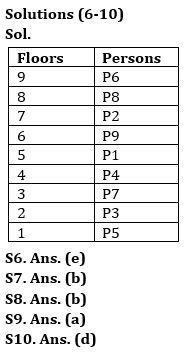
Nine people viz. P1, P2, P3, P4, P5, P6, P7, P8 and P9 live in a building on nine different floors. The ground floor is numbered 1, the floor just above it is numbered 2 and so on till top floor which is numbered as 9 (but not necessarily in the same order). More than four persons are living above P4. Three persons are living between P6 and P1 who is living belowP8. P2 lives immediately above P9 and immediately below P8. P3 lives below P4 and above P5. Only one person is living between P5 and P7.
Q6. Which of the following statement(s) is/are true regarding P1?
(a)Three persons are living below P1
(b)Only One person is living between P1 and P9
(c)P1 is living on an even numbered floor
(d)All are true
(e)Four persons are living above P1
Q7. Four of the following five are alike in a certain way and hence form a group, which of the following does not belong to the group?
(a)P6-P8
(b)P1-P9
(c)P4-P7
(d)P2-P9
(e)P3-P5
Q8. Who among the following is living on the topmost floor?
(a)P1
(b)P6
(c)P9
(d)P8
(e)None of these
Q9. How many persons are living between P4 and P5?
(a)Two
(b)Three
(c)One
(d)More than four
(e)Four
Q10. Number of persons living above P8 is same as the number of persons living below________?
(a)P4
(b)P2
(c)P1
(d)P3
(e)None of these
Solutions
Solutions (1-5):
S1. Ans. (c)
Sol. L 2 ©, V 5 &
S2. Ans. (e)
Sol. 5th to the left of 17th from the left= (17-5) = 12th from the left. i.e 8.
S3. Ans. (b)
Sol. S ¥ U H L © D $ M # C % B * V & A W P E + Q @ F
S4. Ans. (d)
Sol. S ¥ U H L 2 © D $ M # 8 C % B * V 5 & A W 4 P E + Q @ 7 F 6
After rearrangement: B % C # M $ D © 2 L H U ¥ S * V 5 & A W 4 P E + Q @ 7 F 6
S5. Ans. (a)










 SBI Clerk Prelims Exam Analysis 2026, 4t...
 SBI Clerk Prelims Expected Cut Off 2026,...
 SBI Clerk Exam Analysis 2026, 27 Septemb...