

The Punjab & Sind Bank Local Bank Officer (LBO) Exam has become an important opportunity for banking aspirants looking to secure officer-level positions in the banking sector. Since the competition level is increasing every year, candidates are now focusing more on repeated and high-frequency questions asked in previous banking examinations.
Top 50 Most Repeated Questions in Punjab & Sind LBO Exam
Repeated questions help candidates understand the exam pattern, important topics, and the level of preparation required for the Punjab & Sind LBO Exam. Practicing these questions regularly improves speed, accuracy, confidence, and conceptual understanding before the actual examination. Candidates preparing for the upcoming exam should therefore revise important memory-based questions along with mock tests and sectional practice to improve their overall score.
Directions (1-3): In the following questions, the symbols @, %, $, # and & used with the following meaning as illustrated below:
‘A & B’ means ‘A is not greater than B’
‘A $ B’ means ‘A is not smaller than B’
‘A @ B’ means ‘A is neither smaller than nor equal to B’
‘A # B’ means ‘A is neither greater than nor equal to B’
‘A % B’ means “A is neither greater than nor smaller than B’
Now, in each of the following questions assuming the given statements to be true, find which of the three conclusions I, II and III is/are definitely true and give your answer accordingly.
Q1. Statements: J$R@T%U; S&M#T%N
Conclusions: I. N#J II.R@S III.M&U
(a) Both I and III are true
(b) None is true
(c) Only II is true
(d) Only I is true
(e) Both I and II are true
Q2. Statements: E&S%P$D&K; I%L&P%U
Conclusions: I. E&I II.U$D III. E@L
(a) Only I is true
(b) Only II and either I or III is true
(c) Only II is true
(d) Only I and either II or III is true
(e) Both I and III are true
Q3. Statements: D#G&H@M; N%O$H@P
Conclusions: I. M#N II.D@P III.O$M
(a) Both II and III are true
(b) None is true
(c) Only III is true
(d) Only I is true
(e) Both I and II are true
Directions (4-8): Study the following information carefully and answer the questions given below.
Six persons have different designations i.e., General Manager (GM), Deputy General Manager (DGM), Assistant General Manager (AGM), Manager, Assistant Manager (AM), Section Officer (SO) in a company. The order of seniority is the same as given above i.e., GM is the senior-most designation and SO is the junior-most designation. Each of them likes different colours – Red, Blue, Pink, Yellow, Green and White but not necessarily in the same order.
I is designated two persons senior to the one who likes green. At least two persons are junior to the one who likes green. As many persons are senior to I as junior to M. Only two persons are designated between M and the one who likes yellow. N is senior to the one who likes yellow. The one who likes red is just senior to J who is senior to the one who likes white. L is two persons junior to the one who likes blue. The one who likes pink is senior to K.
Q4. Who among the following is designated as Manager?
(a) M
(b) K
(c) I
(d) J
(e) N
Q5. Which among the following statement(s) is/are true?
I. K likes white colour
II. M is not designated as Assistant Manager (AM)
III. More than three persons are junior to N
(a) Both I and III
(b) Both II and III
(c) Only I
(d) Both I and II
(e) Only III
Q6. How many persons are designated between N and the one who likes pink?
(a) One
(b) Three
(c) Two
(d) Four
(e) None
Q7. Which among the following combination is not correct?
(a) K-SO
(b) J-Green
(c) N-GM
(d) I-DGM
(e) All are correct
Q8. Who among the following likes yellow colour?
(a) N
(b) M
(c) I
(d) L
(e) None of these
Q9. How many such pair of letters are there in the word “ROAMING” each of which has as many letters between them as they have in English alphabet (both in forward and backward direction)?
(a) None
(b) One
(c) Two
(d) Three
(e) More than three
Directions (10-12): Study the following information carefully and answer the questions given below:
‘A % B’ means A is 16m west of B.
‘A @ B’ means A is 5m south of B.
‘A & B’ means A is 10m east of B.
‘A # B’ means A is 11m north of B.
Expression: U % N # M & V @ R # E, Q % E, Q # T
Q10. What is the direction of point N with respect to point Q?
(a) North
(b) North-west
(c) North-east
(d) East
(e) None of these
Q11. What is the total distance between point U and point R?
(a) 41m
(b) 46m
(c) 43m
(d) 42m
(e) None of these
Q12. What is the direction of point T with respect to point V?
(a) South-east
(b) South-west
(c) South
(d) North-west
(e) None of these
Directions (13-17): Study the following information carefully and answer the questions given below.
Eight persons i.e., R, K, P, D, N, A, B and U watch a movie on two different dates i.e., the 7th and 10th of four different months viz. January, April, May and September of the same year but not necessarily in the same order. Each of them ordered a different dish i.e., Dosa, Upma, Chips, Bread, Rice, Idli, Vada and Pao
bhaji but not necessarily in the same order.
One person watches a movie between N and P who ordered Chips. P neither watches movies on an odd date nor in the month having an even number of days. Two persons watch a movie between N and K. K is neither the first person to watch the movie nor watch the movie just after P. Three persons watch a
movie between K and D who ordered Upma. Two persons watch a movie between B and R who ordered Pao bhaji. B does not watch the movie in the month having an odd number of days. N and R do not watch the movie in the same month. Two persons watch a movie between the person who ordered Idli and the person who ordered Rice. N does not order Idli. The person who ordered Idli and Rice does not watch a movie just after D. R and U do not watch a movie in the same month. U and B do not order Vada. B does not order Bread.
Q13. Which among the following dishes does B order?
(a) Dosa
(b) Idli
(c) Rice
(d) Pao Bhaji
(e) None of these
Q14. Who among the following persons ordered Vada?
(a) A
(b) R
(c) N
(d) Either A or N
(e) None of these
Q15. How many persons watch the movie before R?
(a) One
(b) Three
(c) Two
(d) Four
(e) None of these
Q16. Which of the following statement(s) is/are true?
(a) D – 10th January
(b) N ordered Vada
(c) Two person watches a movie after P
(d) No one watches a movie before N
(e) All are true
Q17. Who among the following persons watch the movie two persons after A?
(a) R
(b) The person who ordered Idli
(c) P
(d) Either P or R
(e) None of these
Q18. If it is possible to make only one meaningful word from the 3rd, 5th, 6th, 8th and 10th letters from the left end of the word “PROLIFERATE” using each letter only once, then what is the last letter of that meaningful word. If no such meaningful word can be formed the answer will be “X” and if more than one such meaningful word can be formed, the answer will be “Z”?
(a) F
(b) X
(c) T
(d) R
(e) Z
Directions (19-21): Study the following information carefully and answer the questions given below:
A certain number of persons sit in a row facing north. One person sits between A and X. Two person sits between T and X. T does not sit adjacent to A and N. T sits second to the left of U. Four persons sit between U and M. N and T do not sit adjacent to each other. N sits second to the right of M. No one sits to the right of N. The number of persons sit to the right of M is one less than the number of persons sit to the left of X. T does not sit at the end. W sits adjacent to U but not adjacent to T.
Q19. How many persons sit between T and M?
(a) Two
(b) Three
(c) Four
(d) Six
(e) None of these
Q20. What is the position of X with respect to U?
(a) 4th to the left
(b) 4th to the right
(c) 3rd to the left
(d) 5th to the left
(e) None of these
Q21. How many persons sit in the row?
(a) 17
(b) 16
(c) 18
(d) 19
(e) None of these
Directions (22-25): A word and number arrangement machine when given an input line of numbers and word, rearranges them following a particular rule in each step. The following is an illustration of input and rearrangement:
Input: 68 Digital date 49 and 26 57 English report 45
Step I: And digital date 49 26 57 English report 45 48
Step II: Date and digital 49 26 English report 45 48 35
Step III: English date and digital 26 report 45 48 35 36
Step IV: Digital English date and 26 report 48 35 36 20
Step V: Report digital English date and 48 35 36 20 12
Step V is the final output. Find out different steps for the following input based on the above logics.
Input: Times 72 chief 88 in 39 group photo 28 55
Q22. Which of the following element is 6th from the right end in step IV?
(a) 39
(b) Group
(c) Times
(d) Chief
(e) 28
Q23. Which of the following element is 4th to the right of ‘Chief’ in step III?
(a) 39
(b) 14
(c) 27
(d) Photo
(e) 28
Q24. How many elements are in between ‘Group’ and ‘16’ in last step?
(a) Seven
(b) Six
(c) Five
(d) Four
(e) None of the above
Q25. The number of elements to the left of ‘In’ is same as the number of elements to the right of ____ in step IV.
(a) 25
(b) 14
(c) 27
(d) Photo
(e) None of these
Directions (26–29): The following questions are accompanied by two statements i.e. statement (I) and statement (II). You have to determine which statements(s) is/are sufficient/necessary to answer the questions.
(a) Neither statement (I) nor statement (II) by itself is sufficient to answer the question.
(b) Statement (II) alone is sufficient to answer the question but statement (I) alone is not sufficient to answer the question.
(c) Either statement (I) or statement (II) by itself is sufficient to answer the question.
(d) Both the statements taken together are necessary to answer the questions, but neither of the statements alone is sufficient to answer the question.
(e) Statement (I) alone is sufficient to answer the question but statement (II) alone is not sufficient to answer the questions
Q26. An amount of Rs 3720 is to be divided among A, B and C. Find the amount received by of A, B and C respectively.
Statement (I). C received 3/7th of the amount received by B.
Statement (II). A received 200/3 % more amount than C.
Q27. If √𝒛 and √𝒉 are integers and 𝟑𝟐 < 𝒛 < 𝒉 < 𝟗𝟎. Find the value of 𝒛+𝒉
𝟐.
Statement (I). 𝑧 + ℎ ≥ 70
Statement (II). 9z = 4h
Q28. There are five consecutive number which are multiple of two. Find the second largest number.
Statement (I). Difference between largest and second smallest number is 6.
Statement (II). Sum of second largest number and smallest number is 14.
Q29. What will be the total compound interest received on Rs.1000 after three years at rate of R% p.a.
Statement (I). The interest after one year was Rs.100 on same sum and same rate of interest.
Statement (II). The difference between simple interest and compound interest on same sum and same rate at the end of two years was Rs.10.
Q30. There are two boats A and B in a same river, where boat B takes two hours more than to covers 30 km upstream than boat A which cover the same distance in downstream. If sum of speed of boat A in still water and boat B in still water is 16 km/hr and speed of water current is 1 km/hr, then find time taken (in hours) by boat B to cover 42 km in still water?
(a) 14
(b) 2
(c) 7
(d) 3
(e) 6
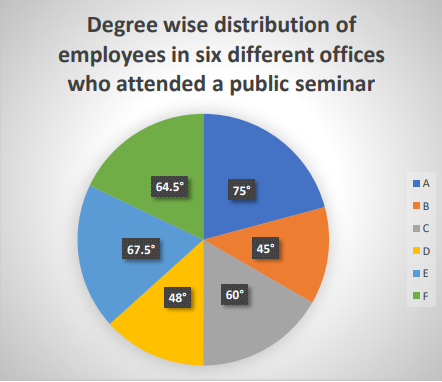
Direction (31-35): The pie chart given shows the degree wise distribution of employees in six different offices from three different companies (X, Y and Z) who attended a public seminar. Read the chart carefully and answer the questions given below.
Note – Degree distribution of employees in A = degree distribution of employees in A from X, Y and Z. (similarly for others)
Q31. In office C, 60% employees who attended seminar are females and in which distribution of females from X, Y and Z are in the ratio of 2 : 3 : 1 respectively. If number of females in C who attended seminar form Y are 60, then find the total males in office C.
(a) 50
(b) 60
(c) 80
(d) 40
(e) 84
Q32. If the ratio of females in office D to males in office F who attended seminar is 4 : 5 and females in office F is 𝟐𝟎𝟎/𝟑% of total employees in that office, then find the number of males in D is what percent (approx.) of total employees in D.
(a) 104%
(b) 94%
(c) 84%
(d) 74%
(e) 64%
Q33. Find the ratio of number of employees who attended seminar from office A and D together to number of employees who attended seminar from office B and C together?
(a) 13 : 17
(b) 17 : 15
(c) 6 : 5
(d) 7 : 8
(e) 9 : 10
Q34. Number of employees in E from company Y who attended seminar is 150 which is 25% of the total employees from E who attended seminar. If number of employees in B from company X who attended seminar is 120, then find the number of employees from B of Y and Z together.
(a) 280
(b) 140
(c) 160
(d) 220
(e) 240
Q35. Number of employees in D who attended seminar are what percent of the number of employees in C who attended seminar.
(a) 60%
(b) 75%
(c) 65%
(d) 80%
(e) 50%
Q36. The saving of A is Rs 1000 more than saving of B and both save 𝟏/𝟏𝟎𝒕𝒉 of their respective income. A and B both invested 𝟑/𝟏𝟎th & 𝟏/𝟓𝒕𝒉 of their respective income in same scheme which offers simple interest at 10% per annum. If A and B invested for 10 months and 12 months respectively and they received total interest of Rs 2500, then find the income of A.
(a) 50000
(b) 48000
(c) 40000
(d) 72000
(e) 60000
Q37. A and B enter into a partnership business with capital of Rs 15000 and Rs 15600 respectively. B left the business after 20 months and they received total Rs 28000 as profit at the end of 2 years. Out of total profit 𝟏𝟖𝒕𝒉 was donate into charity and the remaining profit was distributed between both according to profit ratio. If B received Rs. 25p as profit share, then find the value of p.
(a) 467
(b) 447
(c) 427
(d) 455
(e) 191
Q38. Five years ago, the age of A is two times more than the age of B at that time. The ratio of age of B five year hence to age of C five year ago is 3 : 5. If A is 10 years older than C and (n+2) years hence, the age of C will be 60 years, then find the age of B ‘n’ years ago was?
(a) 20 years
(b) 15 years
(c) 18 years
(d) 10 years
(e) 22 years
Q39. There are some oranges in the shops. Ayush take 50% of the oranges, Pallavi takes 20% of remaining and Rahul takes 40% of the remaining oranges. If Ayush sell all the oranges at Rs.5 and earns Rs5000, then find the total oranges taken by Rahul.
(a) 300
(b) 320
(c) 400
(d) 150
(e) 200
Q40. A & B together can complete a work in 7.5 days, B & C together can complete the same work in 15 days and efficiency of C is 1 unit per days. If A and C work together and after 4 days A left and D comes and complete the rest of work in 5 days, then find the time taken by D to complete the whole work alone (in day).
(a) 50/3
(b) 32/3
(c) 40/21
(d) 15/7
(e) 20/3
Directions (41-45): Read the following information carefully and answer the questions given below.
In a society, people use three different flowers rose, lily and jasmine for decoration of durga puja. People who use only rose and only lily are in the ratio of 4:3 respectively and people who use all the three types of flowers together is 15.
People who use only jasmine is the average number of people who uses only two flowers together and total people who use roses and lily is 230.
People who use only rose & jasmine together is ¼th of the people who uses only rose and 30 people use only lily and jasmine together.
People who use only rose & lily together is average of people who use only rose & jasmine together and use only lily & jasmine together.
Q41. People uses roses is what percentage more than people uses jasmine.
(a) 55.55%
(b) 66.66%
(c) 11.11%
(d) 28%
(e) 15%
Q42. Find the average of total number of people who use at most one type of flower.
(a) 90
(b) 75
(c) 100
(d) 25
(e) 55
Q43. Find the total number of people who use only lily flower is how much more/less than the total number of people who use at least two types of flowers.
(a) 20
(b) 18
(c) 12
(d) 30
(e) 15
Q44. Find the respective ratio of total number of people who use only rose & jasmine flower together to that of only lily & rose flower together.
(a) 4:7
(b) 4:5
(c) 7:5
(d) 6:5
(e) None of these
Q45. Find the difference between total people who uses only one flower and people uses only two flowers together.
(a) 90
(b) 75
(c) 100
(d) 25
(e) 55
Q46. A deposit Rs.7800 at x% per annum at simple interest, while B deposit Rs.9800 at 10% per annum at compound interest. B received Rs.342 more interest than the A in after two years. If B invested Rs P at (x+5)% on simple interest for two years and received Rs 2400 as interest, then find the value of P (in Rs).
(a) 8000
(b) 4800
(c) 4000
(d) 6000
(e) 7500
Q47. Boat X takes 15 hours for travelling downstream from point A to point B and coming back to a point C which is midpoint between A and B. The speed of stream is 6 km/hr and the speed of the boat X in still water is 18 km/hr, while the distance between A and B is ‘x’ km and speed of boat Y is ‘y’ km/hr. If boat Y takes 7 hours to cover (0.5x-6) km distance upstream in same river, then find downstream speed (in km/hr) of boat Y.
(a) 12
(b) 18
(c) 16
(d) 24
(e) 20
Q48. The length, breadth and height of a cuboid is in the ratio of 5:6:7 respectively. The volume of the cuboid is 26250 𝒄𝒎𝟑and the length of a rectangle is 4 cm less than length of the cuboid. If breadth of the rectangle is 5 cm less than breadth of the cuboid, then find the area of the rectangle.
(a) 505 𝑐𝑚2
(b) 525 𝑐𝑚2
(c) 515 𝑐𝑚2
(d) 545 𝑐𝑚2
(e) 500 𝑐𝑚2
Q49. A bag contains 30 pens of red color while 40 of blue color and rest of green color. If 20% red pens are removed and replaced with equal number of green color pen then green color pens become 10% less than blue pens. If 10% of each color pens initially in the bag are removed and replaced with ‘N’ green pens and still number of total pens remains same. Find N + 2?
(a) None of these
(b) 11
(c) 10
(d) 12
(e) 13
Q50. The marked price of a watch is Rs.120x and shopkeeper offers a discount of 12.5%, 10% and 20% on the marked price of a watch while makes profit of 20% and difference between discounted price and marked up price is Rs.189. Find the cost price of a watch.
(a) 𝑅𝑠. 917
(b) 𝑅𝑠. 945
(c) 𝑅𝑠. 922
(d) 𝑅𝑠. 975
(e) 𝑅𝑠. 990
| Answers | |||||||||
| 01 | 02 | 03 | 04 | 05 | 06 | 07 | 08 | 09 | 10 |
| e | b | d | d | a | b | e | c | c | c |
| 11 | 12 | 13 | 14 | 15 | 16 | 17 | 18 | 19 | 20 |
| b | d | a | a | b | c | b | b | d | d |
| 21 | 22 | 23 | 24 | 25 | 26 | 27 | 28 | 29 | 30 |
| b | c | e | a | b | d | b | b | c | e |
| 31 | 32 | 33 | 34 | 35 | 36 | 37 | 38 | 39 | 40 |
| c | e | c | a | d | e | d | e | b | a |
| 41 | 42 | 43 | 44 | 45 | 46 | 47 | 48 | 49 | 50 |
| a | e | d | b | a | e | d | b | d | b |

Common Mistakes Candidates Make While Preparing
Many aspirants practice questions randomly without understanding the actual exam requirement.
- Memorizing answers without concepts
- Ignoring mock tests
- Not revising banking awareness
- Focusing only on aptitude sections
- Skipping professional knowledge
| Related Posts |
| Punjab & Sind Bank LBO Cut Off |
| Punjab & Sind Bank LBO Syllabus |
| Punjab & Sind Bank LBO Previous Year Question Papers |
| Punjab & Sind Bank LBO Salary |








 SBI CBO Previous Year Question Papers Wi...
 SBI PO Admit Card 2026 Out @sbi.bank.in,...
 PNB LBO Recruitment 2026 Notification Ou...