
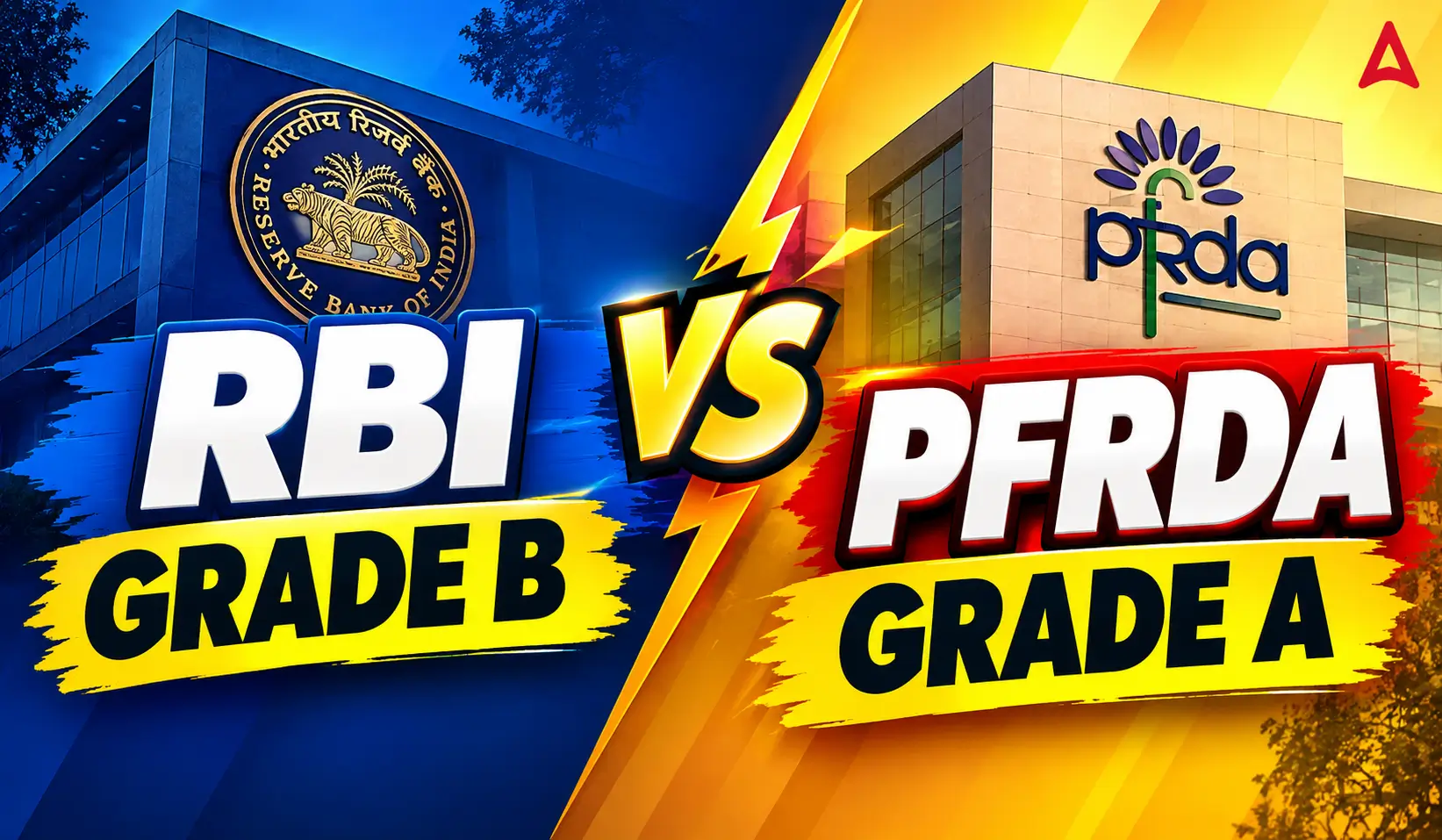
Choosing between RBI Grade B and PFRDA Grade A can be difficult because both are prestigious regulatory-sector jobs offering attractive salaries, professional growth and excellent benefits. However, the two roles differ significantly in terms of eligibility, examination structure, job profile and the nature of work.
RBI Grade B vs PFRDA Grade A
For 2026, the RBI Grade B recruitment has 60 vacancies across General, DEPR and DSIM cadres, including 40 vacancies for the General cadre. The PFRDA Grade A recruitment 2026 has announced 30 Officer Grade A (Assistant Manager) vacancies across General, Research, Actuary and Official Language streams. So, RBI Grade B vs PFRDA Grade A which is better? The answer depends on your educational background, interest in the financial sector, preferred job profile, exam preparation strategy and career goals.
RBI Grade B vs PFRDA Grade A: Quick Comparison
| Particulars | RBI Grade B | PFRDA Grade A |
| Full Form | Reserve Bank of India Grade B Officer | Pension Fund Regulatory and Development Authority Grade A Officer |
| Exam Name | RBI Grade B Recruitment 2026 | PFRDA Grade A Recruitment 2026 |
| Post | Officer in Grade B | Officer Grade A (Assistant Manager) |
| 2026 Vacancies | 60 overall | 30 overall |
| Major Streams | General, DEPR, DSIM | General, Research, Actuary, Rajbhasha |
| Basic Pay | ₹78,450 per month | ₹62,500 per month |
| Approx. Initial Gross | ₹1,54,936 per month without HRA | Approx. ₹2,05,000 per month including specified components and PFRDA’s NPS contribution |
| Selection | Phase I + Phase II + Interview | Phase I + Phase II + Interview |
| Phase I | 200 marks for General | 200 marks |
| Phase II | Three papers for General | Two papers |
| Interview | 75 marks | 15% weightage |
| General Eligibility | Graduation with required marks or eligible PG qualification | Master’s degree/PG Diploma, Law/Engineering degree or specified professional qualifications for General stream |
| Upper Age | 30 years | 30 years |
| Posting | RBI offices/locations as per Bank requirements | Mainly New Delhi and Mumbai currently; liable for posting anywhere in India |
| Regulator Focus | Banking, monetary policy and financial system | Pension sector regulation and development |
RBI Grade B vs PFRDA Grade A Salary
Salary is one of the biggest factors candidates consider while choosing between these two regulatory jobs.
RBI Grade B Salary
- Basic Pay: ₹78,450 per month.
- Pay Scale: ₹78,450-4,050(9)-₹1,14,900-EB-4,050(2)-₹1,23,000-4,650(4)-₹1,41,600.
- Initial Gross Emoluments: Approximately ₹1,54,936 per month, excluding HRA.
- HRA: 15% of pay if RBI accommodation is not provided.
- Major Allowances: Special Allowance, Grade Allowance, Dearness Allowance, Local Compensatory Allowance, Special Grade Allowance, Learning Allowance and HRA.
- Key Benefits: Accommodation subject to availability, medical facilities/reimbursement, Leave Fare Concession, furnishing allowance and concessional loans and advances.
PFRDA Grade A Salary
- Basic Pay: ₹62,500 per month.
- Pay Scale: ₹62,500-3,600(4)-₹76,900-4,050(7)-₹1,05,250-EB-4,050(4)-₹1,21,450-4,650(1)-₹1,26,100.
- Gross Emoluments: Approximately ₹2,05,000 per month at the minimum of the scale.
- Included Components: The stated gross emoluments include PFRDA’s contribution towards NPS along with various allowances.
- Major Allowances: Grade Allowance, Special Allowance, Dearness Allowance, Local Allowance, Family Allowance, Learning Allowance and Housing Allowance.
- Key Benefits: Leave Fare Concession, medical expenses, personal accident insurance, children’s education allowance, knowledge updation allowance, conveyance expenses, house-cleaning allowance, staff furnishing scheme, computer purchase scheme and meal card.
Which Has Better Salary?
- PFRDA Grade A: Approximately ₹2.05 lakh monthly in stated gross emoluments.
- RBI Grade B: Approximately ₹1.55 lakh monthly in initial gross emoluments without HRA.
- The two figures are not directly comparable as take-home salaries, as the PFRDA figure includes the Authority’s NPS contribution and other components, while the RBI figure specifically excludes HRA.
RBI Grade B vs PFRDA Grade A Vacancies
Vacancies can significantly affect competition and should be considered before selecting an exam.
RBI Grade B Vacancy 2026
RBI has announced 60 vacancies across its Grade B recruitment:
- Grade B General: 40
- Grade B DEPR: 10
- Grade B DSIM: 10
PFRDA Grade A Vacancy 2026
PFRDA has announced 30 vacancies:
- General: 25
- Research: 2
- Actuary: 2
- Official Language (Rajbhasha): 1
RBI Grade B vs PFRDA Grade A Eligibility
Eligibility is another major difference between the two examinations.
RBI Grade B General Eligibility
For RBI Grade B General, candidates can apply with a graduation degree in any discipline or an equivalent technical/professional qualification with at least 60% marks for the relevant categories. Candidates with a postgraduate qualification with at least 55% marks can also be eligible, subject to the notification’s conditions. The age limit for RBI Grade B is 21 to 30 years as on April 1, 2026. The notification provides applicable relaxations for eligible reserved categories, PwBD candidates, ex-servicemen and certain other categories.
PFRDA Grade A General Eligibility
PFRDA’s General stream has a different educational requirement. Candidates need a Master’s Degree/Postgraduate Diploma of at least two years’ duration in any discipline, or a Bachelor’s degree in Law, Bachelor’s degree in Engineering, or specified professional qualifications such as ACA/FCA, ACS/FCS, ACMA/FCMA or CFA. The PFRDA upper age limit is 30 years as on July 31, 2026, with applicable relaxations for eligible categories.
RBI Grade B vs PFRDA Grade A Exam Pattern
The examination structure is considerably different.
| Particulars | RBI Grade B General | PFRDA Grade A |
| Selection Stages | Phase I → Phase II → Interview | Phase I → Phase II → Interview |
| Phase I | Objective Exam – 200 marks | 2 Papers – 100 marks each |
| Phase I Paper 1 | General Awareness, English Language, Quantitative Aptitude, Reasoning | English Language – 25 marks; Quantitative Aptitude – 25 marks; Reasoning – 25 marks; General Awareness including Financial Sector – 25 marks |
| Phase I Paper 2 | — | Stream-specific Paper; General stream covers Commerce, Accountancy, Management, Finance, Costing, Companies Act, Economics, Pension Sector, AI, Media, Marketing & Communication |
| Phase I Duration | — | Paper 1: 60 minutes; Paper 2: 40 minutes |
| Phase I Purpose | Candidates must meet the prescribed sectional and aggregate minimum marks to qualify for Phase II | Marks are used only for shortlisting and are not counted in final selection |
| Phase II | 3 Papers | 2 Papers |
| RBI/PFRDA Phase II Papers | Paper I: Economic and Social Issues; Paper II: English Writing Skills; Paper III: General Finance and Management | Paper 1: Descriptive English; Paper 2: Stream-specific |
| Phase II Paper 2 – General Stream | General Finance and Management | 100 marks, 50 questions, 40 minutes; covers the stream-specific syllabus |
| Interview | 75 marks | Final selection includes Interview with 15% weightage |
| Final Selection | Based on Phase II + Interview | Phase II: 85% + Interview: 15% |
| Personality Assessment | Conducted before Interview; non-qualifying and carries no marks | — |
RBI Grade B vs PFRDA Grade A Job Profile
RBI Grade B Job Profile
- RBI is India’s central bank, so Grade B officers can work across a wide range of functions connected with the banking and financial system. The RBI notification describes the Bank as a full-service central bank handling a variety of functions, with officers undertaking different roles depending on their postings.
- For candidates in DEPR, the work is primarily related to economic analysis, research, policy formulation and compilation of sectoral data.
- The General cadre offers exposure to areas connected with monetary policy, banking regulation, financial markets, economic and financial analysis and other central-bank functions.
PFRDA Grade A Job Profile
- PFRDA is the regulator responsible for promoting, developing and regulating the pension sector in India.
- PFRDA officers can be posted to different departments of the Authority and are required to perform duties assigned according to organizational requirements. The Authority currently has offices in New Delhi and Mumbai, although selected candidates may be liable to serve anywhere in India depending on requirements.
- Therefore, the PFRDA role is more closely linked to pension-sector regulation, financial markets, policy, supervision and related regulatory functions.
- Job Profile Winner: RBI Grade B for wider institutional exposure; PFRDA Grade A for specialized pension-sector work.
RBI Grade B vs PFRDA Grade A: Career Growth
- Both jobs offer strong long-term career prospects, but the career environment is different.
- RBI Grade B offers the advantage of working within India’s central banking institution. Officers can gain exposure to banking, monetary policy, financial markets, regulation, economic research and other areas depending on their cadre and posting.
- PFRDA Grade A offers a specialized regulatory career focused on the pension sector. Since PFRDA regulates an important segment of India’s financial system, officers can develop expertise in pension regulation, retirement savings and financial-sector policy.
- Candidates who want a broader central-banking career may prefer RBI, while those who want to develop specialized regulatory expertise in the pension sector may prefer PFRDA.
RBI Grade B vs PFRDA Grade A: Posting
Posting preference can also influence the decision.
- RBI has offices across different locations and officers may be posted according to the Bank’s requirements.
- PFRDA currently has offices in New Delhi and Mumbai, although its notification clearly states that selected candidates may be liable to serve anywhere in India wherever the Authority’s requirements arise.
- Therefore, candidates specifically looking for a career concentrated around Delhi and Mumbai may find PFRDA’s current office structure attractive, while RBI provides a broader institutional footprint.
RBI Grade B vs PFRDA Grade A: Which Is More Difficult?
It is difficult to declare one examination universally easier because the difficulty depends on the candidate’s academic background and preparation. RBI Grade B may feel more difficult if:
- You are weak in Economics and Finance.
- You struggle with descriptive answer writing.
- You are not comfortable with a broad Phase II syllabus.
- You are preparing for General cadre without a strong background in financial awareness.
PFRDA Grade A may feel more difficult if:
- You are unfamiliar with Commerce, Accountancy, Finance and regulatory concepts.
- You do not have a strong specialized subject background.
- You find stream-specific preparation difficult.
- You are uncomfortable with the detailed syllabus of the General stream.
For a candidate preparing for both, there is considerable overlap in areas such as quantitative aptitude, reasoning, English, general awareness, finance and the broader financial-sector ecosystem, but the specialized portions need separate preparation.
RBI Grade B vs PFRDA Grade A: Which Is Better for Freshers?
- Both can be excellent options for fresh graduates or early-career aspirants, subject to meeting the respective eligibility requirements.
- RBI specifically states that for Grade B General, the Bank encourages candidates with no prior experience to apply.
- PFRDA’s 2026 notification does not require prior work experience for the General stream; instead, it specifies the required educational qualifications.
- For candidates who meet PFRDA’s postgraduate/professional eligibility, both exams can be considered.
RBI Grade B vs PFRDA Grade A: Which One Should You Choose?
The choice can be simplified based on your priorities:
| If Your Priority Is… | Better Choice |
| Wider eligibility for General stream | RBI Grade B |
| Higher notified gross emoluments | PFRDA Grade A |
| More vacancies in 2026 | RBI Grade B |
| Central banking exposure | RBI Grade B |
| Pension-sector specialization | PFRDA Grade A |
| Broader regulatory ecosystem | RBI Grade B |
| Specialized financial-sector regulator role | PFRDA Grade A |
| General graduation-based eligibility | RBI Grade B |
| Delhi/Mumbai-focused current office structure | PFRDA Grade A |
RBI Grade B and PFRDA Grade A 2026: Current Status
The RBI Grade B 2026 recruitment cycle has already progressed beyond the written examination stage, and candidates are now moving towards the Interview stage. On the other hand, PFRDA Grade A 2026 recruitment is currently active. The application window is open from September 3 to September 24, 2026, with Phase I scheduled for October 15, 2026 and Phase II for November 20, 2026. Therefore, PFRDA Grade A is the active opportunity at present, while RBI Grade B 2026 is at a later stage of its recruitment process.






 PFRDA Grade A Notification 2026 Out for ...
 UIIC AO vs OICL AO: Which Insurance AO E...
 UIIC AO vs NIACL AO: Difference in Salar...