
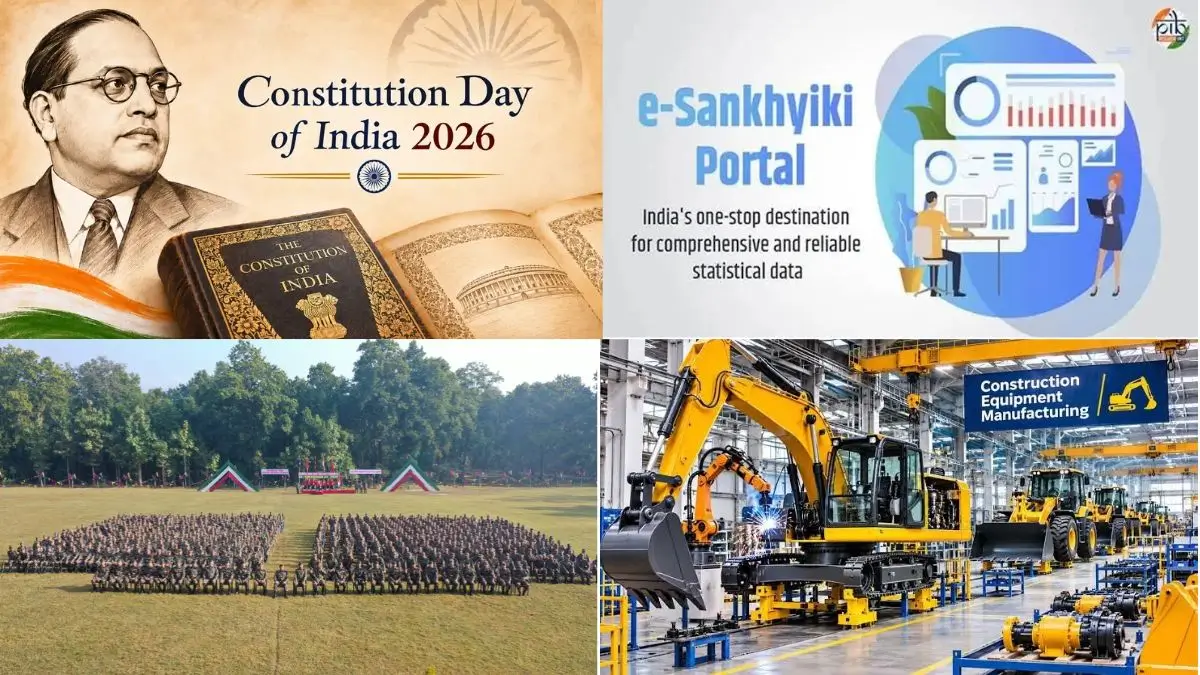
Daily Current Affairs: 27 November 2026
Q1. World Sustainable Transport Day is observed annually on 26 November. In which year did the United Nations General Assembly establish this observance?
(a) 2020
(b) 2016
(c) 2026
(d) 2022
(e) 2023
Answer: e
Solution:
World Sustainable Transport Day is observed annually on 26 November to recognise the important role of safe, affordable, accessible and sustainable transport in promoting economic and social development.
- The day highlights the contribution of sustainable transport towards strengthening connectivity and supporting environmental sustainability.
- It was established by the United Nations General Assembly in 2023 through Resolution 77/286.
- The observance provides an opportunity to raise awareness, share solutions and strengthen international cooperation for developing more sustainable and inclusive transport systems.
Q2. Constitution Day (Samvidhan Diwas) is observed on 26 November to mark the adoption of the Constitution of India by the Constituent Assembly on 26 November 1949. Since which year has 26 November been officially observed as Constitution Day?
(a) 2012
(b) 2014
(c) 2015
(d) 2019
(e) 2020
Answer: c
Solution:
Constitution Day, also known as Samvidhan Diwas, is observed every year on 26 November to commemorate the adoption of the Constitution of India by the Constituent Assembly on 26 November 1949.
- The day has been officially observed as Constitution Day since 2015.
- It provides an opportunity to reflect upon the principles and values enshrined in the Constitution of India.
- The observance aims to strengthen constitutional awareness, promote responsible citizenship and encourage active participation in upholding the democratic values of the nation.
Q3. India’s pavilion—titled Geographies of Distance: Remembering Home and housed at the Arsenale—won the Visitors’ Lion for Best National Participation at the 61st Venice Art Biennale (May 9 to November 22, 2026). Which body served as the executing agency for the pavilion commissioned by the National Gallery of Modern Art (NGMA)?
(a) Lalit Kala Akademi
(b) Indira Gandhi National Centre for the Arts (IGNCA)
(c) Sangeet Natak Akademi
(d) Sahitya Akademi
(e) Archaeological Survey of India (ASI)
Answer: b
Solution:
India’s pavilion, titled “Geographies of Distance: Remembering Home”, won the Visitors’ Lion for Best National Participation at the 61st Venice Art Biennale.
- The award was decided through public votes cast between 9 May and 22 November 2026.
- The pavilion explored the themes of memory and belonging in a rapidly transforming world.
- Prime Minister Narendra Modi described the achievement as a proud moment for India’s art and cultural world.
- The 61st Venice Art Biennale was held in Venice, Italy, from 9 May to 22 November 2026, with preview days from 6 to 8 May.
- The India Pavilion returned to the Biennale Arte after a gap of seven years.
- It was housed at the historic Arsenale in Venice.
- The pavilion was commissioned by the National Gallery of Modern Art (NGMA), Ministry of Culture, while the Indira Gandhi National Centre for the Arts (IGNCA) served as the executing agency.
Q4. President Droupadi Murmu attended the Bali Jatra Festival 2026 in Cuttack (Kataka), Odisha, in November 2026. Held annually on Kartika Purnima, Bali Jatra commemorates the ancient maritime links between Kalinga and Southeast Asia, during which women float miniature boats on the Mahanadi River in a ritual known as what?
(a) Nuakhai Juhar
(b) Boita Bandana
(c) Raja Parba
(d) Chandan Yatra
(e) Chhau Utsav
Answer: b
Solution:
The President of India, Droupadi Murmu, attended the Bali Jatra Festival 2026 in Cuttack, Odisha, on 24 November 2026.
About the Bali Jatra Festival:
- Bali Jatra is celebrated annually in Cuttack, Odisha.
- The term Bali Jatra literally means “Voyage to Bali.”
- The festival is celebrated every year on Kartika Purnima, which marks the day when seafaring traders traditionally departed for the Indonesian islands.
Historical Significance:
- The festival commemorates the approximately 2,000-year-old maritime and cultural links between ancient Kalinga, present-day Odisha, and Bali.
- It also celebrates the historical connections between Kalinga and other regions of South and Southeast Asia, including Java, Sumatra, Borneo, Burma (Myanmar) and Ceylon (Sri Lanka).
- The festival celebrates the maritime skills and achievements of ancient Kalinga’s sailors, who contributed to making the region one of the prosperous empires of its time.
Major Celebrations:
- The festival features grand fairs, elaborate rides, food stalls and cultural performances.
- Women perform the traditional ritual of Boita Bandana, in which they prepare small boats using paper or banana leaves (sholapith), place lighted lamps inside them and float them in the Mahanadi River.
- The festival symbolises Odisha’s rich maritime heritage and its historical trade and cultural connections with Southeast Asia.
Q5. Recently, in November 2026, the Union Cabinet approved a Memorandum of Understanding (MoU) between India and which country on “Cooperation in Skills and Industry Development within the Aviation Maintenance, Repair and Overhaul Sector (MRO)”?
(a) Japan
(b) United Kingdom
(c) United Arab Emirates
(d) Singapore
(e) France
Answer: d
Solution:
The Union Cabinet, chaired by Prime Minister Narendra Modi, approved the signing of a Memorandum of Understanding (MoU) between India and Singapore on 25 November 2026.
- The MoU is titled “Cooperation in Skills and Industry Development within the Aviation Maintenance, Repair and Overhaul Sector (MRO).”
- It will establish a framework for exchanging knowledge, expertise and best practices between the two countries.
- The agreement aims to strengthen India’s aviation MRO ecosystem through skill development, institutional capacity building and industry partnerships.
Key Provisions of the MoU:
- Joint Curriculum Development: India and Singapore will jointly develop an industry-oriented curriculum for Aircraft Maintenance Engineer (AME) training.
- Institutional Capacity Building: Singapore will share its expertise and support capacity building in Indian institutes to ensure quality delivery of the training curriculum.
- Internship and Exchange Programmes: Indian students will receive opportunities to participate in internship and exchange programmes with Singaporean MRO entities to gain practical industry experience.
- Industry Partnerships: The MoU will facilitate partnerships between Indian and Singaporean industry stakeholders to support the expansion of MRO facilities.
Q6. According to the Ministry of Heavy Industries release dated 25 November 2026 on the Production Linked Incentive (PLI) Scheme for the Automobile and Auto Component Industry (total budgetary outlay: ₹25,938 crore), how much incentive was disbursed during FY 2026–27 as of 25 November 2026?
(a) ₹2,064.36 crore
(b) ₹4,385.28 crore
(c) ₹5,280.60 crore
(d) ₹6,771.64 crore
(e) ₹8,299.30 crore
Answer: b
Solution:
The Ministry of Heavy Industries continues to strengthen India’s automobile and auto component manufacturing ecosystem through the Production Linked Incentive (PLI) Scheme for Automobile and
Auto Component Industry.
- The scheme aims to enhance domestic manufacturing capabilities, promote advanced automotive technologies and position India as a global hub for automobile manufacturing.
- The scheme has an approved budgetary outlay of ₹25,938 crore.
- During FY 2026–27, incentive disbursements reached ₹4,385.28 crore as of 25 November 2026.
- The cumulative incentive disbursement since the scheme’s inception reached ₹6,771.64 crore.
Investment, Incremental Sales and Employment Generation:
- As of 30 September 2026, approved applicants had reported cumulative investments of ₹52,806 crore, exceeding the targeted investment of ₹42,500 crore.
- The scheme facilitated incremental sales of ₹82,993 crore over the base year FY 2019–20.
- It also generated 77,755 employment opportunities, contributing to the expansion of India’s automotive manufacturing ecosystem.
Domestic Manufacturing and Value Addition:
- The scheme requires a minimum Domestic Value Addition (DVA) of 50% for eligible products to qualify for incentives.
- As of 25 November 2026, DVA certificates had been issued to nine Champion Original Equipment Manufacturers (OEMs), covering 139 products or variants.
- Additionally, 10 Component Champions had received DVA certificates covering 53 products or variants.
- The scheme supports the objectives of Aatmanirbhar Bharat by strengthening domestic manufacturing capabilities and reducing dependence on imported components.
Q7. Under the National Investment Policy for Urea (NIPU)-2026, the government approved six brownfield urea plant projects—involving an investment of approximately ₹54,000 crore—each with an annual installed production capacity of how many Lakh Metric Tonnes (LMT)?
(a) 8.64 LMT
(b) 10.5 LMT
(c) 12.7 LMT
(d) 15.0 LMT
(e) 18.2 LMT
. Answer: c
Solution:
The Government of India has approved six new brownfield urea plants under the National Investment Policy for Urea (NIPU)-2026.
- The projects involve an estimated investment of approximately ₹54,000 crore.
- The initiative aims to strengthen agricultural resilience, ensure fertiliser security and promote self-reliance in domestic urea production.
- Each of the six approved plants will have an annual installed production capacity of 12.7 lakh metric tonnes (LMT).
Six Approved Urea Plants:
| Urea Plant | Location | State | Project Category |
| MFL–Madras | Madras | Tamil Nadu | PSU brownfield project |
| NFL–Nangal | Nangal | Punjab | PSU brownfield project |
| KFL–Shahjahanpur | Shahjahanpur | Uttar Pradesh | Cooperative brownfield project |
| Matix–Panagarh | Panagarh | West Bengal | Private brownfield project |
| CFCL–Gadepan | Gadepan | Rajasthan | Private brownfield project |
| IIPL–Jagdishpur | Jagdishpur | Uttar Pradesh | Private brownfield project |
Important Details of the Projects:
- MFL–Madras: This PSU brownfield project will replace an existing unit that is more than 60 years old. The new plant will have an annual installed production capacity of 12.7 LMT.
- NFL–Nangal: This PSU brownfield project will replace a plant that is approximately 50–55 years old. The new facility will have an annual installed production capacity of 12.7 LMT.
- KFL–Shahjahanpur: This cooperative brownfield project of KRIBHCO will expand the unit that was commissioned in 1995. The project will have an annual installed production capacity of 12.7 LMT.
- Matix–Panagarh: This private brownfield project will have an annual installed production capacity of 12.7 LMT at an existing modern plant that was commissioned in 2017.
- CFCL–Gadepan: This private brownfield project will expand the complex that has been operational since 1994. The new facility will have an annual installed production capacity of 12.7 LMT.
- IIPL–Jagdishpur: This private brownfield project proposes an additional annual production capacity of 12.7 LMT at the plant established in 1988.
Q8. The Ministry of Statistics and Programme Implementation (MoSPI) launched the State Dashboard on its ‘eSankhyiki’ portal in collaboration with the Institute for Competitiveness. How many indicators across 10 broad themes are currently featured on the State Dashboard?
(a) 119 indicators
(b) 210 indicators
(c) 283 indicators
(d) 340 indicators
(e) 430 indicators
Answer: c
Solution:
The Ministry of Statistics and Programme Implementation (MoSPI) has launched a State Dashboard on its eSankhyiki portal to improve access to State-level statistical data and support informed policymaking.
- The dashboard has been developed in collaboration with the Institute for Competitiveness.
- It brings together State-level data from 21 statistical products already available on the eSankhyiki portal.
- The dashboard currently features 283 indicators drawn from 21 statistical products across 10 broad themes.
- These themes include agriculture, education, work and wages, and gender and inclusion.
- The platform allows users to explore and compare statistical indicators across different States.
Key Features of the State Dashboard:
- State-wise Data Access: Users can select a particular State and theme to access relevant statistical indicators.
- Inter-State Comparison: Users can explore a specific theme across multiple States and compare their performance.
- Interactive Visualisation: The dashboard provides interactive charts and filters to support data analysis.
- Metadata and Statistical Notes: The platform provides metadata and statistical notes to help users interpret the information correctly.
- Download Facility: Users can download the underlying data and metadata, as well as download and share visualisations.
About the eSankhyiki Portal:
- The eSankhyiki portal currently hosts 43 statistical products.
- These products contain 1,109 datasets comprising more than 139 million records.
- The State Dashboard is aligned with the Viksit Bharat Initiative for Statistical Transformation, Analytics and Research (VISTAR).
- Through its Support for Statistical Strengthening component, the initiative aims to strengthen the capacity of States and Union Territories to produce more granular statistics, including district-level data.
- The dashboard will be progressively expanded, with additional indicators being added over time.
Q9. Which company developed the ‘Chariot-1 Foundation Models’—comprising the Chariot-1 Large Language Model (LLM) and Chariot-1 Text-to-Speech (TTS) pre-trained from scratch in India—whose launch under the IndiaAI Mission was inaugurated by MeitY Secretary S. Krishnan at Bharat Mandapam, New Delhi?
(a) Sarvam AI
(b) Chariot Artificial Intelligence Pvt. Ltd.
(c) BharatGen Consortium
(d) Gnani.ai
(e) CoRover
Answer: b
Solution:
Shri S. Krishnan, Secretary of the Ministry of Electronics and Information Technology (MeitY), inaugurated the launch of Chariot-1 Foundation Models under the IndiaAI Mission.
- The models have been developed by Chariot Artificial Intelligence Pvt. Ltd.
- The launch and research showcase took place at Bharat Mandapam, New Delhi.
- Chariot Artificial Intelligence Pvt. Ltd. is among the first four teams selected under the IndiaAI Mission to develop sovereign foundation models.
- The initiative reflects the Government of India’s commitment to developing indigenous AI capabilities and supporting advanced research and innovation.
- The models are designed to address India’s technological, linguistic and societal requirements.
Chariot-1 Model Suite:
The Chariot-1 model suite comprises two major models:
- Chariot-1 Large Language Model (LLM): Developed to advance language understanding capabilities.
- Chariot-1 Text-to-Speech (TTS): Developed to support speech generation capabilities.
- Both models have been developed through pre-training from scratch in India.
- They incorporate research innovations intended to improve computational efficiency, multilingual capabilities and adaptability across different deployment environments.
Q10. Recently, in November 2026, the Department of Drinking Water and Sanitation (DDWS) and the Directorate General of Training (DGT) signed an MoU for the ‘Nal Jal Mitra’ skilling programme under Jal Jeevan Mission 2.0. How many candidates are targeted for training and certification under this MoU?
(a) 25,000 candidates
(b) 50,000 candidates
(c) 2,50,000 candidates
(d) 1,00,000 (one lakh) candidates
(e) 5,00,000 candidates
Answer: d
Solution:
The Department of Drinking Water and Sanitation (DDWS), Ministry of Jal Shakti, and the Directorate General of Training (DGT), Ministry of Skill Development and Entrepreneurship, signed an MoU on 25 November 2026 for the Water Supply Operation and Maintenance Skilling Programme, known as the Nal Jal Mitra Programme.
- The programme will be implemented under Jal Jeevan Mission 2.0 (JJM 2.0).
- The MoU establishes a collaborative framework between DDWS and DGT to develop a trained and certified workforce for the operation and maintenance of rural piped water supply systems.
- The programme will utilise the existing network of Industrial Training Institutes (ITIs) and National Skill Training Institutes (NSTIs) across the country.
- It aims to strengthen the long-term sustainability of rural drinking water infrastructure while creating local employment opportunities.
Key Features of the Nal Jal Mitra Programme:
- Training Target and Financial Outlay: The programme aims to train and certify at least 1 lakh candidates during the extended period of Jal Jeevan Mission. It has an estimated financial outlay of approximately ₹111.93 crore, which will be entirely borne by DDWS from its departmental-level expenditure.
- 165-Hour NSQF-Aligned Course: The short-term training course has been developed by the Central Staff Training and Research Institute (CSTARI) under DGT in consultation with DDWS and approved by the National Council for Vocational Education and Training (NCVET). It comprises 120 hours of institutional training, covering theory and practical work, and 45 hours of mandatory On-the-Job Training (OJT).
- Target Group and Dual Certification: The course will be offered as an optional elective to existing and pass-out trainees of the Craftsmen Training Scheme (CTS) in Fitter and Plumber trades across Government ITIs and NSTIs. Successful candidates will receive an NSQF-aligned Short-Term Training (STT) certificate from DGT in addition to their National Trade Certificate (NTC).
- Practical Training and Field Exposure: The curriculum will cover plumbing, water distribution systems, pumps and motors, basic electrical work, water quality monitoring and routine operation and maintenance. The 45-hour OJT will be facilitated by DDWS at functioning rural piped water supply schemes.
- Implementation and Governance: The National Instructional Media Institute (NIMI), a subordinate office of DGT, will serve as the Training Partner for fund disbursement, training coordination, assessment and certification. DDWS will support trainer orientation, identification of OJT sites and sharing of the database of certified candidates at District and Gram Panchayat levels.
- Joint Steering Committee: A Joint Steering Committee, chaired by an officer not below the rank of Joint Secretary, DDWS, will oversee the programme’s rollout, targets and utilisation of funds.
The programme is expected to create a sustainable pipeline of certified Nal Jal Mitras who can support the operation and maintenance of rural piped water supply infrastructure and generate livelihood opportunities for rural youth





 Daily Current Affairs and GK Updates (26...
 Daily Current Affairs and GK Updates (25...
 Daily Current Affairs Quiz 25th November...