
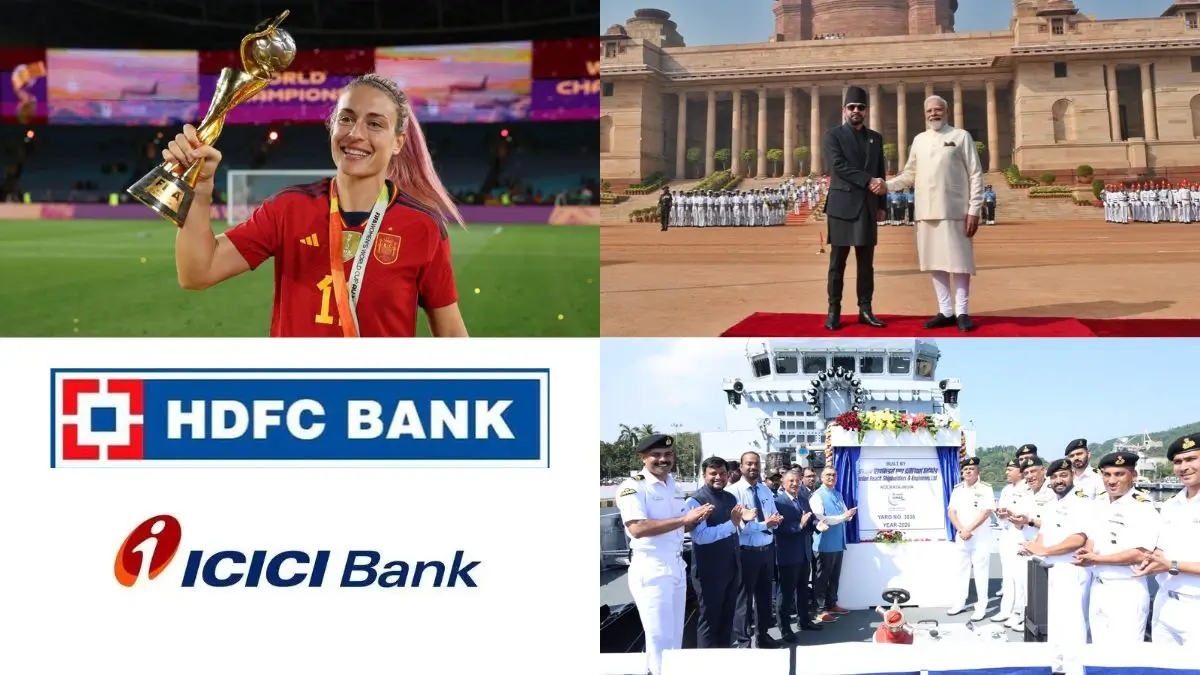
Daily Current Affairs: 25 November 2026
Q1. Yard 3036 ‘Ashank’, an Anti-Submarine Warfare Shallow Water Craft (ASW SWC) propelled by waterjets and delivered to the Indian Navy in November 2026 at Visakhapatnam, was indigenously designed and built by which shipyard?
(a) Cochin Shipyard Limited (CSL), Kochi
(b) Garden Reach Shipbuilders and Engineers (GRSE), Kolkata
(c) Mazagon Dock Shipbuilders Limited (MDL), Mumbai
(d) Goa Shipyard Limited (GSL), Vasco da Gama
(e) Hindustan Shipyard Limited (HSL), Visakhapatnam
Answer: b
Solution:
The Indian Navy received ‘Ashank’, one of the Anti-Submarine Warfare Shallow Water Craft (ASW SWC), on 23 November 2026 at Visakhapatnam.
- The vessel has been indigenously designed and built by Garden Reach Shipbuilders and Engineers (GRSE), Kolkata.
- The ASW Shallow Water Craft have been designed and constructed in accordance with the classification rules of the Indian Register of Shipping (IRS).
- Yard 3036, named ‘Ashank’, is equipped with state-of-the-art lightweight torpedoes, indigenous rocket launchers and advanced sonar systems.
- The vessel is designed to strengthen the Indian Navy’s underwater surveillance and anti-submarine warfare capabilities, particularly in coastal waters.
- These ships are among the largest Indian naval warships propelled by waterjets.
- The ship will further strengthen the Navy’s anti-submarine, coastal surveillance and mine-laying capabilities.
Q2. The Prime Ministers of India and Nepal jointly laid the foundation stone of SJVN’s Lower Arun Hydroelectric Project in Eastern Nepal (estimated cost: ₹5,792.36 crore) in November 2026. Under the Project Development Agreement, what percentage of the electricity generated by this project will be provided free of cost to the Government of Nepal?
(a) 12%
(b) 15%
(c) 18%
(d) 21%
(e) 25%
Answer: d
Solution:
In November 2026, the Prime Ministers of India and Nepal laid the foundation stone for SJVN’s Lower Arun Hydroelectric Project in Nepal. The project is estimated to cost ₹5,792.36 crore.
About the Lower Arun Hydroelectric Project:
- The project is described in the source as a 679 MW run-of-river hydropower project planned on the Arun River, a tributary of the Koshi River, in the Sankhuwasabha and Bhojpur districts of eastern Nepal.
- The project will be developed under the Build, Own, Operate and Transfer (BOOT) model.
- It is being developed by SJVN Lower Arun Power Development Company Pvt. Ltd. (SLPDC), a wholly owned subsidiary of SJVN, formerly known as Satluj Jal Vidyut Nigam.
- SJVN Limited is a Navratna Central Public Sector Enterprise under the Ministry of Power, Government of India.
- An important feature of the project is its integration with SJVN’s 900 MW Arun-3 Hydroelectric Project, which is located upstream on the same river.
- Both projects will operate under a tandem operation system, under which water discharged from the Arun-3 project will be used to generate electricity at Lower Arun.
- This arrangement is intended to optimise the utilisation of available water resources and generate additional renewable energy without constructing a separate storage reservoir.
- Under the Project Development Agreement, 21% of the electricity generated will be supplied free of cost to the Government of Nepal.
Key Facts about the Arun-3 Hydropower Project:
- The Arun-3 project is a 900 MW run-of-the-river hydropower project being developed on the Arun River in Nepal’s Sankhuwasabha District.
- The project includes the construction of a 70-metre-tall and 466-metre-long concrete gravity dam.
- Once completed, it will be Nepal’s biggest hydroelectric facility and is expected to produce 4,018.87 million units of electricity annually.
- The project is being developed by SJVN Arun-III Power Development Company (SAPDC), a wholly owned subsidiary of SJVN, under the BOOT model.
- SAPDC will operate the facility for 25 years, excluding the five-year construction period, before transferring ownership to Nepal.
- The project will provide surplus power to India, thereby strengthening economic linkages between the two countries.
- Electricity generated by the project will be exported from Dhalkebar in Nepal to Muzaffarpur in India.
Q3. In its 2026 list of Domestic Systemically Important Banks (D-SIBs), the Reserve Bank of India (RBI) retained State Bank of India (SBI), HDFC Bank, and ICICI Bank under the same bucketing structure. What is the additional Common Equity Tier 1 (CET1) capital requirement (as a percentage of Risk Weighted Assets) mandated for HDFC Bank under Bucket 2?
(a) 0.20%
(b) 0.40%
(c) 0.60%
(d) 0.80%
(e) 1.00%
Answer: b
Solution:
The Reserve Bank of India (RBI) has retained State Bank of India (SBI), HDFC Bank and ICICI Bank in its 2026 list of Domestic Systemically Important Banks (D-SIBs).
- All three banks have retained their respective positions under the same bucketing structure as in 2025.
- Under the RBI framework, these banks are required to maintain additional Common Equity Tier 1 (CET1) capital requirements based on their respective buckets.
Additional CET1 Capital Requirements:
| Bank | Bucket | Additional CET1 Requirement |
| State Bank of India (SBI) | 4 | 0.80% of RWA (Risk-Weighted Assets) |
| HDFC Bank | 2 | 0.40% of RWAs (Risk-Weighted Assets) |
| ICICI Bank | 1 | 0.20% of RWAs (Risk-Weighted Assets) |
About Domestic Systemically Important Banks (D-SIBs):
- D-SIBs are banks considered “Too Big to Fail” because of their size, cross-jurisdictional activities, complexity, lack of substitutability and interconnectedness.
- The disorderly failure of these banks could significantly disrupt the essential services they provide to the banking system and affect overall economic activity.
- The RBI issued the D-SIB framework in 2014. Under this framework, the RBI is required to disclose the names of designated D-SIBs and classify them into appropriate buckets according to their Systemic Importance Scores (SISs).
- Banks placed in higher buckets are required to maintain larger additional capital requirements.
- These additional requirements are intended to strengthen the financial stability of systemically important banks.
- The RBI designated SBI and ICICI Bank as D-SIBs in 2015 and 2016, respectively.
- In 2017, HDFC Bank was also classified as a D-SIB alongside SBI and ICICI Bank.
- The additional capital requirements are applicable over and above the Capital Conservation Buffer.
Q4. Ms. Pratibha Parkar (IFS: 2000), currently serving as the Ambassador of India to the Republic of Panama, has been concurrently accredited in November 2026 as the next Ambassador of India to which Central American country?
(a) Costa Rica
(b) Honduras
(c) El Salvador
(d) Nicaragua
(e) Guatemala
Answer: d
Solution:
In November 2026, Ms. Pratibha Parkar (IFS: 2000) was concurrently accredited as the next Ambassador of India to the Republic of Nicaragua.
- She is presently serving as the Ambassador of India to the Republic of Panama.
- She will hold the additional accreditation to Nicaragua while residing in Panama.
Nicaragua – Important Geographical Facts
Nicaragua is a country in Central America and is the largest of the Central American republics.
Geographical Boundaries:
- Nicaragua shares its northern border with Honduras.
- Costa Rica lies to the south of Nicaragua.
- The Pacific Ocean forms its western boundary.
- The Caribbean Sea lies along its eastern boundary.
Q5. According to S&P Global’s Economic Outlook Asia-Pacific Q1 2027 report released in November 2026, at what rate is India’s economy projected to grow in both FY 2026–27 (ending March 2027) and FY 2027–28 (ending March 2028)?
(a) 6.5%
(b) 6.8%
(c) 7.0%
(d) 7.2%
(e) 7.5%
Answer: c
Solution:
S&P Global has projected India to be one of the fastest-growing economies in the Asia-Pacific region in 2027.
- The agency expects India’s economy to grow by 7% in both the current fiscal year and the next fiscal year ending March 2028.
- According to its Economic Outlook Asia-Pacific Q1 2027 report, India’s growth during the June and September quarters was driven by robust goods exports, government-led investment spending and strong household consumption.
- Buoyant credit growth also supported economic activity during this period.
- S&P Global highlighted India’s increasing integration into global supply chains and stated that export performance had benefited from trade diversification and the country’s expanding role in global manufacturing.
- Electronics, engineering goods and chemicals were among the sectors that recorded particularly strong performance.
Inflation and Monetary Policy Projections:
- S&P Global expects inflation to average 5.3% in the current fiscal year ending March 2027, with risks tilted towards the upside.
- The agency expects inflation to ease to 4.7% in the fiscal year ending March 2028.
- Against this backdrop, S&P Global expects the RBI to raise policy rates by a further 25 basis points in December.
- It also indicated that the possibility of another rate hike in early 2027 had increased.
Q6. Who has been elected President of the landmark 100th Akhil Bharatiya Marathi Sahitya Sammelan, scheduled to be held from 27 to 30 January 2027 at Savitribai Phule Pune University?
(a) Dr. Sharan Kumar Limbale
(b) Vishwas Patil
(c) Bhalchandra Nemade
(d) Sadanand More
(e) Ravindra Shobhane
Answer: a
Solution:
Senior litterateur Dr Sharan Kumar Limbale has been elected President of the 100th Akhil Bharatiya Marathi Sahitya Sammelan.
- Maharashtra Sahitya Parishad President Yogesh Soman announced his selection at a press conference in Pune on 24 November 2026.
- The 100th edition of the literary conference will be held from 27 to 30 January 2027.
- The event will take place at Savitribai Phule Pune University in Pune, Maharashtra.
- His election as the conference president has been welcomed by the literary fraternity.
Q7. The two-day ASEAN–India Maritime Conclave (23–24 November 2026)—jointly organised by the India Foundation and the Ministry of External Affairs to advance Indo-Pacific security and a resilient blue economy—was held in which Indian port city?
(a) Kochi
(b) Chennai
(c) Visakhapatnam
(d) Mumbai
(e) Paradip
Answer: c
Solution
The ASEAN-India Maritime Conclave began in Visakhapatnam on 23 November 2026.
- The two-day conclave is being held on 23 and 24 November 2026.
- It focuses on Indo-Pacific security, maritime connectivity and the development of a resilient blue economy.
- Minister of State for External Affairs Pabitra Margherita highlighted the importance of maritime cooperation in advancing India’s Act East Policy and Indo-Pacific vision.
- Policymakers, diplomats and naval officials called for stronger regional cooperation to safeguard Indo-Pacific trade routes, address geopolitical challenges and promote a resilient blue economy.
- The conclave is being organised by the India Foundation in partnership with the Ministry of External Affairs.
- Andhra Pradesh Minister Nara Lokesh, Chief of the Naval Staff Admiral Krishna Swaminathan, former Naval Chief Admiral Dinesh Kumar Tripathi, India Foundation President Ram Madhav and representatives from ASEAN member countries participated in the event.
Q8. According to Moody’s Ratings’ 2027 Cross-Region Banking Outlook, what is the overall credit outlook assigned to the global banking sector for 2027?
(a) Positive
(b) Stable
(c) Negative
(d) Developing
(e) Cautious
Answer: b
Solution:
According to Moody’s Ratings, the global banking sector is expected to maintain a stable credit outlook in 2027.
- Strong capitalisation, ample liquidity and resilient profitability are expected to support the banking sector.
- However, geopolitical uncertainties, refinancing pressures and evolving regulatory frameworks may continue to pose challenges for lenders.
- In its 2027 cross-region banking outlook, Moody’s stated that banks were entering the year with stronger financial positions and improved capacity to withstand economic and market disruptions.
- Stable economic growth across major economies, moderating inflation and relatively resilient labour markets are expected to provide a supportive operating environment.
- The agency also observed that banks had successfully adapted to changing market conditions and navigated the rapid monetary tightening cycle.
Six Key Themes Influencing Banks’ Credit Profiles in 2027:
- Geopolitical risks are expected to remain an important factor influencing banks’ credit profiles.
- Regulatory changes may affect the operating environment and risk-taking capacity of financial institutions.
- The expansion of private credit markets and non-bank financial institutions may create both opportunities and risks for banks.
- Higher long-term government bond yields may affect securities valuations and increase funding costs.
- The delayed impact of elevated borrowing costs may increase refinancing pressures among households and businesses.
- Investments in artificial intelligence and technology are expected to become an increasingly important factor in determining banks’ competitiveness.
Q9. FIFA has confirmed the United States, Mexico, Costa Rica, and Jamaica as co-hosts of the 2031 FIFA Women’s World Cup (the first edition to feature 48 teams). Which four nations have been confirmed as the joint hosts of the 2035 FIFA Women’s World Cup?
(a) Spain, Portugal, Morocco, and France
(b) Brazil, Argentina, Chile, and Uruguay
(c) England, Northern Ireland, Scotland, and Wales
(d) Japan, South Korea, Australia, and New Zealand
(e) Germany, Netherlands, Belgium, and Denmark
Answer: c
Solution:
FIFA has announced the host countries for the 2031 and 2035 editions of the FIFA Women’s World Cup.
- The United States, Mexico, Costa Rica and Jamaica have been announced as the co-hosts of the 2031 FIFA Women’s World Cup.
- The 2031 edition will be the first tournament to feature 48 teams.
- England, Northern Ireland, Scotland and Wales have been confirmed as the hosts of the 2035 FIFA Women’s World Cup.
Q10. The 7th World Landslide Forum (WLF7)—being hosted in India and South Asia for the first time from 22 to 27 November 2026 at Amrita Vishwa Vidyapeetham in Faridabad—is being held under which official theme?
(a) “Living with Landslides: Global Resilience”
(b) “Landslide Science and Practice for Safe and Resilient Communities”
(c) “Reducing Landslide Risk in a Changing Climate”
(d) “Sustainable Mountain Development and Slope Stability”
(e) “Early Warning and Innovation for Landslide Mitigation”
Answer: b
Solution:
The 7th World Landslide Forum (WLF7) is being held from 22 to 27 November 2026 at Amrita Vishwa Vidyapeetham in Faridabad, India.
- This is the first edition of the World Landslide Forum to be hosted in India and South Asia.
- The theme of the forum is “Landslide Science and Practice for Safe and Resilient Communities.”
- The event is being hosted by Amrita Vishwa Vidyapeetham in collaboration with the International Consortium on Landslides (ICL) and the International Programme on Landslides (IPL).
- The inaugural session brought together international experts, scientists and policymakers from more than 75 countries.
- The forum provides a platform for scientists, engineers, practitioners and policymakers to share knowledge, advance landslide science and technology, and strengthen international cooperation in landslide disaster risk reduction.
- The World Landslide Forum has been organised every three years since its first edition in Tokyo, Japan, in 2008.






 Daily Current Affairs and GK Updates (24...
 Daily Current Affairs Quiz 24th November...
 Daily Current Affairs and GK Updates (23...