
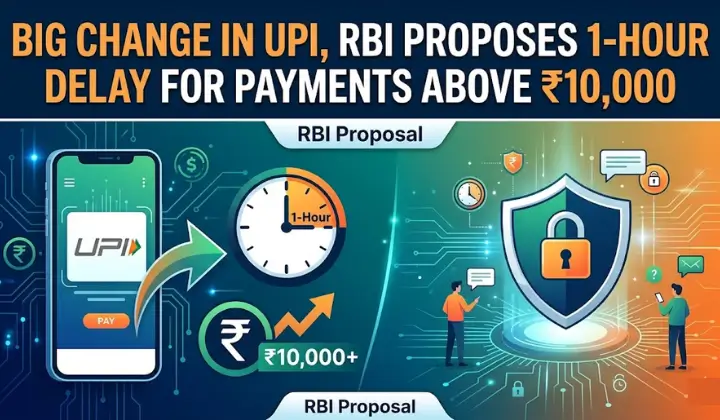
India’s digital payment ecosystem, powered largely by the Unified Payments Interface (UPI), has transformed the way people transfer money. From splitting bills to making business payments, everything happens in seconds. However, with the rapid rise in digital transactions, cases of online fraud have also increased.
RBI Proposes 1-Hour Delay for Payments Above ₹10,000
The proposed 1-hour delay for transactions above ₹10,000 reflects RBI’s proactive approach to making digital payments safer. While it may slightly impact the speed of transactions, the move is largely aimed at protecting users from rising fraud risks. If implemented carefully with proper flexibility, this change could strike the right balance between security and convenience in India’s fast-growing digital economy.
Why This Change is Being Considered
The primary reason behind this proposal is the increasing number of digital payment frauds, especially those where users are tricked into transferring money themselves. In many such cases, once the payment is made, it becomes almost impossible to recover the funds due to the instant nature of UPI.
RBI’s Proposal to Introduce a Cooling-Off Period for Safer Transactions
To address this, RBI is exploring the idea of introducing a cooling-off period for certain transactions. The goal is simple: give users a small window to rethink their action and prevent impulsive or manipulated transfers. To tackle this growing concern, the Reserve Bank of India (RBI) is considering a significant change that could impact how high-value transactions are processed.
What is the Proposed Rule?
Under the proposed framework:
- Transactions above ₹10,000 may not be processed instantly
- A delay of up to 1 hour could be introduced before the money is credited
- During this period, users may get an option to review or cancel the transaction
- The rule may apply to UPI, IMPS, and other digital fund transfer systems
- This means that while smaller transactions will continue to remain instant, higher-value payments may require a short waiting period.
Exceptions and Flexibility
The proposal is not intended to disrupt all types of payments. RBI is expected to introduce certain relaxations, such as:
- Merchant payments (like shopping or bill payments) may remain unaffected
- Users may be able to add trusted beneficiaries to avoid delays
- Regular or frequent transactions to known accounts may not face restrictions
- These adjustments aim to balance user convenience with security.
Additional Safety Measures Under Discussion
Apart from the delay mechanism, RBI is also exploring other ways to strengthen digital payment safety:
- Extra verification for high-value transactions, especially for vulnerable users
- A facility to temporarily block transactions in case of suspected fraud
- Better monitoring of suspicious accounts and unusual transaction patterns
Such measures could significantly reduce the chances of financial loss due to scams.
Impact on Users
Positive Side
- Provides a safety buffer against fraud
- Helps users avoid making decisions under pressure
- Strengthens trust in digital payment systems
Challenges
- May reduce the instant nature of UPI for large payments
- Could create inconvenience during urgent transactions
- Businesses dealing with high-value transfers might need to adjust workflows



 SBI PO Previous Year Question Papers Wit...
 IBPS Calendar 2026-27 Out @ibps.in for P...
 Indian Bank SO Recruitment 2026 Notifica...