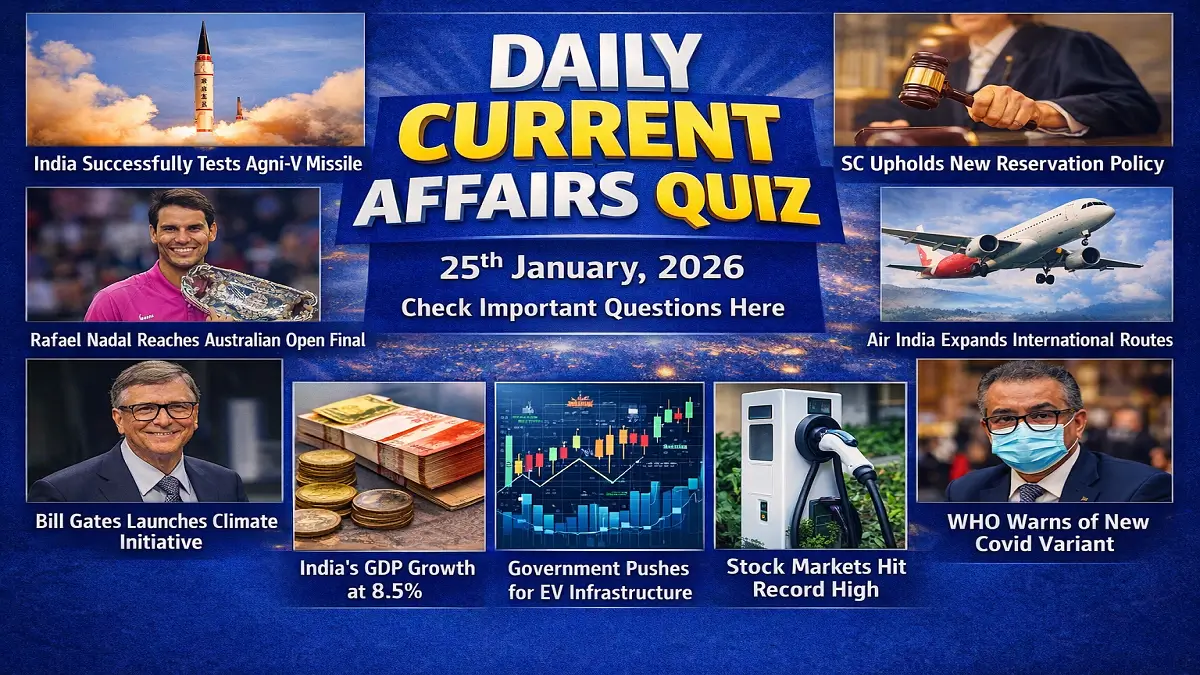
Practice today’s Daily Current Affairs Quiz to stay updated with national, international, economic, and banking news. Boost your exam readiness, improve speed and accuracy, strengthen memory, and gain confidence for competitive exams and interviews.
Q1. The objective of the Memorandum of Understanding (MoU) signed between the Indian Army and the Indian Institute of Science (IISc), Bengaluru, on 23 January 2026 aligns with India’s strategic push towards technological self-reliance. What is the primary focus of this agreement?
(a) Development of satellite-based navigation systems
(b) Creation of a fully indigenous AI-based system
(c) Establishment of a national cyber training academy
(d) Procurement of foreign defence technologies
(e) Expansion of military communication networks
Answer: b
Solution:
- On 23 January 2026, the Indian Army signed a Memorandum of Understanding (MoU) with the Indian Institute of Science (IISc), Bengaluru.
- The agreement aims to develop a fully indigenous Artificial Intelligence (AI)-based system through collaborative research and innovation.
- The initiative focuses on addressing emerging challenges in the digital information landscape, particularly in areas related to data security, information integrity, and advanced analytics.
- The collaboration reflects India’s broader push towards self-reliance in critical and strategic technologies under the Atmanirbhar Bharat vision.
- The project is expected to strengthen the technological capabilities of the Indian Army while promoting stronger industry–academia–defence partnerships.
Q2. PepsiCo India’s leadership transition in its finance function reflects a strategic move to strengthen regional financial governance across South Asia. Who has been appointed as the new Chief Financial Officer for India and South Asia?
(a) Kaushik Mitra
(b) Savitha Balachandran
(c) Indra Nooyi
(d) Ramesh Chauhan
(e) Nitin Paranjpe
Answer: b
Solution:
- PepsiCo India has appointed Savitha Balachandran as the Chief Financial Officer (CFO) for India and South Asia.
- She will succeed Kaushik Mitra, who is set to retire on 15 April 2026.
- Kaushik Mitra concludes a 24-year tenure with PepsiCo at the time of his retirement.
- The leadership transition aims to ensure financial continuity and strategic oversight across PepsiCo’s operations in India and the South Asia region.
Q3. The Indira Gandhi Prize for Peace, Disarmament and Development for 2025 was announced in January 2026 to honour a prominent humanitarian for her contributions to international peace and social development. Who was selected for this award?
(a) Ellen Johnson Sirleaf
(b) Malala Yousafzai
(c) Michelle Bachelet
(d) Wangari Maathai
(e) Graca Machel
Answer: e
Solution:
- Mozambican rights activist and humanitarian Graca Machel has been selected for the Indira Gandhi Prize for Peace, Disarmament and Development 2025, as announced by the Indira Gandhi Memorial Trust on 21 January 2026.
- The selection was made by an international jury chaired by former National Security Advisor Shivshankar Menon.
- The Indira Gandhi Peace Prize was instituted in 1986 in memory of former Prime Minister Indira Gandhi by a trust established in her name.
- The award is officially known as the Indira Gandhi Prize for Peace, Disarmament and Development.
- It carries a monetary award of ₹25 lakh, along with a formal citation.
- The prize is awarded annually by the Indira Gandhi Memorial Trust to an individual or organisation, without distinction of nationality, race, or religion.
- The award recognises creative and sustained efforts in the following areas:
- Promoting international peace, disarmament, racial equality, and harmony among nations
- Securing economic cooperation and encouraging a new international economic order
- Advancing the overall development of developing nations
- Ensuring that scientific and modern knowledge is used for the greater good of humanity
- Expanding the scope of freedom and enriching the human spirit
Q4. The World Economic Forum’s decision to establish five new Centres for the Fourth Industrial Revolution in January 2026 aims to strengthen global governance of emerging technologies. Which of the following Indian states hosts one of these newly announced centres?
(a) Maharashtra
(b) Uttar Pradesh
(c) Andhra Pradesh
(d) Gujarat
(e) Karnataka
Answer: c
Solution:
- The World Economic Forum (WEF) announced the signing of agreements to establish five new Centres for the Fourth Industrial Revolution (C4IR), expanding its global network focused on the responsible adoption of frontier and emerging technologies.
- The new centres will concentrate on Artificial Intelligence (AI), frontier technologies, energy transition, and cyber resilience, which are key strategic priorities for governments and industries worldwide.
- The centres will be located in France, the United Kingdom, the United Arab Emirates, and India, addressing regional needs while promoting international dialogue and cooperation.
- In Paris, France, the European Centre for AI Excellence has been launched in partnership with VivaTech to accelerate trustworthy and responsible AI innovation, strengthen Europe’s competitiveness, and support AI deployment across multiple sectors.
- In London, United Kingdom, the Centre for AI-Driven Innovation, hosted by Imperial College London, will focus on AI adoption across key sectors and explore its convergence with quantum technology, biotechnology, and generative AI for scalable cross-sector impact.
- In Abu Dhabi, United Arab Emirates, the Centre for Frontier Technologies, hosted by the Technology Innovation Institute, will advance innovation in quantum technologies, robotics, and space, while promoting public-private collaboration for responsible deployment.
- Also in Abu Dhabi, the Centre for Intelligent Future, hosted by Mohamed bin Zayed University of Artificial Intelligence (MBZUAI), will strengthen global AI research, infrastructure, and adoption, and lead cross-sector initiatives involving government, business, civil society, and academia.
- In Andhra Pradesh, India, the Centre for Energy and Cyber Resilience, established in partnership with the Government of Andhra Pradesh, will promote innovation in the energy transition, strengthen cybersecurity across industries, and develop scalable solutions in green energy systems, cybersecurity strategies, and workforce development.
- Together, these new centres will enhance global collaboration under the Fourth Industrial Revolution Network, ensuring that emerging technologies are developed and deployed in a responsible, secure, and inclusive manner.
- The Fourth Industrial Revolution Network, launched by the World Economic Forum in 2017, serves as a global platform for multistakeholder collaboration, bringing together public and private sectors to ensure that new technologies benefit society while minimizing risks.
- The network currently includes centres across Europe, the Middle East, Asia, Africa, and the Americas, including countries such as France, the United Kingdom, Germany, India, South Africa, the United States, the United Arab Emirates, Saudi Arabia, Korea, and others, covering a wide range of thematic and national innovation hubs.
Q5. The RBI’s report on State finances highlights a rise in consolidated fiscal deficit beyond the traditional benchmark. According to the report “State Finances: A Study of Budgets of 2025–26”, what was the States’ consolidated gross fiscal deficit as a percentage of GDP in 2024–25?
(a) 2.7%
(b) 3.0%
(c) 3.5%
(d) 3.3%
(e) 4.0%
Answer: d
Solution:
- According to the RBI report “State Finances: A Study of Budgets of 2025–26”, the states’ consolidated gross fiscal deficit rose to 3% of GDP in 2024–25, after remaining below 3% during the previous three financial years.
- For 2025–26, states have again budgeted a gross fiscal deficit of 3.3% of GDP, while aiming to improve the quality of spending by restraining revenue expenditure.
- The RBI noted that the deficit exceeding 3% is mainly due to 50-year interest-free loans from the Centre, provided under special assistance to states for capital investment, which are over and above the normal net borrowing limits.
- The focus on capital expenditure (capex) has continued, with capex remaining steady at 7% of GDP in 2023–24 and 2024–25, and it is budgeted to rise to 3.2% of GDP in 2025–26.
- Consolidated outstanding liabilities of states declined to 1% of GDP by the end of March 2024, down from a peak of 31% in March 2021.
- The RBI attributed this improvement to fiscal consolidation efforts and favourable debt dynamics.
- However, outstanding liabilities are budgeted to increase to 29.2% of GDP by the end of March 2026.
- Despite relatively high debt levels, the RBI stated that indicators of debt sustainability remain favourable.


 Daily Current Affairs Quiz 31st March 20...
 Daily Current Affairs and GK Updates (30...
 Daily Current Affairs Quiz 30th March 20...