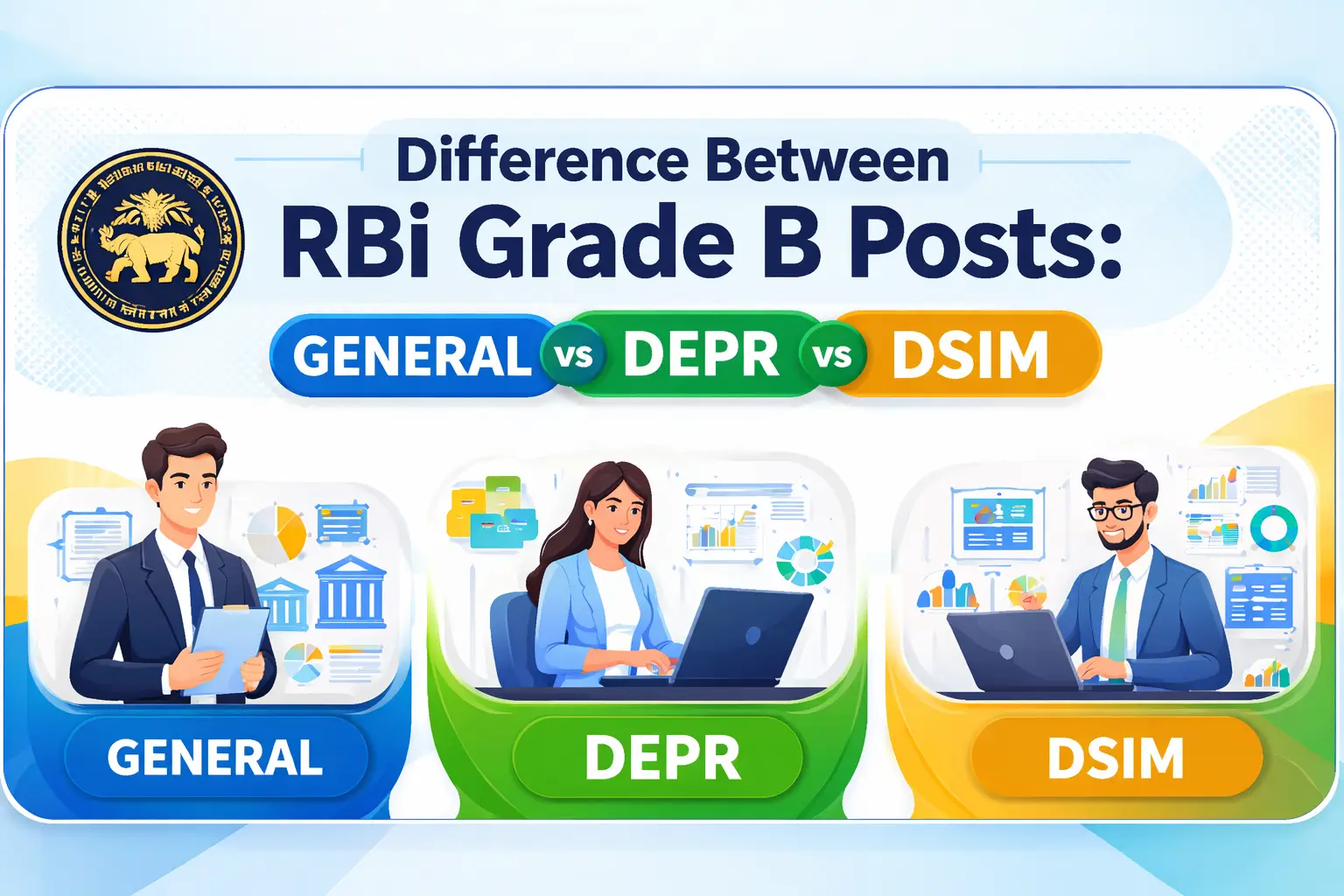
With the RBI Grade B 2026 notification expected to be released soon, this is the right time for aspirants to gain clarity about the different posts before starting their final phase of preparation. The Reserve Bank of India offers multiple streams under Grade B, and choosing the right one General, DEPR, or DSIM can significantly impact your preparation strategy and career path.
Difference Between RBI Grade B Posts
The Reserve Bank of India offers three distinct streams under RBI Grade B General, DEPR, and DSIM. Each post has a different role, eligibility, and career path, so understanding the differences is crucial before choosing your target.
Instead of waiting for the notification, candidates should understand the requirements, roles, and expectations of each post in advance to make a well-informed decision.
- General
- DEPR – (Department of Economic & Policy Research
- DSIM – (Department of Statistics & Information Management)
RBI Grade B (General)
This is the most popular stream among aspirants. Officers handle core central banking functions like monetary policy implementation, banking regulation, financial stability, and currency management.
- Background: Open to graduates from any discipline
- Focus Areas: Finance, Economy, Management, Current Affairs
- Nature of Work: Administrative + policy-related
- Best For: Aspirants with a generalist approach and strong overall aptitude
- Work Profile: Policy implementation, regulatory roles, administrative tasks
- Skills Required: Analytical ability, decision-making, awareness of economy
- Career Scope: Diverse roles across RBI departments
RBI Grade B (DEPR) – Department of Economic & Policy Research
This stream is designed for candidates with a strong academic background in economics. Officers are involved in research, policy formulation, and economic analysis.
- Background: Postgraduate in Economics / Econometrics
- Focus Areas: Macroeconomics, Microeconomics, Statistics
- Nature of Work: Research-oriented
- Best For: Candidates interested in economic policy and research roles
- Work Profile: Economic research, report writing, policy analysis
- Skills Required: Strong conceptual clarity in economics, research aptitude
- Career Scope: Opportunity to contribute to national economic policies
RBI Grade B (DSIM) – Department of Statistics & Information Management
This post is for candidates with expertise in statistics, mathematics, or data science. Officers work on data analysis, statistical modeling, and policy support through data insights.
- Background: Postgraduate in Statistics / Mathematics / Data Science
- Focus Areas: Statistics, Data Analysis, Programming
- Nature of Work: Technical + data-driven
- Best For: Candidates with strong quantitative and analytical skills
- Work Profile: Data analysis, statistical modeling, database management
- Skills Required: Strong quantitative skills, technical expertise
- Career Scope: Growing importance with increasing focus on data-driven policy making
Key Difference Between RBI Grade B General vs DEPR vs DSIM
Before choosing a stream, it’s important to quickly understand how the General, DEPR, and DSIM posts differ from each other in terms of eligibility, work profile, and exam focus under the Reserve Bank of India.
| Aspect | General | DEPR | DSIM |
| Eligibility | Graduation | PG in Economics | PG in Stats/Math |
| Nature of Work | Administrative | Research | Data & Analytics |
| Exam Focus | Aptitude + ESI + FM | Economics (Descriptive) | Statistics + Technical |
| Competition | Very High | Moderate | Lower |
Which One Should You Choose?
Your choice should depend on your academic background and long-term career goals. If you come from a general background and want a versatile role, the General stream is the right fit. If you have specialized knowledge in economics or statistics, DEPR and DSIM offer more focused and intellectually rewarding career paths.
Preparation Strategy for RBI Grade B Each Stream
Preparation should be tailored according to the stream you choose:
- General: Focus on current affairs, ESI, FM, and aptitude sections. Regular mock tests and revision are crucial.
- DEPR: Build strong conceptual clarity in economics and practice answer writing for descriptive papers.
- DSIM: Strengthen statistics concepts and practice numerical and data-based questions extensively.






![Symbiosis Entrance Test [SET] Test Series 2026 | Test Series by Careers Adda](https://storeimages.adda247.com/image1sybiosis1764929799.png)
![Symbiosis Entrance Test [SET] Test Series 2027 | Test Series by Adda247](https://storeimages.adda247.com/image111759237214.png)
 South Indian Bank Junior Officer Recruit...
 CWC Recruitment 2026 Notification Out fo...
 Daily Current Affairs and GK Updates (16...