
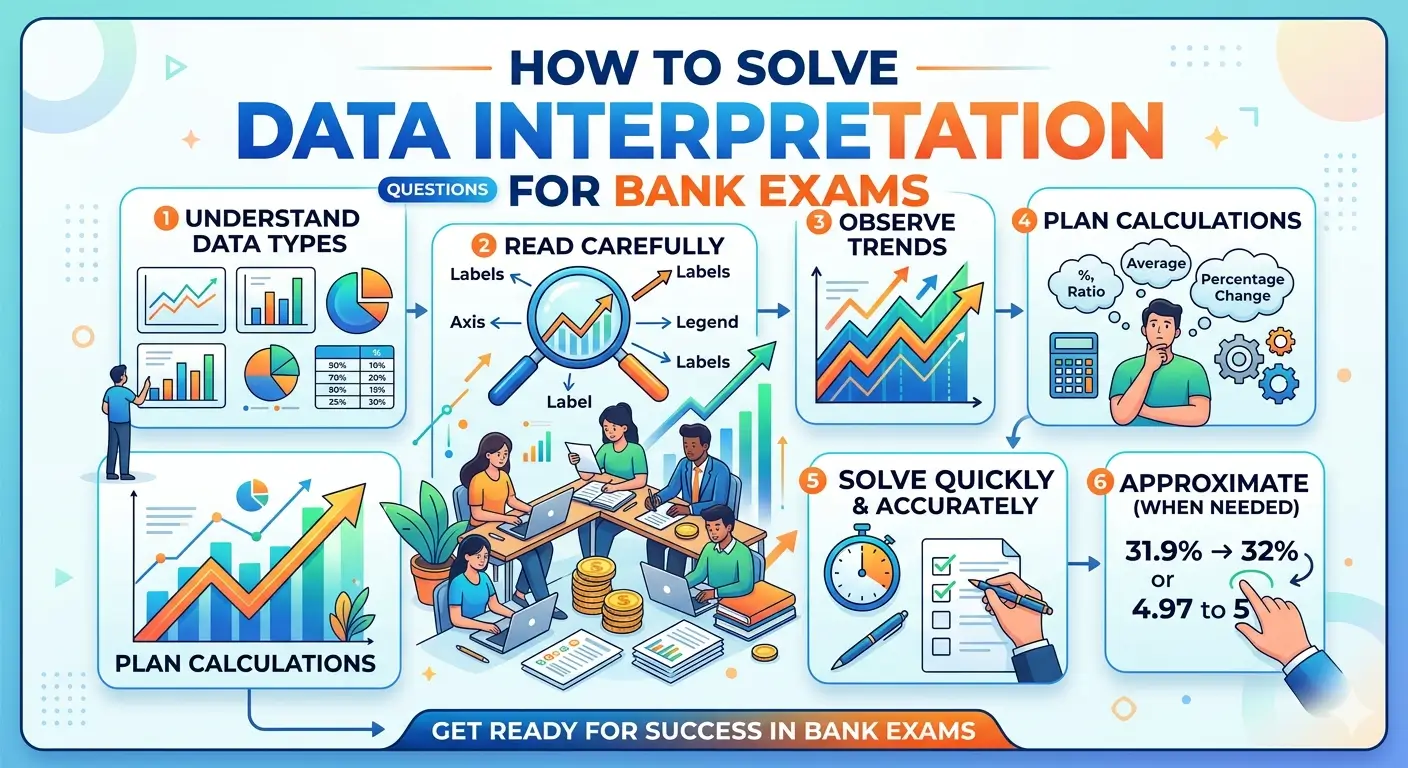
Data Interpretation (DI) is one of the most scoring yet challenging sections in banking exams like IBPS, SBI, RBI, and RRB Exams. These questions test your ability to analyze numerical data presented in tables, charts, and graphs. With the right approach, you can maximize accuracy and minimize time spent.
How to Solve Data Interpretation Questions for Bank Exams
Mastering DI is improves your speed and enhances your confidence in handling complex data sets under time pressure. Below we present the theme of this article, which will guide you through effective techniques, smart shortcuts, and practical tips to solve DI questions quickly and accurately in bank exams.
1. Understand the Types of DI Questions
Bank exams often include several types of DI questions:
- Tabular DI – Data presented in tables.
- Bar Graph / Column Chart DI – Data shown as bars of varying heights.
- Line Graph DI – Data trends over time.
- Pie Chart DI – Data represented as percentages of a whole.
- Mixed DI – Combines two or more chart types.
Understanding the type helps you decide the fastest approach to solve it.
2. Read the Question Carefully
Before looking at the data:
- Check what is asked – Are you calculating percentages, ratios, or differences?
- Identify traps – Some questions may have unnecessary data meant to confuse.
- Always read the questions first; it reduces the chance of performing extra calculations.
3. Organize Your Approach
Bank exams are time-bound, so a structured approach is key:
- Scan the data quickly – Identify totals, maximum, minimum, or trends.
- Highlight key information – Mark numbers that appear in the question to save time.
- Break down complex questions – If a question requires multiple steps, solve step by step.
4. Use Shortcuts and Formulas
DI questions often involve repetitive calculations. Some shortcuts help save time:
- Percentage Calculation: (Part/Total)×100
- Profit & Loss / Cost Related DI: Use ratios instead of actual numbers.
- Difference or Growth: Use direct subtraction instead of fractions for absolute values.
- Ratio Simplification: Reduce fractions before solving to save time.
5. Practice Approximation
- Exact calculations are time-consuming. Bank exams allow some flexibility:
- Round off numbers for easier multiplication or division.
- Use estimation to eliminate wrong options quickly in multiple-choice questions.
6. Time Management
- Spend max 2 minutes per DI set in preliminary exams.
- If a set is too lengthy, skip and return later.
- Focus on sets with easy numbers first to maximize score.
7. Regular Practice
- Solve previous year DI questions for your target exam.
- Use mock tests to practice speed and accuracy.
- Analyze mistakes to identify weak areas – e.g., pie charts or mixed graphs.
8. Stay Calm and Avoid Panic
- DI questions can seem intimidating, but confidence is key.
- Avoid guessing blindly – use elimination techniques when unsure.
- Practice mental calculations to reduce dependency on rough paper.

Data Interpretation Questions for Bank Exams
Directions (1–5): The line graph given below shows total number five (A, B, C, D and E) different items sold by a shop. Read the data carefully and answer the following questions.
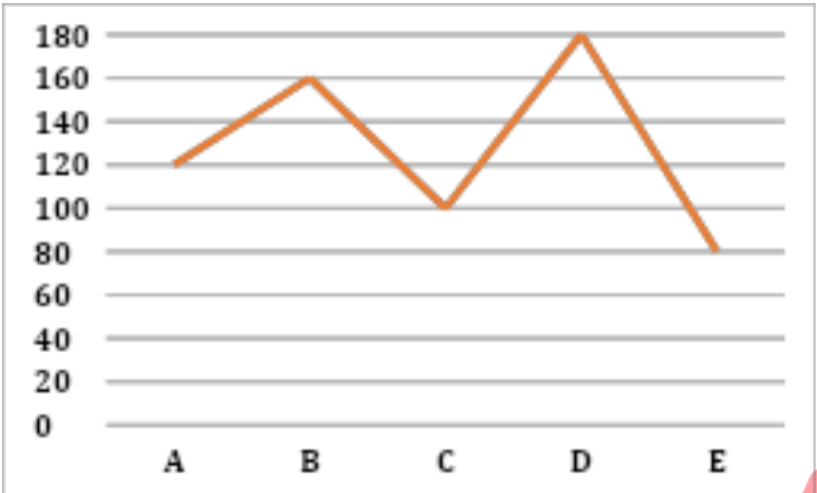
Q1. The ratio of items C and E sold by online to that of offline mode is 3 : 2 & 5 : 3 respectively. Find the difference between total item C and E sold by online mode.
(a) 6
(b) 10
(c) 8
(d) 12
(e) 5
Q2. Find the ratio of total number of item A to total number of item D sold by the shop.
(a) 3 : 5
(b) 2 : 5
(c) 1 : 3
(d) 1 : 2
(e) 2 : 3
Q3. If total item X sold by the shop is 50% more than total item B sold by the shop and total item X sold by online mode is 60% of total item X sold by the shop, then find total item X sold by offline mode.
(a) 96
(b) 72
(c) 76
(d) 106
(e) 90
Q4. Total number of item A and E sold by shop is what percent more than total number of items B sold by the shop.
(a) 20%
(b) 25%
(c) 24%
(d) 30%
(e) 40%
Q5. Find the difference between total item C & D sold by the shop and total item B & E sold by the shop.
(a) 40
(b) 50
(c) 30
(d) 20
(e) 10
Directions (6-10): Table given below shows total number of three different (Chocolate, Vanilla and Fruits) cakes sold by a bakery on three different days. Read the data carefully and answer the questions.
| Cakes | Sunday | Monday | Tuesday |
| Chocolate | 136 | 224 | 192 |
| Vanilla | 168 | 128 | 160 |
| Fruits | 144 | 176 | 236 |
Q6. Total number of chocolate cakes sold on Sunday and Tuesday together is what percentage more than total number of fruit cakes sold on Sunday and Monday together.
(a) 5/2%
(b) 2%
(c) 3/2%
(d) 7/2%
(e) 3%
Q7. Find the average number of all three types of cakes sold by shop on Tuesday.
(a) 188
(b) 198
(c) 192
(d) 186
(e) 196
Q8. Find the ratio of total number of fruit cakes sold on Sunday to total number of vanilla cakes sold on Sunday.
(a) 4 : 3
(b) 6 : 5
(c) 6 : 7
(d) 9 : 4
(e) 7 : 6
Q9. Total number of fruit cakes sold on Tuesday is how much more than total number chocolate cakes sold on Sunday.
(a) 90
(b) 80
(c) 100
(d) 120
(e) 60
Q10. Find the total number of chocolate cakes sold on all the given three days.
(a) 552
(b) 554
(c) 564
(d) 562
(e) 572


 World Homeopathy Day 2026, Theme, Histor...
 Bellary DCC Bank Recruitment 2026 Notifi...
 JAIIB 2026 Preparation Tips, Check Prove...