
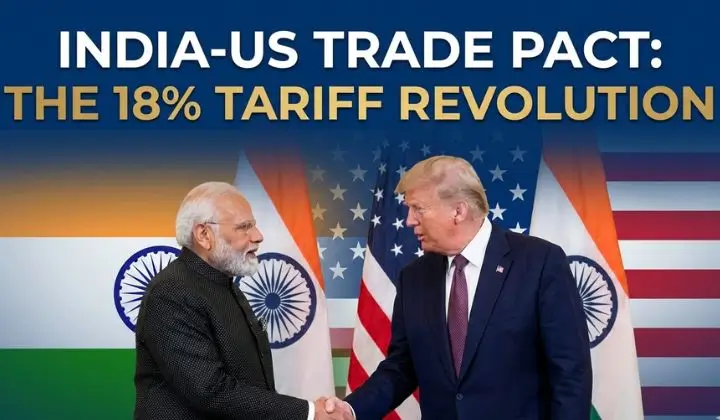
India and the United States unveiled a major trade agreement to strengthen economic ties and ease ongoing trade tensions. The breakthrough, confirmed on February 2, 2026, followed discussions between Donald Trump and Narendra Modi, bringing notable changes in tariff structures, market access, and energy trade cooperation.
India & US Finalize Major Trade Agreement with 18% Tariff Reduction
Under the agreement, the United States will reduce its reciprocal tariffs on Indian goods from 25% to 18%. This reduction aims to boost Indian exports to the U.S. and improve long-term trade relations between the two countries. In addition to the tariff cut, the U.S. has agreed to withdraw an extra 25% punitive tariff that was imposed on Indian imports tied to previous disagreements over energy purchases.
Mutual Market Access and Trade Barriers
As part of the deal India has agreed to reduce its tariffs and non-tariff barriers on American goods to zero, opening its markets wider for U.S. products. Both sides have expressed intentions to continue enhancing market access and remove remaining obstacles to bilateral trade. This represents a major shift from past trade disputes and is expected to lead to increased commercial cooperation across sectors.
Energy and Strategic Trade Commitments
President Trump stated that India agreed to stop buying Russian crude oil and to increase energy purchases from the United States and potentially Venezuela. This pivot in energy sourcing was highlighted as part of broader diplomatic and trade negotiations. While these energy commitments were emphasized in U.S. announcements, full details on implementation and timelines are still awaited.
Impact on India-U.S. Commercial Relations
Leaders from both countries described the agreement as a major step forward:
- Prime Minister Modi welcomed the tariff reduction as a boost for “Made in India” products and Indian exporters, calling his conversation with President Trump “wonderful.”
- U.S. officials have touted expanded opportunities for American farmers, manufacturers, and technology companies in the Indian market.
- The deal is expected to strengthen cooperation in sectors including energy, technology, agriculture, defence, and infrastructure going forward.
Economic and Strategic Significance
Trade analysts say the agreement could have long-term benefits its also fits into India’s broader strategy of forming multiple major trade relationships including its recent free-trade agreement with the European Union to expand global market access.
-
- Improving investor confidence and boosting stock market performance in India.
- Increasing competitiveness of Indian exports in global markets.
- Accelerating technology transfer and bilateral economic integration.
Positive and Competitive Outcome on the Agreement
India and the United States finalising the trade agreement with 18% tariff reduction delivers robust positive and competitive outcomes, enhancing market access while countering rivals like China. This slashes costs for Indian exports such as textiles and gems, potentially lifting volumes by 15-20% and bilateral GDP by 0.5-1% annually through reciprocal commitments exceeding $500 billion in U.S. energy and tech purchases.
India and US Finalise Trade Agreement: Seafood Exports Get a Major Boost
India and United States finalise trade agreement with 18% tariff reduction supercharges seafood exports to the U.S., valued at $2B+ yearly (mainly shrimp), by cutting duties and enabling 25% shipment growth, raising its trade share to 4% by 2027 amid Budget 2026 MSME support.
Marco Rubio Advances Trade, Energy Talks
India and United States finalise trade agreement with 18% tariff reduction prompts EAM S. Jaishankar’s upcoming meeting with Secretary Marco Rubio to finalize oil transition details and barrier removals, deepening defense-tech synergies post-Trump-Modi pact. Overall, the India and United States Finalise Trade Agreement is not just a tariff adjustment it is a long-term economic partnership designed to drive growth, job creation, and strategic stability in the Indo-Pacific region.

Brooke Rollins Backs Farm Export Boost
US Secretary of Agriculture Brooke Rollins praised the India-US trade deal, stating it will export more American farm products to India’s massive market, lifting prices and pumping cash into rural America. She highlighted the 2024 U.S. agricultural trade deficit with India at $1.3 billion, noting the agreement lowering tariffs to 18% will significantly reduce this gap by opening doors for U.S. goods amid India’s population growth. Rollins thanked President Trump for delivering this “America First victory” for farmers.


 All India Mock Test For JAIIB 2026, Chec...
 NABARD Development Assistant Mains Admit...
 IIFCL Recruitment 2026 Notification Out ...