
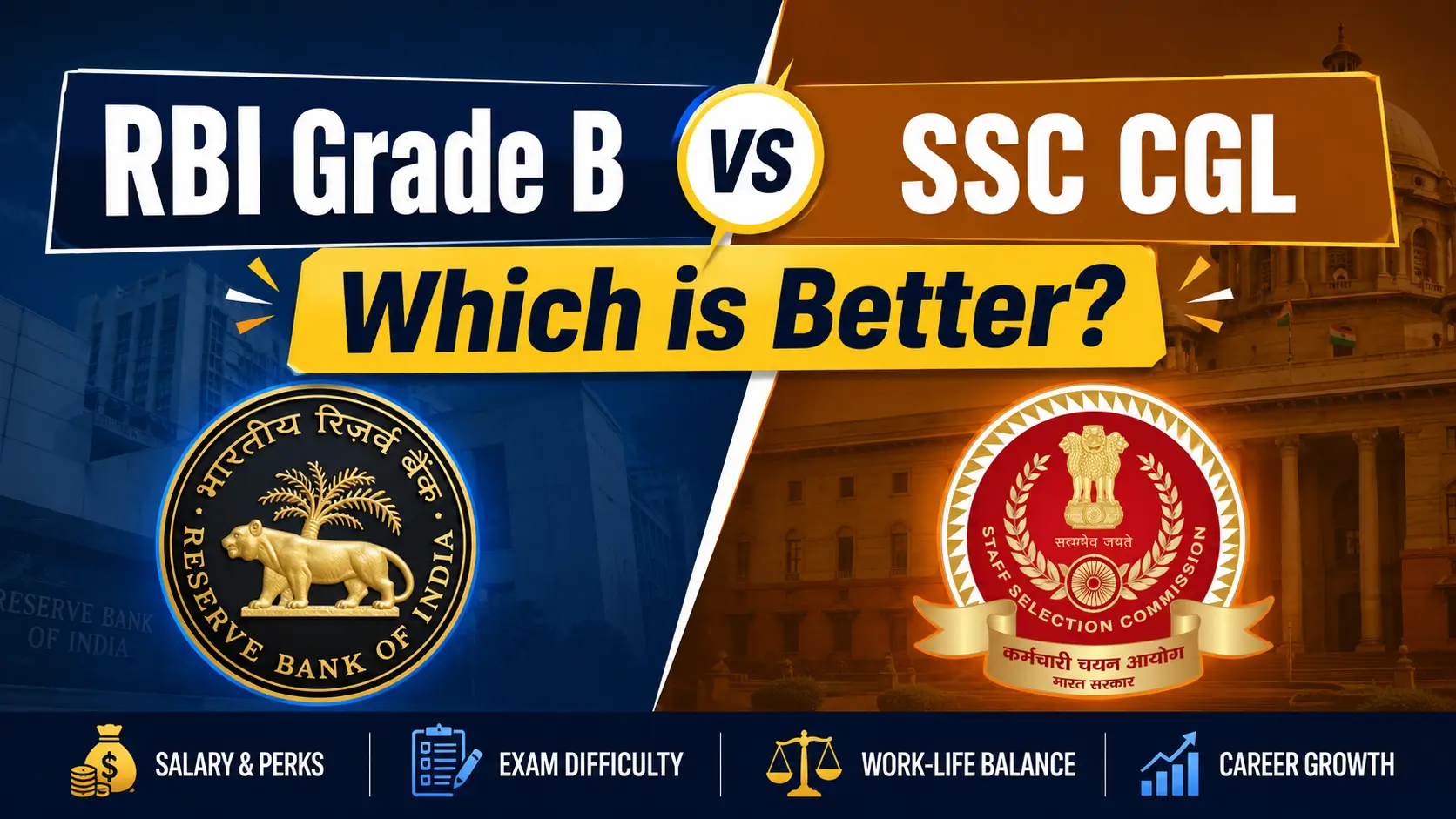
Choosing between RBI Grade B and SSC CGL is one of the most common dilemmas among government job aspirants in India. Both are prestigious exams, but they differ significantly in job profile, salary, growth, difficulty level, and lifestyle. The better option ultimately depends on your career goals and working preferences.
RBI Grade B vs SSC CGL Comparison
RBI Grade B and SSC CGL are two of the most sought-after government exams in India, attracting millions of candidates every year. While both lead to lucrative and well-paid public sector jobs, they offer very different career paths. One is associated with central banking and economic policymaking, while the other opens doors to a variety of administrative roles in central government departments.
| Parameter | RBI Grade B | SSC CGL |
| Exam Name | RBI Grade B Exam | SSC CGL Exam |
| Conducting Body | Reserve Bank of India | Staff Selection Commission |
| Job Type | Officer in central banking & regulatory authority | Group B & C posts in central government departments |
| Job Profile | Policy-making, monetary policy, financial regulation, research | Administrative, clerical, audit, enforcement, taxation roles |
| Salary (Starting) | Higher (approx. ₹1 lakh+ in-hand with allowances) | Varies (approx. ₹40,000–₹90,000 depending on post) |
| Work Nature | Analytical, research-oriented, desk job | Mixed (desk + field depending on post) |
| Work-Life Balance | Generally very good | Depends on post; varies widely |
| Career Growth | Structured and fast progression in RBI hierarchy | Slower but steady; depends on department |
| Competition Level | Highly analytical & selective | Very high number of applicants |
| Difficulty Level | Tough (finance + economics + interview focus) | Moderate to tough (wide syllabus, tiered exams) |
| Posting | Usually in RBI offices (metro cities) | Across India, depends on allocation |
| Prestige Factor | Very high (top banking regulatory job) | High (central government job) |
Job Profile of RBI Grade B and SSC CGL
While RBI Grade B is more specialized and finance-oriented, SSC CGL offers a wide range of administrative roles across various government departments.
RBI Grade B
RBI Grade B officers work with the Reserve Bank of India, India’s central bank. The role is highly analytical and policy-oriented.
Key responsibilities include:
- Monetary policy analysis
- Banking regulation and supervision
- Economic research
- Financial stability monitoring
- This job is more economics, finance, and policy-driven.
SSC CGL
SSC CGL offers posts in multiple ministries and departments like Income Tax, Excise, Customs, Audit, etc.
Key roles include:
- Administrative work
- Field inspections (for some posts like Income Tax Inspector)
- Clerical and desk jobs (depending on post)
- Government departmental coordination
- This job is more administrative and operational with varied profiles.
Salary and Perks of RBI Grade B and SSC CGL
When it comes to salary and perks, both RBI Grade B and SSC CGL offer attractive government pay packages along with several allowances and benefits. However, there is a clear difference in the pay scale, growth speed, and overall financial advantages of both posts, which makes comparison important for aspirants.
RBI Grade B
- Starting in-hand salary: ₹80,000 – ₹1,00,000 per month (approx.)
- Perks: House allowance, medical benefits, official accommodation in some cases
- Faster promotions and high financial growth
- One of the highest-paying government jobs in India at entry level.
SSC CGL
- Starting in-hand salary: ₹40,000 – ₹70,000 per month (depending on post and city)
- Perks: HRA, TA, DA, government accommodation (for some posts)
- Salary varies significantly based on post (Income Tax Inspector > Assistant Section Officer, etc.)
- Good salary, but generally lower than RBI Grade B at entry level.
Exam Difficulty Level of RBI Grade B and SSC CGL
When comparing exam difficulty, it is important to note that both RBI Grade B and SSC CGL are competitive exams, but they differ greatly in syllabus depth and analytical requirements. While RBI Grade B demands advanced conceptual understanding and analytical thinking, SSC CGL focuses more on speed-based aptitude and general problem-solving skills.
RBI Grade B
- Very high difficulty
- Requires strong understanding of:
- Economics
- Finance
- Current affairs (deep analysis)
- Limited vacancies → high competition
- One of the toughest banking exams in India.
SSC CGL
- Moderate to high difficulty
- Focus areas:
- Quantitative aptitude
- Reasoning
- English
- General awareness
- More repetitive syllabus and practice-based
- Comparatively more approachable than RBI Grade B, but still highly competitive.
Work-Life Balance Career Growth RBI Grade B and SSC CGL
Before comparing RBI Grade B and SSC CGL in terms of work-life balance and career growth, it is important to understand that both roles offer stable government careers but differ significantly in working conditions, promotion speed, and long-term professional development depending on the nature of the post.
RBI Grade B
- Structured working hours (mostly office-based)
- High intellectual workload but stable environment
- Posting usually in RBI offices or regional branches
- Better work-life balance with premium work environment.
- Faster promotions within RBI hierarchy
- Exposure to global financial systems and policy-making
- Strong reputation in financial sector
- Excellent long-term career prestige and growth.
SSC CGL
- Depends on post
- Desk jobs: good balance
- Field jobs (like Income Tax Inspector): more hectic, targets and raids
- Promotion depends on department and seniority
- Growth is steady but slower compared to RBI Grade B
- Opportunities for departmental exams and cadre shifts
- Stable but moderate career progression.
RBI Grade B vs SSC CGL, Which is Better?
Before making a final choice between RBI Grade B and SSC CGL, it is important to understand that both exams open the door to respected government careers, but they differ in terms of job nature, preparation level, salary structure, and long-term growth opportunities.
Choose RBI Grade B if you:
- Prefer finance, economics, and policy work
- Want higher salary and elite job profile
- Can handle a tougher exam with fewer vacancies
- Aim for long-term corporate-like growth in a government setup
Choose SSC CGL if you:
- Want a broader range of job options
- Prefer moderate difficulty exam preparation
- Want stable government job with decent salary
- Are okay with varied job roles across departments








 CCI Result 2026 Out, Download PDF
 RBI Grade A Syllabus & Exam Pattern ...
 RBI Grade B Preparation Strategy 2027 Wi...