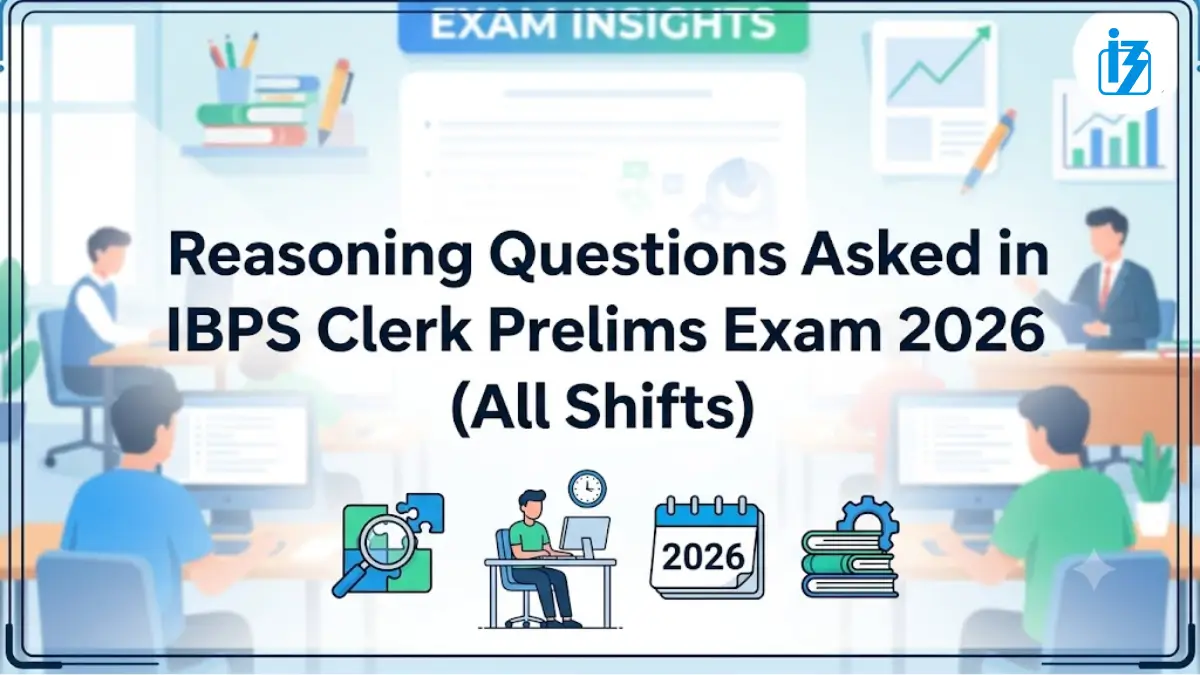
The IBPS Clerk Prelims Exam 2026 was conducted on 10 and 11 October in four shifts each day. The Reasoning Ability section carried 35 questions in every shift, covering puzzles, seating arrangements, coding-decoding, series, syllogism, inequality, and other topics. Candidates can check the complete shift-wise distribution below to identify important topics and prepare for upcoming banking examinations.
Reasoning Questions Asked in IBPS Clerk Prelims Exam 2026 (All Shifts)
The Reasoning Ability section tested candidates on a mix of logical thinking, pattern recognition, and problem-solving skills. The questions varied in format and difficulty across shifts, making it useful to compare the topic-wise distribution before deciding which areas require more practice for upcoming bank exams.
IBPS Clerk Reasoning Questions 2026: 10 October All Shifts
The table below provides the topics and number of questions asked in the Reasoning Ability section across all four shifts on 10 October 2026.
| Topic | Shift 1 | Shift 2 | Shift 3 | Shift 4 | Total Questions |
| Floor / Flat-Floor Puzzles | 5 | – | 5 | 5 | 15 |
| Seating Arrangement (Circular / Square / Parallel / Linear) | 5 | 5 | 10 | 10 | 30 |
| Other Puzzles (Sequence / Month-Date / Comparison) | 5 | 3 | 3 | 5 | 16 |
| Uncertain Linear Seating | – | 3 | – | – | 3 |
| Chinese / Simple Coding | 5 | 1 | – | 5 | 11 |
| Series (Digit / Symbol / Mixed / 3-Digit) | 5 | 5 | 5 | 5 | 20 |
| Inequality | 4 | 3 | 3 | – | 10 |
| Syllogism | – | 2 | 3 | 2 | 7 |
| Direction & Distance | 3 | 3 | 3 | – | 9 |
| Blood Relation | – | – | – | 3 | 3 |
| Single Questions (Pair Formation / Odd One Out / Meaningful Word / Single Series) | 3 | 2 | 3 | 2 | 10 |
| Total | 35 | 35 | 35 | 35 | 140 |
IBPS Clerk Reasoning Questions 2026: 11 October All Shifts
The following combined table covers all four shifts conducted on 11 October 2026.
| Topic | Shift 1 | Shift 2 | Shift 3 | Shift 4 | Total Questions |
| Floor Puzzles | 5 | 5 | – | 5 | 15 |
| Seating Arrangement (Square / Circular) | 5 | – | 5 | – | 10 |
| Other Puzzles (Box / Month-Date / Sequence / Letter) | 5 | 10 | 15 | 10 | 40 |
| Uncertain / Certain Linear Seating | 3 | 3 | – | 3 | 9 |
| Chinese Coding | – | – | 5 | 5 | 10 |
| Series (Digit / Word / 3-Letter) | 5 | 5 | – | 5 | 15 |
| Inequality | 3 | 3 | – | – | 6 |
| Syllogism | 3 | 3 | 2 | 2 | 10 |
| Direction & Distance | 3 | – | 3 | – | 6 |
| Blood Relation | – | 3 | 3 | 3 | 9 |
| Single Questions (Pair Formation / Odd One Out / Meaningful Word) | 3 | 3 | 2 | 2 | 10 |
| Total | 35 | 35 | 35 | 35 | 140 |
Overall Weightage of Reasoning in IBPS Clerk Exam 2026
Across all 8 shifts, the exam pattern remained consistent:
- Puzzles & Seating Arrangement (18–20 Questions per shift): Forms the core weightage. Common types include Floor/Flat-Floor, Month-Date, Circular, Square, Linear, and Sequence puzzles.
- Miscellaneous Topics (10–12 Questions per shift): Includes Chinese Coding, Alphanumeric/Digit/Word Series, Inequality, Syllogism, Direction & Distance, and Blood Relations.
- Single-Mark Questions (3 Questions per shift): Consistently tested Pair Formation, Odd One Out, and Meaningful Word creation across almost every shift.
Important Topics Asked in IBPS Clerk Reasoning 2026
Based on the questions reported across all eight shifts, candidates can identify the following important topics for upcoming bank examinations:
- Puzzles and Seating Arrangements: Floor-based, month and date-based, box-based, circular, linear, square, sequence-based, and comparison-based puzzles appeared across multiple shifts.
- Coding-Decoding: Chinese coding was reported in several shifts, along with simple coding.
- Series: Digit series, three-digit series, mixed series, word series, and letter-based series featured in different shifts.
- Syllogism and Inequality: Both topics appeared repeatedly, although the number of questions varied by shift.
- Direction and Distance: Direction-based questions were reported in multiple shifts.
- Other Topics: Blood relation, pair formation, meaningful word, and odd one out were also included.
Important Reasoning Topics for Upcoming Bank Exams
Based on the reported shift-wise analysis, candidates should prioritise the following topics:
- Puzzles and Seating Arrangements: Floor, flat, box, month and date, circular, linear, square, and sequence-based puzzles.
- Coding-Decoding: Chinese coding and simple coding.
- Series: Digit series, three-digit series, mixed series, word series, and letter-based series.
- Other Important Topics: Syllogism, inequality, direction and distance, blood relation, pair formation, and odd one out.





 PFRDA Grade A Syllabus and Exam Pattern ...
 IMF Raises India’s FY27 GDP Growth For...
 SCI Senior Personal Assistant Recruitmen...