
Preparing for competitive banking exams requires more than just solving quantitative aptitude and reasoning questions. A solid understanding of banking terminology and financial concepts is equally important. In exams such as the IBPS PO Exam, SBI PO Exam, IBPS Clerk Exam, and RBI Assistant Exam, the Banking Awareness section often includes questions related to key banking terms and financial systems.
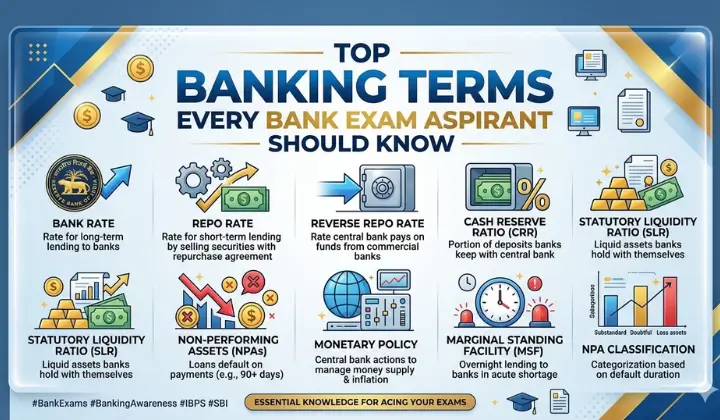
Top Banking Terms Every Bank Exam Aspirant Should Know
Understanding these concepts helps aspirants perform better in exams and also provides insight into how the banking sector operates. Learning these terms regularly also helps candidates stay updated with financial news and economic developments, which are frequently asked in competitive exams.
Important Monetary Policy Terms
Understanding these banking terms is essential for candidates preparing for competitive exams in the banking sector. A clear knowledge of such concepts helps aspirants score better in the Banking Awareness section and stay confident during the examination.
Repo Rate
The Repo Rate is the rate at which the Reserve Bank of India lends money to commercial banks to meet their short-term financial needs. When the repo rate increases, borrowing becomes more expensive for banks, which can lead to higher interest rates for loans.
Reverse Repo Rate
The Reverse Repo Rate is the rate at which the Reserve Bank of India borrows money from commercial banks. It is used as a tool to control excess liquidity in the banking system.
Cash Reserve Ratio (CRR)
The CRR is the percentage of a bank’s total deposits that must be maintained as reserves with the Reserve Bank of India in the form of cash. This helps regulate the amount of money available in the banking system.
Statutory Liquidity Ratio (SLR)
The SLR is the minimum percentage of deposits that banks must maintain in the form of liquid assets such as cash, gold, or approved government securities.
Key Banking and Financial Terms
Understanding important banking and financial terms is essential for candidates preparing for banking exams. These concepts explain how banks manage loans, deposits, and financial risks. Many of these terms are also related to the policies and regulations set by institutions like the Reserve Bank of India and global banking standards followed by financial systems worldwide.
Non-Performing Asset (NPA)
A Non-Performing Asset refers to a loan or advance where the borrower has failed to repay the interest or principal for 90 days or more. High levels of NPAs can affect the financial stability of banks.
Marginal Cost of Funds Based Lending Rate (MCLR)
The MCLR is the minimum interest rate below which banks cannot lend money, except in certain cases permitted by the Reserve Bank of India. It ensures transparency in lending rates.
CASA Ratio
CASA stands for Current Account and Savings Account ratio. It represents the proportion of deposits in current and savings accounts compared to a bank’s total deposits. A higher CASA ratio generally means the bank has access to low-cost funds.
Basel Norms
The Basel Norms are international banking regulations developed by the Bank for International Settlements. These guidelines ensure that banks maintain sufficient capital and manage financial risks effectively.
Digital Banking and Payment Systems
Digital payment systems allow people to transfer money quickly and securely without visiting a bank. Services developed by the National Payments Corporation of India have made online transactions faster, easier, and accessible across India.
NEFT (National Electronic Funds Transfer)
NEFT is an electronic payment system that allows individuals and businesses to transfer funds from one bank account to another across the country.
RTGS (Real Time Gross Settlement)
RTGS is used for high-value transactions and allows funds to be transferred in real time between banks.
IMPS (Immediate Payment Service)
IMPS is an instant interbank fund transfer system that works 24×7, including weekends and holidays.
These payment systems are part of the digital payment infrastructure developed by the National Payments Corporation of India, which promotes secure and fast digital transactions across India.
KYC and Banking Compliance
Know Your Customer (KYC)
KYC is a process used by banks to verify the identity and address of their customers. It helps financial institutions prevent fraud, money laundering, and other illegal activities.
Why Banking Terms Are Important for Bank Exams
Banking awareness plays a major role in both prelims and mains examinations. Candidates who are familiar with important financial terms can easily understand questions related to monetary policy, banking operations, and digital payment systems. Many of these terms are directly linked with the policies of the Reserve Bank of India, which regulates and supervises the banking system in India.



 RBI Assistant Prelims Admit Card 2026 Ou...
 RBI Assistant Syllabus & Exam Patter...
 Daily Current Affairs Quiz 4th April, 20...