
Daily Current Affairs and GK Updates (11th February 2026)

National News

3 Hour Takedown Rule! Government Cracks Down on Online Content

  • The government has amended the IT Rules, 2021, effective February 20, 2026, tightening regulations on social media intermediaries.
  • Platforms must now display prominent, non-removable labels on AI-generated (synthetic) content to improve transparency and curb deepfakes.
  • The content removal timeline has been sharply reduced from 36 hours to 3 hours, and to 2 hours for non-consensual intimate imagery, with non-compliance risking loss of safe harbour protection.
  • The amendments also mandate technical safeguards, user disclosure of AI content, and swift action against unlawful synthetic media to strengthen digital accountability.

No-Confidence Motion Against Om Birla! Here’s What You Must Know Constitutional Path

  • A no-confidence motion has been moved against Lok Sabha Speaker Om Birla under Article 94(c), which allows removal by a majority of all members.
  • A 14-day notice is required, and at least 50 members must support the motion for it to be admitted.
  • Debate is limited to the charges, and the Speaker can participate and vote in the first instance.
  • Historically, such motions have been moved three times (1954, 1966, 1987) but none succeeded, and the Speaker continues in office even if the House is dissolved, until the first meeting of the newly elected Lok Sabha.

MHA Updates Rules on Order of National Song and Anthem

  • The MHA has issued new guidelines on Vande Mataram. All six stanzas must be sung before the National Anthem at official events.
  • The directive was released on January 28, 2026.
  • The full rendition takes about 3 minutes and 10 seconds. Standing is mandatory during official performance. Schools must begin activities with the National Song.
  • The Centre is celebrating 150 years of Vande Mataram. The order brings uniform protocol and clarity across institutions.

Release Dates Announced for India’s New GDP, CPI, and IIP Series

  • The Ministry of Statistics and Programme Implementation (MoSPI) has revised the base years for India’s key economic indicators: GDP and IIP to 2022-23 and CPI to 2024.
  • The updated series will be released on 12 February 2026 (CPI), 27 February 2026 (GDP), and May 2026 (IIP).
  • Base year revisions account for structural economic changes, new industries, and shifting consumption patterns, ensuring accurate, relevant, and globally comparable statistics.
  • The exercise incorporates major surveys like PLFS, HCES, and ASUSE, with methodological improvements such as larger samples, updated survey tools, and revised sectoral weights, enhancing the reliability of India’s economic data.

State News

Assam to Strengthen Disaster Management with $182 Million ADB Funding

  • The Asian Development Bank approved an additional $182 million loan to strengthen flood and riverbank erosion management in Assam, complementing the existing $200 million Climate Resilient Brahmaputra project.
  • The funding will enhance embankments, early warning systems, and climate-resilient infrastructure to reduce recurring flood damage and displacement.
  • Assam’s annual Brahmaputra floods threaten livelihoods, agriculture, and infrastructure, making long-term disaster resilience critical.
  • This integrated approach focuses on both structural measures and community-based preparedness, aiming to safeguard rural communities, protect economic assets, and build sustainable climate adaptation strategies in the flood-prone region.

Uttar Pradesh Just Announced a Game Changing ₹9.13 Lakh Crore Budget 2026-27

  • Uttar Pradesh’s 2026-27 budget totals ₹9.13 lakh crore, a 12.2% rise over last year, with the fiscal deficit capped at 3% of GSDP until 2030-31.
  • Key allocations include education (12.4%), health (6%), and agriculture (9%), reflecting focus on human capital, healthcare, and rural development.
  • The budget emphasizes infrastructure and capital investment, aiming to boost economic productivity, create jobs, and support Uttar Pradesh’s goal of becoming a $1 trillion economy.
  • It balances growth-led spending with fiscal discipline, ensuring sustainable expansion while strengthening priority sectors.

International News

How the New India-UK Pact Cuts Social Security Burden for Workers

  • India and the UK signed a Social Security Agreement on February 10, 2026, preventing temporary employees (up to 36 months) from paying double social security contributions.
  • The pact protects workers home-country coverage, reduces employment costs, and benefits sectors like IT, finance, education, and consulting.
  • It forms part of the broader India-UK Comprehensive Economic Trade Agreement, highlighting labour mobility as a key pillar of modern trade partnerships.
  • By easing financial and administrative burdens, the agreement is expected to boost professional mobility, strengthen bilateral trade, and deepen economic ties.

Agreements News

AIIA Signs MoU with General Insurance Council for Cashless Ayurveda Coverage

  • The All India Institute of Ayurveda (AIIA) signed an MoU with the General Insurance Council, enabling cashless Ayurveda treatment under 32 general insurance companies.
  • This historic step integrates Ayurveda into the mainstream health insurance system, allowing policyholders to access insured therapies like Panchakarma and chronic care without upfront payments.
  • The move strengthens the Ministry of Ayush’s goal of mainstreaming traditional medicine within India’s healthcare ecosystem.
  • A dedicated Ayush Health Insurance Helpline has also been launched to assist patients with coverage, claims, and insurance-related queries.

Ranks & Reports News

Global Corruption Perceptions Index 2025 Shows Decline in Average Score: Read Here All Data

  • The Corruption Perceptions Index 2025 shows a global decline, with the average score falling to 42, the lowest in over a decade, and 122 countries scoring below 50.
  • Denmark leads as the least corrupt nation with a score of 89, while conflict-affected countries like South Sudan and Somalia rank at the bottom.
  • India is ranked 91st with a score of 39, slightly improving but still below the global average.
  • The report highlights persistent governance challenges worldwide, even in high-scoring nations, and stresses the need for stronger transparency, accountability, and anti-corruption reforms to curb systemic public sector corruption.

Denmark Tops, Afghanistan Last! Where Do India and US Rank in Women, Peace and Security Index 2025/26?

  • The Women, Peace and Security (WPS) Index 2025/26 measures women’s inclusion, justice, and security, scoring countries from 0 to 1.
  • Denmark ranks first (0.939), followed by Iceland and Norway, while conflict-affected nations like Afghanistan (0.279) and Yemen rank lowest.
  • India is placed 131st with a score of 0.607, showing progress in financial inclusion and maternal health but challenges remain in gender-based violence and workforce participation.
  • The US ranks 31st, improving due to lower maternal mortality.
  • The index highlights that political stability, legal equality, and security strongly influence women’s well-being globally, with fragile states showing the worst outcomes.

Global Billionaire Wealth Reaches $15.8 Trillion, Look At India’s Position

  • In 2025, global billionaire wealth hit a record $15.8 trillion, rising 13% in a year, with nearly 3,000 billionaires worldwide. Self-made billionaires contributed $386.5 billion, driven by innovation and inheritance trends.
  • The US leads with 924 billionaires and $6.89 trillion, followed by China (470 billionaires, $1.77 trillion) and India (188 billionaires, $888.2 billion).
  • While India added three billionaires, its total wealth slightly declined by 1.9%.
  • Other top countries include Germany, the UK, and Switzerland, while smaller economies like Singapore saw the fastest wealth growth.
  • The report highlights shifting global wealth patterns and concentration in technology, finance, and manufacturing.

Schemes News

From Birth to Graduation: Delhi’s ₹1 Lakh Promise for Daughters

  • The Delhi government launched ‘Lakhpati Bitiya Yojana’ to provide long-term financial support for girl children from birth until graduation.
  • Under the scheme, beneficiaries will receive ₹56,000 in phased instalments, which will mature into over ₹1 lakh after graduation, encouraging higher education.
  • The process is fully digital and transparent, with online applications and direct benefit transfers, eliminating the need for office visits.
  • By linking financial aid to educational milestones, the scheme promotes gender equity, financial inclusion, and long-term empowerment of girls in the national capital.

Science & Technology News

India Just Got Two Mega Telescopes – Here’s Why It Matters

  • India’s 2026 Union Budget approves major astronomy projects in Ladakh, including the National Large Solar Telescope (NLST), National Large Optical–Near Infrared Telescope (NLOT), and an upgraded Himalayan Chandra Telescope (HCT).
  • NLST will study solar magnetism and space weather, while NLOT’s 13.7-metre segmented mirror will enable research on exoplanets, stellar evolution, and the universe’s origins.
  • HCT’s upgrade to a 3.7-metre mirror will enhance transient astronomy and gravitational wave studies.
  • Located in Hanle’s Dark Sky Reserve, these telescopes benefit from high altitude, dry climate, and clear skies, positioning India as a global leader in observational astronomy.

17 Year Old Aditya Pandya Becomes India’s Youngest Male Analog Astronaut

  • Seventeen-year-old Aditya Pandya became India’s youngest male analog astronaut after completing a lunar-habitat simulation from February 1–8, 2026 in Dholavira, Gujarat.
  • The mission by AAKA Space Studio replicated Moon-like isolation, testing psychological endurance, habitat systems, and crew autonomy. Aditya also led hardware and IoT integration, managing sensors, biometric monitoring, and real-time telemetry inside the modular habitat.
  • A digital twin mirrored the habitat for continuous monitoring and analysis.
  • The mission advanced India’s analog space research and youth participation, demonstrating how engineers can both design and test technology in simulated extraterrestrial environments.

New Dragonfly Species Lyriothemis keralensis Discovered in Kerala

  • Kerala has revealed a new dragonfly species, Lyriothemis keralensis, endemic to the Western Ghats.
  • Found in vegetated pools and shaded rubber and pineapple plantations in Ernakulam, it thrives even in human-modified landscapes. Males are bright red, females yellow, with distinct anatomical traits separating them from related species.
  • This discovery enriches India’s Odonate diversity and highlights that plantations can support unique wildlife.
  • Since much of its population exists outside protected forests, the species faces conservation risks from habitat changes and pesticide use, underscoring the need to document and preserve lesser-known insects for ecological balance.

Sports News

India Storms to 39 Gold! Indian Shooters Shine Bright at Asian Rifle/Pistol Championship

  • India strengthened its dominance at the Asian Rifle/Pistol Championship 2026 in New Delhi, raising its gold tally to 39 and total medals to 66 (39 gold, 15 silver, 12 bronze).
  • Junior shooter Prachi Gaikwad won gold in the 50m rifle three-position event, while the junior women’s team also secured gold.
  • In the senior category, Aakriti Dahiya claimed silver and Anjum Moudgil won bronze, with the team earning another silver.
  • India remains comfortably at the top of the medal table, showcasing exceptional depth in both junior and senior shooting categories.

Important Days News

International Day of Women and Girls in Science 2026: Why It Matters More Than Ever

  • International Day of Women and Girls in Science is observed annually on 11 February to promote equal participation of women and girls in STEM fields.
  • Declared by the United Nations, the day addresses persistent gender gaps in scientific research, leadership, and technology sectors despite progress in education.
  • The 2026 theme “Synergizing AI, Social Science, STEM and Finance: Building Inclusive Futures for Women and Girls” — highlights the need for integrated, inclusive innovation.
  • The observance supports the 2030 Sustainable Development Goals, emphasizing that gender equality in science drives stronger economies, better innovation, and sustainable global development.

Current Affairs Today | 11 February 2026 Current Affairs | Daily Current Affairs By Ashish Gautam

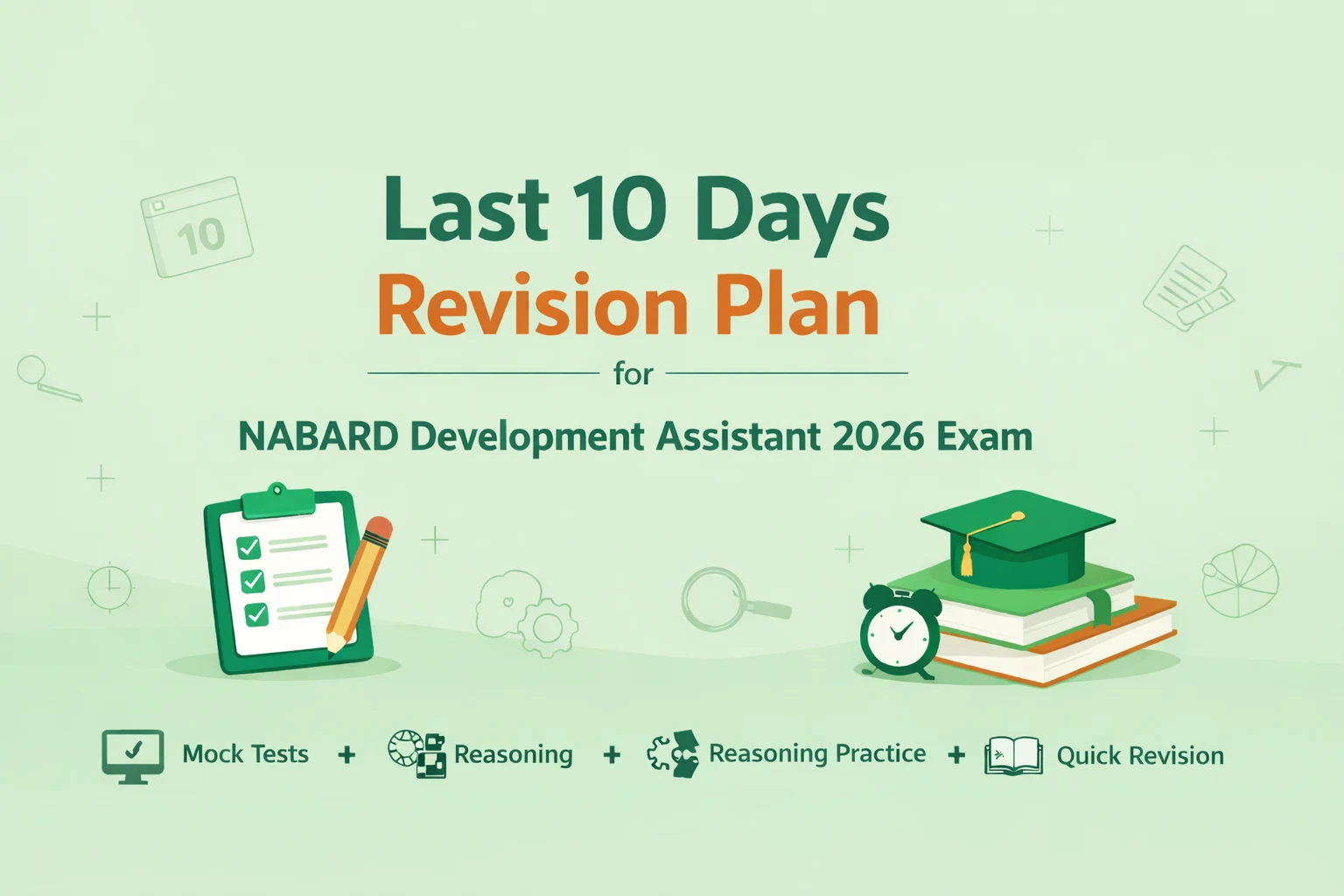
Last 10 Days Revision Plan for NABARD Development Assistant 2026 Exam

As the NABARD Development Assistant 2026 Exam is approaching and final 10 days are left, this is the time when you boost your preparation and influence your score. This is not a learning phase, it’s a structured revision and smart practice phase. A very structured plan would lead you to improve speed, build confidence before the exam.

NABARD Development Assistant Exam 2026 Exam Overview

The NABARD Development Assistant Exam 2026 Prelims typically tests the following subject arenas:

  1. Reasoning Ability
  2. Quantitative Aptitude
  3. English Language

You revision should be very much focused and quality oriented that would include mock practice and concept reinforcement.

10 Day Revision Plan (Last 10 Days)

The article below would give a structures, balanced and focus oriented 10 Day Revision Plan that would help you in scoring a good grade in your NABARD Development Assistant Examination.

Day 1: Full Length Mock + Analysis

  • Attempt one full length mock test as if you were sitting in a exam hall.
  • Analyse your mistakes in details and minimum 2-3 hours should be devoted.
  • Identify your core and weak areas in other subjects to make make sure you don’t lose scores.

NOTE- Your main lookout should be like Accuracy over attempts.

Day 2: Quantitative Aptitude

Give a full day to the most asked questions subjects which are Quants.

Quants:

  • Simplification & Approximation
  • Number Series
  • Data Interpretation (Basic Tables & Charts)

NOTE: Practice 1 sectional Mock of Quantitative Aptitude to practice well.

Day 3: Reasoning

A full day of Reasoning would give the candidate a strong hold on the subjects that would give a scoring chance in the examination. Revise shortcuts and diagram techniques to save time and speed up.

  • Puzzle (Floor, Linear, Box Based)
  • Seating Arrangement
  • Syllogism
  • Inequality
  • Blood Relation

Day 4: English

These two are the easy scoring subjects which help you get a strong section of the all examination.

English:

  • Reading Comprehension
  • Close Test
  • Error Detection
  • Para Jumbles

Note- With a good amount of practice can lead you hold a strong score.

TEST prime

Day 5: Full Length Mock

  • Attempt 1 full mock.
  • Analyse weak areas.

NOTE- Practice on the weak areas

Day 6: Quants Advanced Revision

Quants is a section which is highly calculative and strategic needs hands on practice.

  • Arithmetic: Profit & Loss, SI-CI, Time & Work, Ratio
  • DI practice (2–3 sets)
  • Quick formula revision notebook

Attempt 1 timed Quants practice set.

Day 7: Reasoning Mixed Practice

Reasoning is a brain oriented section of the examination. You should give strong read on the following topics:

  • Mixed Puzzles
  • Coding Decoding
  • Direction Sense
  • Order & Ranking

Note- Attempt a sectional mock to practice a section of question and revise the wrong answers.

Day 8: English Revision

Attempt a full length English Mock that would help you make speed to read Reading Comprehension.

  • Revise grammar rules.
  • Practice RC sets.
  • Review previous mock mistakes notebook

Day 9: Final Mock + Light Revision

Now you have two days left. This is the time make your brain relax and read the listed topics:

  1. Attempt final full mock.
  2. Analyse only major errors.
  3. Formulas
  4. Puzzle types

Day 10: Quick Revision Only

  • Revise short notes.
  • Simplification tricks
  • Reasoning patterns
  • Keep documents ready.
  • Stay calm and confident.

NOTE- Avoid the full mocks and make sure you sleep well for the examination.

What to Avoid in the Last 10 Days?

Last phase of the examination is just for revision and not for starting and  learning something new. This is the phase where you don’t have to overload your brain with the information and instead you have to polish you speed and accuracy for scoring so well in the examination. Now read the following things to avoid:

  • Avoid Starting New Topics
  • Ignoring Mock Analysis
  • Studying without any Revision
  • Over attempting mocks without review
  • Panic Studying
Related Articles
NABARD Development Assistant Salary NABARD Development Assistant Cut Off
NABARD Development Assistant Syllabus NABARD Development Previous Year Question Paper

SBI CBO Eligibility 2026 Revised, Check Latest Changes in Official Notice

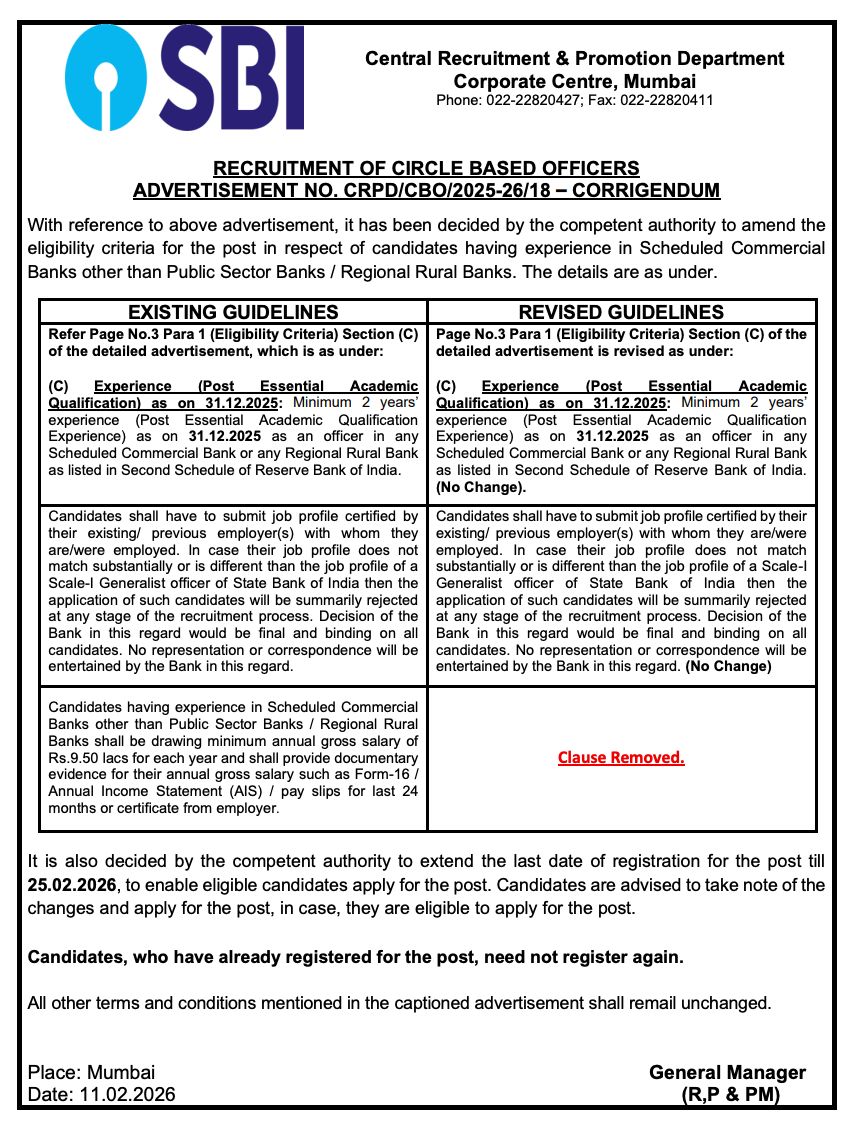
The State Bank of India has introduced an important update regarding the SBI Circle Based Officer (CBO) Eligibility 2026, bringing relief to many aspirants who were previously unsure about their eligibility. With the recruitment process currently underway for 2273 vacancies, candidates must pay close attention to the revised guidelines mentioned in the official corrigendum. Additionally, the registration deadline has been extended, giving eligible candidates more time to complete the application process.

SBI CBO Eligibility 2026 Revised

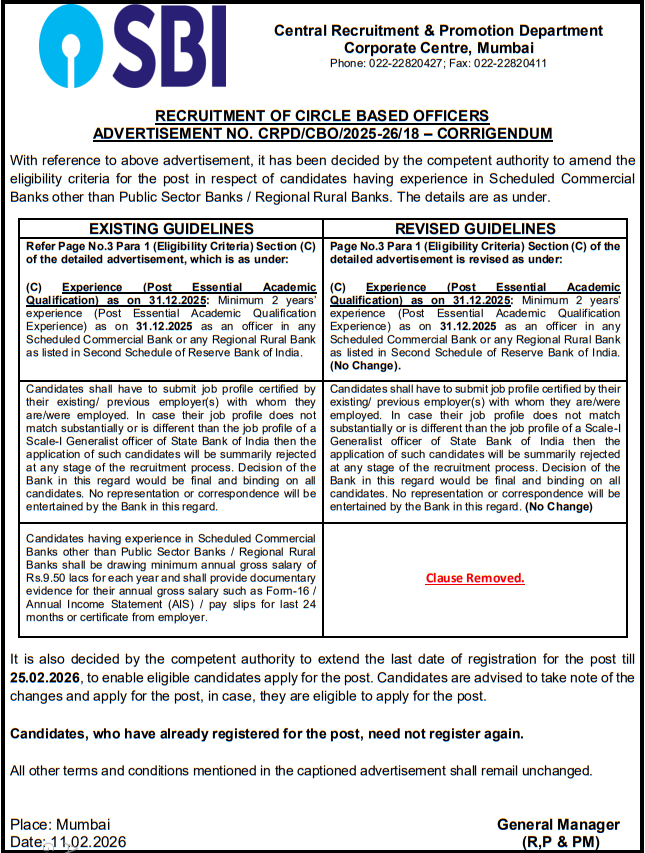
the bank has modified certain eligibility conditions related to candidates with experience in Scheduled Commercial Banks other than Public Sector Banks and Regional Rural Banks. The last date to apply has been extended to 25 February 2026, allowing more candidates to take advantage of this recruitment drive. Importantly, applicants who have already registered do not need to submit a fresh application, as their earlier registration remains valid.

Daily Current Affairs and GK Updates (11th February 2026)_6.1

Changes in SBI Circle Based Officers’ Eligibility

The most significant revision affects candidates working in Scheduled Commercial Banks other than Public Sector Banks (PSBs) and Regional Rural Banks (RRBs). What changed?

Aspect Earlier Guidelines Revised Guidelines
Basic Experience Minimum 2 years as an officer in a Scheduled Commercial Bank/RRB (as on 31.12.2025) No change – 2 years of experience still required
Job Profile Match Must match Scale-I Generalist officer profile at SBI No change
Salary Requirement REMOVED: Minimum annual gross salary of ₹9.50 lakhs per year (for Commercial Bank other than PSBs/RRBs) No salary bar – Clause deleted
Documents Required Form-16 / Annual Income Statement (AIS) / Pay slips for last 24 months / Employer certificate for salary proof Not required – Only job profile certificate needed

Key Implications of SBI CBO Eligibility Change

  • ₹9.50 lakhs salary requirement REMOVED – No longer mandatory for private sector bank candidates
  • Equal eligibility for all bank types – PSBs, RRBs, and private banks (HDFC Bank, ICICI Bank, Axis Bank, Kotak Mahindra, etc.) now have same criteria
  • Only 2-year experience required – Minimum officer experience in Scheduled Commercial Bank/RRB as on 31.12.2025
  • Job profile certificate mandatory – Must be certified by existing/previous employer
  • No salary proof documents needed – Form-16, AIS, 24-month pay slips, or employer salary certificate NOT required
  • Simplified documentation – Reduced paperwork burden for private bank candidates

Daily Current Affairs and GK Updates (11th February 2026)_7.1

SBI CBO Recruitment 2026 Notification Out, Apply Online Begins for 2273 Posts

The State Bank of India (SBI) has released the SBI CBO Recruitment 2026 notification for the post of Circle Based Officer (CBO), announcing 2,273 vacancies, including 2,050 regular and 223 backlog posts. The Apply online process has now been extended till 25 February 2026, giving candidates additional time to complete their applications. Eligible candidates can apply through the official website sbi.bank.in.

SBI CBO Recruitment 2026

  • Organization Name: State Bank of India (SBI)
  • Post Name: Circle Based Officer (CBO)
  • Recruitment Type: SBI CBO Recruitment 2026
  • Total Vacancies: 2273 posts
  • Application Mode: Online
  • Age Limit: 21 to 30 years
  • Educational Qualification: Graduation in any discipline
  • Basic Pay: ₹48,480 per month
  • Selection Process Includes:
    Online Examination
    Screening
    Interview
    Local Language Proficiency Test (LPT)
  • Official Website: www.sbi.co.in


pdpCourseImg

SBI CBO 2026: Eligibility & Deadline Revised

SBI CBO Notice 2025-26 has been released, an official correction/amendment notice from the State Bank of India (SBI) regarding the recruitment of Circle Based Officers (CBOs). Here’s what has been changed and revised:

1. Salary Barrier Removed: The most significant change is for candidates working in Private Sector Banks (Scheduled Commercial Banks other than PSBs/RRBs).

  • Old Rule: You had to prove a minimum annual gross salary of ₹9.50 lakhs.
  • New Rule: This salary requirement has been completely removed. You no longer need to meet a specific income threshold to be eligible.

2. Deadline Extended: The last date to register and apply for the post has been extended to 25 February 2026.

3. What Stays the Same?

  • Experience: You still need a minimum of 2 years of experience as an officer in a Scheduled Commercial Bank or Regional Rural Bank as of December 31, 2025.
  • Job Profile: Your current job role must still match the responsibilities of an SBI Scale-I Generalist Officer.
  • Previous Applicants: If you have already registered, you do not need to do anything or register again.

SBI CBO Notice

SBI CBO Vacancy 2026

  • Total Vacancies: 2,273
  • Regular Vacancies: 2,050
  • Backlog Vacancies: 223

The vacancies are distributed circle-wise and category-wise as mentioned in the official notification.

SBI CBO 2026 Eligibility Criteria

Educational Qualification:

  • A graduation in any discipline from a recognised university
  • Degrees like Engineering, Medical, CA, and Cost Accountant are also eligible
  • The passing date will be considered as mentioned on the mark sheet or provisional certificate

Age Limit (As on 31/12/2025):

  • Minimum Age: 21 Years
  • Maximum Age: 30 Years

Age Relaxation:

  • SC/ST: 5 years
  • OBC (Non-Creamy Layer): 3 years
  • PwBD (Gen/EWS): 10 years
  • PwBD (OBC): 13 years
  • PwBD (SC/ST): 15 years
  • Ex-Servicemen / ECOs / SSCOs: 5 years

Work Experience

  • Minimum 2 years of experience
  • Must be working as an Officer
  • Experience should be in:
    Scheduled Commercial Bank, or
    Regional Rural Bank (RRB)
  • Bank must be listed under the Second Schedule of the RBI

Who Cannot Apply for SBI CBO 2026

  • SBI clerical or supervisory staff
  • SBI contractual employees
  • Officers who resigned from SBI or its Associate Banks
  • Employees of subsidiaries of Scheduled Commercial Banks
  • Candidates with loan or credit card defaults that are not cleared

How to Apply for SBI CBO Recruitment 2026

  • Visit www.sbi.co.in
  • Go to Careers → Current Openings
  • Click on SBI CBO Recruitment 2026 Apply Online
  • Register using your email ID and mobile number
  • Login and fill in personal, educational, and work details
  • Upload required documents
  • Pay application fee (if applicable)
  • Submit and download the application form

Important Instructions for Candidates

Candidates applying for SBI CBO 2026 should follow these instructions:

  • Apply for only one Circle to avoid rejection.
  • Keep your email and mobile number active until the final result.
  • Government, PSU, or RRB employees must submit a No Objection Certificate (NOC) at the interview stage.
  • SBI can cancel the recruitment at any stage without prior notice.
  • False information will lead to disqualification.

SBI CBO 2026 Application Fees

  • General / OBC / EWS: ₹750
  • SC / ST / PwBD: Nil

SBI CBO 2026 Selection Process

Candidates must qualify for all stages below:

  • Online Written Examination
  • Screening
  • Interview
  • Local Language Proficiency Test (LPT)

SBI CBO 2026 Exam Pattern

The SBI CBO 2026 online exam includes objective-type questions along with a descriptive test, depending on the official notification. The exam is designed to assess professional knowledge, reasoning ability, and communication skills relevant to the officer role.

Objective Test

  • Sections: English Language, Banking Knowledge, General Awareness/Economy, Computer Aptitude
  • Total Questions: 120
  • Total Marks: 120
  • Duration: 2 Hours
  • No negative marking

Descriptive Test

  • Tasks: One letter and one essay
  • Total Marks: 50
  • Duration: 30 minutes

SBI CBO 2026 Salary

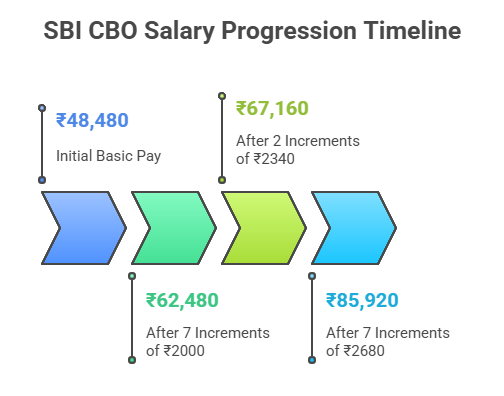
  • Basic Pay: 48,480/-
  • Pay Scale48480-2000/7-62480-2340/2-67160-2680/7-85920

SBI CBO Salary Structure 2025

SBI CBO Important Links

Notification PDF: Download PDF
Apply Online Link: Click Here


Related Posts
SBI CBO Syllabus SBI CBO Previous Year Question Papers
SBI CBO Cut Off SBI CBO Salary


NABARD Development Assistant Previous Year Question Paper PDF With Answer

Practising previous year question papers is one of th esmartest way to prepare for any competitive exam, andthe NABARD Development Assistant test is no exception. By going through real questions asked in earlier years along with their answers, aspirants can understand the exam pattern, identify important topics, and get a feel for the actual difficulty level. Instead of guessing what might come, you get clarity on question formats, recurring concepts, and time management strategies.

NABARD Development Assistant Previous Year Question Paper

Candidates aiming for the NABARD Development Assistant Recruitment 2026 should begin their preparation without delay, as early planning plays a crucial role in success. Regular practice with these papers also enables aspirants to analyse their performance and design a focused and effective preparation strategy aligned with the 2026 recruitment.

NABARD DA Previous Year Paper
NABARD DA Previous Year Paper 2019 Download PDF

Importance of Previous Year Question Papers for NABARD DA 2026

Downloading and practising the NABARD Development Assistant Previous Year Question Papers for 2026 will help candidates improve their accuracy, boost speed, and assess the overall difficulty level of the examination. Once aspirants clearly understand the latest exam pattern and syllabus, the preparation process becomes more structured and manageable.

NABARD Development Assistant Previous Year Question Paper: Benefits

These papers help candidates experience the actual exam environment, understand the latest exam pattern, and identify the difficulty level of questions asked in different sections. By solving previous year papers, aspirants can evaluate their speed, accuracy, and overall performance, while also spotting important and frequently asked topics.

  1. Aspirants will get to know the types of questions asked in the exam with the help of NABARD Development Assistant previous year question paper
  2. When candidates will solve the previous year paper by themselves then they will discover the common mistakes. Such common mistakes can be avoided by practicing the topics which needed improvement
  3. The confidence of the candidates will boost up when they will regularly solve the questions of different difficulty level asked in the NABARD Development Assistant’s previous year question paper.
  4. The previous year paper will let you revise the topics which are important from exam point of view
  5. It is one of the most reliable resources for finding out what kind of questions should be practiced to excel in exam

Bank Mahapack Plus

NABARD Development Assistant Syllabus NABARD Development Assistant Cut Off 
NABARD Development Assistant Mock Test  

RBI Office Attendant Syllabus and Exam Pattern 2026, Subject Wise Topics

Having a thorough understanding of the RBI Office Attendant Syllabus and Exam Pattern 2026 will help candidates focus on the topics carrying more weightage and make their revision easier and avoid last-minute confusion. The RBI Office Attendant exam is scheduled for 28 February 2026, so candidates are ramping up their preparations to know what to study and how the exam will unfold.

RBI Office Attendant Syllabus And Exam Pattern 2026

Knowing the exam format in advance also helps in planning time wisely during the test and approaching each section with better accuracy and confidence. Below is a quick overview of the exam details to help candidates understand the pattern and key information.

RBI Office Attendant Syllabus & Exam Pattern 2026
Exam Name
Conducting Body
Reserve Bank of India (RBI)
Vacancies 572
Exam Mode
Online (Computer-Based Test)
Exam Dates
28th February & 1st March 2026
Total Questions 120
Total Marks 120
Exam Duration 90 Minutes
Negative Marking
0.25 marks for each wrong answer
Exam Language
English, Hindi + 12 Regional Languages
Selection Process
Online Test + Language Proficiency Test (LPT)
Official Website www.rbi.org.in

RBI Office Attendant Syllabus 2026

The RBI Office Attendant Syllabus 2026 outlines the key subjects and topics that candidates must prepare for the online written examination. The syllabus is designed to test a candidate’s basic aptitude, language proficiency, numerical skills, and awareness of current events and general knowledge. A thorough understanding of the subject-wise syllabus will help aspirants plan their preparation effectively, prioritize important topics, and improve their overall performance in the examination.

RBI Office Attendant Syllabus 
Subject Topics
Reasoning Ability
  • Linear Arrangement
  • Circular Arrangement
  • Floor Puzzles
  • Scheduling
  • Inequality
  • Syllogism
  • Coding–Decoding
  • Machine Input–Output
  • Data Sufficiency
  • Blood Relations
  • Ordering and Ranking
  • Arrangement and Ranking
  • Distance and Direction
  • Alphabet Test
  • Number Series
  • Verbal Reasoning
General English
  • Reading Comprehension
  • Cloze Test
  • Fill in the Blanks
  • Spotting Errors
  • Sentence Improvement
  • Para Jumbles
  • Idioms and Phrases
  • Synonyms
  • Antonyms
  • Grammar
  • Vocabulary
  • Sentence Framing
  • Passage Making
General Awareness
  • Current Affairs (India & Global)
  • Static GK
  • Political Science
  • History
Numerical Ability
  • Simplification
  • Approximation
  • Number Serie
  • Data Interpretation
  • Percentages
  • Profit & Loss
  • Simple & Compound Interest
  • Time & Work
  • Time, Speed & Distance
  • Averages
  • Ratios & Proportion
  • Problem on Ages
  • Partnership
  • Mixture & Alligation
  • Quadratic Equation
  • Miscellaneous Questions

pdpCourseImg

RBI Office Attendant Language Proficiency Test

Candidates must demonstrate their ability to read, write, and speak the prescribed regional language, as it is essential for day-to-day duties and interaction at the workplace. The table below outlines the recruitment offices along with their corresponding local languages applicable for the LPT. The table below provides candidates with the state-wise syllabus for the RBI Office Attendant Language Proficiency Test.

RBI Office Attendant Language Proficiency Test
Recruitment Office Local Language
New Delhi Hindi
Mumbai Marathi / Konkani
Chennai Tamil
Kolkata Bengali / Nepali
Bengaluru Kannada
Hyderabad Telugu
Ahmedabad Gujarati
Jaipur Hindi
Chandigarh Punjabi / Hindi
Kanpur & Lucknow Hindi
Bhopal Hindi
Patna Hindi / Malayalam
Nagpur Marathi / Hindi
Thiruvananthapuram & Kochi Malayalam
Bhubaneswar Odia
Guwahati Assamese / Bengali / Khasi / Manipuri / Bodo / Mizo / English
Jammu Urdu / Hindi / Kashmir

RBI Office Attendant Exam Pattern 2026

Candidates who are preparing for the upcoming RBI Office Attendant Exam 2026 must be familiar with the RBI Office Attendant Exam Pattern 2026 to make the right preparation plan.

  • The RBI Office Attendant Exam will be conducted in Online CBT (Computer-Based Test) mode.
  • The question paper will consist of Objective Type Multiple Choice Questions (MCQs).
  • Negative marking is applicable, with 1/4th OR 0.25 mark deducted for each incorrect answer.
RBI Office Attendant Exam Pattern 2026
Subjects No. of Questions Marks Language Duration
Reasoning 30 30 English and Hindi 90 minutes
General English 30 30 English Only
General Awareness 30 30 English and Hindi
Numerical ability 30 30 English and Hindi
Total 120 120 90 minutes

Bank Mahapack

RBI Office Attendant Marking Scheme 2026

The RBI Office Attendant Marking Scheme 2026 explains how marks are awarded in the online exam. Knowing this marking pattern helps candidates understand how their score is calculated and plan their attempts carefully. Below is the point-to-point marking scheme for easy understanding.

  • The marking scheme is simple and easy to understand.
  • Candidates get 1 mark for each correct answer.
  • For every wrong answer, 0.25 marks are deducted as negative marking.
  • No marks are deducted for questions that are not attempted.

Due to negative marking, candidates should attempt questions carefully and avoid random guessing.

RBI Office Attendant Selection Process 2026

The RBI Office Attendant 2026 exam is conducted by the Reserve Bank of India to recruit candidates for the post of Office Attendant in its various offices. The selection is done in two stages.

  • Online Test – This is a computer-based test to check candidates’ reasoning, numerical ability, general awareness, and English skills.
  • Language Proficiency Test (LPT) – Candidates who pass the online test must qualify in the LPT to prove their knowledge of the regional language of the applied state.
  • Final selection is based on online test marks and qualifying for the LPT.

RBI Office Attendant Exam Pattern 2026: Language Proficiency Test

While the application process was going on, candidates were required to fill in their preferred state and the language they are most comfortable with. Based on the language selected by candidates, RBI will conduct its Language Proficiency Test in the following format.

  • Exam Pattern: The written test will include approximately 40–50 objective-type multiple-choice questions.
  • Marking Scheme: Each question carries one mark in the written examination.
  • Difficulty Level: The paper is usually of an easy to moderate level, particularly for candidates who are proficient in the local language.
  • Topics Covered: Preparation should focus on Grammar, Vocabulary, Reading Comprehension, and Sentence Construction.
  • Spoken Examination: There is a spoken examination where candidates are interviewed and evaluated on their ability to speak the state’s official language.

How to Maximize Score in RBI Office Attendant Exam 2026

With the RBI Office Attendant Exam 2026 just days away, scoring well now depends more on smart execution than starting anything new. A clear attempt strategy, strong revision, and controlled accuracy can significantly boost your final score.

  • Focus on High-Scoring Sections First: Begin the exam with sections you are most comfortable with, such as Reasoning or Numerical Ability. Securing quick and accurate marks early builds confidence and saves time for tougher questions later.
  • Prioritize Accuracy Over Attempts: Since negative marking is applicable, avoid blind guessing. Attempt only those questions where you are reasonably sure of the answer. A slightly lower number of accurate attempts is better than high attempts with errors.
  • Strengthen Static + Current Awareness: General Awareness can be a game-changer. Revise important current affairs from the last 5–6 months along with basic static GK topics. This section usually requires less time and offers direct scoring opportunities.
  • Use Smart Time Management: You have 90 minutes for 120 questions, which means less than a minute per question. Do not get stuck on a single problem. If a question seems time-consuming, skip it and move ahead.
  • Revise Frequently Asked Topics: Focus on commonly asked topics like simplification, percentages, puzzles, reading comprehension, and basic grammar rules. These areas carry consistent weightage and are easier to score with practice.
  • Practice with Mock Tests: Attempt full-length mock tests under exam-like conditions. Analyze your mistakes carefully to identify weak areas and improve speed, accuracy, and section-wise balance.
  • Stay Calm and Read Questions Carefully: In the final moments of the exam, stay composed. Read each question properly, especially in Reasoning and English, to avoid silly mistakes caused by misinterpretation.
Related Post
RBI Office Attendant Salary RBI Office Attendant Cut Off
RBI Office Attendant Previous Year Paper

IB SA Tier 2 Admit Card 2026 Out, Download Security Assistant Hall Ticket

The IB Security Assistant Tier 2 Admit Card 2026 has been made available by the Intelligence Bureau on its official website mha.gov.in. Applicants who successfully cleared the Tier-1 examination are now eligible to access and download their admit cards through the official portal. Tier-2 is an important stage of the recruitment process, as it assesses candidates on descriptive writing abilities and language proficiency, which play a key role in the final selection.

IB SA Tier 2 Admit Card 2026 Out

The IB Security Assistant Tier 2 Admit Card 2026 has been released online for candidates who qualified for the Tier 1 exam. Along with the admit card, the Tier 2 exam date has been announced. The Tier 2 exam will be held in offline (pen and paper) mode on 22nd February 2026 (Sunday). The admit card contains important details such as exam date, reporting time, exam centre address, and instructions. Candidates must carry a printed copy of the admit card to the exam centre; entry will not be allowed without it.

IB Security Assistant Tier 2 Admit Card 2026 Overview

Candidates appearing for the IB Security Assistant Tier 2 Exam 2026 must carry a printed copy of their admit card along with a valid government-issued photo identity proof, as entry without these documents will not be permitted. The Tier 2 examination is scheduled to be held on 22 February 2026 at various centres across India.

Particulars Details
Organization Intelligence Bureau (IB)
Exam Name IB Security Assistant (SA) Tier 2 Exam 2026
Admit Card Status Released
Tier 2 Exam Date 22 February 2026
Exam Mode Offline (Descriptive)
Nature of Paper Qualifying
Type of Test Translation Test
Total Marks 50 Marks
Duration of Exam 1 Hour
Eligibility Candidates qualified in Tier 1
Admit Card Required Yes (Printed Copy Mandatory)
ID Proof Required Aadhaar Card / PAN Card / Voter ID / Passport
Prohibited Items Mobile phones, smart devices, electronic gadgets
Official Website mha.gov.in
Admit Card Link Download Now


Test Prime

How to Download IB SA Tier 2 Admit Card 2025?

Candidates appearing for the Phase-2 examination can download their admit card by following the steps below:

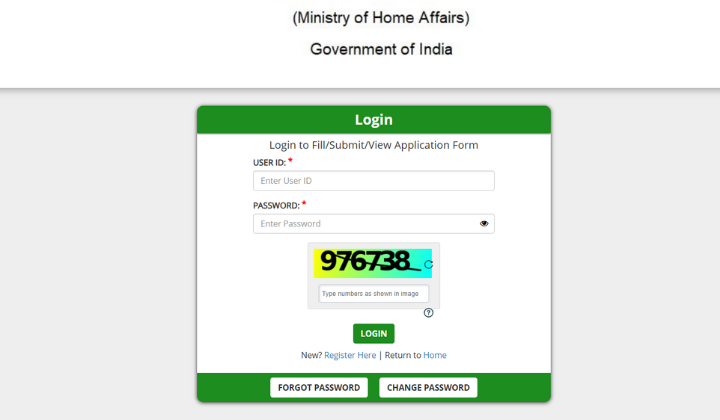
  • Open your browser and go to the official Ministry of Home Affairs website mha.gov.in.
  • Scroll down the homepage and look for the latest updates or recruitment notices.
  • Find and select the option related to Tier-2 Admit Card for SA and MTS Exam.
  • A new page will open asking for login details.
  • Enter your User ID and Password correctly.
  • Type the captcha code shown on the screen and proceed further.
  • Your admit card will be displayed. Check your name, exam date, centre, and timing.
  • Save the admit card on your device and print a copy to carry to the examination centre.

IB SA Tier 2 Exam Date 2026

The Intelligence Bureau has scheduled the IB Security Assistant Tier 2 Examination 2026 to be conducted on 22 February 2026. Candidates are advised to check the exact reporting time and exam venue mentioned on their Tier 2 admit card and reach the examination centre well in advance to avoid any last-minute inconvenience.

Things to Remember Before Entering the Examination Hall

The admit card provides essential details such as the examination centre, reporting time, and candidate information, all of which should be checked carefully after download.  In case any discrepancy is noticed on the admit card, candidates should immediately contact the examination authorities for correction. It is important to note that mobile phones, smart devices, and other electronic gadgets are strictly prohibited inside the examination hall.

Details Mentioned on IB Security Assistant Tier 2 Admit Card

Once the IB Security Assistant Tier 2 Admit Card is downloaded, candidates must thoroughly review all the particulars printed on it. Since Phase-2 is a descriptive examination, even minor errors can lead to issues on exam day. Any discrepancy should be promptly reported to the concerned authority through the MHA portal.

Candidates must confirm the accuracy of the following details on the Phase-2 admit card:

  • Candidate’s Name and Roll Number
  • Phase-2 Exam Date and Paper Timing
  • Language/Medium opted for the descriptive test
  • Examination City and Test Centre Code
  • Reporting Time and Entry Instructions
  • Candidate’s Photograph and Identity Details
  • Signature/Thumb Impression (if printed)
  • Guidelines specific to the Phase-2 descriptive exam

IB Security Assistant Phase-2 Exam Pattern

Tier-II Descriptive Test (Offline): Translation Paper

Mode of Examination: Offline

Type of Test: Descriptive

Nature of Paper: Qualifying

Task:

  • Translation from local language/dialect to English
  • Translation from English to the local language/dialect

Word Limit: 500 words

Time Duration: 1 Hour

Marks: 50 Marks

IB Security Assistant Tier 2 Exam Day Guidelines

  • Candidates must reach the exam centre well before the reporting time mentioned on the admit card.
  • Entry will be allowed only with a printed copy of the Tier-2 admit card.
  • Carry a valid government-issued photo ID such as Aadhaar Card, PAN Card, Voter ID, or Passport.
  • Electronic gadgets, including mobile phones, smartwatches, calculators, and Bluetooth devices, are strictly prohibited.
  • Candidates should bring only essential stationery, as specified in the admit card instructions.
  • Follow all security checks and verification procedures at the exam centre.
  • The Tier-2 exam is a descriptive paper, so candidates should ensure neat handwriting and clear presentation.
  • Any form of unfair means or misconduct may lead to immediate disqualification.
  • Candidates must strictly adhere to the instructions given by the invigilators during the examination.
  • Leaving the exam hall before the completion of the exam duration may not be permitted.
Related Table
IB SA Salary IB SA Previous Year Question Papers
IB SA Syllabus IB SA Cut Off

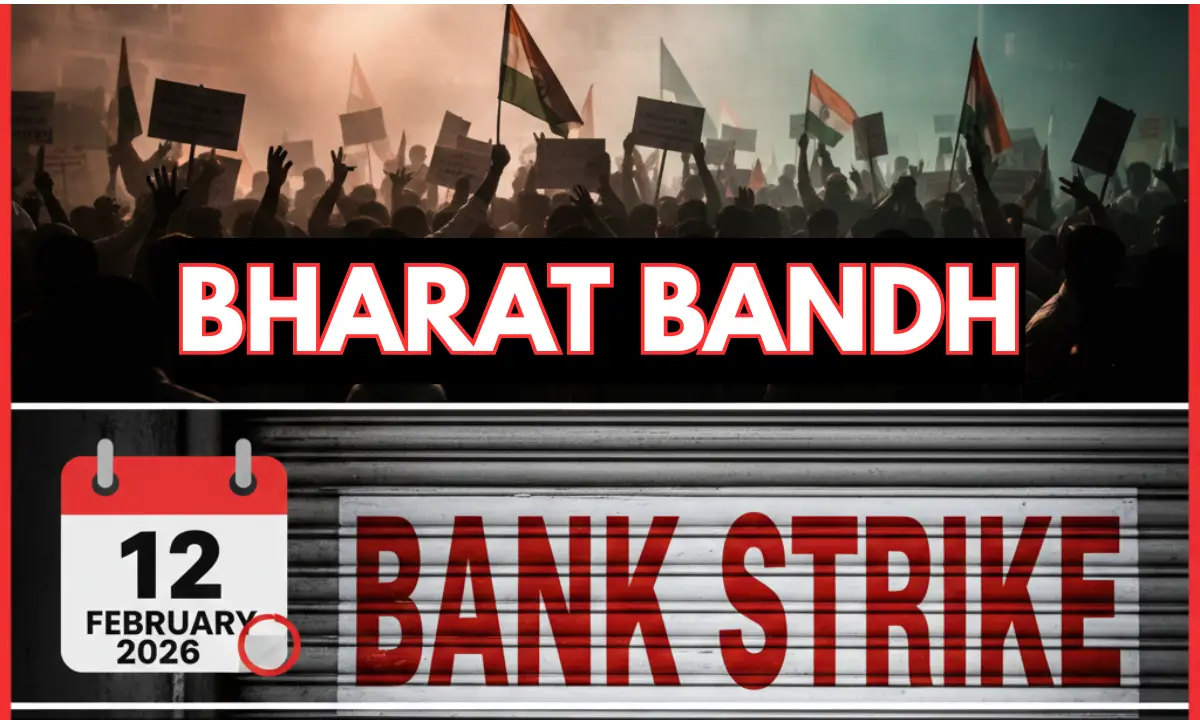
12 February Bharat Bandh, Check Reasons Behind the Nationwide Bank Strike

A countrywide Bharat Bandh has been announced for Thursday, 12 February 2026, with several central trade unions and farmer groups extending their support to the protest. The strike is expected to witness participation across multiple states, potentially affecting day-to-day activities and public services. While not every region may experience the same level of disruption, authorities and institutions have advised citizens to stay informed about local developments.

12 February Bharat Bandh

The strike has been called by a joint platform of prominent trade unions, backed by farmer organisations such as the Samyukt Kisan Morcha. The primary concern revolves around policy decisions taken by the central government, particularly the implementation of the four consolidated labour codes that replaced several earlier labour laws.

Core Demands of the 12 February Bharat Bandh

According to the unions, these codes may dilute worker safeguards, impact job security, and make union-related procedures more restrictive. Protesters are also raising broader economic and employment-related concerns, including demands linked to social welfare schemes like MGNREGA. Through this nationwide shutdown, organisers aim to draw attention to these issues and press for policy reconsideration.

What Services Could Be Affected?

The extent of disruption may vary from state to state depending on participation levels. However, certain sectors are more likely to experience interruptions:

  • Banking Operations: Employee unions in the banking sector have extended support to the strike call. As a result, branch-level services such as cash transactions, cheque processing, and customer assistance desks may operate with limited staff or face temporary interruptions.
  • Public Transport: State-run bus services and other public transport systems could see partial suspension in areas where transport unions are participating. Commuters may encounter delays or reduced frequency of services.
  • Markets and Commercial Establishments: Retail outlets and wholesale markets in protest-heavy regions might remain shut as a mark of solidarity. However, essential commodity shops are generally expected to function.
  • Government Offices: Attendance in certain departments could be lower than usual, which may slow administrative work in affected states.
  • Essential services including healthcare facilities, emergency services, and utilities are expected to continue operating.

Why Bharat Bandh Matters

The Bharat Bandh matters because it reflects widespread concerns over labour, employment, and economic policies. It draws national attention to workers’ issues and pressures authorities to review or clarify reforms, highlighting the importance of democratic protest.

Will Banks Be Closed on 12 February?

The Reserve Bank of India has not declared 12 February as an official banking holiday. This means banks are scheduled to remain open as per the regular calendar. However, since banking unions are supporting the strike, customers may notice reduced staff availability in some branches. Routine services at physical counters could be slower or temporarily limited.

On the other hand, digital banking platforms such as ATMs, internet banking, mobile applications, and UPI services are expected to operate without interruption. Private sector banks may experience fewer disruptions compared to public sector institutions, depending on staff participation.

Will Schools and Colleges Remain Closed?

There has been no nationwide directive mandating closure of educational institutions. Most schools and colleges are expected to function normally unless local administrations decide otherwise based on the situation in their respective regions.

In states where participation in the strike is strong, institutions may issue their own notices regarding temporary closure or online classes. Students and parents are advised to check official communications from their schools or colleges for updates.

What About Transport and Markets?

  • Transport Services: Public transport could operate on a restricted schedule in certain cities. In some locations, demonstrations or gatherings may lead to traffic diversions. Those planning travel are advised to verify local transport updates before commuting.
  • Markets and Business Activity: Commercial hubs in areas with active participation may observe closures for the day. However, grocery stores, pharmacies, and other essential service providers are generally expected to remain accessible.

SBI Statement on Bharat Bandh

The State Bank of India (SBI) has officially alerted customers that a nationwide bank strike is scheduled for 12 February 2026, and as a result, banking services may be affected to a limited extent on that day. SBI has warned that work at branches could be impacted during the strike and advised customers to plan their transactions in advance. However, the bank did not announce February 12 as an official bank holiday, meaning branches are expected to remain open, though some routine services could be disrupted if staff participate in the strike.

Key points from SBI’s notice:

  • Banking services may be disrupted  especially at physical branch counters.
  • Customers are advised to complete routine banking work before February 12 if possible.
  • Digital channels like mobile/internet banking, UPI, and ATMs are expected to function normally.
  • This statement was made to help customers prepare and avoid inconvenience in case a large number of bank staff join the strike.

Bank Mahapack

Can Final Year Students Apply for the SBI PO 2026 exam?

The SBI PO 2026 notification is expected to be released soon, and the application window will likely open between June and July 2026. As aspirants prepare for one of the most competitive banking exams in the country, candidates from diverse educational backgrounds begin getting ready  some are graduates, some postgraduates, and many are currently in their final year of studies.

Can Final Year Students Apply for SBI PO?

Yes, final year or final semester students are allowed to apply for SBI PO 2026, but only provisionally. As per the previous year notification, candidates must have passed their graduation degree. This means if you’re currently in your last semester and are confident that your results will be declared before the said date in the upcoming notification pdf, you’re eligible.

Final Year Students Can Apply – But With a Condition

Final-year students can apply for SBI PO 2026, but there’s a condition. You must complete your graduation by the cutoff date mentioned in the official notification. At the time of interview or document verification, you’ll need to show valid proof such as a degree certificate, mark sheet, or provisional certificate confirming that you passed before the specified date. This rule also applies to Integrated Dual Degree (IDD) candidates and Chartered Accountants (CAs), as per the same cutoff timeline.

Age Limit for SBI PO

While there is some flexibility in educational qualifications, the age limit does not come with any provisional clauses. You must strictly meet the age criteria, without exception. No relaxation is provided for candidates awaiting age eligibility. Whether you’re a final year student or a postgraduate, if your age does not fall within the permissible range, you’re not eligible to apply. Here’s the category-wise age limit you need to meet:

Category Age Limit / Relaxation
Minimum Age 21 years
Maximum Age 30 years
OBC (Non-Creamy Layer) 3 years relaxation (up to 33 years max)
SC/ST 5 years relaxation (up to 35 years max)
PwBD (UR/EWS) 10 years relaxation
PwBD (OBC) 13 years relaxation
PwBD (SC/ST) 15 years relaxation
Ex-Servicemen 5 years relaxation


Bank Mahapack


What are the Minimum Marks Required for SBI PO?

Here’s some relief for all academic profiles, SBI does not prescribe any minimum percentage of marks in graduation for the PO recruitment.

Whether you’ve just cleared your exams or graduated with flying colours, all candidates are considered equally eligible as long as they hold a valid degree. There’s no cutoff based on marks at the application stage. So yes, don’t let your graduation score hold you back if you meet the other eligibility criteria.

Related Posts
SBI PO Notification 2025
SBI PO Salary SBI PO Exam Pattern
SBI PO Previous Year Question Paper  SBI PO Cut Off


International Day of Women & Girls in Science 2026, Significance and Theme

The International Day of Women and Girls in Science 2026 is widely celebrated on 11 February each year which embarks the important role that is played by Women and Girls in the world of Science. One of the key global themes for 2026 highlights “Synergizing AI, Social Science, STEM and Finance: Building Inclusive Futures for Women and Girls.” Another related focus for the year is “From Vision to Impact: Redefining STEM by Closing the Gender Gap.” These themes emphasize turning ideas into action and creating opportunities for women in emerging scientific domains.

International Day of Women and Girl in Science 2026

The article talks about the history, theme and importance of the International Day of Women and Girl in Science 2026. The importance of it lies in encouraging more women participation in the world of science. This year the theme emphasis on Synergizing AI, Social Science, STEM and Finance: Building Inclusive Futures for Women and Girls. You will understand the importance to celebrate women and girls in science.

Also Check, Important Days In February 2026

International Day of Women and Girls in Science History

The first International Day of Women and Girls in Science was celebrated on 11 February 2016. The main aim of celebrating it was to create awareness about the lack of women and girls in technology, science, engineering and it was started by United Nations. The day honors the achievement of women scientists and also to encourage the girls to study mathematics, science etc. This issue make female feel a little away from the society but the main purpose is to create more inclusive society for the women.

Bank Mahapack

International Day of Women and Girls in Science Significance

The International Day of Women and Girls in Science is very important because it aims in the promotion of equality among women in the filed of science, technology and mathematics. Women are still not as present in these fields as men both in schools and jobs. This day makes women and girls believe in their strength of the technical skills which actually makes their contribution count. It also helps in highlight the challenges women face, just like not having enough resources and make sure to curb these.

How is International Day of Women and Girls in Science Celebrated?

On 11 February, each year schools, universities, research organization and other international institutes make sure that women and girls are aware enough to get themselves in the science and technology. Following things are done:

  1. Many awareness camps and seminars are organised.
  2. Science workshops for the females to make them feel included.
  3. Mentorship programs are organised to keep them in included.
  4. Discussions about STEM are done to encourage equality.


QR Code
Scan Me