
Do you follow a proper plan or strategy for IBPS RRB Mains 2019? Are you aiming IBPS RRB 2019 this time? If yes, then this is the section which can help you to do wonders if practiced well. A good attempt with a mix of accuracy can help you fetch good marks. The reasoning is a game of wits and mind. It is all about logics that a question may have. Speed and accuracy are what that matters the most in this section. The only way to achieve an ambitious goal is by practicing only. So, attempt the quiz of Reasoning ability that inculcates the important questions from the important topics. Do not miss out to practice the Reasoning Ability Quiz that is being provided on Bankersadda.
Directions (1-5): Read the following information carefully and answer the questions following it.
Seven Students M, N, O, P, A, B and C going for summer vacation in different cities- Auli, Lonavala, Goa, Manali, Rishikesh, Mysore and Gangtok. They like different sports- Skiing, Rafting, Scuba Diving, Trekking, Camping, Cycling and Sky DIving.
The one who likes Cycling is going to Gangtok. A is going to Goa. M does not like Scuba Diving. N likes Trekking. The ones who are going to Auli and Rishikesh like Skiing and Rafting respectively. The one who is going to Manali, does not like Camping, Skiing, Rafting, and Scuba Diving. M is going to Mysore. C likes Camping and is not going to Rishikesh and Auli. The one who is going to Mysore likes Sky Diving. O likes Cycling. B is going to Rishikesh.
Q1. Who is going to Lonavala?
(a) C
(b) N
(c) O
(d) P
(e) M
Q2. Who among the following likes Scuba Diving?
(a) N
(b) P
(c) A
(d) B
(e) O
Q3. Which city P has decided to go?
(a) Goa
(b) Manali
(c) Rishikesh
(d) Gangtok
(e) Auli
Q4. A likes which of the following sports?
(a) Cycling
(b) Camping
(c) Sky Diving
(d) Scuba Diving
(e) Rafting
Q5. Who among the following likes RAFTING?
(a) B
(b) C
(c) M
(d) N
(e) A
Solution (1-5):
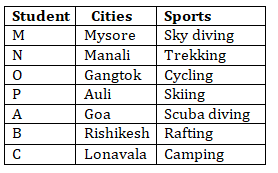
S1. Ans.(a)
S2. Ans.(c)
S3. Ans.(e)
S4. Ans.(d)
S5. Ans.(a)
Directions (6-10): Study the information and answer the following questions:
In a certain code language:
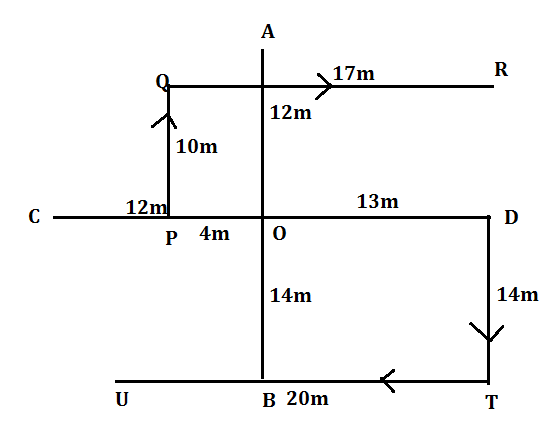
“nature river colour” is coded as “F$17 5$21 5$6”
“flower tree wood” is coded as “E&26 S&9 F&23”
“beauty soul rainbow” is coded as “X$21 M&22 Z$5”
Q6. What is the code for ‘Music’ in the given code language?
(a) D$16
(b) W&8
(c) T$8
(d) D$8
(e) None of these
Q7. ‘Z$11’ can be coded for which of the following?
(a) Liar
(b) Highway
(c) Hair
(d) National
(e) None of these
Q8. What is the code for ‘Miracle’ in the given code language?
(a) G&18
(b) P$21
(c) P&13
(d) F&16
(e) None of these
Q9. ‘O$21’ can be coded for which of the following?
(a) Mother
(b) Reason
(c) Together
(d) Create
(e) None of these
Q10. What will be the code for ‘Earth Life’ in the given code language?
(a) U$15 L$18
(b) L&20 C&12
(c) G$8 F&15
(d) F$14 G$20
(e) None of these
Directions (6-10):
S6. Ans(a)
S7. Ans(b)
S8. Ans(d)
S9. Ans(b)
S10. Ans(c)
Directions (11-15): Study the following information and answer the questions given below:
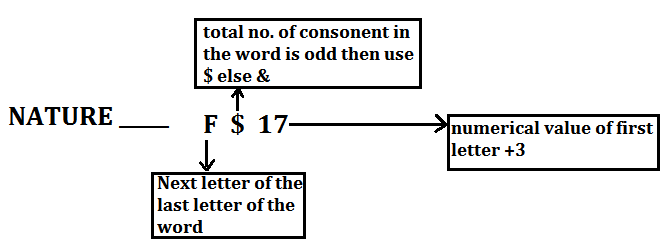
There are AB axis in such a way that A is in north and B is in south direction. There is CD axis in such a way that C is in west direction and D is in east direction. AB axis and CD axis intersect at a point O in such a way that AO is 12m, OB is 14m, OC is 12m, OD is 13 m.
A person starts walking from point P which is 4m to the west of point O and walks 10m in North direction to reach point Q and then he takes a turn to his right and walks 17m and stops at point R. Another person starts walking from point D and walks 14m in south direction to reach point T, then turns to his right and walks 20 m and stops at point U.
Q11. Point B is in which direction with respect to Point U?
(a) south
(b) east
(c) south-west
(d) west
(e) north-west
Q12. Point T is in which direction with respect to point Q?
(a) north
(b) east
(c) north-east
(d) north-west
(e)None of these
Q13. What is shortest distance between point O and point U?
(a) 31m
(b) 33m
(c) 11m
(d) 20m
(e) None of these
Q14. Point R is in which direction with respect to Point T?
(a) south
(b) north
(c) south-west
(d) west
(e) None of these
Q15. What is distance between point R and point T?
(a) 31m
(b) 33m
(c) 11m
(d) 20m
(e) 24m
Solution (11-15):
S11. Ans.(b)
S12. Ans.(e)
S13. Ans.(e)
S14. Ans (b)
S15. Ans (e)
If you are preparing for Bank exams, then you can also check out a video for Reasoning below:
You may also like to Read:










 APCOB Admit Card 2026 Out for Assistant ...
 Daily Current Affairs and GK Updates (18...
 IBPS RRB Handwritten Declaration 2026 Fo...