Daily Current Affairs: 10 July, 2026
Q1. The Delhi Transport Corporation is transitioning from a manual ticketing model to a digital transit card mechanism for its fare-free travel scheme for women and transgender. What is the official name designated to this new digital travel card?
(a) Delhi One Mobility Card
(b) Pink Saheli Smart Card
(c) Nari Shakti Common Card
(d) Saheli NCMC Travel Pass
(e) Pink Transit Smart Pass
Answer: b
Solution:
The Delhi Government has made the Pink Saheli Smart Card mandatory for availing free bus travel on Delhi Transport Corporation (DTC) and cluster buses from 1 August 2026.
Key Highlights
- The Pink Saheli Smart Card is a digital travel card introduced for women and transgender commuters in Delhi.
- From 1 August 2026, the card will be mandatory to avail free travel on Delhi Transport Corporation (DTC) and cluster buses.
- Pink paper tickets will remain valid only until 31 July 2026.
- Beginning 1 August 2026, free pink tickets will be issued only to passengers who possess the Pink Saheli Smart Card at the time of boarding and travel.
- The Pink Saheli Smart Card was launched on 2 March 2026 by President Droupadi Murmu.
- The card is integrated with the One Nation, One Card (ONOC) framework and operates on the National Common Mobility Card (NCMC) platform.
- The scheme is available to women and transgender residents of Delhi aged 12 years and above.
- Applicants must possess a Delhi Aadhaar card and an Aadhaar-linked mobile number to register for the card.
Q2. In July, 2026, the World Bank Board of Executive Directors approved a massive USD 890 million financing package to accelerate India’s green energy transition. Which specific national initiative is this funding package designed to support?
(a) PM-KUSUM Yojana
(b) PM Surya Ghar: Muft Bijli Yojana
(c) National Green Hydrogen Mission
(d) Atal Bhujal Yojana
(e) PM PRANAM Yojana
Answer: b
Solution:
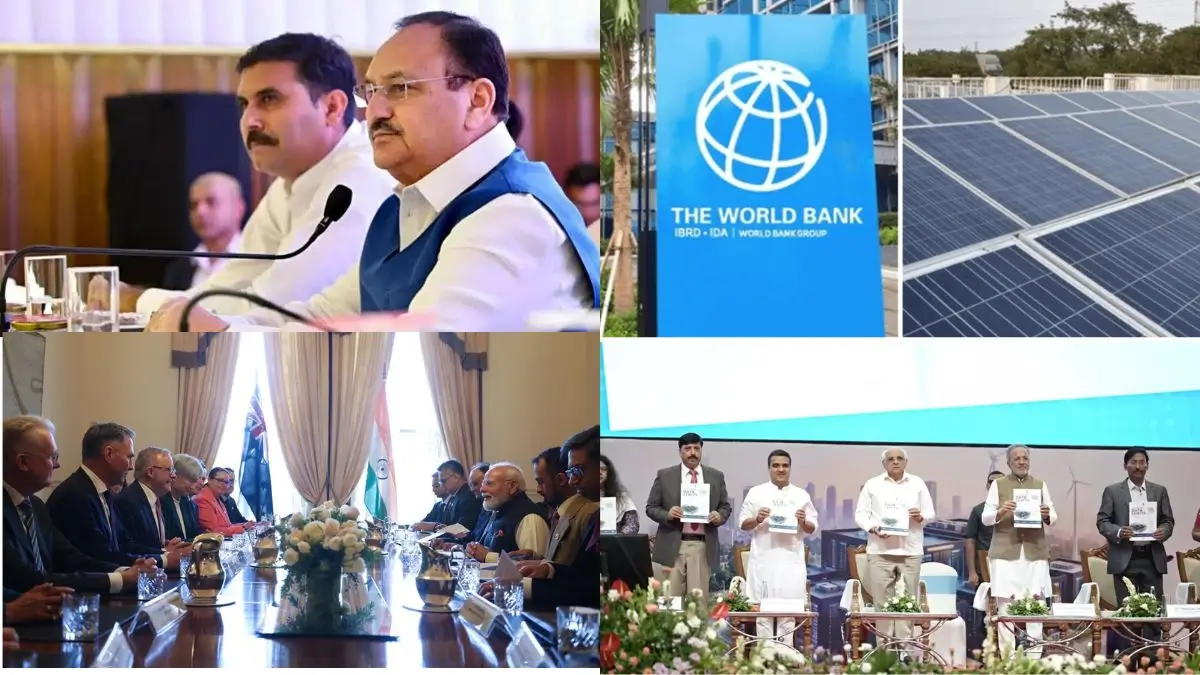
- The World Bank approved a US$890 million financing package for India’s national rooftop solar programme on 9–10 July 2026.
- The financing will support the implementation of PM Surya Ghar: Muft Bijli Yojana, which aims to promote residential rooftop solar installations in both rural and urban households across India.
- The financing package includes an US$820 million loan from the International Bank for Reconstruction and Development (IBRD).
- It also includes a US$60 million concessional loan from the Clean Technology Fund (CTF).
- An additional US$10 million grant will be provided through the IBRD’s Livable Planet Fund.
- The funding is expected to accelerate the adoption of rooftop solar energy, expand access to clean electricity, and support India’s renewable energy and climate goals.
Q3. In July 2026, Maharashtra Chief Minister Devendra Fadnavis announced the formation of a high-level seven-member panel to draft a Uniform Civil Code (UCC) legislation for the state. Who has been appointed as the chairperson of this legal committee?
(a) Justice Ranjana Desai
(b) Justice R. C. Chavan
(c) Justice S. G. Mehare
(d) Justice Pushpa Ganediwala
(e) Justice Ritu Raj Awasthi
Answer: a
Solution:
- The Maharashtra Government has constituted a seven-member committee to prepare the draft Uniform Civil Code (UCC) for the state.
- The committee is headed by retired Supreme Court Judge Justice Ranjana Desai.
- Other members of the committee include former Bombay High Court Judges Justice R. C. Chavan and Justice S. G. Mehare.
- The committee also comprises former Chief Secretary and former Advocate General of Maharashtra Ramesh Patange, a Padma Shri awardee and constitutional expert, and educationist and social activist Suvarna Rawal, along with two other members.
- The proposed Uniform Civil Code is expected to govern marriage, divorce, inheritance, and succession, irrespective of religion.
- Justice Ranjana Desai had earlier chaired the expert committees constituted by the Uttarakhand and Gujarat governments for the implementation of the Uniform Civil Code.
- Uttarakhand became the first state in post-Independence India to implement the Uniform Civil Code.
- Gujarat subsequently enacted its own UCC legislation, while Assam became the third state to pass a Uniform Civil Code law earlier in 2026.
Q4. The Economist Intelligence Unit (EIU) released its highly anticipated Global Liveability Index 2026. Which international capital successfully retained its crowning position as the world’s most liveable city for the second consecutive year?
(a) Vienna, Austria
(b) Melbourne, Australia
(c) Copenhagen, Denmark
(d) Geneva, Switzerland
(e) Vancouver, Canada
Answer: c
Solution:
The Economist Intelligence Unit (EIU) released the Global Liveability Index 2026, in which New Delhi and Mumbai were placed in the lower half of the rankings, while Copenhagen (Denmark) retained its position as the world’s most liveable city for the second consecutive year.
Key Highlights
- The EIU Global Liveability Index 2026 assessed 173 cities across the world based on overall quality of life.
- Copenhagen, Denmark, retained the top position as the world’s most liveable city for the second consecutive year.
- New Delhi ranked 120th out of 173 cities, with a liveability score of 48.1.
- Mumbai ranked 121st, with a liveability score of 47.9.
- Both New Delhi and Mumbai retained the same positions as in the previous year’s index, indicating no change in their rankings.
- Among other Indian cities, Chennai ranked 123rd and Bengaluru ranked 127th.
- The index evaluates cities across 30 indicators grouped into five categories: Stability, Healthcare, Culture & Environment, Education, and Infrastructure.
Q5. Every year, the international community observes Global Energy Independence Day to raise awareness about the transition to clean energy ecosystems and long-term resource security. On which date is this global event celebrated annually?
(a) 5 June
(b) 8 July
(c) 10 July
(d) 28 July
(e) 1 August
Answer: c
Solution:
- Global Energy Independence Day is observed annually on 10 July.
- The observance was initiated in 2006 to raise awareness about the need for energy independence through renewable and sustainable energy sources.
- The day promotes the use of solar, wind, hydro, and other clean energy sources as alternatives to fossil fuels.
- It highlights the importance of clean energy, technological innovation, energy security, and responsible energy consumption for achieving a sustainable future.
Q6. The ‘Viksit Gujarat Data Centre Policy 2026-29’, launched at Mahatma Mandir in Gandhinagar, outlines an ambitious infrastructure roadmap to establish the state as India’s premier computing and Artificial Intelligence (AI) hub. What is the maximum aggregate power capacity targeted by the state government under this policy framework?
(a) 3 Gigawatts (GW)
(b) 5 Gigawatts (GW)
(c) 6 Gigawatts (GW)
(d) 12 Gigawatts (GW)
(e) 8 Gigawatts (GW)
Answer: e
Solution:
- The Viksit Gujarat Data Centre Policy 2026–29 was launched by the Gujarat Government on 9 July 2026 at Mahatma Mandir, Gandhinagar.
- The policy aims to establish Gujarat as India’s leading data centre and AI hub by creating up to 8 gigawatts (GW) of data centre capacity.
- It seeks to attract investments worth ₹6 lakh crore and generate large-scale employment opportunities in the state.
- To promote sustainable development, the policy mandates that data centres use at least 51% green energy.
- The policy also requires data centres to source water from desalination plants, promoting efficient and sustainable water management.
- Speaking at the launch, Chief Minister Bhupendra Patel said the policy aligns with the Union Budget’s vision of making India a global hub for cloud computing and AI infrastructure.
- He also highlighted the 20-year tax holiday for service providers, announced in the Union Budget, as a key incentive to boost investment in the sector.
- The policy is expected to strengthen digital governance, e-commerce, cloud services, smart manufacturing, and accelerate the growth of Gujarat’s digital economy.
Q7. In July 2026, the United Nations Conference on Trade and Development (UNCTAD) published its flagship “2026 World Investment Report: International Investment in a Turbulent Era”. According to the report, what rank did India secure globally as a recipient of Foreign Direct Investment (FDI) inflows for the year 2025?
(a) 9th position
(b) 20th position
(c) 11th position
(d) 15th position
(e) 18th position
Answer: c
Solution:
In July 2026, the United Nations Conference on Trade and Development (UNCTAD) released the World Investment Report 2026: International Investment in a Turbulent Era. The report shows that India became the world’s 11th largest recipient of Foreign Direct Investment (FDI) in 2025.
Key Highlights
- According to the World Investment Report 2026, India ranked 11th globally in FDI inflows, improving two positions compared to 2024.
- India’s FDI inflows increased by around 44%, rising to USD 38.89 billion in 2025.
- The United States remained the world’s largest FDI destination with inflows of USD 277 billion.
- Singapore ranked second, receiving USD 151 billion in FDI.
- Hong Kong Special Administrative Region (SAR), China, ranked third with USD 116 billion in FDI inflows.
- India also improved its position among the world’s top home economies for FDI, moving up two places to 18th.
- India’s FDI outflows increased by 47%, rising from USD 24.26 billion in 2024 to USD 35.66 billion in 2025.
Global Findings
- Global FDI inflows increased by 6% to USD 1.6 trillion in 2025, following two consecutive years of decline.
- The United States was also the largest source economy for FDI, with outflows of USD 263 billion in 2025.
- The top five source economies for outward FDI in 2025 were:
- United States
- Japan
- China
- Luxembourg
- Hong Kong SAR, China
Q8. In July 2026, India achieved a massive milestone in environmental engineering by developing its first completely indigenous process technology for Hydrofluoroolefin-1234yf (HFO-1234yf). Which specific national laboratory under the CSIR umbrella successfully innovated this process?
(a) CSIR-National Chemical Laboratory (NCL), Pune
(b) CSIR-Indian Institute of Chemical Technology (IICT), Hyderabad
(c) CSIR-Central Leather Research Institute (CLRI), Chennai
(d) CSIR-Indian Institute of Petroleum (IIP), Dehradun
(e) CSIR-Central Electrochemical Research Institute (CECRI), Karaikudi
Answer: b
Solution:
In July 2026, the Council of Scientific and Industrial Research–Indian Institute of Chemical Technology (CSIR-IICT), Hyderabad, developed India’s first indigenous process technology for Hydrofluoroolefin-1234yf (HFO-1234yf), an eco-friendly refrigerant for refrigeration and air-conditioning systems.
Key Highlights
- CSIR-IICT, Hyderabad, developed India’s first indigenous process technology for Hydrofluoroolefin-1234yf (HFO-1234yf).
- The technology is ready for transfer to industry for commercial production.
- The indigenous process uses readily available raw materials, enabling domestic manufacturers to produce HFO-1234yf within India.
- HFO-1234yf is a next-generation green refrigerant designed to replace conventional Hydrofluorocarbons (HFCs) used in refrigeration and air-conditioning systems.
- The development supports the Atmanirbhar Bharat initiative by reducing dependence on imported refrigerant technologies and promoting indigenous manufacturing.
Q9. In July 2026, the Delhi-based Centre for Studies of International Relations (CSIR) teamed up with the Manas National Academy to launch a unique joint academic bridge named the International Centre for Civilizational Studies ‘Manas and Mahabharata’. In which capital city has this research centre been permanently established?
(a) Dushanbe
(b) Tashkent
(c) Bishkek
(d) Ashgabat
(e) Astana
Answer: c
Solution:
In July 2026, the Centre for Studies of International Relations (CSIR), New Delhi, in collaboration with the Manas National Academy, established the International Centre for Civilizational Studies ‘Manas and Mahabharata’ in Bishkek, Kyrgyzstan.
Key Highlights
- The International Centre for Civilizational Studies ‘Manas and Mahabharata’ has been established in Bishkek, Kyrgyzstan.
- The Centre has been set up jointly by the Centre for Studies of International Relations (CSIR), New Delhi, and the Manas National Academy, Kyrgyzstan.
- The Centre was inaugurated during the visit of an Indian delegation to Kyrgyzstan from 4–7 July 2026.
- The initiative aims to strengthen scientific, educational, and cultural cooperation between India and Kyrgyzstan through comparative civilizational and epic studies.
- The Centre will promote comparative civilizational research, humanitarian diplomacy, international scientific cooperation, and researcher training.
- During the inauguration, the first Hindi translation of the Kyrgyz epic Manas, translated by Hem Chandra Pande and Ramakant Dwivedi, was released.
- A trilateral agreement was signed between the Manas National Academy, the Centre for Studies of International Relations (CSIR), and seven universities in Kyrgyzstan to strengthen academic and research collaboration.
Q10. In July 2026, Indian tennis icon and Olympic medallist Leander Paes was appointed to a major continental role as a Player Ambassador. Which sports governing body handed him this executive mandate to elevate grassroots participation?
(a) International Tennis Federation (ITF)
(b) Asian Tennis Federation (ATF)
(c) Association of Tennis Professionals (ATP)
(d) All India Tennis Association (AITA)
(e) Sports Authority of Asia (SAA)
Answer: b
Solution:
In July 2026, Leander Paes, former Indian professional tennis player and Olympic medallist, was appointed as the Player Ambassador of the Asian Tennis Federation (ATF).
About Leander Paes
- Leander Paes is one of India’s most accomplished tennis players, with a professional career spanning more than three decades before retiring in 2021.
- He was a former World No. 1 in doubles and remains India’s only tennis player to win an Olympic medal, securing the bronze medal in men’s singles at the 1996 Atlanta Olympic Games in the United States.
- Paes won 18 Grand Slam titles in men’s doubles and mixed doubles and completed a Career Grand Slam in both categories.
- He also won eight medals at the Asian Games, including five gold medals, between 1990 and 2006.
Awards and Honours
- Arjuna Award – 1990
- Rajiv Gandhi Khel Ratna Award (now Major Dhyan Chand Khel Ratna Award) – 1996–97
- Padma Shri – 2001
- Padma Bhushan – 2014
- Inducted into the International Tennis Hall of Fame under the Player Category – 2024








 Daily Current Affairs and GK Updates (24...
 Daily Current Affairs and GK Updates (23...
 Daily Current Affairs and GK Updates (22...