
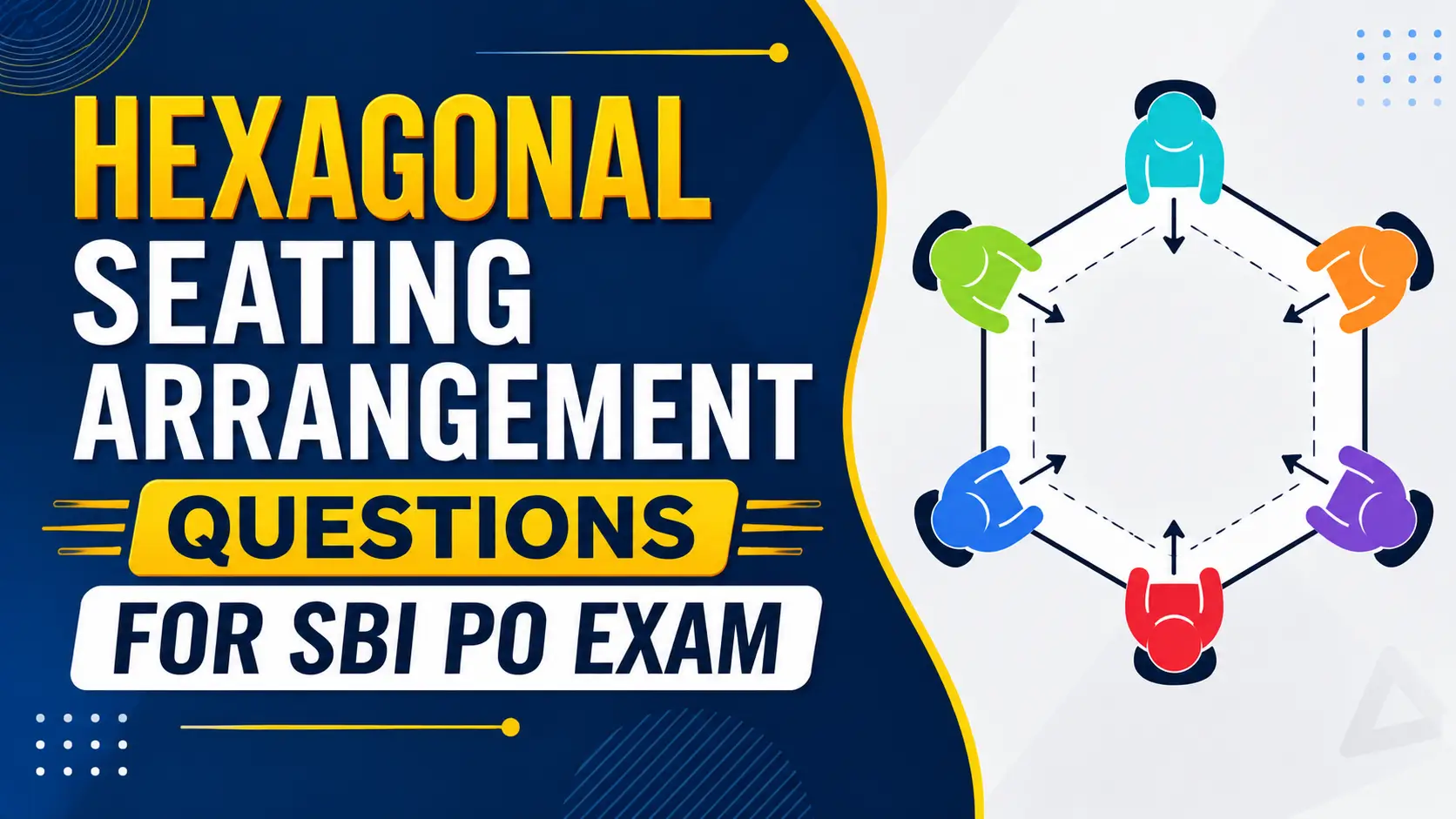
Seating arrangement is one of the most important topics in the Reasoning Ability section of the SBI PO exam. Among the different types of seating arrangements, hexagonal seating arrangement questions are considered a bit challenging due to their unique structure and multiple directional possibilities. Candidates who master this topic can significantly improve their speed and accuracy in the Reasoning section.
What is a Hexagonal Seating Arrangement?
In a Hexagonal Seating Arrangement six or more persons are seated around a hexagon-shaped figure. Candidates are required to identify the exact positions of individuals based on a set of clues. These questions test logical thinking, analytical ability, and visualization skills.
The arrangement may include:
- Persons seated at the vertices of a hexagon
- Persons seated on the sides of a hexagon
- Single or multiple hexagonal layers
- Facing inside, outside, or mixed directions
Tips to Solve Hexagonal Seating Arrangement Questions
1. Draw the Diagram First: Always begin by drawing a rough hexagonal structure. This helps in placing individuals accurately and reduces confusion.
2. Identify Direction Carefully: Check whether people are facing towards the center or away from the center. Direction changes the interpretation of left and right.
3. Start with Definite Clues: Place the individuals mentioned in direct position-based statements before solving relative clues.
4. Use Elimination Method: After placing a few candidates, eliminate impossible positions to narrow down the arrangement.
5. Practice Regularly: Consistent practice helps improve visualization skills and reduces the time required to solve complex puzzles.
Hexagonal Seating Arrangement Questions For SBI PO Exam
Directions (1-4): Study the following information carefully and answer the given questions.
Six persons A, B, C, D, E and F are sit around a hexagonal shaped table facing towards the centre, but not necessarily in the same order. Each of them likes a different fruit: Apple, Banana, Mango, Grapes, Orange, and Pineapple.
One person sits between C and the one who likes Grapes. F sits immediately to the right of the person who likes Grapes. One person sits between the one who likes Pineapple and F. D is an immediate neighbour of the one who likes Grapes but doesn’t like Pineapple. The one who likes Apple sits second to the right of A. E doesn’t like Grapes. The one who likes Banana sits immediate right of the one who likes Pineapple. E sits immediate right of the one who likes Apple. F doesn’t like Mango. B doesn’t like Apple.
Q1. Which among the following statement is not correct?
(a) A and the one who likes Mango are immediate neighbours.
(b) F sits third to the left of B.
(c) B doesn’t sit opposite to F
(d) Two persons sit between A and E
(e) All are correct
Q2. Which among the following combination is correct?
(a) E – Mango
(b) C – Banana
(c) A – Banana
(d) F – Pineapple
(e) E – Pineapple
Q3. How many persons sit between F and D ( counted from the right of F)?
(a) Two
(b) Four
(c) None
(d) Three
(e) Can’t be determined
Q4. What is the position of the one who likes Grapes with respect to B?
(a) Fifth to the left
(b) Fourth to the left
(c) Fourth to the right
(d) Second to the left
(e) None of these
Directions {6-9}: Study the following information carefully and answer the question given below:
Six persons G, H, I, J, K and L sit around a hexagonal table and face inside but not necessarily in the
same order. Each person has a different number of items i.e., 4, 7, 12, 9, 13 and 21 but not necessarily in the same order. Each person sits at the corner of the table.
One person sits between G and the person who has 7 items. L has more number of items than G. Two persons sit between G and K who have 12 items. One person sits between L and the person who has 4 Items. K and L do not sit adjacent to each other. L does not sit to the immediate left of G. The difference between the number of items of H and K is equal to the number of persons sit between J and H when counted from the right of H. J does not have 4 items. H does not have 13 items.
Q5. How many items does G have?
(a). 4
(b). 9
(c). 13
(d). Either 13 or 9
(e). None of these
Q6. What is the difference between the number of items of J and H?
(a). 2
(b). 4
(c). 3
(d). 5
(e). None of these
Q7. What is the position of K with respect to L?
(a). Second to the left
(b). Third to the left
(c). Second to the right
(d). Immediately right
(e). None of these
Q8. How many persons sit between I and K when counted from the left of I?
(a). Two
(b). Three
(c). One
(d). None
(e). None of these

| Related Posts | |
| SBI PO Syllabus | SBI PO Quantitative Aptitude |
| SBI PO Salary | SBI PO Reasoning Questions |
| SBI PO Exam Pattern 2026 |
SBI PO Previous Year Papers |
| SBI PO Cut Off |
SBI PO Mock Test |







 Daily Current Affairs Quiz 20th October,...
 SBI Clerk Syllabus 2026 (Prelims and Mai...
 SBI Clerk Previous Year Question Paper w...