
The Reasoning Ability section in the SBI PO Exam 2026 is a high-scoring area that tests a candidate’s logical thinking, problem-solving skills, and decision-making ability. With the SBI PO 2026 notification released for 1500 vacancies, it’s the right time to sharpen your reasoning skills. The section includes a variety of topics such as puzzles, seating arrangements, syllogisms, coding-decoding, inequality, and logical reasoning. To help you prepare more effectively, we have compiled a set of SBI PO Reasoning Questions based on the latest 2026 exam pattern.
Reasoning Questions in SBI PO Exam
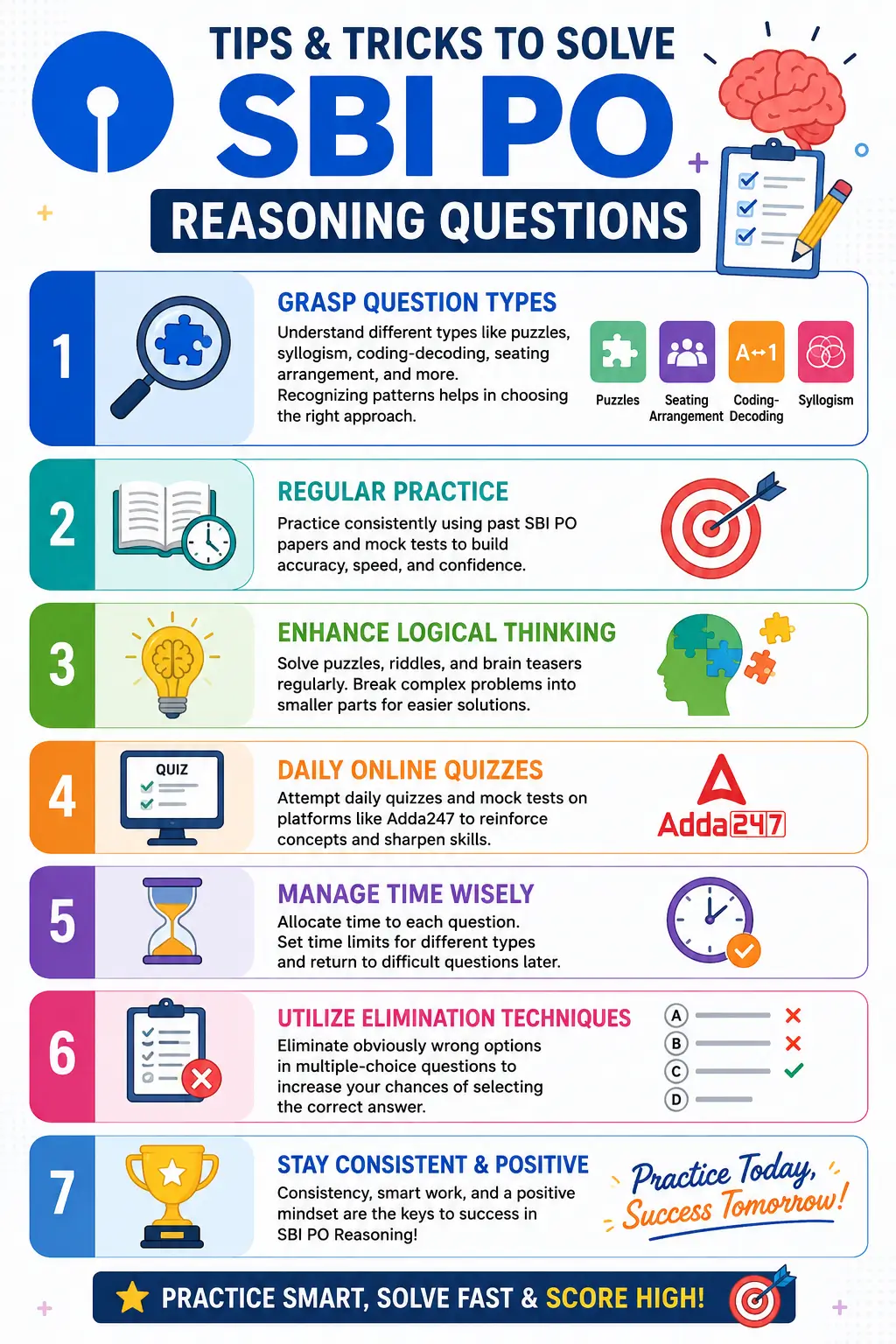
Before diving into the Reasoning questions, it’s crucial to acquaint ourselves with the diverse question structures organized by topics for the SBI PO Exam. The Reasoning segment of the SBI PO test comprises a variety of question styles carefully designed to assess candidates’ logical and analytical abilities. Some common question formats include:
| Question Format | |
| Topic | Question Type |
| Seating Arrangement | Arranging individuals or objects in an order based on the given conditions, such as circular arrangement, linear arrangement, or rectangular arrangement. |
| Puzzles | Arranging elements or variables based on the given conditions to arrive at a logical solution. |
| Syllogism | Drawing logical conclusions from the statements provided using the set of rules. |
| Blood Relation | Determining the relationship between different individuals based on the information given. |
| Coding-Decoding | Deciphering the coded messages or patterns from the underlying logic. |
| Input-Output | Understand the logic behind a series of inputs and outputs to answer questions based on the pattern. |
| Direction Sense | Interpreting the directions and navigating through a given scenario or finding out the distance. |
| Logical Reasoning | Evaluate arguments, draw conclusions, and identify patterns in the given set of information. |
| Inequalities | Questions involving comparing quantities and determining the relationship and comparison between them. |
| Logical Reasoning | Logical reasoning questions involve deductive reasoning, pattern recognition, and drawing logical conclusions. |
Logical Reasoning for SBI PO
Logical Reasoning also forms important part of Reasoning Section in mains exam of SBI PO. Some of the important topics under logical reasoning are mentioned in the table below.
| Logical Reasoning | |
| Topics | Description |
| Statement & Conclusion | This topic involves analyzing a set of statements and determining the logical conclusion or inference that can be drawn from them, based on the information provided. |
| Statement & Assumption | In this topic, candidates evaluate whether the given statements imply certain assumptions, and assess the validity of those assumptions in relation to the context provided. |
| Cause & Effect | Cause and effect questions require candidates to identify the relationship between events or phenomena, determining which is the cause and which is the effect based on the given information. |
| Statement & Inference | This topic involves analyzing statements to derive logical inferences or conclusions that can be reasonably drawn from them, considering implicit meanings or implications beyond the explicit information provided. |
Weightage of Reasoning in SBI PO Exam
The Reasoning Ability section continues to play an very important role in the SBI PO 2026 selection process. As per the latest exam pattern, the number of Reasoning questions in the Prelims has been reduced from 35 to 30, while the English Language section has been increased to 40 questions. In the Mains examination, the number of questions remains 40, but the marks allotted have increased from 50 to 60, making accuracy and conceptual clarity even more important. Candidates should focus on strengthening puzzle-solving, logical reasoning, seating arrangement, and analytical thinking to maximize their scores.
| Exam | No. of Questions | Total Marks | Duration |
| Prelims | 30 | 30 | 20 Minutes |
| Mains (Reasoning & Computer Aptitude) | 40 | 60 | 50 Minutes |
SBI PO 2026 Reasoning Section: Latest Exam Pattern Highlights
- Reasoning Ability in Prelims now consists of 30 questions carrying 30 marks, to be attempted within 20 minutes.
- Reasoning & Computer Aptitude in Mains consists of 40 questions for 60 marks, to be completed in 50 minutes.
- The overall Mains Objective Test has been revised to 200 marks, while the Descriptive Test has been reduced from 50 marks to 30 marks, making the total Mains examination 230 marks.
- There is no sectional cutoff in the Preliminary Examination, whereas sectional qualifying criteria continue in the Mains examination.
- Negative marking remains unchanged, with 0.25 marks deducted for every incorrect answer in both Prelims and Mains.
- The Preliminary Examination is qualifying in nature. The final merit list is prepared based on Mains (75% weightage) and Phase III (Group Exercise & Interview – 25% weightage).
- The last date to submit the SBI PO 2026 online application is 8th July 2026. Candidates are advised to complete the application process well before the deadline.
SBI PO Mains Reasoning Questions with Solutions
Directions (1-4): Read the given information carefully and answer the questions based on it:
A certain number of persons sit in a row facing north. The known persons like different colors. On counting from left, the persons at even positions are managers and the persons at odd positions are associates. Four persons are in between A and the one who likes red. G sits third to the left of A. The one who likes blue sits exactly between G and the one who likes red. Four persons are in between C and the one who likes blue. The one who likes pink sits immediate right of C. D sits three persons sit to the right of the one who likes pink. The number of persons sit to the right of D is equal to the square root of the number of persons sit between D and the one who likes red. T sits sixth to the left of H who sits adjacent to C. H likes pink and sits immediate right of the one who likes yellow. No one sits to the left of B who sits adjacent to T. The one who likes black sits fourth from right end. The one who likes grey sits second to the right of B and third to the left of the one who likes white.
Q1. How many associates sit to the right of the one who likes white?
(a) Three
(b) Four
(c) Five
(d) Six
(e) More than six
Q2. What is the position of C with respect to the one who likes grey?
(a) 5th to the right
(b) 7th to the right
(c) 8th to the left
(d) Immediate right
(e) 4th to the right
Q3. Which of the following statement is correct?
I. The one who sits 7th to the right of B is manager.
II. Four associates sit between B and the one who likes black.
III. H is manager and sits second to the right of A
(a) Only II
(b) Only III
(c) Only I and II
(d) Only I and III
(e) All I, II and III
Q4. Choose the incorrect combination.
(a) G – grey – associate
(b) D – black – associate
(c) A – white – manager
(d) T – blue – manager
(e) B – yellow – associate
Directions (5-8): Read the following information carefully and answer the following
Eight persons—A, B, C, D, E, F, G and H—are sitting in a circular arrangement, all facing the center. Each of them has a unique card number ranging from 2 to 9. Each person holds a distinct card number ranging from 2 to 9. Note: The difference between the card numbers of persons sitting adjacent to each other is more than 1. C sits sixth to the right of the person whose card number is a prime number. Two persons sit between the person who sits second to the right of C and G. The person whose card number is a multiple of 5 is an immediate neighbour of G. F sits third to the right of the person whose card number is a multiple of 5. The person who sits opposite to the person whose card number is 5 has card number which is two less than card number G. The person whose card number is 8 sits second to the left of F. One person sits between the person who has 6 card number and H. A is an immediate neighbour of the person who has card number 6 and has card number that is a multiple of 3. Card number of B is not 2, 5 and 8. The person who sits second to the left of A has card number 4. The difference between card number of C and A is equal to card number of B. D is an immediate neighbour of the person who has card number 3. D is not an immediate neighbour of A and H. D doesn’t sit opposite to H and F. E is an immediate neighbour of G.
Q5. Who among the following person sits fourth to the right of the person who has card number 4?
(a) H
(b) B
(c) The person who has card number 5
(d) D
(e) None of these
Q6. What is the sum of the card numbers of C, G and H?
(a) 25
(b) 20
(c) 23
(d) 21
(e) None of these
Q7. How many persons sit between the person who has card number 9 and E when counting in
the anti-clockwise direction from E?
(a) Three
(b) Four
(c) Five
(d) One
(e) Two
Q8. Which of the following pairs are adjacent and have card numbers differing less than 4?
(a) A and B
(b) E and G
(c) C and D
(d) H and A
(e) None of these
Directions (9-13): Study the following information carefully and answer the questions given below.
Fourteen persons B, C, D, E, F, G, H, I, J, K, L, M, N and O sit around two tables—one circular (referred to
as a rope-shaped table) inscribed within a square-shaped table. Four persons sit at the corners of the square table, while four sit in the middle of the sides. The persons who sit at corners face inside and the persons who sit on the middle of the sides of table face outside. Six persons sit at the circular rope-shaped table at a distance of multiples of 3 between them consecutively such as 3m, 6m, 9m and so on. The persons who sit on the circular rope shaped table face inside. F sits 9m to the left of J in a circular shaped table. There is distance of 27m between J and G when counting from one of the sides from J. O sits third to the right of I. Two persons sit between O and N. L sits immediately to the right of C. N doesn’t sit on the middle of the sides of the table. G is an immediate neighbour M. There is a distance of 42m between G and B. There is a distance of more than 12m between B and R when counting from both sides of B. There is a distance of more than 15m between R and G when counting from both sides of R. H sits third to the left of D. E sits third to the left of L. D is not an immediate neighbour of O.
Q9. What is the position of D with respect of C?
(a) Fifth to the left
(b) Fifth to the right
(c) Sixth to the right
(d) Sixth to the left
(e) Second to the right
Q10. If E and R interchanged their places then who sits 45m away from E when counting from
one of the sides from E?
(a) B
(b) F
(c) H
(d) R
(e) M
Q11. Which of the following pairs of persons are immediate neighbors?
(a) E and O
(b) R and G
(c) F and J
(d) B and M
(e) J and B
Q12. Four of the following five form a group based on their seating arrangement. Which one does
not belong to this group?
(a) B
(b) O
(c) I
(d) N
(e) C
Q13. Which of the following statements is true?
I. F sits at a distance of 9m from M when counting right of M.
II. L sits at one of the corners of the square-shaped table.
III. Four persons sit between H and C when counting from left of C.
(a) Only I
(b) Both I and II
(c) Both II and III
(d) Only III
(e) Only II
Directions (14-18): Read the given information carefully and answer the questions based on it:
A certain number of persons are seated in a row facing north. Some of the persons like different colours. The total number of persons in the row is four times the number of persons sitting to the right of the one who likes white. The person who likes blue sits second to the left of N who sits 3rd to the right of the one who likes red. Two persons sit between O and M who sits sixth to the right of N. The person who likes brown sits exactly between P and Q who is adjacent to O. Four persons sit between R and S. O sits third from one end and is two places to the left of the one who likes purple. The one who likes orange sits second from the right end. Two persons sit between O and the one who likes brown. The one who likes green sits exactly between P and S. The one who likes white sits immediate right of M. The one who likes grey sits third to the left of T who sits third to the left of the one who likes purple. Neither N nor immediate neighbour of N likes green.
Q14. Who sits second to the left of the one who sits 3rd to the right of S?
(a) The person who likes blue
(b) The person who likes grey
(c) O
(d) The person who likes white
(e) R
Q15. How many persons are seated to the left of M?
(a) 14
(b) 15
(c) 13
(d) 10
(e) 12
Q16. Which colour does the person who sits immediate left of R likes?
(a) Green
(b) Grey
(c) Purple
(d) Orange
(e) Blue
Q17. Four of the following five are alike in a certain way and hence form a group. Which of the
following does not belong to that group?
(a) Q, M
(b) R, P
(c) S, The one who likes white
(d) O, M
(e) T, The one who likes grey
Q18. How many persons sit between O and the person who likes blue?
(a) 11
(b) 12
(c) 10
(d) 9
(e) 14
Directions (19-21): Study the following information carefully and answer the given questions below:
Eight persons sit in two parallel rows – A, B, C and D sit in Row-1 and face north while P, Q, R and S sit in row 2 and face south, but not necessarily in same order. Each person has a different number of chocolates with them. The sum of total number of chocolates in row 1 is 139 and the sum of total number of chocolates in row 2 is 136. The person who sits opposite to B sits second to the right of the person who has 22 chocolates. Only one person sits between the one who has 16 chocolates and B. Sis immediate neighbour of the one who has 22 chocolates. S sits second to the left of R who sits opposite to the one who has 64 Chocolates. One of the immediate neighbours of R has 29 chocolates. The sum of number of chocolates Q and R have is 70. The one who sits immediately to the right of B has 34 chocolates. B doesn’t sit opposite to Q. More than one person sits between D and A. D doesn’t sit opposite to Q.
Q19. Four of the following five are alike in a certain way and form a group. Which of the
following does not belong to the group?
(a) Q
(b) B
(c) R
(d) C
(e) A
Q20. What is the sum of the number of chocolates S, B and C have?
(a) 86
(b) 91
(c) 98
(d) 81
(e) 96
Q21. If R is related to B and in the same way S is related to A then who among the following is
related to C?
(a) D
(b) Q
(c) P
(d) The one who has 16 chocolates
(e) The one who has 37 chocolates
Directions (22-25): Study the following information carefully and answer the questions.
A certain number of persons sit in a row and face north. F sits fourth to the right of C. Two persons sit between F and K. The number of persons sit between H and F is thrice the number of persons sit between K and E. Five persons sit between C and H and H doesn’t sit to the right of F. E doesn’t sit to the left of F. Two persons sit between R and M who sits second from one of the extreme ends of the row. O sits sixth to the right of K. More than three persons sit between K and B. B sits exactly between H and C. R sits immediately to the right of E. As many persons sit to the right of E as to the left of B.
Q22. Who among the following sits sixth to the right of the person who sits tenth to the right of
B?
(a) R
(b) M
(c) K
(d) O
(e) None of these
Q23. How many persons sit between E and H?
(a) Nineteen
(b) Twelve
(c) As many persons sit between C and M
(d) As many persons sit between B and K
(e) Sixteen
Q24. What is the difference between total numbers of persons
sit in this row and total number of persons sit between F and
E?
(a) 18
(b) 19
(c) 25
(d) 20
(e) None of these
Q25. Which of the following statements is/are true?
I. E sits exactly between K and M
II. Ten persons sit between C and O.
III. B sits eight to the left of K.
(a) Only I
(b) Only II
(c) Only III
(d) Both II and III
(e) Both I and III

Answers:
| Answers | ||||
| 1. b | 6. d | 11. e | 16. e | 21. c |
| 2. e | 7. e | 12. a | 17. a | 22. d |
| 3. e | 8. d | 13. c | 18. c | 23. e |
| 4. e | 9. c | 14. b | 19. b | 24. b |
| 5. b | 10. b | 15. d | 20. e | 25. a |
| Related Posts | |
| SBI PO Mains Exam Analysis Trend | SBI PO Previous Year Question Papers |
| SBI PO Syllabus | SBI PO Salary |
| SBI PO Cut Off | SBI PO Preparation Strategy |





 500+ Reasoning Questions PDF for SBI Cle...
 500+ Reasoning Questions for SBI PO 2026...
 Puzzle Questions for SBI PO Exam