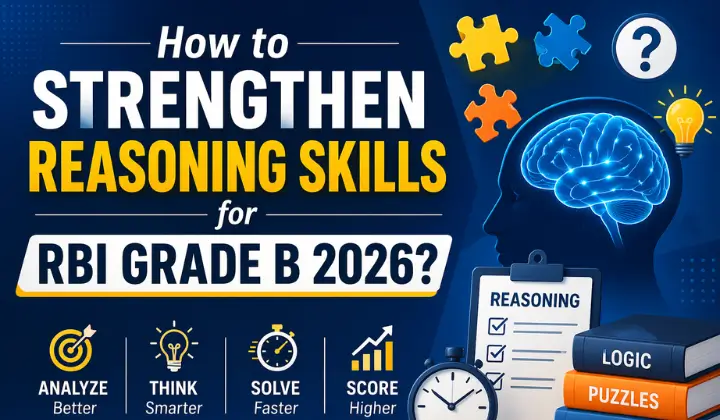
Strengthening your reasoning skills for RBI Grade B 2026 isn’t about solving hundreds of random questions, but rather about developing clarity, speed, and decision-making under pressure. This exam tests how well you can understand patterns, not just how much practice you’ve put in. Here’s how to do it smartly:
How to Strengthen Reasoning Skills for RBI Grade B 2026?
The Reasoning section of the RBI Grade B exam is often considered by candidates to be the most unpredictable and challenging part of Stage 1. With 60 questions to be solved in 45 minutes, it’s not just about finding the right answer; it’s about strategic selection and speed. As you prepare for the 2026 cycle, here’s a comprehensive guide to strengthen your reasoning skills.
1. Build Strong Basics First
Start with core topics like puzzles, seating arrangement, syllogism, inequalities, coding-decoding, and blood relations. If your basics are weak, even easy questions will feel time-consuming.
Focus on understanding:
- How different puzzle types are structured
- Standard logic rules (especially in syllogism and inequalities)
- Common reasoning patterns used in exams
- Avoid rushing into mocks before this stage is solid.
2. Master Puzzles & Seating Arrangement
These are the most scoring yet time-consuming parts.
Work on:
- Linear & circular seating arrangements
- Floor-based and box puzzles
- Scheduling puzzles
Instead of solving randomly, practice one type at a time and analyze:
- How clues are linked
- Which clue to pick first
- How to avoid rework
3. Develop a Question Selection Strategy
Not every question is worth attempting.
Train yourself to:
- Skip lengthy puzzles initially
- Pick high-accuracy topics first (inequality, syllogism, coding)
- Return to tougher sets later
- This alone can boost your score significantly.
4. Practice Timed Sets Daily
Reasoning is all about speed + accuracy.
- 2–3 sectional quizzes daily
- Set a strict timer (shorter than actual exam time)
- Gradually, your brain starts recognizing patterns faster.
5. Analyze Every Mock Test Deeply
Mocks are useless if you don’t analyze them.
After each test:
- Identify which puzzles took the most time
- Find where you made logical mistakes
- Re-solve unsolved questions without time pressure
- Your improvement will come more from analysis than attempts.
6. Improve Calculation & Visualization
Even in reasoning, quick rough work matters.
Practice:
- Drawing structured diagrams for puzzles
- Using symbols and short notations
- Keeping your rough work clean and organized
- Messy approach = wasted time.
7. Focus on Accuracy First, Then Speed
- Trying to be fast too early usually backfires.
- First aim for 90%+ accuracy
- Then gradually reduce time per question
- Accuracy builds confidence; speed follows naturally.
8. Revise Standard Patterns Weekly
Reasoning questions often repeat patterns.
Maintain a notebook of:
- New puzzle types
- Unique logic tricks
- Mistakes you made
- Revisiting these will prevent repeated errors.
9. Stay Consistent (This is Non-Negotiable)
Reasoning is a skill if you stop practicing, you lose speed.
Even on busy days:
- Solve at least 1 puzzle set
- Attempt 10–15 mixed questions
- Consistency beats intensity here.
10. Simulate Exam Pressure
Before the exam:
- Attempt full-length mocks in exam-like conditions
- Practice sitting for long durations without distraction
- This prepares your mind for real exam pressure.
Previous Year Trends of RBI Grade B Reasoning Section
Understanding previous year trends is crucial because RBI Grade B does not drastically change the syllabus it changes the difficulty level, pattern, and question framing. Here’s a clear, exam-focused analysis based on recent years:
1. Overall Difficulty Level Trend
The reasoning section has remained moderate to difficult over the years. Most questions are not direct and require careful thinking, with only a few easy ones.
2. Dominance of Puzzles & Seating Arrangement
A major portion of the section (around 40–50%) is covered by puzzles and seating arrangements, making them the most important topics to prepare.
3. Increasing Complexity of Questions
Questions are becoming more analytical and multi-layered, often combining different concepts and requiring deeper logical understanding.
4. Weightage of Miscellaneous Topics
Topics like syllogism, coding-decoding, blood relations, and direction sense appear regularly and are usually quick to solve and scoring.
- Syllogism (often reverse)
- Coding-Decoding
- Blood Relations
- Input-Output
- Direction & Distance
- Data Sufficiency
5. Shift Towards Time-Consuming Sets
The section is often lengthy rather than extremely difficult, so solving all questions is not practical without smart selection.
6. Good Attempts & Cut-Off Trend
A good number of attempts usually falls in the mid-range, and the cut-off stays relatively low due to the difficulty level, making accuracy crucial.
7. Consistency in Core Topics
The core topics remain mostly the same every year; only the pattern and difficulty level change.







 Satya Prakash Jena's SBI CBO Journey: Fr...
 How To Crack SBI CBO Interview?
 52946 Applications Registered for NABARD...