

Financial institutions play an important role in the development and stability of India’s economy. They support different sectors by providing credit, refinancing facilities, investment opportunities, insurance protection and payment services. Some institutions focus on specific areas such as agriculture, housing, exports, infrastructure and small businesses, while others regulate the financial system and protect the interests of customers.
Important Financial Institutions in India
India has several financial institutions working under different ministries, regulators and statutory frameworks. The Department of Financial Services (DFS), Ministry of Finance, lists seven Public Financial Institutions under its administrative control, including NABARD, SIDBI, EXIM Bank, NHB, IFCI, IIFCL and NaBFID. The Reserve Bank of India also identifies NABARD, SIDBI, NHB, EXIM Bank and NaBFID as specialised All-India Financial Institutions (AIFIs) that support key sectors of the economy.
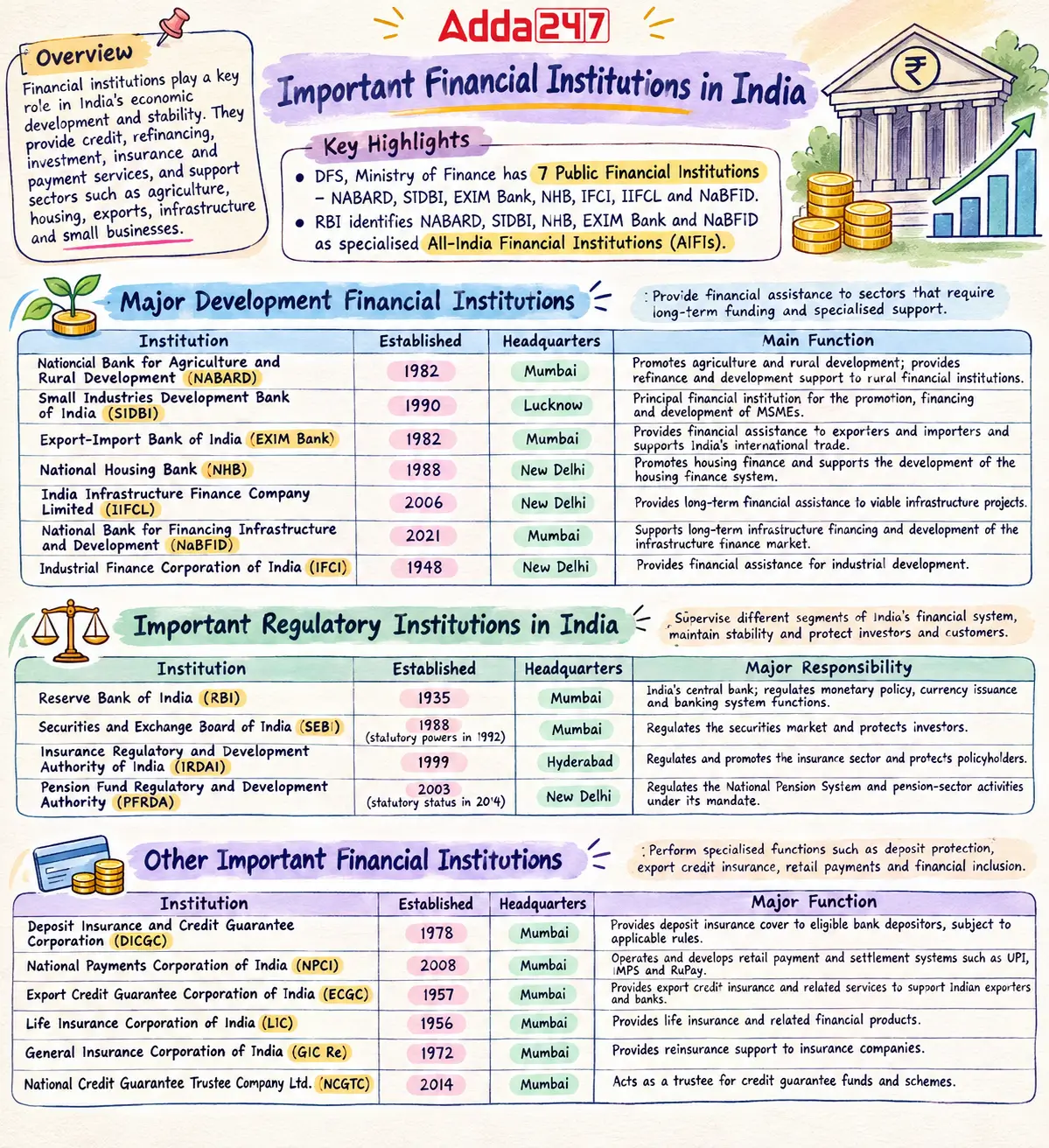
Major Development Financial Institutions
Development financial institutions provide financial assistance to sectors that require long-term funding and specialised support.
| Institution | Established | Headquarters | Main Function |
| National Bank for Agriculture and Rural Development (NABARD) | 1982 | Mumbai |
Promotes agriculture and rural development; provides refinance and development support to rural financial institutions.
|
| Small Industries Development Bank of India (SIDBI) | 1990 | Lucknow |
Principal financial institution for the promotion, financing and development of MSMEs.
|
| Export-Import Bank of India (EXIM Bank) | 1982 | Mumbai |
Provides financial assistance to exporters and importers and supports India’s international trade.
|
| National Housing Bank (NHB) | 1988 | New Delhi |
Promotes housing finance and supports the development of the housing finance system.
|
| India Infrastructure Finance Company Limited (IIFCL) | 2006 | New Delhi |
Provides long-term financial assistance to viable infrastructure projects.
|
| National Bank for Financing Infrastructure and Development (NaBFID) | 2021 | Mumbai |
Supports long-term infrastructure financing and development of the infrastructure finance market.
|
| Industrial Finance Corporation of India (IFCI) | 1948 | New Delhi |
Provides financial assistance for industrial development.
|
Important Regulatory Institutions in India
Financial regulators supervise different segments of India’s financial system. Their responsibilities include maintaining stability, protecting investors and customers, and ensuring that regulated entities follow applicable rules.
| Institution | Established | Headquarters | Major Responsibility |
| Reserve Bank of India (RBI) | 1935 | Mumbai |
India’s central bank; regulates monetary policy, currency issuance and banking system functions.
|
| Securities and Exchange Board of India (SEBI) | 1988; statutory powers in 1992 | Mumbai |
Regulates the securities market and protects investors.
|
| Insurance Regulatory and Development Authority of India (IRDAI) | 1999 | Hyderabad |
Regulates and promotes the insurance sector and protects policyholders.
|
| Pension Fund Regulatory and Development Authority (PFRDA) | 2003; statutory status in 2014 | New Delhi |
Regulates the National Pension System and pension-sector activities under its mandate.
|
Other Important Financial Institutions
Apart from development banks and regulators, several institutions perform specialised functions such as deposit protection, export credit insurance, retail payments and financial inclusion.
| Institution | Established | Headquarters | Major Function |
| Deposit Insurance and Credit Guarantee Corporation (DICGC) | 1978 | Mumbai |
Provides deposit insurance cover to eligible bank depositors, subject to applicable rules.
|
| National Payments Corporation of India (NPCI) | 2008 | Mumbai |
Operates and develops retail payment and settlement systems such as UPI, IMPS and RuPay.
|
| Export Credit Guarantee Corporation of India (ECGC) | 1957 | Mumbai |
Provides export credit insurance and related services to support Indian exporters and banks.
|
| Life Insurance Corporation of India (LIC) | 1956 | Mumbai |
Provides life insurance and related financial products.
|
| General Insurance Corporation of India (GIC Re) | 1972 | Mumbai |
Provides reinsurance support to insurance companies.
|
| National Credit Guarantee Trustee Company Limited (NCGTC) | 2014 | Mumbai |
Acts as a trustee for credit guarantee funds and schemes.
|
Important Financial Institutions: Key Facts to Remember
The following facts are useful for quick revision before banking and insurance examinations. Pay special attention to institutions with similar names, as questions may test their areas of operation.
- NABARD: Apex development financial institution for agriculture and rural development.
- SIDBI: Principal financial institution for the MSME sector.
- EXIM Bank: Supports India’s export and import activities.
- NHB: Focuses on the development of the housing finance sector.
- NaBFID: Dedicated to long-term infrastructure financing.
- IIFCL: Provides financial assistance to infrastructure projects.
- IFCI: Established in 1948 to support industrial finance.
- RBI: India’s central bank, established on 1 April 1935.
- SEBI: Regulates India’s securities market.
- IRDAI: Regulates the insurance sector.
- PFRDA: Regulates the pension sector, including the National Pension System.
- DICGC: Provides deposit insurance to eligible bank depositors.
- NPCI: Operates major retail payment systems, including UPI and RuPay.
- ECGC: Provides export credit insurance.







 RBI Monetary Policy 2026: Repo Rate, CRR...
 Daily Current Affairs and GK Updates (7t...
 BOI Credit Officer GBO Result 2026 Out, ...