

The Reserve Bank of India (RBI) uses monetary policy to regulate the supply of money and credit in the economy. Its primary objective is to maintain price stability while keeping economic growth in mind. Through changes in policy rates and reserve requirements, the RBI influences borrowing costs, bank lending, liquidity and inflation. Understanding these concepts is essential for candidates preparing for SBI, IBPS, RRB, RBI and other banking examinations.
RBI Monetary Policy 2026
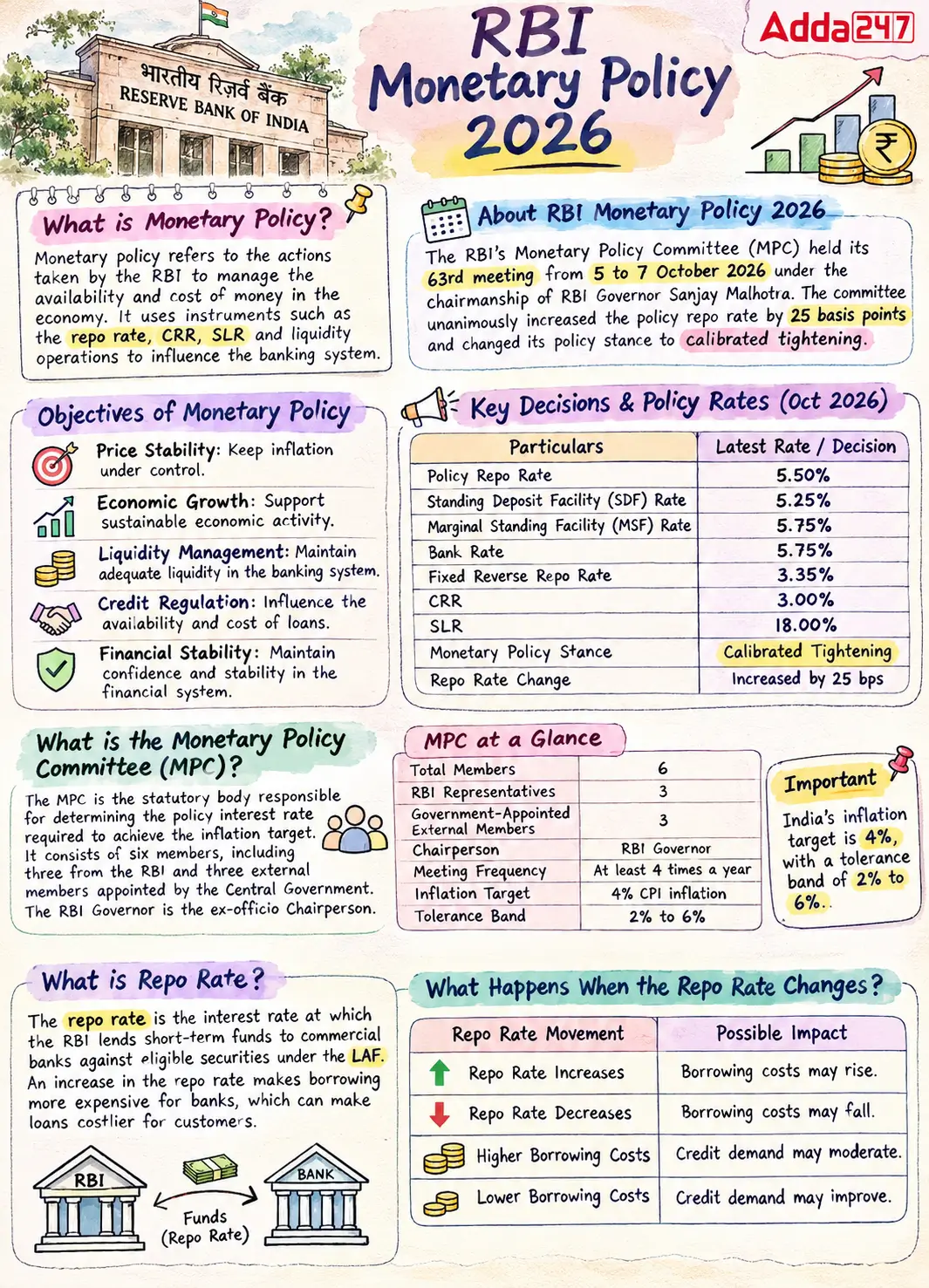
The RBI’s Monetary Policy Committee (MPC) held its 63rd meeting from 5 to 7 October 2026 under the chairmanship of RBI Governor Sanjay Malhotra. The committee unanimously increased the policy repo rate by 25 basis points and changed its policy stance to calibrated tightening.
| Particulars | Latest Rate / Decision |
| Policy Repo Rate | 5.50% |
| Standing Deposit Facility (SDF) Rate | 5.25% |
| Marginal Standing Facility (MSF) Rate | 5.75% |
| Bank Rate | 5.75% |
| Fixed Reverse Repo Rate | 3.35% |
| CRR | 3.00% |
| SLR | 18.00% |
| Monetary Policy Stance | Calibrated Tightening |
| Repo Rate Change | Increased by 25 bps |
What Is Monetary Policy?
Monetary policy refers to the actions taken by the RBI to manage the availability and cost of money in the economy. It uses instruments such as the repo rate, CRR, SLR and liquidity operations to influence the banking system. When inflation rises, the RBI may tighten monetary conditions to reduce excessive demand. When economic activity needs support, it may adopt measures that make credit more affordable and improve liquidity.
- Price Stability: Keep inflation under control.
- Economic Growth: Support sustainable economic activity.
- Liquidity Management: Maintain adequate liquidity in the banking system.
- Credit Regulation: Influence the availability and cost of loans.
- Financial Stability: Maintain confidence and stability in the financial system.
What Is the Monetary Policy Committee (MPC)?
The Monetary Policy Committee is the statutory body responsible for determining the policy interest rate required to achieve the inflation target. It consists of six members, including three members from the RBI and three external members appointed by the Central Government. The RBI Governor is the ex-officio Chairperson of the committee.
| Particulars | Details |
| Total Members | 6 |
| RBI Representatives | 3 |
| Government-Appointed External Members | 3 |
| Chairperson | RBI Governor |
| Meeting Frequency | At least 4 times a year |
| Inflation Target | 4% CPI inflation |
| Tolerance Band | 2% to 6% |
Important: India’s inflation target is 4%, with a tolerance band of 2% to 6%.
What Is Repo Rate?
The repo rate is the interest rate at which the RBI lends short-term funds to commercial banks against eligible securities under the Liquidity Adjustment Facility (LAF). When the RBI increases the repo rate, borrowing funds from the central bank becomes more expensive for banks. Banks may pass on this higher cost through increased lending rates, which can make loans more expensive for customers.
What Happens When the Repo Rate Changes?
| Repo Rate Movement | Possible Impact |
| Repo Rate Increases | Borrowing costs may rise |
| Repo Rate Decreases | Borrowing costs may fall |
| Higher Borrowing Costs | Credit demand may moderate |
| Lower Borrowing Costs | Credit demand may improve |
What Is CRR (Cash Reserve Ratio)?
Cash Reserve Ratio is the percentage of a bank’s Net Demand and Time Liabilities (NDTL) that it must maintain as a cash balance with the RBI. Banks cannot use this required reserve for lending or investment. An increase in CRR reduces the funds available with banks for lending, while a decrease can release additional liquidity into the banking system.
Example: If a bank has an NDTL of ₹1,000 crore and the CRR is 3%, it must maintain ₹30 crore as a cash reserve with the RBI.
What Is SLR (Statutory Liquidity Ratio)?
Statutory Liquidity Ratio is the minimum percentage of a bank’s NDTL that it must maintain in the form of liquid assets. These assets can include cash, gold and eligible unencumbered government securities. Unlike CRR, SLR assets are maintained by banks themselves rather than as a cash balance with the RBI. SLR helps ensure that banks maintain a minimum level of liquid assets.
Example: If a bank has an NDTL of ₹1,000 crore and the SLR is 18%, it must maintain ₹180 crore in eligible liquid assets.
Difference Between Repo Rate, CRR and SLR
These three instruments influence the banking system in different ways.
| Basis | Repo Rate | CRR | SLR |
| Full Form | Repurchase Rate | Cash Reserve Ratio | Statutory Liquidity Ratio |
| Meaning | Rate at which RBI lends to banks | Cash reserve maintained with RBI | Liquid assets maintained by banks |
| Maintained With | RBI provides funds to banks | RBI | Banks themselves |
| Form | Interest rate | Cash balance | Cash, gold and eligible securities |
| Main Purpose | Manage borrowing cost and liquidity | Control liquidity | Ensure liquidity and financial stability |
| Current Rate | 5.50% | 3.00% | 18.00% |
Other Important Terms Related to RBI Monetary Policy
Apart from Repo Rate, CRR and SLR, candidates should understand the following policy rates and liquidity-related terms for Banking Awareness.
1. Reverse Repo Rate
Reverse Repo Rate refers to the rate at which the RBI borrows money from commercial banks against eligible securities under the reverse repo arrangement. It helps absorb liquidity from the banking system. The fixed reverse repo rate is 3.35%, while the SDF is the floor of the current liquidity adjustment corridor.
2. Standing Deposit Facility (SDF)
The Standing Deposit Facility is a facility through which banks can deposit surplus funds with the RBI without providing collateral. It acts as the floor of the Liquidity Adjustment Facility corridor. The current SDF rate is 5.25%.
3. Marginal Standing Facility (MSF)
Marginal Standing Facility is an overnight borrowing facility that allows scheduled commercial banks to borrow funds from the RBI against eligible securities under specified conditions. It helps banks manage unexpected liquidity shortages. The current MSF rate is 5.75%.
4. Bank Rate
Bank Rate is the rate at which the RBI is prepared to buy or rediscount eligible bills of exchange or commercial papers under the relevant provisions. It is also aligned with the MSF rate under the current policy framework. The current Bank Rate is 5.75%.
5. Open Market Operations (OMO)
Open Market Operations refer to the purchase and sale of government securities by the RBI in the open market. When the RBI purchases government securities, it injects liquidity into the banking system. When it sells securities, liquidity is absorbed from the system.
6. Liquidity Adjustment Facility (LAF)
Liquidity Adjustment Facility is a framework through which the RBI manages short-term liquidity in the banking system. It includes repo and related liquidity operations. It helps maintain orderly money market conditions and guide short-term interest rates.
7. Monetary Policy Stance
The monetary policy stance indicates the RBI’s broad approach towards inflation, growth and liquidity conditions. It provides an indication of the direction of monetary policy, although future decisions depend on economic developments.
How Does Monetary Policy Affect the Economy?
A change in the repo rate can influence the cost of funds for banks, lending rates, consumption, investment and overall economic activity.
For example, higher interest rates can discourage excessive borrowing and spending, helping moderate inflationary pressures. Lower interest rates can encourage borrowing and investment when economic activity requires support.
| Term | Meaning |
| Basis Point (bps) |
One-hundredth of a percentage point
|
| Inflation |
General rise in prices of goods and services
|
| CPI | Consumer Price Index |
| NDTL |
Net Demand and Time Liabilities
|
| Liquidity |
Availability of funds in the financial system
|
| Monetary Tightening |
Measures to restrict money supply or raise borrowing costs
|
| Monetary Easing |
Measures to support liquidity and reduce borrowing costs
|
| Core Inflation | Inflation excluding selected volatile components, commonly food and fuel |
| LAF | Liquidity Adjustment Facility |
| OMO | Open Market Operations |
| MPC | Monetary Policy Committee |
| MSF | Marginal Standing Facility |










 Important Financial Institutions in Indi...
 Daily Current Affairs and GK Updates (7t...
 BOI Credit Officer GBO Result 2026 Out, ...