
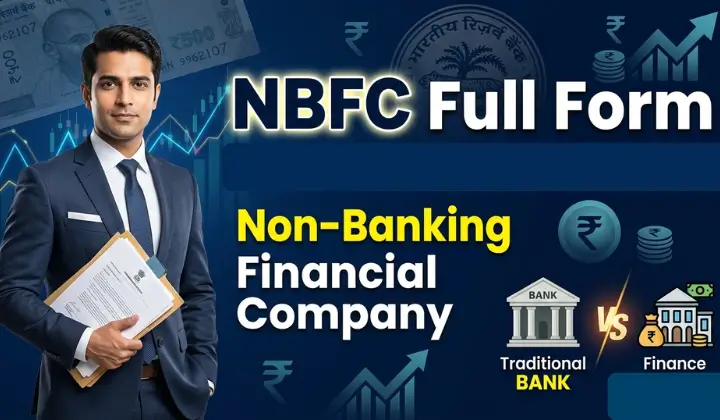
The financial sector in India is not limited to banks alone. A major role in credit distribution and financial inclusion is played by NBFCs. In this article, we will understand the NBFC Full Form, meaning, functions, types, regulations, and key differences between NBFCs and banks.
What is NBFC?
A Non-Banking Financial Company (NBFC) is a company registered under the Companies Act, 2013 (earlier Companies Act, 1956) and regulated by the Reserve Bank of India (RBI). As per RBI’s updated regulatory framework (2026), an NBFC is a company engaged in:
- Loans and advances
- Acquisition of shares, stocks, bonds, debentures, and securities
- Leasing and hire-purchase
- Insurance business
- Chit business
- Asset financing and infrastructure funding
- Microfinance and MSME financing
However, NBFCs do not include companies primarily engaged in:
RBI also includes companies whose principal business involves receiving deposits under schemes or arrangements (subject to regulations).
- Agriculture activities
- Industrial production
- Trading of goods (other than securities)
- Real estate construction or sale
Key Functions of NBFC
Non-Banking Financial Companies (NBFCs) play a significant role in strengthening India’s financial ecosystem. While they do not operate as banks, they provide a wide range of financial services that support individuals, businesses, startups, and large infrastructure projects. In 2026, NBFCs continue to expand their role in credit distribution, financial inclusion, and economic growth. Below are the major functions performed by NBFCs.
| Function | Meaning | Key Features / Examples | Purpose |
| Hire Purchase Services | Financing arrangement where goods are sold on instalments and ownership transfers after full payment. | Vehicles, machinery, consumer durables | Enables customers to buy assets without paying full amount upfront |
| Retail Financing | Short-term and medium-term loans provided to individuals. | Gold loans, personal loans, loan against property, loan against shares | Helps individuals meet personal and urgent financial needs |
| Trade Finance | Financial support provided to businesses for trade activities. | Dealer financing, distributor finance, vendor finance, working capital loans | Maintains liquidity and smooth business operations |
| Infrastructure Funding | Funding large-scale infrastructure and development projects. | Real estate, metro projects, airports, ports, highways, power projects | Supports national development and economic growth |
| Asset Management Services | Managing pooled funds from investors for investment in financial markets. | Investment in equity, debt, securities via fund managers | Generates returns for investors through professional management |
| Leasing Services | Providing assets on lease for a fixed period without transferring ownership. | Equipment leasing, machinery leasing, commercial property leasing | Allows businesses to use assets without purchasing them |
| Venture Capital Financing | Investment in early-stage startups with high growth potential. | Equity funding to startups and emerging businesses | Promotes entrepreneurship and innovation |
| MSME Financing | Financial support to Micro, Small and Medium Enterprises. | Business loans, equipment finance, working capital loans | Encourages employment and business expansion |
Difference Between NBFC and Bank
Although NBFCs and banks both operate in the financial sector and provide loans and investment services, they are not the same. Banks are full-fledged financial institutions governed by the Banking Regulation Act, while NBFCs are companies registered under the Companies Act and regulated by the RBI. The key differences lie in deposit acceptance, payment system participation, regulatory requirements, and operational powers. The table below highlights the major distinctions between banks and NBFCs as per the updated 2026 framework.
| Basis | Banks | NBFCs |
| Demand Deposits | Can accept demand deposits | Cannot accept demand deposits |
| Deposit Insurance | Covered under DICGC | Not covered under deposit insurance |
| Payment System | Part of RTGS, NEFT, UPI | Cannot issue cheques or be part of payment system like banks |
| Foreign Investment | Allowed up to 74% | Allowed up to 100% (subject to regulations) |
| CRR | Applicable | Not applicable |
| SLR | Applicable | Applicable only to certain deposit-taking NBFCs |
| CRAR | Applicable | Minimum 15% for systemically important NBFCs |
| SARFAESI Act | Applicable | Applicable |
| Incorporation | Banking Regulation Act | Companies Act, 2013 |
| Cheque Issuance | Allowed | Not allowed |







 Regional Languages in IBPS RRB PO and Cl...
 Is SBI Clerk Exam More Difficult Than IB...
 SBI CBO Interview Questions 2026, Check ...