
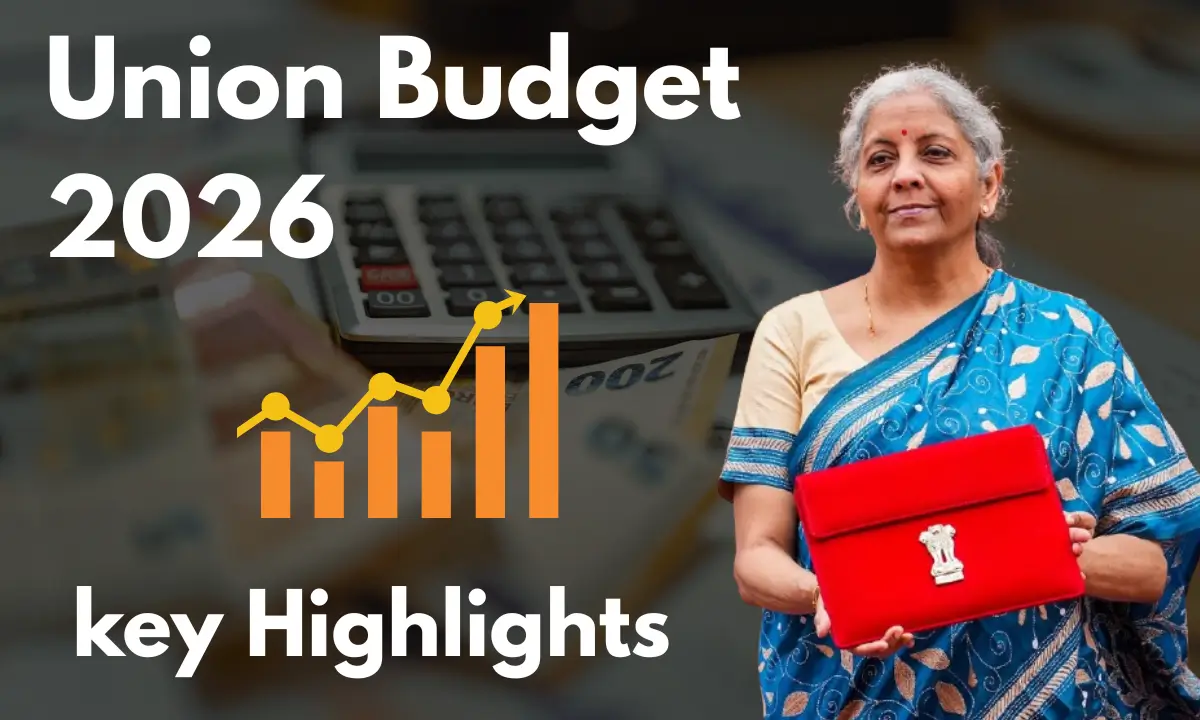
The Union Budget 2026 had announced on 1 February 2026 by Finance Minister Nirmala Sitharaman in Parliament. It is the government’s annual financial plan that outlines estimated revenue and expenditure for the upcoming financial year (April 2026 – March 2027), including tax proposals and spending on key sectors like education, health, defence, and infrastructure.
Union Budget 2026
The Union Budget is the Government of India’s annual financial statement that outlines how much money the government expects to earn and how it plans to spend it in the upcoming financial year. Presented by the Finance Minister in Parliament, it includes details about taxes, government spending on sectors like education, health, defence, and infrastructure, as well as the fiscal deficit.
Why Union Budget 2026 is Important
The Union Budget is important because it decides how the government will collect and spend money to run the country and support development. It shapes tax policies, funds key sectors, and influences economic stability, making it a major factor in the daily lives of citizens.
- Sets Tax Policies – Affects income tax, business tax, and indirect taxes
- Allocates Government Spending – Funds health, education, defence, and infrastructure
- Supports Welfare Schemes – Provides money for social and public benefit programs
- Drives Economic Growth – Encourages investment, jobs, and business activity
- Controls Fiscal Deficit – Manages government borrowing and financial stability
- Impacts Daily Life – Influences prices, services, and employment opportunities
Union Budget 2026 First Time in History
This marks the first time in the history that the Union Budget is being presented on a Sunday. The Budget Session of Parliament started on January 28 and will continue until April 2. However, February 1 was not always the official Budget date. Until 2017, the Union Budget was usually presented on the last working day of February.
Union Budget 2026 Highlights
The Union Budget 2026 introduced several key announcements aimed at strengthening India’s economy, supporting development, and improving the lives of citizens. The Finance Minister outlined major policy decisions, tax updates, and sector-wise allocations that will shape the country’s financial and economic direction for the year ahead.
Defence Highlights
- Annual defence production crosses ₹1.3 lakh crore, targeting ₹3 lakh crore by 2029.
- Defence exports jump from <₹2,000 crore (2015) to ₹21,000 crore (FY25), target ₹50,000 crore by 2029.
- Defence outlay rises from ₹1.8 lakh crore → ₹2.3 lakh crore, focusing on modernization.
- 65% of defence procurement now from domestic suppliers; private sector contributes 23%.
- Milestone towards Atmanirbhar Bharat in defence and global competitiveness.
Taxation & Compliance Reforms
- Simplified Income Tax rules and redesigned ITR forms, effective April 1, 2026.
- New Income Tax Act to reduce litigation, decriminalise minor offences, and encourage voluntary compliance.
- TCS/TDS rationalization:
- Overseas education & medical expenses: 5% → 2%
- Overseas tour packages: 2% TCS
- Manpower services: 1–2% TDS
- Foreign income/assets compliance scheme: immunity for disclosure ≤ ₹5 crore.
- Tax holiday until 2047 for foreign companies providing cloud services using Indian data centres.
- Safe harbour rules for IT/ITeS services simplified: common margin 15.5%.
- Tax exemption for non-residents in bonded zones and component manufacturing (2% profit margin).
- Dividend income tax exemption for notified National Cooperative Federations (3 years).
Financial Sector & Investment
- PROIs investment limit raised from 5% → 10%.
- Measures to deepen municipal & corporate bond markets, including ₹100 crore support for ₹1,000 crore bonds.
- Focus on MSME bond funding and public sector NBFC efficiency.
- Emphasis on financial inclusion, easier urban infrastructure financing, and capital market development.
Sectoral & Industrial Initiatives
- Biopharma Shakti: ₹10,000 crore investment over 5 years for research & domestic manufacturing.
- India Semiconductor Mission 2.0 (ISM 2.0) for equipment & material design.
- Container manufacturing ecosystem: ₹10,000 crore push.
- Mega Textile Parks & National Fibre Scheme (self-reliance in silk/wool).
- Rare Earth Corridor: Odisha, Kerala, Tamil Nadu, Andhra Pradesh.
- Sports goods & sports shoes manufacturing units.
- Chemical parks under plug-and-play model.
Urban, Infrastructure & Connectivity
- Public CapEx: ₹12.2 lakh crore (infra-led growth).
- 7 new high-speed rail corridors (Mumbai–Pune, Hyderabad–Bengaluru, Chennai–Bengaluru, Delhi–Varanasi, Varanasi–Siliguri).
- Dedicated Freight Corridors (Dankuni–Surat) + 20 new National Waterways.
- East Industrial Corridor from Durgapur; 4,000 e-buses for green urban transport.
- University townships near industrial/logistics corridors.
Agriculture, Rural & Women Empowerment
- Bharat Vistaar: AI-powered agri-advisory tool.
- Dedicated schemes for cashew & coconut (exports & income support).
- Divyangjan Kaushal Yojana for employment.
- SHE Marks for rural women entrepreneurs.
- Fisheries & livestock: credit-linked subsidies, FFPO strengthening.
Tourism, Heritage & Sports
- Expansion of Buddhist Circuit in Northeast.
- National Institute of Hospitality, tourist guide upskilling, eco-tourism trails.
- Development of 15 major archaeological & heritage sites.
- Expansion of Khelo India Mission & sports infrastructure.
- Hosting International Big Cat Alliance summit.
Education, Skills & Creative Economy
- AVGC sector push: labs in 15,000 schools + 500 colleges; Indian Institute of Creative Technology.
- Institute of Design in Eastern India.
- STEM capital support for girls.
- Veterinary sector expansion: 20,000+ new professionals.
- High-powered standing committee to link education, skilling, and enterprise.
Financial & Banking Reforms
- Comprehensive review of FEMA framework, especially for non-debt instruments, to attract stable foreign investment.
- High-level Banking Sector Committee to recommend reforms aligned with Viksit Bharat goals.
- New Infrastructure Risk Guarantee Fund to ease financing of large infrastructure projects.
- Commitment to fiscal discipline under FRBM Act, 2003.
Infrastructure & Connectivity
- Public Capital Expenditure raised to ₹12.2 lakh crore, continuing infra-led growth.
- 7 new high-speed rail corridors (Mumbai–Pune, Hyderabad–Bengaluru, Chennai–Bengaluru, Delhi–Varanasi, Varanasi–Siliguri, etc.).
- New Dedicated Freight Corridors (Dankuni–Surat) to reduce logistics costs.
- Development of 20 new National Waterways over 5 years.
- Tunnel boring equipment to be manufactured in India.
Urban Development
- Cities declared engines of growth, focus on Tier II & Tier III cities.
- ₹5,000 crore per city for urban infrastructure development.
- Special push for cities with population above 5 lakh.
Manufacturing & Industry
- ₹10,000 crore Biopharma Shakti to boost domestic innovation.
- India Semiconductor Mission 2.0 (ISM 2.0) for equipment and material design.
- ₹40,000 crore outlay for Electronics Components Manufacturing Scheme.
- ₹10,000 crore container manufacturing ecosystem.
- Chemical Parks under plug-and-play model.
- Dedicated manufacturing unit for sports shoes & sports goods.
- Mega Textile Parks and National Fibre Scheme (silk & wool self-reliance).
- Rare Earth Corridor covering Odisha, Kerala, Tamil Nadu & Andhra Pradesh.
MSME & Employment
- Creating Champion SMEs: revival of 200 legacy industrial clusters.
- ₹2,000 crore top-up to Self-Reliant India Fund.
- Faster MSME payments via transaction settlement platform.
- “Corporate Mitras” in Tier II & III towns with ICAI & ICMAI support.
Green Tech, Tourism & Aviation
- Push for Carbon Capture, Utilisation & Storage (CCUS) as per national roadmap.
- Incentives for indigenous seaplane manufacturing.
- Enhanced last-mile & remote connectivity to boost tourism.
Vision-Oriented Initiatives
- Budget driven by Yuvashakti and three Kartavyas.
- High-level committee for Viksit Bharat Roadmap.
- Expansion of REM Corridors for regional industrial growth.

 RBI Assistant Admit Card 2026 Out at rbi...
 Exim Bank Management Trainee Admit Card ...
 NIACL AO Final Result 2026 Out, Download...