The UPSC Civil Services Examination (CSE) is considered one of the most prestigious and challenging competitive exams in India. The UPSC Syllabus 2026 serves as a roadmap for candidates aiming to secure top services such as IAS, IPS, IFS, and IRS. Understanding the syllabus for both Prelims and Mains helps aspirants plan effectively, identify key subjects, and manage their study schedule with clarity. With multiple topics spanning history, polity, economy, environment, current affairs, and ethics, knowing the complete syllabus is the first step toward structured preparation for the CSE.
UPSC Syllabus 2026
The UPSC Syllabus 2026 includes two stages of written examination: Prelims, which tests objective understanding of general studies and aptitude, and Mains, which evaluates analytical writing, comprehension, and in-depth knowledge of various subjects. Candidates must study the syllabus carefully and relate topics to current events to prepare effectively. The detailed syllabus outlines what to read, what to revise regularly, and which areas require deeper conceptual clarity. Consistent preparation based on the syllabus can significantly improve exam performance and confidence.
UPSC CSE Syllabus 2026: Overview
Whether you’re an experienced candidate or a newcomer, understanding the UPSC Syllabus 2026 is a crucial step toward preparation. An overview has been provided below in tabular form regarding UPSC.
| UPSC Syllabus 2026: Overview | |
| Conducting Body | Union Public Service Commission |
| Exam Name | Civil Services Exam |
| Post | IAS, IPS, IRS, etc. |
| Vacancy | To be announced |
| UPSC CSE 2026 Selection Process | Prelims, Mains & Interview |
| UPSC Official Website | upsc.gov.in |
| WhatsApp Official Channel | Join WhatsApp Channel |
UPSC Syllabus 2026: Exam Pattern
UPSC CSE 2026 comprises three stages: Preliminary Exam, Mains Examination & Interview. The Preliminary exam is an objective-type test consisting of two papers, each worth 200 marks, while the Mains Examination is a descriptive-type test comprising nine papers, including language & optional papers. The details are mentioned below.
UPSC Syllabus 2026 (Prelims)
The UPSC Syllabus 2026 (Prelims) is an objective type test consisting of two papers of 400 marks (200 marks each). The Prelims phase demands sharp GK, analytical ability, and basic numerical skills.
| UPSC Prelims Syllabus | |||
| Paper | Max. Marks | Duration | |
| Paper I | General Studies – I | 200 | 2 hours |
| Paper II | General Studies – II: CSAT (Civil Services Aptitude Test) | 200 | 2 hours |
Note: There is a negative marking of 1/3 (one-third) for every answer marked wrong.
Note: General Studies II (CSAT) will be the qualifying in nature (qualifying marks is 33% i.e. 66 marks)
UPSC Prelims Syllabus 2026
General Studies Paper I – (200 marks)
- Recent National & International Importance.
- India’s History & Indian National Movement.
- Geography of India and the World, covering Physical, Social, and Economic aspects.
- Indian Polity & Governance – Constitution, Political System, Panchayati Raj, Public Policy, Rights, Issues, etc.
- Economics and Social Development, including Sustainable Development, Poverty, Demographics, Social Sector Initiatives, etc.
- General issues on Environmental Ecology, Bio-Diversity & Climate Change – without specialized knowledge.
- General Science
General Studies Paper II (CSAT) – (200 marks)
- Reading Comprehension
- Interpersonal Skills, including communication skills
- Logical Reasoning and Analytical Abilities
- Decision-making & Problem-solving
- General Mental Aptitude
- Fundamental Numerical Ability (Numbers and their relations, order of magnitude, etc.) (Class X level)
- Data Interpretation- Charts, Graphs, Tables, & Data Sufficiency (also class X level)
UPSC Syllabus 2026 (Mains)
The primary aim of the Main Examination is to evaluate the candidate’s intellectual capabilities and depth of understanding. The UPSC Syllabus 2026 (Mains) consists of nine papers of descriptive type.
| UPSC Mains Syllabus | |||
| Paper | Max. Marks | Duration | |
| Qualifying Papers | |||
| Paper A | One of the Indian Languages (Schedule VIII of the Constitution of India) | 300 | 3 hours |
| Paper B | English | 300 | 3 hours |
| Merit-based Papers | |||
| Paper I | Essay | 250 | 3 hours |
| Paper II | General Studies- I | 250 | 3 hours |
| Paper III | General Studies- II | 250 | 3 hours |
| Paper IV | General Studies- III | 250 | 3 hours |
| Paper V | General Studies- IV | 250 | 3 hours |
| Paper VI | Optional Subject- I | 250 | 3 hours |
| Paper VII | Optional Subject- II | 250 | 3 hours |
| Total (Merit-based papers only) | 1750 | – | |
UPSC Mains Syllabus 2026
Paper A– Indian Language (any one)
- Comprehension of given passages
- Precis Writings
- Usage and Vocabulary
- Short Essays
- Translation from Indian Language to English & vice-versa.
For the Indian language paper, a candidate has to select a language from the following:
| Indian Languages | ||||
| Assamese | Bengali | Gujarati | Hindi | Kannada |
| Kashmiri | Konkani | Malayalam | Manipuri | Marathi |
| Nepali | Odia | Punjabi | Sanskrit | Sindhi |
| Tamil | Telugu | Urdu | Bodo | Dogri |
| Maithili | Santhali | |||
Paper B – English
- Comprehension of given passages
- Precis Writings
- Usage and Vocabulary
- Short Essays
Paper I: Essay
Essays on multiple topics
Paper II: General Studies I– Indian Heritage & Culture, World History & Geography, and Society
- Indian Culture- Salient aspects of Art Forms, Literature, and Architecture from ancient to modern times
- Modern Indian History- Mid-Eighteenth century until present
- The Freedom Struggle- different stages and significant personalities & their contributions (across the country)
- Post-independence consolidation & Reorganisation within the country
- World History- Events from the 18th century: Industrial Revolution, World Wars, National Boundaries redrawal, colonization-decolonisation, political philosophies, etc.
- Indian Society, Diversity of India
- Role of Women & Women’s Organisations, Population & its issues, Poverty & developmental issues, Urbanisation; their problems & remedies
- Globalization’s Effect on Indian Society
- Social empowerment, communalism, regionalism & secularism
- World’s Physical Geography
- Natural resources’ distribution across the world; Responsible factors for Primary, Secondary & Tertiary sectors’ location
- Important Geophysical phenomena such as earthquakes, tsunamis, Volcanic activity, cyclones, etc.
Paper III: General Studies II– Governance, Constitution, Polity, Social Justice & International Relations
- Constitution of India- History, Evolution, Amendments, Significant Provisions and Basic Structure
- The Union & the States
- Power Separation
- Parliament & State Legislature
- The Executive & the Judiciary
- Representation of People’s Act
- Constitutional Bodies
- Judicial Bodies
- Government policies and interventions
- The development industry & its processes – NGOs, SHGs, etc
- Welfare schemes by the Centre and States
- Issues related to poverty & hunger
- Issues relating to the development and management of the Social Sector
- Important aspects of governance, transparency and accountability, E-governance
- Role of civil services in a democracy.
- India and its neighbourhood- relations
- Important International institutions, agencies
Paper IV: General Studies III– Technology, Economic Development, Bio diversity, Environment, Security and Disaster Management
- Indian Economy
- Inclusive growth & its issues
- Government Budgeting
- Major crops; irrigation system; e-technology in the aid of farmers.
- Direct & indirect farm subsidies and MSP; PDS; buffer stock & food security; animal-rearing
- Food processing and related industries in India
- Land reforms in India.
- Liberalization & its impact
- Infrastructure: Energy, Ports, Roads, Airports, Railways etc.
- Investment models
- Science and Technology- developments and their applications and effects in everyday life.
- Achievements of Indians in science & technology
- Awareness in the fields of IT, Space, Computers, robotics, nano-technology, bio-technology, and issues relating to intellectual property rights.
- Environmental impact- Conservation, pollution and degradation
- Disaster and disaster management
- Role of External State and non-state factors in creating challenges to internal security
- Border Areas- Security challenges and their management
- Various Security forces and agencies
Paper V: General Studies IV– Ethics, Integrity & Aptitude
- Issues relating to integrity, probity in public life, and the problem-solving approach of a candidate
- Ethics & Human Interface
- Attitude; Moral & Political Attitude; social influence and persuasion
- Aptitude and foundational values for Civil Service, integrity, impartiality and non-partisanship
- Emotional Intelligence
- Philosophers & Moral Thinkers (from India & World)
- Public/Civil Service Values and Ethics in Public Administration
- Probity in Governance
Paper VI & Paper VII: Optional Subject Paper I & II
Candidates have to choose one of the optional subjects of their choice from the list below
| Optional Subjects | |||
| Agriculture | Animal Husbandry & Veterinary Science | Anthropology | Botany |
| Chemistry | Civil Engineering | Commerce & Accountancy | Economics |
| Electrical Engineering | Geography | Geology | History |
| Law | Management | Mathematics | Mechanical Engineering |
| Medical Science | Philosophy | Physics | Political Science & International Relations |
| Psychology | Public Administration | Sociology | Statistics |
| Zoology | Literature (Schedule VIII of Indian Constitution) | ||
UPSC Syllabus 2026: Interview
The objective of the interview is to assess the personal suitability of a candidate in the civil services. Candidates who qualify in the main examination will be called for an interview of 275 marks. Evaluation criteria include mental alertness, assimilation ability, the balance of judgement, interest variety & depth, intellectual, and moral integrity, social cohesion & leadership, etc.
| Total Marks | |
| Mains Examination (Merit-based papers only) | 1750 marks |
| Interview (Personality Test) | 275 marks |
| Total | 2025 marks |
Understanding the syllabus & paper-wise weightage, and exam pattern helps in forming a plan for UPSC CSE. Whatever you choose in the optional subject, honing your General Studies papers and focused writing practice is the key to acing the UPSC CSE Exam.




 SBI Clerk Apply Online 2026 Link Active,...
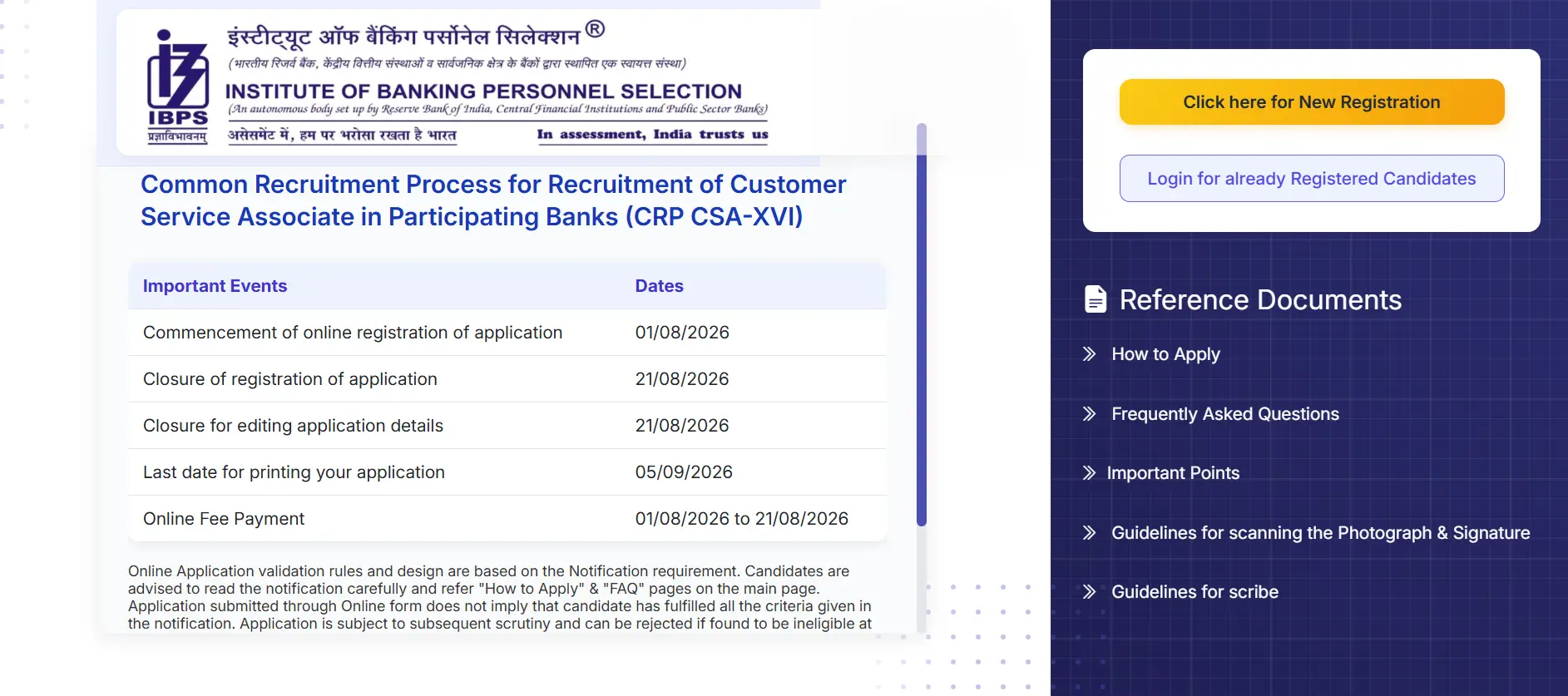 IBPS Clerk Apply Online 2026 @ibps.in, D...