
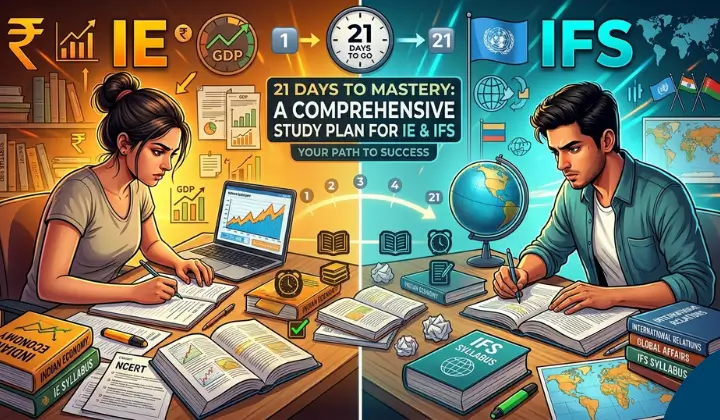
Preparing for IE & IFS (Indian Economy & Indian Financial System) in just 21 days may look challenging, but with a structured study plan, smart prioritization, and consistent revision, you can still score very well in the exam. This article gives you a complete 21-day roadmap, including module-wise weightage, daily schedule, preparation strategy, and high-scoring topics.
How to approach IE and IFS Syllabus in 21 Days?
The JAIIB IE & IFS Exam requires a strong balance of conceptual understanding and practical application. With limited time in hand, it becomes essential to focus on high-weightage modules and follow a structured plan. This 21-day strategy is designed to help you cover the syllabus efficiently, practice enough MCQs, and revise effectively. By following this plan, candidates can improve accuracy, strengthen weak areas, and approach the exam with better confidence and clarity.
IE & IFS Module-Wise Weightage (Expected MCQs)
The JAIIB IE & IFS Exam follows a structured distribution of questions, where certain modules carry more importance than others. Knowing this breakdown helps aspirants allocate their time wisely and concentrate on areas that can fetch higher marks. It also allows better planning by aligning preparation with scoring opportunities.
| Module | Subject Area | Expected Weightage |
| Module D | Financial Products & Services | 35% |
| Module B | Economic Concepts | 25% |
| Module C | Financial Architecture | 22% |
| Module A | Indian Economy | 18% |
21-Day IE & IFS Study Plan
To make the most of limited time, a well-defined schedule is essential. This plan is designed to gradually build understanding, strengthen key concepts, and ensure timely practice. By dividing the preparation into phases, candidates can cover the syllabus efficiently while maintaining consistency and improving overall performance.
Week 1 Module D – Financial Products & Services
This is the highest-weighted module, so start here to build a strong scoring base.
| (Days 1–7) | ||
| Day | Topics | Practice |
| Day 1 | Financial Markets and Money Markets | 30 MCQs |
| Day 2 | Capital Markets, Debt and Bond Markets | 30 MCQs |
| Day 3 | Forex Markets and Market Dynamics | 30 MCQs |
| Day 4 | Merchant Banking and Derivatives | 30 MCQs |
| Day 5 | Factoring, Forfaiting, Venture Capital, Leasing | 30 MCQs |
| Day 6 | Credit Rating, Mutual Funds, Insurance | 30 MCQs |
| Day 7 | Pension Systems + Full Revision | 40 MCQs |
Week 2 : Module B + Module A Economic Concepts
This week focuses on economic concepts and Indian economy fundamentals.
| Day | Topics | Practice |
| Day 8 | Micro & Macro Economics, Demand & Supply | 30 MCQs |
| Day 9 | Money Supply, Inflation, Interest Theories | 30 MCQs |
| Day 10 | Business Cycles, Monetary & Fiscal Policy | 30 MCQs |
| Day 11 | GDP, GNP, Budget Concepts | 30 MCQs |
| Day 12 | Full Revision + Mock Test | 50 MCQs |
| Module A: Indian Economy | ||
| Day | Topics | Practice |
| Day 13 | NITI Aayog, Priority Sector, MSME | 30 MCQs |
| Day 14 | LPG Reforms, WTO, Economic Reforms | 30 MCQs |
Week 3 (Days 15–21): Module C + Final Revision
This week focuses on financial system structure and exam simulation.
| Module C: Financial Architecture | ||
| Day | Topics | Practice |
| Day 15 | Financial System, Banking System & Laws | 30 MCQs |
| Day 16 | DFIs, NBFCs, Microfinance | 30 MCQs |
| Day 17 | Insurance, Regulators, Banking Reforms | 30 MCQs |
| Day 18 | Full Revision + Mock Test | 50 MCQs |

Final Preparation Phase
| Day | Plan |
| Day 19 | Full Syllabus Mock Test (100 MCQs, Timed) |
| Day 20 | Weak Area Revision (Based on Analysis) |
| Day 21 | Final Revision + Quick Mock |
Preparation Strategy for Maximum Score
1. Focus on High-Weight Areas
Prioritize:
- Financial Products & Services
- Economic Concepts
These alone can secure a major portion of your score.
2. Follow a Daily Study Routine
A balanced routine improves retention:
- 2–3 hours focused study
- Daily MCQ practice
- Quick revision of previous topics
3. Importance of Mock Tests
Mock tests help you identify:
- Weak areas
- Time management issues
- Question patterns
Start mocks after covering major syllabus and increase frequency in the final week.
4. Effective Revision Technique
Use a 3-layer revision method:
- Same-day revision
- 3-day revision cycle
- Final revision before exam
This ensures long-term retention and recall accuracy.






 NICL Assistant Mains Exam Date 2026 Out ...
 SBI Data Leak Shock! 3.75 Lakh Customer ...
 UIIC AO Admit Card 2026 Out: Download Li...