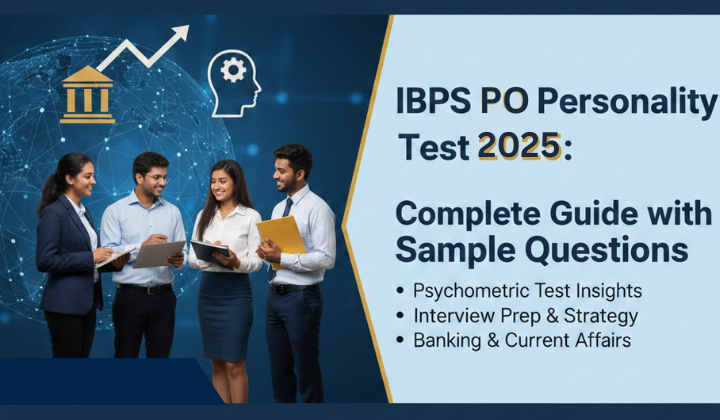
The IBPS PO Personality Test 2025 introduces an evaluation stage designed to assess behavioural traits, workplace attitude, and suitability for banking roles. As the recruitment process evolves, candidates are now expected to demonstrate not only academic and analytical skills but also psychological and interpersonal competencies. This stage helps IBPS understand how well an individual aligns with the demands of managerial responsibilities in the banking sector.
IBPS PO Personality Test 2025
The Personality Test, newly introduced in recent years, is mandatory but generally non-qualifying in nature for IBPS PO. The profile generated from this test is placed before the interview panel. It is typically conducted online and often involves psychometric questions to gauge your mental and behavioural stability, ethics, and ability to adapt.
What Is the IBPS PO Personality Test?
The IBPS PO Personality Test/Interview is a face-to-face evaluation conducted by a panel of 3–5 members. It assesses areas like banking awareness, situational judgment, professional attitude, and interpersonal skills. The interview carries 100 marks, and a good score can significantly boost your final merit ranking.
Key Focus Areas of the IBPS PO Personality Test 2025
The IBPS PO Personality Test evaluates candidates beyond written knowledge, focusing on how well they can handle real-world banking situations. To score well, aspirants must demonstrate strong communication skills, practical awareness of the financial sector, balanced decision-making, and a professional attitude. The panel closely observes these key areas to determine whether a candidate is truly fit for the role of a Probationary Officer.
- Communication & Clarity: Your ability to express thoughts clearly and confidently.
- Banking & General Awareness: Basic understanding of financial terms, RBI updates, government schemes, and economic concepts.
- Situational Judgement: How you react to real-life banking scenarios involving customers, pressure, or ethical dilemmas.
- Leadership & Team Behaviour: Your ability to work together, motivate others, and take responsibility.
- Personal Background: Questions related to your academics, hobbies, experiences, or gaps in education/work.
Sample Questions for IBPS PO Personality Test 2025
Q1. I continue working on an assignment even when it becomes monotonous or tiring.
(a) Agree or Strongly Agree
(b) Disagree or Strongly Disagree
Q2. I often need someone to remind me to complete my tasks on time.
(a) Agree or Strongly Agree
(b) Disagree or Strongly Disagree
Q3. I believe it is acceptable to slightly bend rules if it makes things easier.
(a) Agree or Strongly Agree
(b) Disagree or Strongly Disagree
Q4. I try to keep my desk and digital files arranged in an orderly way.
(a) Agree or Strongly Agree
(b) Disagree or Strongly Disagree
Q5. I feel uncomfortable sharing confidential office information with anyone outside work.
(a) Agree or Strongly Agree
(b) Disagree or Strongly Disagree
Q6. I avoid participating in group discussions whenever possible.
(a) Agree or Strongly Agree
(b) Disagree or Strongly Disagree
Q7. I usually speak without thinking much about how my words may affect others.
(a) Agree or Strongly Agree
(b) Disagree or Strongly Disagree
Q8. I often analyse my mistakes to understand what went wrong.
(a) Agree or Strongly Agree
(b) Disagree or Strongly Disagree
Q9. I feel comfortable approaching new people when work requires it.
(a) Agree or Strongly Agree
(b) Disagree or Strongly Disagree
Q10. I often start tasks without planning and figure things out as I go along.
(a) Agree or Strongly Agree
(b) Disagree or Strongly Disagree
Q11. I decide the order of my tasks after considering what is most important.
(a) Agree or Strongly Agree
(b) Neutral / Sometimes
(c) Disagree or Strongly Disagree
Q12. I make an effort to understand how my behaviour appears to others at work.
(a) Agree or Strongly Agree
(b) Neutral / Sometimes
(c) Disagree or Strongly Disagree
Q13. If a task is repetitive, I gradually reduce my effort on it.
(a) Agree or Strongly Agree
(b) Neutral / Sometimes
(c) Disagree or Strongly Disagree
Q14. I like to take the lead in coordinating work when my team is unsure how to proceed.
(a) Agree or Strongly Agree
(b) Neutral / Sometimes
(c) Disagree or Strongly Disagree
Q15. I sometimes set aside official procedures if I personally feel my way is better.
(a) Agree or Strongly Agree
(b) Neutral / Sometimes
(c) Disagree or Strongly Disagree
Q16. I keep my physical and digital workspace properly sorted so that I can find things easily.
(a) Strongly Agree
(b) Agree
(c) Disagree
(d) Strongly Disagree
Q17. I regularly review my work before submitting it to check for errors.
(a) Strongly Agree
(b) Agree
(c) Disagree
(d) Strongly Disagree
Q18. I rarely think about long-term consequences when making day-to-day decisions.
(a) Strongly Agree
(b) Agree
(c) Disagree
(d) Strongly Disagree
Q19. I avoid initiating conversations with new colleagues even when collaboration would help the work.
(a) Strongly Agree
(b) Agree
(c) Disagree
(d) Strongly Disagree
Q20. I continue to follow ethical standards even when I am under pressure to compromise.
(a) Strongly Agree
(b) Agree
(c) Disagree
(d) Strongly Disagree
Q21. I plan my workday in advance and rarely need to rush at the last minute.
(a) Strongly Agree
(b) Agree
(c) Neutral
(d) Disagree
(e) Strongly Disagree
Q22. I make sure that my behaviour does not create discomfort or embarrassment for others in the workplace.
(a) Strongly Agree
(b) Agree
(c) Neutral
(d) Disagree
(e) Strongly Disagree
Q23. When my team faces difficulties, I stay involved until the issue is resolved.
(a) Strongly Agree
(b) Agree
(c) Neutral
(d) Disagree
(e) Strongly Disagree
Q24. I keep giving consistent effort even when I am not immediately appreciated or rewarded.
(a) Strongly Agree
(b) Agree
(c) Neutral
(d) Disagree
(e) Strongly Disagree
Q25. I see it as my responsibility to maintain personal discipline, even when the environment around me is relaxed.
(a) Strongly Agree
(b) Agree
(c) Neutral
(d) Disagree
(e) Strongly Disagree
| Q.No. | Answer | Explanation | Trait Tested | Ideal Answer |
| 1 | (a) | Shows persistence even when work becomes monotonous; essential for routine-heavy roles. | Perseverance | (a) |
| 2 | (b) | Indicates self-driven behaviour and independent responsibility handling. | Self Disciplined | (b) |
| 3 | (b) | Reflects respect for rules and non-negotiable procedures, crucial in banking. | Rule Bound | (b) |
| 4 | (a) | Suggests strong organisational habits and structured working style. | Rules and Orderliness | (a) |
| 5 | (a) | Demonstrates ethical integrity and respect for confidentiality. | Moral Standard | (a) |
| 6 | (b) | Shows willingness to collaborate and participate in team decisions. | Team Spirit | (b) |
| 7 | (b) | Reflects thoughtful, respectful communication and social sensitivity. | Socially Precise | (b) |
| 8 | (a) | Indicates responsibility and learning from mistakes, supporting improvement. | Conscientious | (a) |
| 9 | (a) | Shows sociability and comfort in initiating communication. | Extrovert / Introvert | (a) |
| 10 | (b) | Suggests preference for planning and structure before taking action. | Consciousness | (b) |
| 11 | (a) | Indicates logical task prioritisation and clarity in handling responsibilities. | Foresight Parameter | (a) |
| 12 | (a) | Shows self-awareness and social mindfulness for harmonious interactions. | Socially Precise | (a) |
| 13 | (c) | Demonstrates sustained effort even during repetitive tasks. | Perseverance | (c) |
| 14 | (a) | Indicates initiative and willingness to support team progress. | Team Spirit | (a) |
| 15 | (c) | Shows adherence to established procedures over personal convenience. | Rule Bound | (c) |
| 16 | (a) | Points to organised behaviour and strong habit of orderliness. | Rules and Orderliness | (a) |
| 17 | (b) | Reflects seriousness about accuracy and quality of work. | Conscientious | (b) |
| 18 | (d) | Suggests forward-thinking and considering long-term consequences. | Foresight Parameter | Strongly Disagree |
| 19 | (c) | Indicates willingness to step out of comfort zone for teamwork. | Extrovert / Introvert | Disagree |
| 20 | (a) | Shows strong moral values and resistance to unethical decisions. | Moral Standard | Strongly Agree |
| 21 | (b) | Shows balanced planning and time management abilities. | Consciousness | Agree |
| 22 | (a) | Indicates high sensitivity and respect for others’ comfort and perception. | Socially Precise | Strongly Agree |
| 23 | (a) | Shows commitment to team goals even during tough phases. | Team Spirit | Strongly Agree |
| 24 | (b) | Reflects emotional stability and internal motivation to stay productive. | Perseverance | Agree |
| 25 | (a) | Shows strong internal discipline, independent of supervision. | Self-disciplined | Strongly Agree |

IBPS PO Personality Test 2025 Weightage in Final Selection
The final merit list for the IBPS PO selection is based on a composite score derived from the IBPS PO Mains Exam and the Interview. You must score a minimum of 40% (35% for SC/ST/OBC/PwD) in the interview to be considered for final selection.
- Mains Exam Score: 80% Weightage
- Interview Score (out of 100 marks): 20% Weightage

 Assam Cooperative Apex Bank Recruitment ...
 Bank of Baroda Peon Mains Admit Card 202...
 World Forest Day 2026, Date, Theme, Hist...