
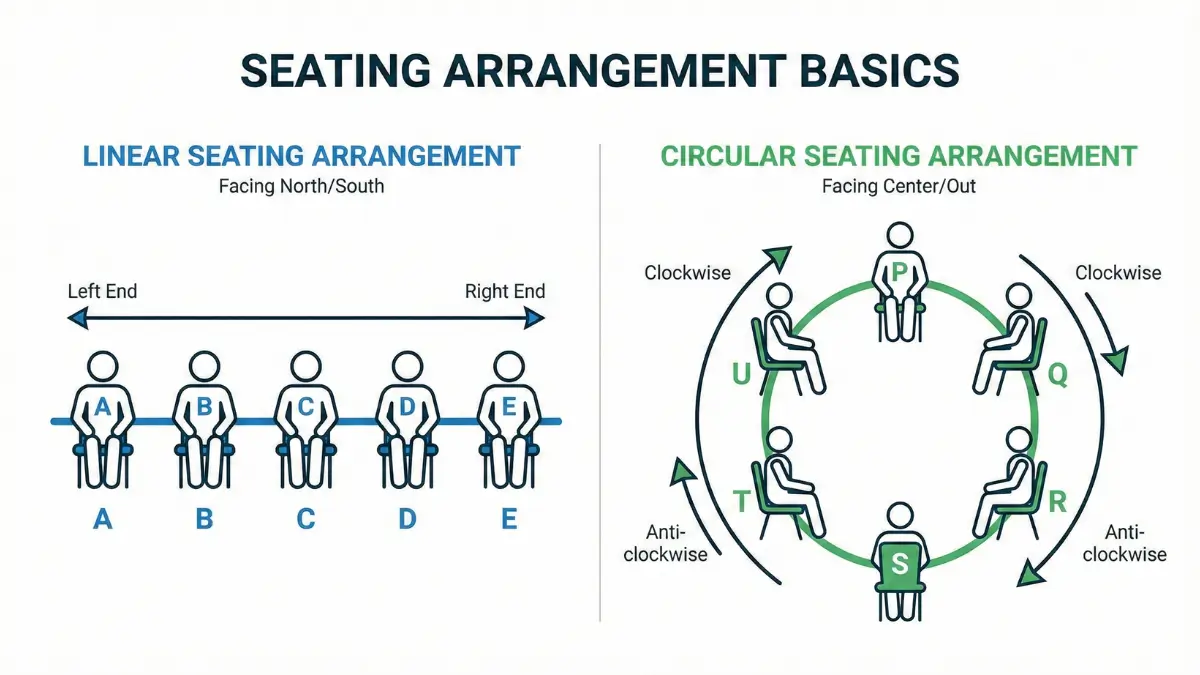
Seating arrangement is one of the most scoring and game-changing topics in Reasoning for banking and other competitive exams. It tests your ability to decode positions, directions, and relationships between people arranged in a line or around a circle. While it may look confusing at first, once you grasp the basic concepts and rules, it becomes one of the easiest sections to master and score high in. Let’s break down Linear and Circular seating arrangements in a simple and beginner-friendly way.
Seating Arrangement Questions – Basic Idea & Types
Seating arrangement questions are logic-based puzzles where you are given a set of clues about how people are seated, and you have to arrange them correctly. These questions are mainly of two types Linear Seating Arrangement (people sitting in a straight line) and Circular Seating Arrangement (people sitting around a circle). In exams, variations may also include square, rectangular, or double-row arrangements, but the core logic remains the same. The main goal is to understand the clues, apply direction rules, and form the correct seating order step by step.
Linear Seating Arrangement Basics
In a linear arrangement, all people sit in a straight line, and they face either North or South. The direction decides how left and right are counted.
Basic Rules
- If a person faces North, their left is your left, and their right is your right.
- If a person faces South, the directions reverse left becomes right, and right becomes left.
- Words like immediate left, second right, third from the left end, and at one end help you place people correctly.
- Phrases such as “between”, “adjacent”, and “exactly left/right” are key to understanding the relative position.
Simple Example
- “A sits second to the right of B” means count two seats on B’s right side.
- “C sits at one end” means C is either at the extreme left or extreme right of the row.
Circular Seating Arrangement Basics
In a circular arrangement, people sit around a circle and face either towards the center or away from the center.
Direction rules are slightly different here.
If facing the centre:
- Left to Anticlockwise
- Right to Clockwise
If facing outward:
- Left to Clockwise
- Right to Anticlockwise
Key Terms
- Opposite means sitting directly across.
- Immediate left/right means exactly next to the person.
- Between means sitting in the middle of two people.
How to Solve Seating Arrangement Questions
- Draw a rough diagram : Never solve mentally; always sketch to avoid confusion.
- Start with fixed clues : Clues like “A sits at one end” or “A sits opposite B” make it easier to begin.
- Place certain information first : Keep the tricky or unclear clues for later.
- Use the direction rules carefully : Knowing who faces which direction is the most important part.
- Make more than one diagram if needed : If a clue has two possible positions, create two diagrams and eliminate the wrong one later.

Important Keywords You Must Know
For Linear and Circular Seating Arrangement questions, students must know some fixed keywords related to direction, position and relationships. These keywords help in converting language statements into correct diagrams for bank and other competitive exams.
| Linear seating: core keywords | |
| Keyword/Phrase | Meaning |
| Left / Right | Direction from a fixed point in the row. |
| Immediate left / right | Exactly next seat on the left or right, no one in between. |
| Second / third to left/right | Two or three seats away on the left or right. |
| Extreme left / right end | First seat on the left or right side of the row. |
| At one of the ends | Sitting at either the left end or the right end. |
| Between | Sitting in the middle of two given persons. |
| Exactly between | Same number of persons on both sides between two given persons. |
| In the middle | Sitting at the centre of the row (when total seats are odd). |
| Next to / Adjacent | Sitting just beside another person. |
| Immediate neighbour | Person sitting directly next to someone. |
| Not an immediate neighbour | At least one person sitting between them. |
| Facing north / south | Direction of face; changes what is called left and right. |
| Facing same direction | Everyone is facing in the same given direction. |
| Facing opposite directions | Some face north and others face south. |
| Circular seating: core keywords | |
| Keyword/Phrase | Meaning |
| Facing centre | Everyone is looking towards the centre of the circle. |
| Facing outside | Everyone is looking away from the centre of the circle. |
| Left of / Right of | Position decided using clockwise/anticlockwise as per facing. |
| Immediate left / right | Exactly next seat on left or right in the circle. |
| Second / third to left/right | Two or three seats away on left or right in the circle. |
| Clockwise | Direction of clock movement around the circle. |
| Anticlockwise | Direction opposite to clock movement. |
| Opposite / Exactly opposite | Sitting directly across a person. |
| Immediate neighbours | Persons sitting on both sides of someone. |
| Between two persons | Sitting in the middle of two given persons. |
| Sitting together | Sitting side by side, no one in between. |
| Not sitting together | There is at least one seat gap between them. |
| Adjacent / Not adjacent | Adjacent: side by side; not adjacent: not side by side. |

 Why RBI Chose to Hold Repo Rate at 5.25%...
 Important Documents and Guidelines for R...
 What is the Job Role of Punjab and Sind ...