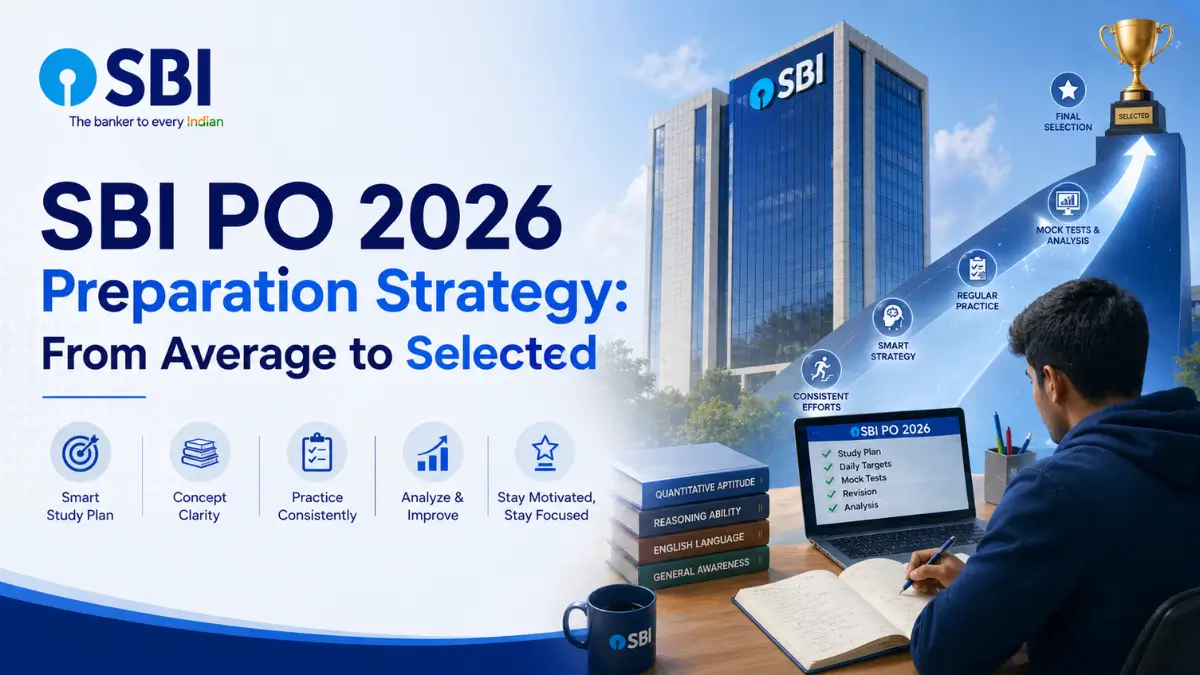
Every year, lakhs of aspirants sit for the SBI PO. Very few get selected. The gap between an average candidate and a selected one is rarely about intelligence — it is almost always about strategy.
The honest truth: SBI PO is not the hardest exam in banking. But it is one of the most competitive. The difference-maker is not how hard you study — it is how smartly you structure your preparation.
First, Understand What You Are Preparing For
Most aspirants start practising questions before they understand the exam properly. That is a mistake. Know the structure inside out before you study a single topic.
SBI PO Exam Structure
| Stage | Subjects / Components | Marks | Time | Counts in Merit? |
|---|---|---|---|---|
| Prelims | English (30) + Reasoning (35) + Quant (35) | 100 | 1 hour | No — shortlisting only |
| Mains | Reasoning & Computer (45) + Data Analysis (35) + GA & Economy (40) + English (35) | 200 + 50 (Descriptive) | 3 hrs + 30 min | Yes |
| Interview | Personal Interview | 30 | — | Yes |
Key things to note:
- Prelims score does NOT count in the final merit list — it only gets you to Mains
- Mains + Interview = 100% of your final selection score (roughly 75:25 weightage)
- Descriptive writing (Letter + Essay) in Mains is evaluated only if you clear the objective cut-off
- Each section in Prelims and Mains has an independent sectional cut-off
- Negative marking: 0.25 marks per wrong answer in both Prelims and Mains
Strategic implication: Do not over-invest in Prelims. Clear it comfortably — then shift your full focus to Mains. Most aspirants prepare for Prelims and hope Mains works out. That is why most aspirants do not get selected.
Honest Self-Assessment: Where Are You Right Now?
Before building your strategy, you need to know your actual starting point — not where you think you are.
Take one full Prelims mock test right now (before any preparation). Then answer these questions honestly:
- Which section did you score the lowest in?
- Which topics did you leave blank or guess entirely?
- Did you run out of time in any section?
- What was your overall accuracy percentage?
Based on your result, categorise yourself:
| Score Range (out of 100) | Where You Stand | Primary Focus |
|---|---|---|
| Below 40 | Basics are weak | Concepts first, then practice |
| 40–60 | Average — some topics covered | Plug topic gaps, start timed practice |
| 60–75 | Good foundation | Speed + accuracy drills, Mains topics |
| 75+ | Strong — focus on Mains | Mains-level difficulty + GA + Descriptive |
This assessment shapes everything that follows. Be brutally honest.
The Mindset Shift That Changes Everything
Average aspirants prepare to clear Prelims. Selected candidates prepare to top the Mains.
Internalise these five mindset shifts before you go further:
- Stop preparing in isolation. Every topic you study for Prelims should be taken to Mains-level depth. The extra effort is not wasted — it compounds.
- Mock tests are not practice — they are diagnosis. A mock without a 30-minute post-analysis is just wasted time. The analysis is where the real improvement happens.
- Accuracy before speed. Getting 60 questions right in 60 minutes beats getting 80 questions attempted with 50% accuracy every time — because of negative marking.
- GA is not optional. Most Prelims-focused candidates ignore General Awareness until the last week. In Mains, GA carries 40 marks and is the highest-weightage objective section. Ignore it and you cannot clear Mains no matter how good your aptitude is.
- Descriptive writing is winnable. Most aspirants are scared of the essay and letter writing component. In reality, a well-structured, well-presented answer with no major grammar errors comfortably scores 35+ out of 50. It is not a barrier — it is an opportunity.
SBI PO Subject-Wise Preparation Strategy
Quantitative Aptitude (Prelims + Mains)
What changes from Prelims to Mains:
- Prelims → straightforward arithmetic, number series, basic DI
- Mains → complex caselet DI, mixed DI, advanced arithmetic, data sufficiency
Build the foundation first:
- Memorise tables up to 20, squares up to 30, cubes up to 15, square roots up to 25
- Learn percentage-fraction equivalents (1/8 = 12.5%, 1/6 = 16.67%, etc.) — speeds up DI dramatically
- Master BODMAS, approximation, and simplification before anything else
Topic priority for Prelims (high to low):
- Data Interpretation (bar, line, pie, table) — 10–15 marks
- Simplification and Approximation — 5–8 marks, easiest to score
- Number Series — 5 marks, pattern-based
- Arithmetic (percentage, profit/loss, SI/CI, ratio, time-work, speed-distance) — 10–15 marks
- Quadratic Equations — 5 marks, formula-driven
Topic priority for Mains (high to low):
- Caselet DI and Mixed DI — 15–20 marks, highest weightage
- Data Sufficiency — 5–8 marks
- Advanced arithmetic (partnerships, mixtures, boats, trains, pipes) — 8–10 marks
- Quantity comparison — 5 marks
Daily routine:
- Weeks 1–3: Arithmetic basics + simple DI (45–60 min/day)
- Weeks 4–6: Complex DI + advanced topics (60 min/day)
- Week 7 onwards: Timed section tests + mock analysis
Reasoning Ability (Prelims + Mains)
What changes from Prelims to Mains:
- Prelims → standard puzzles, basic syllogisms, inequalities, simple coding
- Mains → multi-variable composite puzzles, critical reasoning, input-output, logical reasoning sets
Topic priority for Prelims:
- Puzzles and Seating Arrangement — 15–20 marks, non-negotiable
- Syllogisms — 5 marks, rule-based once you learn the method
- Inequalities — 5 marks, fastest topic to master
- Coding-Decoding — 5 marks, new-pattern language-based
- Blood Relations + Direction Sense — 4–5 marks combined
Topic priority for Mains:
- High-difficulty composite puzzles — 20–25 marks
- Logical/Critical Reasoning — 8–10 marks (assumptions, inferences, arguments)
- Input-Output — 5 marks
- Computer Awareness — 5–8 marks (covered in the combined Reasoning + Computer section)
Daily routine:
- Do at least 3 puzzle sets daily — time each set (target: under 7 minutes per set)
- Do 10 syllogism questions daily until you can solve a 5-question set in under 3 minutes
- From Week 4, include one high-difficulty Mains-level puzzle daily
English Language (Prelims + Mains)
What changes from Prelims to Mains:
- Prelims → RC, cloze test, error spotting, para jumbles, fill in the blanks
- Mains → lengthy RC passages, sentence rearrangement, vocabulary-heavy cloze, odd sentence out, paragraph completion
The one daily habit that improves everything:
- Read one editorial daily from The Hindu, Indian Express, or Mint
- Read actively — identify the main argument, supporting points, and the author’s tone
- This single habit improves RC accuracy, vocabulary, and writing ability simultaneously
Topic priority for Prelims:
- Reading Comprehension — 10 marks, highest weightage
- Error Spotting and Sentence Correction — 5–8 marks
- Cloze Test — 5–8 marks
- Para Jumbles — 5 marks
Topic priority for Mains:
- Reading Comprehension (2 passages, 15+ marks) — prioritise inference and tone questions
- Sentence Rearrangement and Para Completion — 5–8 marks
- Vocabulary-based questions (word usage, synonym-antonym in context) — 5 marks
Grammar basics to cover once and master:
- Subject-verb agreement
- Tenses (especially perfect and continuous tenses)
- Articles (a, an, the) — one of the most tested areas
- Prepositions and conjunctions
- Modifiers and parallelism
General Awareness and Economy (Mains only)
This is the section most aspirants underestimate — and the one that most often decides whether a Mains-qualified candidate makes the final cut.
What is tested:
- Banking and Financial Awareness — RBI policies, monetary policy, repo rate, banking schemes
- Economy and Government Schemes — Union Budget, Economic Survey, key government programmes
- Current Affairs — last 6 months of news (appointments, awards, summits, sports, defence, international)
- Static GK — country-capital-currency, HQs of banks and financial institutions, important committees
How to prepare:
- Read one current affairs capsule daily — Bankersadda Daily GK Update is the most efficient source
- Maintain a GK notebook for banking awareness: RBI decisions, new schemes, policy changes
- Revise the last 6 months of current affairs at least twice before Mains
- Cover the Union Budget and Economic Survey summaries — 4–6 questions appear directly from these every year
- Memorise HQs, taglines, and MD&CEOs of all major public sector banks and financial institutions
Start GA from Day 1 — not from the week before Mains. GA is cumulative. You cannot cram 6 months of news in one week.
Daily time split (recommended):
Quantitative Aptitude — 60 minutes
Reasoning — 50 minutes
English — 35 minutes
General Awareness — 25 minutes (daily, non-negotiable)
Descriptive Writing — 20 minutes (from Week 5 onwards)
Review and error log — 15 minutes
SBI PO Mock Test Strategy
Most aspirants take mocks. Few aspirants analyse them properly. That gap is why most aspirants stay average.
How to take a mock:
- Simulate exact exam conditions — same time slot, no phone, no breaks
- Do not pause the timer for any reason
- Attempt every section even if you feel stuck — never leave a section blank
How to analyse a mock (spend equal time as the mock itself):
- Check every wrong answer — identify if it was: conceptual gap | careless error | time pressure | unfamiliar topic
- Check every skipped question — could you have solved it with more time? Should you have attempted it?
- Track your time split per section — which section is eating too much time?
- Identify your strongest 2–3 topics (your “anchor topics”) — always attempt these first in the real exam
- Add every conceptual error to your error log
Mock test schedule:
- Weeks 1–3: No full mocks — only diagnostic mock at the start
- Weeks 4–6: 1 Prelims mock per week, analyse thoroughly
- Weeks 7–8: 2 Prelims mocks per week + 1 Mains sectional test
- Weeks 9–12: 3 full mocks per week (mix of Prelims and Mains), daily error log review
Target scores to aim for in mocks before the exam:
Prelims → consistently 75+ out of 100
Mains (objective) → consistently 130+ out of 200
Mains (descriptive) → 35+ out of 50
SBI PO Interview — What Average Candidates Miss
The interview carries 30 marks and is part of the final merit calculation (roughly 25% weightage). Many candidates who clear Mains comfortably lose their selection at the interview stage — because they start preparing for it only after clearing Mains.
What the SBI PO interview tests:
- Banking and financial awareness (same content as Mains GA — so your Mains preparation directly helps)
- Why you want to join SBI specifically — know SBI’s history, key financial figures, current MD & CEO, recent initiatives
- Your academic background and how it connects to banking
- Current events in economy, banking sector, and government policy
- Personal qualities — communication, composure, analytical thinking
How to prepare without wasting time:
- Your GA preparation for Mains automatically covers 70% of interview content — do not treat them as separate preparations
- Read about SBI specifically: number of branches, subsidiaries, recent financial results, key campaigns, digital banking initiatives
- Practice speaking your answers aloud — not just thinking them. Communication style matters in the interview room.
- Prepare a 2-minute “tell me about yourself” answer that connects your background logically to a career in banking
- Stay updated on RBI monetary policy decisions and major budget announcements — these are almost always asked

Common Reasons Average Candidates Stay Average
These are the real reasons most SBI PO aspirants do not get selected — not lack of talent or hard work:
- Preparing for Prelims only, ignoring Mains depth. Prelims is just the door. Mains is the exam that matters.
- Taking mocks without analysing them. A mock without analysis is just a score. A mock with analysis is a lesson.
- Skipping General Awareness until it is too late. GA cannot be crammed. It compounds daily over months.
- Never writing descriptive answers. Writing is a skill that requires practice. Reading about it does not help.
- Studying without a timetable. Unstructured study gives the feeling of hard work without the results.
- Giving up after one failure. SBI PO typically requires 2–3 serious attempts for most candidates. One failure is not the end — it is data. Use it.
- Comparing progress with others. Your only benchmark is your own previous mock score. Everyone has a different starting point.
From Average to Selected
The journey from average to selected in SBI PO is not about studying more hours. It is about studying the right things, in the right order, with the right feedback loop.
The selected candidate:
- Prepared for Mains from Day 1, not just Prelims
- Analysed every mock, not just took them
- Stayed consistent with GA every single day
- Practiced descriptive writing every week
- Tracked mistakes in an error log and fixed them
- Treated every failure as information, not defeat
That candidate can be you. The strategy is here. The decision to follow it is yours.
Your Action Plan — Start Today:
① Take one full Prelims mock test this week — get your honest baseline score.
② Download and study the complete SBI PO 2026 syllabus and exam pattern.
③ Start your daily GA capsule habit from today — not from next week.
④ Open your error log notebook after your very first practice session.
⑤ Build your 12-week timetable using the plan in this article and start Day 1 immediately.
| Related Posts | |
| SBI PO Syllabus |
|
| SBI PO Salary | |
| SBI PO Preparation Strategy | |






 NICL Assistant Mains Exam Date 2026 Out ...
 SBI Data Leak Shock! 3.75 Lakh Customer ...
 UIIC AO Admit Card 2026 Out: Download Li...