
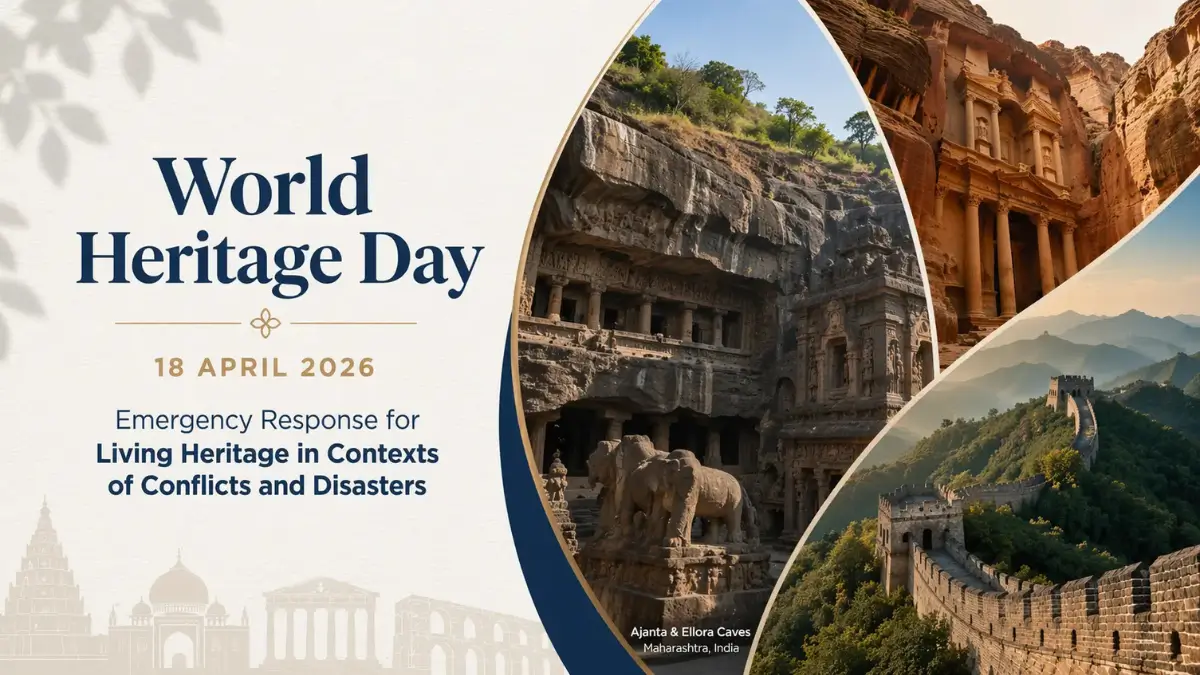
Every year on April 18, the world unites to celebrate World Heritage Day, also known as the International Day for Monuments and Sites (IDMS). This global observance serves as a powerful reminder of our shared responsibility to protect and preserve the cultural and natural treasures that define human civilization.
World Heritage Day 2026
World Heritage Day is celebrated every year on 18 April to raise awareness about the importance of preserving cultural heritage and historical monuments across the globe. The day highlights the rich legacy of civilizations and encourages people to protect and conserve heritage sites for future generations. In 2026, World Heritage Day continues to remind us of the value of our shared history and the need to safeguard it against threats like urbanization and climate change.
World Heritage Day 2026 Theme
“Emergency Response for Living Heritage in Contexts of Conflicts and Disasters”
This theme, selected by the International Council on Monuments and Sites (ICOMOS), addresses one of the most pressing challenges facing global heritage today.
Understanding “Living Heritage”
UNESCO defines “Living Heritage” as the “oral traditions, performing arts, social practices, rituals and festive events, knowledge and practices concerning nature and the universe, and the knowledge and skills related to craftsmanship.” ICOMOS expands this definition to encompass all dimensions of cultural heritage- tangible, intangible, and natural.
History of World Heritage Day
The journey of World Heritage Day began at an ICOMOS conference in Tunisia on April 18, 1982, where the International Council on Monuments and Sites proposed establishing an international day dedicated to monuments and sites. The following year, UNESCO officially approved this proposal at its 22nd General Conference in 1983, establishing April 18 as the permanent date for this observance.
| Year | Milestone |
| 1982 | ICOMOS proposes World Heritage Day concept |
| 1983 | UNESCO officially approves at 22nd General Conference |
| 2001 | First themed celebration: “Save Our Historic Villages” |
| 1972 | UNESCO World Heritage Convention adopted (foundation for protection) |
| 2026 | 44th annual observance with focus on emergency response |
World Heritage Day: Importance and Significance
- Preservation of Cultural Identity: Heritage sites and traditions represent the essence of who we are and where we come from. They connect us to our ancestors and provide continuity for future generations.
- Economic Impact: Heritage tourism contributes significantly to local and national economies. The preservation of these sites supports sustainable tourism and creates employment opportunities.
- Environmental Awareness: Natural World Heritage Sites protect biodiversity and ecosystems. A 2020 IUCN report showed that 33% of natural World Heritage sites are at risk from climate change, making conservation urgent.
- Global Solidarity: These sites belong to all humanity, transcending national boundaries. Their protection requires international cooperation and shared responsibility.
- Educational Value: World Heritage Day serves as an educational platform, teaching younger generations about history, culture, and the importance of preservation.
The Five Cs of World Heritage Convention
India, which currently serves its fourth term (2021-2025) on the World Heritage Committee, actively promotes the Five Cs:
- Credibility: Ensuring rigorous evaluation of sites
- Conservation: Protecting existing heritage
- Capacity Building: Training heritage professionals
- Communication: Raising public awareness
- Communities: Engaging local populations
Types of Heritage
1. Cultural Heritage:
Tangible Cultural Heritage: Monuments (Taj Mahal, Colosseum, Pyramids), Groups of buildings (historic city centres), Archaeological sites (Machu Picchu, Petra)
Intangible Cultural Heritage: Oral traditions and expressions, Performing arts (music, dance, theatre), Social practices and rituals, Traditional craftsmanship, Knowledge and practices concerning nature
2. Natural Heritage
Outstanding natural areas with exceptional universal value:
- National parks and wildlife reserves
- Unique ecosystems (Great Barrier Reef, Sundarbans)
- Geological formations (Grand Canyon)
- Biodiversity hotspots (Galápagos Islands)
3. Mixed Heritage
Sites possessing both cultural and natural significance: Khangchendzonga National Park, India – Sacred Himalayan landscape with exceptional biodiversity
Interesting Facts About World Heritage
| Fact | Detail |
| Total UNESCO World Heritage Sites | 1,223+ sites across 168 countries |
| Cultural Sites | ~900 |
| Natural Sites | ~218 |
| Mixed Sites | ~39 |
| Countries with Most Sites | Italy (58), China (56), Germany (51), France (49), Spain (49) |
| India’s World Heritage Sites | 44 sites (36 Cultural, 7 Natural, 1 Mixed) – 6th globally |
Fascinating Heritage Facts
- Italy has the highest number of UNESCO-listed sites, followed closely by China.
- The Pyramids of Egypt, one of the Seven Wonders of the Ancient World, are among the oldest heritage sites.
- Venice, Italy is at risk due to climate change and rising sea levels, highlighting the urgency of the 2026 theme.
- The Galápagos Islands inspired Charles Darwin’s theory of evolution and remain a biodiversity hotspot.
- Machu Picchu in Peru receives over 1.5 million visitors annually, demonstrating the economic power of heritage tourism.
- The Great Wall of China is the largest man-made structure ever built, stretching over 21,000 kilometres.
- Stonehenge in England aligns with the solstices, showing ancient astronomical knowledge.
- Angkor Wat in Cambodia is the largest religious monument in the world, originally built as a Hindu temple.
India’s Heritage Treasures
India is home to 44 UNESCO World Heritage Sites, including:
| Site | Location | Type |
| Taj Mahal | Agra | Cultural |
| Red Fort | Delhi | Cultural |
| Hampi | Karnataka | Cultural |
| Ajanta & Ellora Caves | Maharashtra | Cultural |
| Sundarbans National Park | West Bengal | Natural |
| Kaziranga National Park | Assam | Natural |
| Khangchendzonga National Park | Sikkim | Mixed |
| Great Living Chola Temples | Tamil Nadu | Cultural |
| Konark Sun Temple | Odisha | Cultural |
Threats to World Heritage
Natural Disasters
- Earthquakes and floods
- Climate change impacts
- Wildfires and droughts
Human-Caused Conflicts
- War and armed conflict
- Vandalism and looting
- Illicit trafficking of artifacts
Development Pressures
- Urbanization and construction
- Unsustainable tourism
- Pollution and environmental degradation








 NICL Assistant Mains Exam Date 2026 Out ...
 SBI Data Leak Shock! 3.75 Lakh Customer ...
 UIIC AO Admit Card 2026 Out: Download Li...