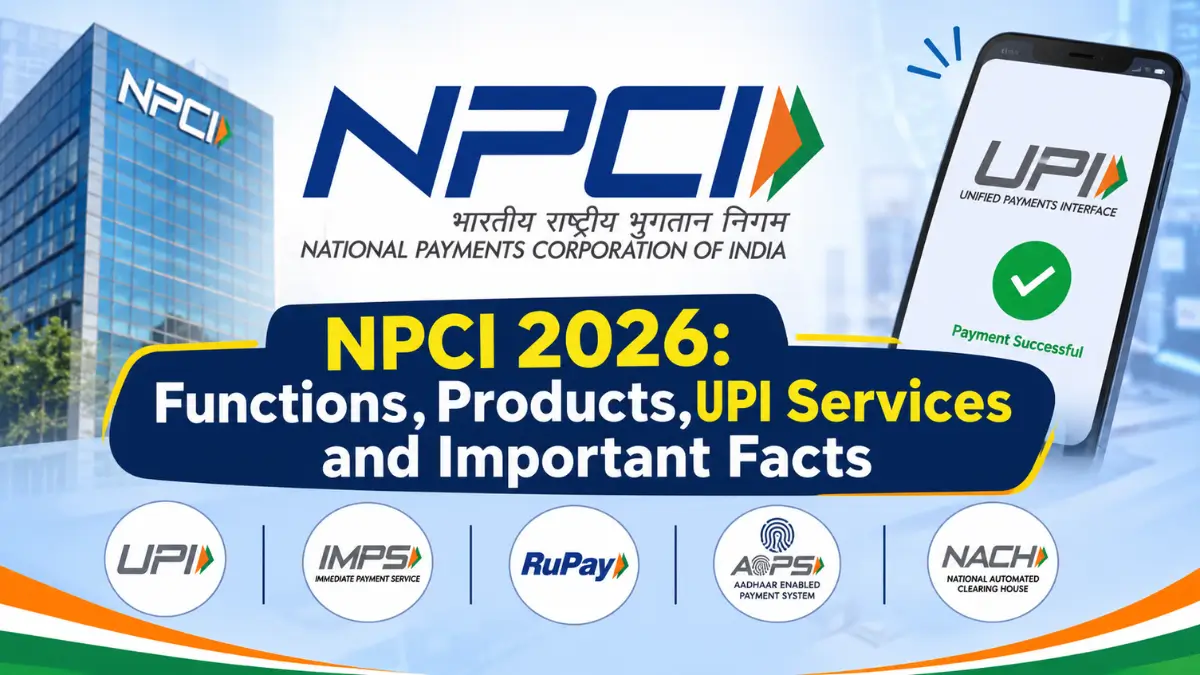
NPCI 2026: Functions, Products, UPI Services and Important Facts

The National Payments Corporation of India (NPCI) manages India’s retail payment and settlement systems. Established under the guidance of the Reserve Bank of India (RBI) and the Indian Banks’ Association (IBA), it promotes digital payments and financial inclusion through services such as UPI, RuPay, IMPS, and NETC.

NPCI 2026: Functions, Products, UPI Services and Important Facts

The National Payments Corporation of India (NPCI) plays a major role in managing India’s digital payment infrastructure. It operates several payment systems, including UPI, RuPay, IMPS, and AePS, making digital transactions faster, safer, and more accessible.

Important Points About NPCI:

  • NPCI was established in December 2008.
  • It operates under the regulatory supervision of the Reserve Bank of India (RBI).
  • It was established by RBI and the Indian Banks’ Association (IBA).
  • Its headquarters is located in Mumbai, Maharashtra.
  • It manages major digital payment platforms such as UPI, RuPay, IMPS, and NACH.
  • Its primary objective is to promote secure digital payments and financial inclusion across India.

Important Facts About NPCI for Banking Exams

Candidates preparing for banking and government examinations should remember the following important facts about NPCI:

Particulars Details
Full Form National Payments Corporation of India
Established December 2008
Headquarters Mumbai, Maharashtra
Type Not-for-profit organisation
Regulatory Authority Reserve Bank of India
Key Initiative Digital Payment Infrastructure
UPI Launch Date 11 April 2016
RuPay Launch 2012
BHIM Launch 30 December 2016
Official Website www.npci.org.in

What is NPCI?

The National Payments Corporation of India (NPCI) is an umbrella organisation that manages India’s retail payment systems. Established in December 2008, it works under RBI’s regulatory supervision to promote secure, efficient, and accessible digital transactions.

Important facts about NPCI:

  • Full Form: National Payments Corporation of India
  • Established: December 2008
  • Type: Not-for-profit organisation
  • Regulatory Authority: Reserve Bank of India (RBI)
  • Established By: RBI and Indian Banks’ Association (IBA)
  • Main Objective: To develop and manage retail payment systems in India
  • Headquarters: Mumbai, Maharashtra

Functions of NPCI

NPCI performs several important functions to strengthen India’s digital payment infrastructure. Its major responsibilities include:

  • Payment Infrastructure: Develops and manages retail payment and settlement systems across India.
  • Digital Transactions: Promotes electronic fund transfers through platforms such as UPI and IMPS.
  • Financial Inclusion: Makes banking and payment services accessible to people in rural and remote areas.
  • Security: Establishes technological and operational standards to ensure secure payment transactions.
  • Interoperability: Enables customers to make payments across different banks and payment applications.
  • Innovation: Introduces new payment technologies to improve convenience and efficiency.

Major Products and Services of NPCI

NPCI manages several payment products that support different types of financial transactions. Some of its major products are:

Product Full Form / Purpose
UPI Unified Payments Interface
RuPay India’s domestic card payment network
IMPS Immediate Payment Service
AePS Aadhaar Enabled Payment System
NACH National Automated Clearing House
NETC National Electronic Toll Collection
BBPS Bharat Bill Payment System
NFS National Financial Switch
BHIM Bharat Interface for Money

UPI Services Offered by NPCI

Unified Payments Interface (UPI) is one of NPCI’s most important payment systems. Launched on 11 April 2016, it enables instant money transfers between bank accounts using mobile applications.

Some important UPI services include:

  • UPI Lite: Facilitates small-value digital payments with a simplified transaction process.
  • UPI 123PAY: Allows feature phone users to make digital payments without requiring an internet connection.
  • UPI Circle: Enables users to authorise trusted individuals to make payments from their UPI accounts under defined conditions.
  • UPI Global: Supports UPI acceptance at selected international locations.
  • Credit Card on UPI: Allows eligible RuPay credit cards to be linked with UPI applications.
  • UPI ATM: Enables cardless cash withdrawal through supported ATMs.
Important Financial Institutions in India: RBI, NABARD, SIDBI, NHB and EXIM Bank

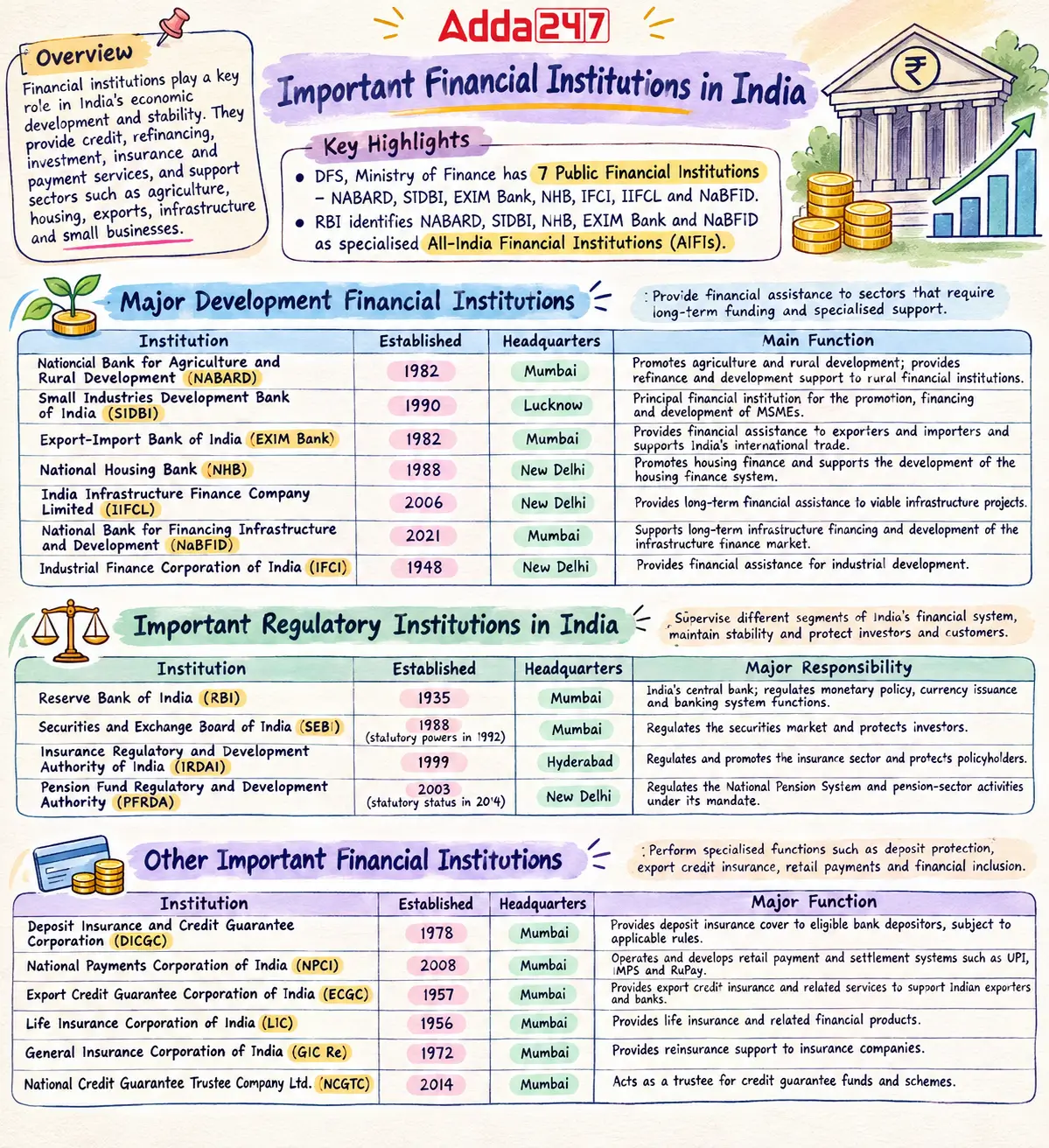
Financial institutions play an important role in the development and stability of India’s economy. They support different sectors by providing credit, refinancing facilities, investment opportunities, insurance protection and payment services. Some institutions focus on specific areas such as agriculture, housing, exports, infrastructure and small businesses, while others regulate the financial system and protect the interests of customers.

Important Financial Institutions in India

India has several financial institutions working under different ministries, regulators and statutory frameworks. The Department of Financial Services (DFS), Ministry of Finance, lists seven Public Financial Institutions under its administrative control, including NABARD, SIDBI, EXIM Bank, NHB, IFCI, IIFCL and NaBFID. The Reserve Bank of India also identifies NABARD, SIDBI, NHB, EXIM Bank and NaBFID as specialised All-India Financial Institutions (AIFIs) that support key sectors of the economy.

Important Financial Institutions in India

Major Development Financial Institutions

Development financial institutions provide financial assistance to sectors that require long-term funding and specialised support.

Institution Established Headquarters Main Function
National Bank for Agriculture and Rural Development (NABARD) 1982 Mumbai
Promotes agriculture and rural development; provides refinance and development support to rural financial institutions.
Small Industries Development Bank of India (SIDBI) 1990 Lucknow
Principal financial institution for the promotion, financing and development of MSMEs.
Export-Import Bank of India (EXIM Bank) 1982 Mumbai
Provides financial assistance to exporters and importers and supports India’s international trade.
National Housing Bank (NHB) 1988 New Delhi
Promotes housing finance and supports the development of the housing finance system.
India Infrastructure Finance Company Limited (IIFCL) 2006 New Delhi
Provides long-term financial assistance to viable infrastructure projects.
National Bank for Financing Infrastructure and Development (NaBFID) 2021 Mumbai
Supports long-term infrastructure financing and development of the infrastructure finance market.
Industrial Finance Corporation of India (IFCI) 1948 New Delhi
Provides financial assistance for industrial development.

Important Regulatory Institutions in India

Financial regulators supervise different segments of India’s financial system. Their responsibilities include maintaining stability, protecting investors and customers, and ensuring that regulated entities follow applicable rules.

Institution Established Headquarters Major Responsibility
Reserve Bank of India (RBI) 1935 Mumbai
India’s central bank; regulates monetary policy, currency issuance and banking system functions.
Securities and Exchange Board of India (SEBI) 1988; statutory powers in 1992 Mumbai
Regulates the securities market and protects investors.
Insurance Regulatory and Development Authority of India (IRDAI) 1999 Hyderabad
Regulates and promotes the insurance sector and protects policyholders.
Pension Fund Regulatory and Development Authority (PFRDA) 2003; statutory status in 2014 New Delhi
Regulates the National Pension System and pension-sector activities under its mandate.

Other Important Financial Institutions

Apart from development banks and regulators, several institutions perform specialised functions such as deposit protection, export credit insurance, retail payments and financial inclusion.

Institution Established Headquarters Major Function
Deposit Insurance and Credit Guarantee Corporation (DICGC) 1978 Mumbai
Provides deposit insurance cover to eligible bank depositors, subject to applicable rules.
National Payments Corporation of India (NPCI) 2008 Mumbai
Operates and develops retail payment and settlement systems such as UPI, IMPS and RuPay.
Export Credit Guarantee Corporation of India (ECGC) 1957 Mumbai
Provides export credit insurance and related services to support Indian exporters and banks.
Life Insurance Corporation of India (LIC) 1956 Mumbai
Provides life insurance and related financial products.
General Insurance Corporation of India (GIC Re) 1972 Mumbai
Provides reinsurance support to insurance companies.
National Credit Guarantee Trustee Company Limited (NCGTC) 2014 Mumbai
Acts as a trustee for credit guarantee funds and schemes.

Important Financial Institutions: Key Facts to Remember

The following facts are useful for quick revision before banking and insurance examinations. Pay special attention to institutions with similar names, as questions may test their areas of operation.

  • NABARD: Apex development financial institution for agriculture and rural development.
  • SIDBI: Principal financial institution for the MSME sector.
  • EXIM Bank: Supports India’s export and import activities.
  • NHB: Focuses on the development of the housing finance sector.
  • NaBFID: Dedicated to long-term infrastructure financing.
  • IIFCL: Provides financial assistance to infrastructure projects.
  • IFCI: Established in 1948 to support industrial finance.
  • RBI: India’s central bank, established on 1 April 1935.
  • SEBI: Regulates India’s securities market.
  • IRDAI: Regulates the insurance sector.
  • PFRDA: Regulates the pension sector, including the National Pension System.
  • DICGC: Provides deposit insurance to eligible bank depositors.
  • NPCI: Operates major retail payment systems, including UPI and RuPay.
  • ECGC: Provides export credit insurance.

RBI Monetary Policy 2026: Repo Rate, CRR, SLR and Important Terms

The Reserve Bank of India (RBI) uses monetary policy to regulate the supply of money and credit in the economy. Its primary objective is to maintain price stability while keeping economic growth in mind. Through changes in policy rates and reserve requirements, the RBI influences borrowing costs, bank lending, liquidity and inflation. Understanding these concepts is essential for candidates preparing for SBI, IBPS, RRB, RBI and other banking examinations.

RBI Monetary Policy 2026

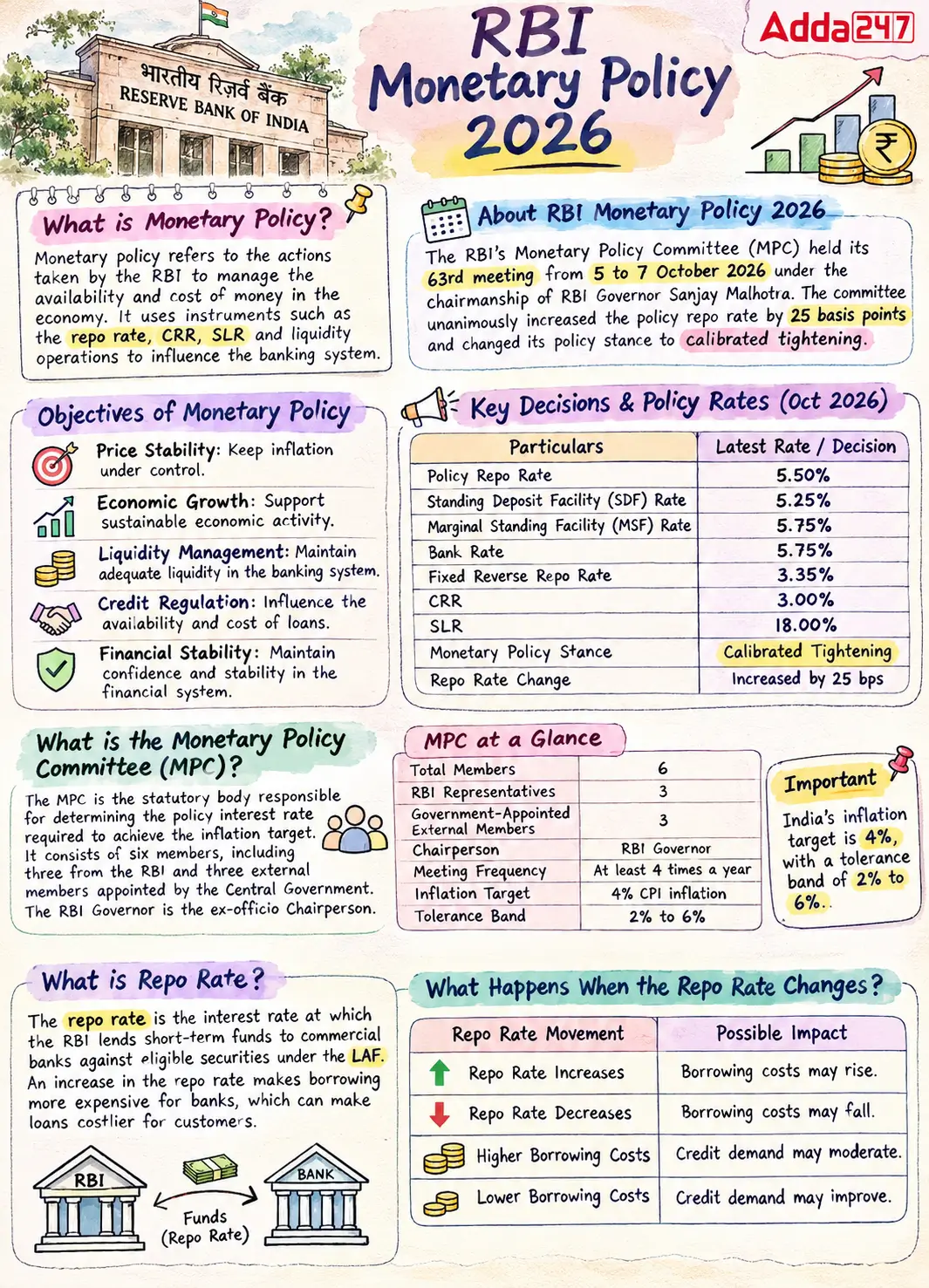
The RBI’s Monetary Policy Committee (MPC) held its 63rd meeting from 5 to 7 October 2026 under the chairmanship of RBI Governor Sanjay Malhotra. The committee unanimously increased the policy repo rate by 25 basis points and changed its policy stance to calibrated tightening.

Particulars Latest Rate / Decision
Policy Repo Rate 5.50%
Standing Deposit Facility (SDF) Rate 5.25%
Marginal Standing Facility (MSF) Rate 5.75%
Bank Rate 5.75%
Fixed Reverse Repo Rate 3.35%
CRR 3.00%
SLR 18.00%
Monetary Policy Stance Calibrated Tightening
Repo Rate Change Increased by 25 bps

Home_6.1

What Is Monetary Policy?

Monetary policy refers to the actions taken by the RBI to manage the availability and cost of money in the economy. It uses instruments such as the repo rate, CRR, SLR and liquidity operations to influence the banking system. When inflation rises, the RBI may tighten monetary conditions to reduce excessive demand. When economic activity needs support, it may adopt measures that make credit more affordable and improve liquidity.

  • Price Stability: Keep inflation under control.
  • Economic Growth: Support sustainable economic activity.
  • Liquidity Management: Maintain adequate liquidity in the banking system.
  • Credit Regulation: Influence the availability and cost of loans.
  • Financial Stability: Maintain confidence and stability in the financial system.

What Is the Monetary Policy Committee (MPC)?

The Monetary Policy Committee is the statutory body responsible for determining the policy interest rate required to achieve the inflation target. It consists of six members, including three members from the RBI and three external members appointed by the Central Government. The RBI Governor is the ex-officio Chairperson of the committee.

Particulars Details
Total Members 6
RBI Representatives 3
Government-Appointed External Members 3
Chairperson RBI Governor
Meeting Frequency At least 4 times a year
Inflation Target 4% CPI inflation
Tolerance Band 2% to 6%

Important: India’s inflation target is 4%, with a tolerance band of 2% to 6%.

What Is Repo Rate?

The repo rate is the interest rate at which the RBI lends short-term funds to commercial banks against eligible securities under the Liquidity Adjustment Facility (LAF). When the RBI increases the repo rate, borrowing funds from the central bank becomes more expensive for banks. Banks may pass on this higher cost through increased lending rates, which can make loans more expensive for customers.

What Happens When the Repo Rate Changes?

Repo Rate Movement Possible Impact
Repo Rate Increases Borrowing costs may rise
Repo Rate Decreases Borrowing costs may fall
Higher Borrowing Costs Credit demand may moderate
Lower Borrowing Costs Credit demand may improve

What Is CRR (Cash Reserve Ratio)?

Cash Reserve Ratio is the percentage of a bank’s Net Demand and Time Liabilities (NDTL) that it must maintain as a cash balance with the RBI. Banks cannot use this required reserve for lending or investment. An increase in CRR reduces the funds available with banks for lending, while a decrease can release additional liquidity into the banking system.

Example: If a bank has an NDTL of ₹1,000 crore and the CRR is 3%, it must maintain ₹30 crore as a cash reserve with the RBI.

What Is SLR (Statutory Liquidity Ratio)?

Statutory Liquidity Ratio is the minimum percentage of a bank’s NDTL that it must maintain in the form of liquid assets. These assets can include cash, gold and eligible unencumbered government securities. Unlike CRR, SLR assets are maintained by banks themselves rather than as a cash balance with the RBI. SLR helps ensure that banks maintain a minimum level of liquid assets.

Example: If a bank has an NDTL of ₹1,000 crore and the SLR is 18%, it must maintain ₹180 crore in eligible liquid assets.

Difference Between Repo Rate, CRR and SLR

These three instruments influence the banking system in different ways.

Basis Repo Rate CRR SLR
Full Form Repurchase Rate Cash Reserve Ratio Statutory Liquidity Ratio
Meaning Rate at which RBI lends to banks Cash reserve maintained with RBI Liquid assets maintained by banks
Maintained With RBI provides funds to banks RBI Banks themselves
Form Interest rate Cash balance Cash, gold and eligible securities
Main Purpose Manage borrowing cost and liquidity Control liquidity Ensure liquidity and financial stability
Current Rate 5.50% 3.00% 18.00%

Other Important Terms Related to RBI Monetary Policy

Apart from Repo Rate, CRR and SLR, candidates should understand the following policy rates and liquidity-related terms for Banking Awareness.

1. Reverse Repo Rate

Reverse Repo Rate refers to the rate at which the RBI borrows money from commercial banks against eligible securities under the reverse repo arrangement. It helps absorb liquidity from the banking system. The fixed reverse repo rate is 3.35%, while the SDF is the floor of the current liquidity adjustment corridor.

2. Standing Deposit Facility (SDF)

The Standing Deposit Facility is a facility through which banks can deposit surplus funds with the RBI without providing collateral. It acts as the floor of the Liquidity Adjustment Facility corridor. The current SDF rate is 5.25%.

3. Marginal Standing Facility (MSF)

Marginal Standing Facility is an overnight borrowing facility that allows scheduled commercial banks to borrow funds from the RBI against eligible securities under specified conditions. It helps banks manage unexpected liquidity shortages. The current MSF rate is 5.75%.

4. Bank Rate

Bank Rate is the rate at which the RBI is prepared to buy or rediscount eligible bills of exchange or commercial papers under the relevant provisions. It is also aligned with the MSF rate under the current policy framework. The current Bank Rate is 5.75%.

5. Open Market Operations (OMO)

Open Market Operations refer to the purchase and sale of government securities by the RBI in the open market. When the RBI purchases government securities, it injects liquidity into the banking system. When it sells securities, liquidity is absorbed from the system.

6. Liquidity Adjustment Facility (LAF)

Liquidity Adjustment Facility is a framework through which the RBI manages short-term liquidity in the banking system. It includes repo and related liquidity operations. It helps maintain orderly money market conditions and guide short-term interest rates.

7. Monetary Policy Stance

The monetary policy stance indicates the RBI’s broad approach towards inflation, growth and liquidity conditions. It provides an indication of the direction of monetary policy, although future decisions depend on economic developments.

How Does Monetary Policy Affect the Economy?

A change in the repo rate can influence the cost of funds for banks, lending rates, consumption, investment and overall economic activity.

For example, higher interest rates can discourage excessive borrowing and spending, helping moderate inflationary pressures. Lower interest rates can encourage borrowing and investment when economic activity requires support.

Term Meaning
Basis Point (bps)
One-hundredth of a percentage point
Inflation
General rise in prices of goods and services
CPI Consumer Price Index
NDTL
Net Demand and Time Liabilities
Liquidity
Availability of funds in the financial system
Monetary Tightening
Measures to restrict money supply or raise borrowing costs
Monetary Easing
Measures to support liquidity and reduce borrowing costs
Core Inflation Inflation excluding selected volatile components, commonly food and fuel
LAF Liquidity Adjustment Facility
OMO Open Market Operations
MPC Monetary Policy Committee
MSF Marginal Standing Facility

Daily Current Affairs and GK Updates (7th November, 2026)

National News

Supreme Court Declares National Book Trust a State Under Article 12

  • The Supreme Court of India declared the National Book Trust (NBT) a ‘State’ under Article 12 of the Constitution on 6 November 2026.

  • The Court upheld the 2012 Delhi High Court judgment recognising NBT as an instrumentality of the State.

  • The bench comprised Justices Prashant Kumar Mishra and Augustine George Masih.

  • The ruling was based on the Central Government’s deep and pervasive control over NBT’s administration, finances and governance.

  • It enables the enforcement of Fundamental Rights against NBT, but does not make it a government department.

Semicon 2.0 Portal Launched, 12 New ECMS Projects Approved

  • Union Electronics and IT Minister Ashwini Vaishnaw launched the Semicon 2.0 portal, opening applications under three pillars: semiconductor machines and materials, fabrication facilities, and ATMP/OSAT.

  • The Cabinet-approved Semicon 2.0 programme has a total outlay of ₹1,27,500 crore and six strategic pillars.

  • The government approved 12 additional projects under the Electronics Components Manufacturing Scheme (ECMS).

  • These projects involve an investment of ₹7,503 crore, expected production of ₹39,045 crore and creation of 7,127 direct jobs across seven states.

  • Key Fact: Total ECMS approvals have reached 118 applications, covering 34 products across 16 states, with projected investment of ₹77,051 crore.

VAJRA-SAT Exercise Strengthens India’s Preparedness for FMD SAT-1

  • The Department of Animal Husbandry and Dairying (DAHD), in collaboration with ICAR-NIVEDI, Bengaluru, conducted the two-day national tabletop exercise VAJRA-SAT on 4–5 November 2026.

  • The exercise focused on preparedness for Foot-and-Mouth Disease (FMD) serotype SAT-1.

  • It was conducted under the theme “Detect Early, Confirm Fast, Contain Together.”

  • A total of 83 participants from 25 States, three Union Territories and national institutions took part.

  • Key Fact: Although SAT-1 has not been reported in India, its spread beyond Africa to parts of West Asia has prompted preventive preparedness.

Central Bureau of Narcotics Celebrates Its 77th Foundation Day

  • The Central Bureau of Narcotics (CBN) celebrated its 77th Foundation Day on 6 November 2026 at its headquarters in Gwalior, Madhya Pradesh.

  • Established on 6 November 1950, it functions under the Department of Revenue, Ministry of Finance.

  • Its responsibilities include regulating legal opium poppy cultivation and overseeing the import and export of narcotic drugs and psychotropic substances.

  • It also combats illegal drug trafficking under the NDPS Act, 1985.

  • Key Fact: Major initiatives include Operation Parivartan for eradicating illicit crops and Mission Yuva Raksha for drug-prevention awareness.

State News

Karnataka Names Malabar Tree Toad as State Amphibian

  • Karnataka became the first Indian state to designate an official state amphibian, selecting the Malabar Tree Toad (Pedostibes tuberculosus).

  • It is locally known as Malenadina Mara Gantikappe.

  • The Forest, Ecology and Environment Department issued the declaration order on 27 October 2026.

  • The species is endemic to the Western Ghats and inhabits moist evergreen forests.

  • Key Fact: It is listed as Least Concern on the IUCN Red List and under Schedule II of the Wildlife (Protection) Act, 1972.

Chhattisgarh Plans Return of Blackbucks to Gomarda Sanctuary

  • Chhattisgarh plans to reintroduce 50 blackbucks (Antilope cervicapra) into Gomarda Wildlife Sanctuary after more than five decades of local extinction.

  • The animals will be translocated from Barnawapara Wildlife Sanctuary.

  • A conservation programme launched in 2017–18 brought 77 blackbucks from Delhi’s National Zoological Park and Bilaspur’s Kanan Pendari Zoological Garden.

  • The Barnawapara population subsequently increased to more than 150.

  • Key Fact: The reintroduction aims to restore the locally extinct species, improve grassland biodiversity and strengthen habitat conservation.

Tamil Nadu Sanctions ₹1.3 Crore for Golden Jackal Conservation

  • The Tamil Nadu government sanctioned ₹1.3 crore in November 2026 for conserving golden jackals (Canis aureus) and Indian Bengal foxes (Vulpes bengalensis).

  • The initiative includes habitat assessment, threat monitoring, anti-poaching measures and community awareness.

  • It also proposes establishing a captive-breeding centre at Salem Zoo.

  • Golden jackals are medium-sized omnivorous canids found in grasslands, scrublands, river valleys and coastal areas.

  • Key Fact: Golden jackals are listed as Least Concern by the IUCN and under Schedule I of the Wildlife (Protection) Act, 1972, in India.

Amit Shah Inaugurates 1857 First War Martyrs Memorial in Ambala

  • Union Home Minister Amit Shah inaugurated the Martyrs’ Memorial of the First War of Independence of 1857 in Ambala, Haryana, on 5 November 2026.

  • The memorial has been constructed across 22 acres at a cost of ₹594 crore.

  • It features 22 galleries displaying historical records, traditional crafts and modern technologies such as virtual reality and holography.

  • It honours freedom fighters including Rani Lakshmibai, Nana Saheb, Tatya Tope and Rao Tula Ram.

  • Key Fact: The memorial’s open-air theatre has a seating capacity of 2,500 people.

International News

Stephen Miller Named White House Chief of Staff

  • US President Donald Trump appointed Stephen Miller as the 33rd White House Chief of Staff, effective 9 November 2026.

  • Miller, aged 41, previously served as Deputy Chief of Staff for Policy and Homeland Security Adviser.

  • He is known for shaping Trump’s immigration agenda, including stricter border enforcement and mass deportation policies.

  • He graduated from Duke University.

  • Key Fact: Miller’s appointment followed the 2026 midterm elections, after which Democrats gained control of both chambers of Congress.

India and EU Conclude Horizon Europe Association Negotiations

  • India and the European Union (EU) concluded negotiations for India’s association with Horizon Europe, the EU’s flagship research and innovation programme.

  • The announcement was made by the Department of Science and Technology on 7 November 2026.

  • Horizon Europe is a €93.5 billion funding programme covering the period 2021–2027.

  • India’s proposed association covers Pillar II, focusing on Global Challenges and European Industrial Competitiveness.

  • Key Fact: The association will enable Indian researchers, universities and industries to access research funding and undertake joint projects with European partners.

Business News

Noel Tata to Retire as Titan Company Vice-Chairman

  • Noel N. Tata will retire as Director and Vice-Chairman of Titan Company Limited on 12 November 2026, after attaining 70 years of age.

  • The company announced the decision through a stock exchange filing dated 5 November 2026.

  • The retirement follows Tata Group Governance Guidelines, which prescribe 70 years as the retirement age for Non-Independent Non-Executive Directors.

  • Noel Tata joined Titan’s board in 2003 and has been associated with the Tata Group for over four decades.

  • Key Fact: Noel Tata also serves as the Chairman of Tata Trusts.

Bharti Airtel Regains Second Position Among India’s Valuable Companies

  • Bharti Airtel regained its position as India’s second-most valuable company by market capitalisation on 6 November 2026, overtaking Jio Platforms.

  • Airtel’s market capitalisation reached ₹13.15 lakh crore, compared with ₹12.95 lakh crore for Jio Platforms.

  • Reliance Industries retained the top position with a market capitalisation of ₹17.86 lakh crore.

  • Airtel shares gained 2.45% to close at ₹2,107.20.

  • Key Fact: Airtel reported Q2 FY27 revenue of ₹60,878 crore, while its India mobile Average Revenue Per User (ARPU) increased to ₹271.

Awards News

Uttarakhand Police Receives President’s Colour as 16th State Force

  • Union Home Minister Amit Shah presented the President’s Colour to Uttarakhand Police in Dehradun on 6 November 2026.

  • Uttarakhand became the 16th state police force in India to receive this honour.

  • The recognition acknowledges the force’s 25 years of service, discipline, professionalism and contribution to public safety.

  • Its achievements include disaster-response operations, pilgrim safety, digital policing and border-area support.

  • Key Fact: Uttarakhand Police recorded a score of 93.46 on the CCTNS/ICJS 2.0 Dashboard. Its motto is Karm Satyam Shauryam.

Defense News

India and Myanmar Conduct First Tri-Services HADR Exercise RAHAT MITRA

  • India and Myanmar conducted their first bilateral Tri-Services Humanitarian Assistance and Disaster Relief (HADR) exercise, RAHAT MITRA, in Chennai on 5–6 November 2026.

  • More than 300 personnel from the Army, Navy and Air Force of both countries participated.

  • The Indian Navy coordinated the exercise.

  • It was conducted under the theme “Together for Humanity, Stronger through Partnership.”

  • Key Fact: The exercise aims to strengthen disaster-response coordination and reflects India’s Neighbourhood First policy and MAHASAGAR vision.

Exercise Tiger Triumph 2026 Concludes in Visakhapatnam

  • The fifth edition of the India–US bilateral Tri-Service HADR Exercise Tiger Triumph 2026 concluded in Visakhapatnam on 5 November 2026.

  • The exercise was conducted from 31 October to 5 November 2026.

  • It focused on improving interoperability and joint disaster-response capabilities, particularly combined amphibious operations.

  • It comprised a Staff Exercise (STAFFEX) and a Tabletop Exercise (TTX).

  • Key Fact: India’s National Disaster Response Force (NDRF) participated in the exercise for the first time.

INS Amini Delivered to Indian Navy to Strengthen Coastal Defence

  • The Indian Navy received INS Amini, an indigenously designed Anti-Submarine Warfare Shallow Water Craft (ASW SWC), from GRSE on 5 November 2026.

  • The vessel was delivered at Kattupalli, Tamil Nadu.

  • It has over 80% indigenous content and is equipped with sonar systems, lightweight torpedoes, indigenous rocket launchers and waterjet propulsion.

  • The vessel is named after Amini Island in Lakshadweep.

  • Key Fact: INS Amini is the fifth of eight ASW shallow-water craft being built by Garden Reach Shipbuilders and Engineers (GRSE).

Science & Tech News

New Flowering Plant Species Discovered in Assam and Meghalaya

  • A new flowering plant species, Disporum kamakhasiense, was discovered in the forests of Assam and Meghalaya.

  • The discovery was reported in the international botanical journal Novon.

  • It belongs to the family Colchicaceae and genus Disporum.

  • The perennial herb was recorded at Garbhanga Reserve Forest and Laisong in Assam, and Barapani in Meghalaya.

  • Key Fact: The plant can grow up to 180 cm and is found in semi-evergreen forests at elevations of 200–1,100 metres.

Sports News

Mohammed Shami Retires from Test Cricket After 229 Wickets

  • Indian fast bowler Mohammed Shami announced his retirement from Test cricket on 6 November 2026, ending a 13-year career.

  • He made his Test debut against the West Indies at Eden Gardens, Kolkata, on 6 November 2013.

  • He finished with 229 wickets in 64 Tests at an average of 27.71.

  • His career included six five-wicket hauls, with best innings figures of 6/56.

  • Key Fact: Shami will continue playing white-ball cricket, domestic competitions and the Indian Premier League (IPL).

73rd Senior National Kabaddi Championship Scheduled in Karnataka

  • The 73rd Senior National Kabaddi Championship 2027 is scheduled to be held in Karnataka.

  • The tournament is organised under the aegis of the Amateur Kabaddi Federation of India (AKFI).

  • It is expected to feature around 30 teams and more than 400 players.

  • The reported venue is Sir M Vishveshvaraiah Stadium, Mandya.

  • Key Fact: Indian Railways will enter as defending champions after defeating Maharashtra 49–31 in the 72nd edition held in Vadodara, Gujarat, in February 2026. The dates differ between the report (7–10 January) and AKFI calendar (15–18 January 2027).

India Wins Record Sixth Asian Champions Trophy Title, Beats Japan

  • India defeated Japan 4–1 in the Men’s Asian Champions Trophy 2026 final at Mohali, Punjab, on 5 November 2026.

  • Japan took an early lead through Kazumasa Matsumoto in the third minute.

  • India’s goals came from Shilanand Lakra, Dilpreet Singh, Jugraj Singh and Sukhjeet Singh.

  • India completed a hat-trick of consecutive titles after winning in 2023 and 2024 and remained unbeaten with seven victories.

  • Key Fact: India secured its sixth Asian Champions Trophy title, while Harmanpreet Singh was named Player of the Tournament and top scorer with 10 goals.

Important Days News

National Cancer Awareness Day Observed Across India on 7 November

  • National Cancer Awareness Day is observed in India every year on 7 November to promote cancer prevention, early detection and timely treatment.

  • It was initiated in 2014 by the Union Ministry of Health and Family Welfare under then Health Minister Dr. Harsh Vardhan.

  • The date coincides with the birth anniversary of Marie Curie, born on 7 November 1867.

  • According to IARC’s GLOBOCAN 2022 estimates, India recorded approximately 14.13 lakh new cancer cases and 9.17 lakh deaths.

  • Key Fact: Population-based screening under the National Programme for Prevention and Control of Non-Communicable Diseases targets oral, breast and cervical cancers among people aged 30 years and above.

Obituaries News

South African Media Pioneer Ramprakash Gopidayal Passes Away

  • South African media personality Ramprakash Gopidayal, popularly known as Ramu, passed away on 5 November 2026, aged 70.

  • He joined the South African Broadcasting Corporation (SABC) in 1980 as its first Indian-origin technician.

  • In 1986, he launched Impressions, SABC’s first television programme dedicated to the Indian community, and served as its executive producer.

  • He contributed to Radio Lotus by establishing the resident music band Kamal Sungeeth.

  • Key Fact: He organised South Africa’s first Indian songwriting competition in five languages: Hindi, Tamil, Urdu, Gujarati and Telugu.

Current Affairs Today | 07 November 2026 | Daily Current Affairs | By Ashish Gautam

BOI Credit Officer GBO Result 2026 Out, Check list of Selected Candidates

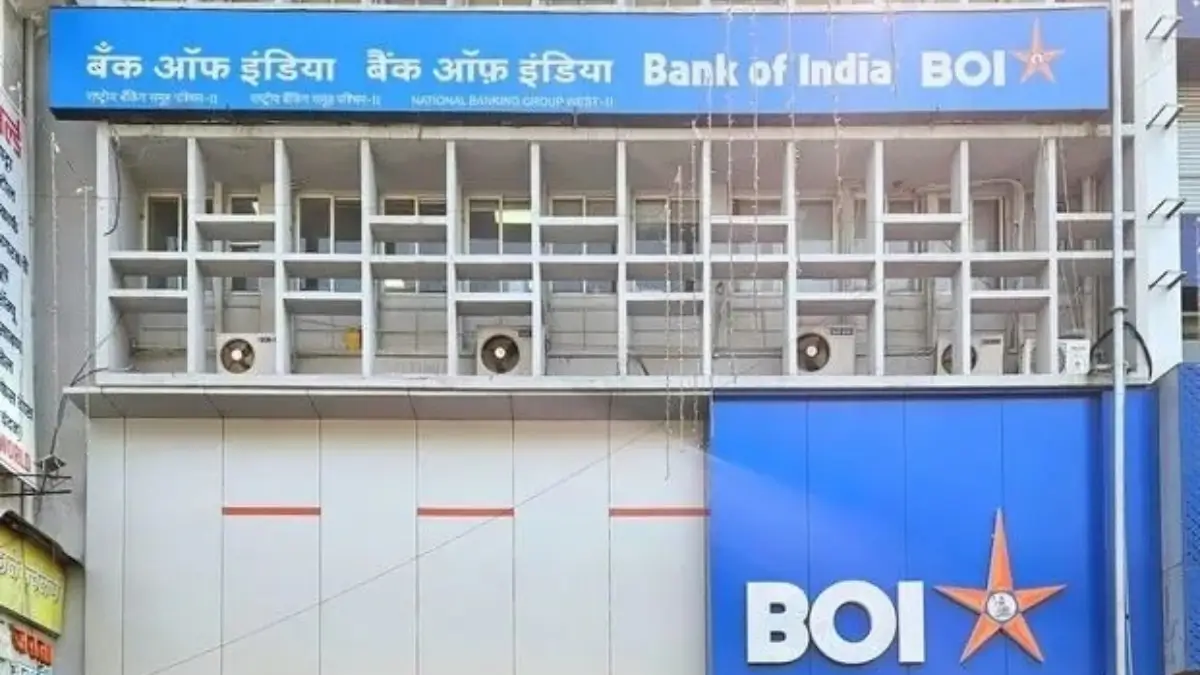
The BOI Credit Officer GBO Result 2026 has been released on 07 November 2026 by the Bank of India for candidates who appeared in the recruitment examination under Project No. 2026-27/01. The bank has published the lists of candidates provisionally shortlisted for the interview stage. Candidates can now check their registration number and roll number in the respective result PDFs for MMGS-II, MMGS-III and SMGS-IV.

BOI Credit Officer GBO Result 2026 Out

A total of 1,443 candidates have been shortlisted across these scales, subject to fulfilment of the eligibility criteria specified in the recruitment notification dated 1 June 2026. Candidates should check the relevant list carefully and stay updated about the upcoming interview schedule and further selection formalities.

BOI Credit Officer GBO Result 2026: Highlights

The result lists contain the details of candidates shortlisted for the interview stage. A separate PDF has been provided for each scale, allowing candidates to locate their details easily.

Particulars Details
Organisation Bank of India
Recruitment Credit Officers in GBO Stream
Project Number 2026-27/01
Result Status Released
Shortlisting Stage Interview
Scales MMGS-II, MMGS-III and SMGS-IV
Result Format PDF
Details Available Registration Number, Roll Number and Online Exam Centre

BOI Credit Officer GBO Result 2026: Download PDF

Candidates can refer to the respective scale-wise result list to check their shortlisting status. The PDFs include the candidate’s registration number, roll number and online examination centre.

Scale Result PDF
BOI Credit Officer GBO MMGS-II Download PDF
BOI Credit Officer GBO MMGS-III Download PDF
BOI Credit Officer GBO SMGS-IV Download PDF

How to Check BOI Credit Officer GBO Result 2026?

Candidates can follow these steps to check their names or roll numbers in the BOI Credit Officer GBO Result 2026. It is advisable to keep the registration number or roll number ready before opening the PDF.

  • Visit the official website of Bank of India.
  • Open the Careers or recruitment section.
  • Find the notice related to the recruitment of Credit Officers in the GBO Stream under Project No. 2026-27/01.
  • Open the PDF corresponding to MMGS-II, MMGS-III or SMGS-IV.
  • Use the search option (Ctrl + F) to enter your registration number or roll number.
  • Check the details carefully and save the PDF for future reference.

BOI Credit Officer GBO Shortlisted Candidates 2026

Bank of India has released three separate PDFs containing the registration numbers and roll numbers of candidates provisionally shortlisted for interviews. According to the released lists, a total of 1,443 candidates have been shortlisted across the three scales.

Officer Scale Number of Candidates Shortlisted
Credit Officer MMGS-II 1,167
Credit Officer MMGS-III 162
Credit Officer SMGS-IV 114
Total 1,443

What After BOI Credit Officer GBO Result 2026?

Candidates whose details appear in the provisional shortlist are eligible to proceed to the interview stage, subject to verification of the prescribed eligibility conditions. They should keep checking the Bank of India’s official website and their registered email address for further communication.

Candidates should keep the following documents ready for the next stage:

  • Interview call letter, when released.
  • Printed application form.
  • Valid photo identity proof.
  • Educational qualification certificates and mark sheets.
  • Work experience documents, wherever applicable.
  • Category certificate, if applicable.
  • Other documents specified by the bank.

J&K Bank PO Salary 2026, Check Pay Scale, Perks & Allowances

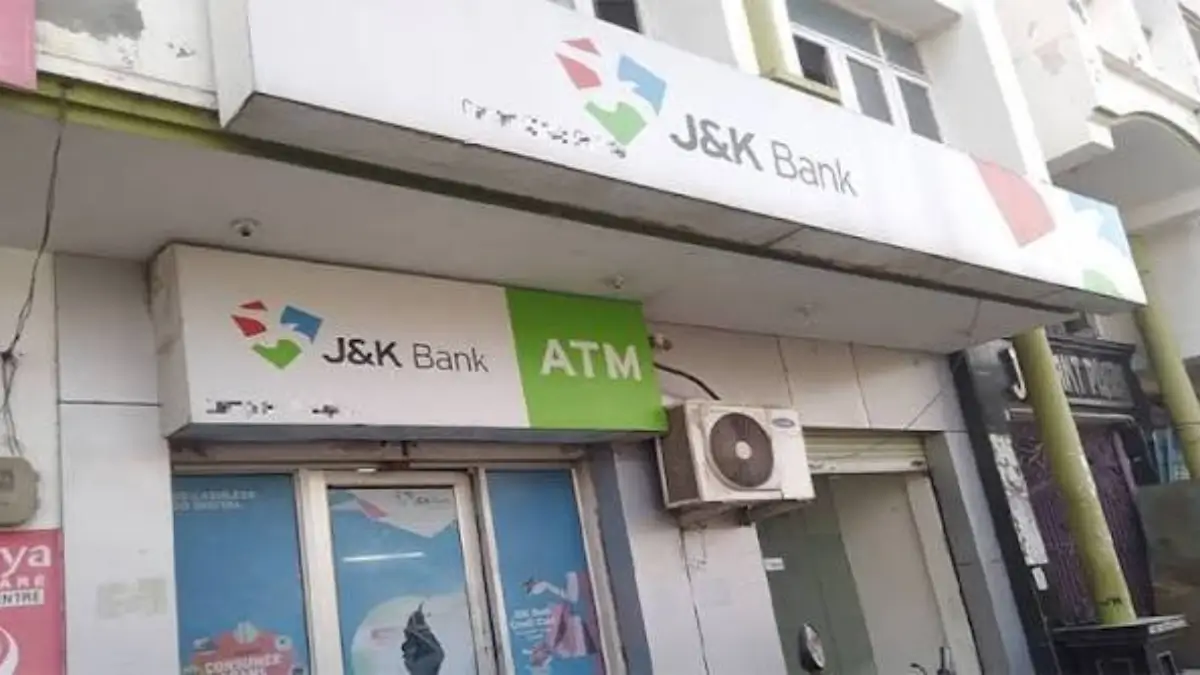
Jammu & Kashmir Bank offers an attractive salary package to candidates appointed as Probationary Officers (POs) in 2026. The post carries a starting basic pay of ₹48,480 per month, along with other perks applicable to Junior Management Grade Scale-I (JMGS-I). The salary increases through a structured increment system, allowing officers to progress to a maximum basic pay of ₹85,920. Along with the pay package, the position offers opportunities to gain experience in banking operations, customer relationship management, credit and branch administration.

J&K Bank PO Salary 2026

The J&K Bank PO salary is based on the JMGS-I pay scale specified in the 2026 recruitment notification. The notification confirms the starting basic pay and the applicable scale, along with other perks available to officers in this grade. The actual monthly gross and in-hand salary will depend on applicable allowances, posting location and deductions.

J&K Bank PO Pay Scale 2026

The starting basic pay of a J&K Bank Probationary Officer is ₹48,480. The pay scale follows a fixed increment structure, under which the basic salary increases at different stages of service. The notification specifies seven increments of ₹2,000, followed by two increments of ₹2,340 and seven increments of ₹2,680. After completing the prescribed increments, the basic pay reaches ₹85,920.

Pay Scale: ₹48,480 – 2,000/7 – 62,480 – 2,340/2 – 67,160 – 2,680/7 – 85,920

J&K Bank PO Salary Increments 2026

The increment structure determines how an officer’s basic pay progresses during service. Initially, the officer receives seven increments of ₹2,000 each, taking the basic pay from ₹48,480 to ₹62,480. The next two increments are ₹2,340 each, followed by seven increments of ₹2,680 each. This structured progression takes the basic pay to the maximum of ₹85,920.

Stage Increment Basic Pay After Increment
Starting Basic Pay — ₹48,480
First 7 increments ₹2,000 each ₹62,480
Next 2 increments ₹2,340 each ₹67,160
Next 7 increments ₹2,680 each ₹85,920

J&K Bank PO Perks and Allowances 2026

Apart from basic pay, J&K Bank Probationary Officers are entitled to other perks applicable to Junior Management Grade Scale-I. These benefits form an important part of the overall compensation package and may vary according to the bank’s prevailing service rules and the officer’s posting.

  • Dearness Allowance (DA): An allowance linked to the applicable cost-of-living index and revised periodically under the relevant rules.
  • House Rent Allowance (HRA): Housing-related allowance as applicable under the bank’s rules and posting conditions.
  • City Compensatory Allowance (CCA): Applicable according to the relevant location and service provisions.
  • Medical Benefits: Medical facilities or reimbursement as permitted under the bank’s employee benefit rules.
  • Leave and Other Benefits: Leave facilities and other service-related benefits available to officers under the applicable policy.

J&K Bank PO Job Profile 2026

A Probationary Officer joins the bank in an officer-grade position and receives exposure to different areas of banking operations. The role involves handling branch activities, assisting customers, supporting business development and ensuring that banking processes are carried out according to the bank’s policies. Officers may be assigned responsibilities across deposits, advances, account services and administrative functions.

Area of Work Responsibilities
Customer Service Handling customer queries, resolving service issues and guiding customers about banking products.
Account Operations Supervising account opening, KYC documentation and account-related services.
Loans and Advances Assisting with loan applications, documentation, verification and credit-related activities.
Banking Transactions Monitoring routine branch transactions and ensuring operational accuracy.
Business Development Promoting deposits, loans, insurance and other banking products.
Compliance Following banking regulations, internal procedures and risk-control guidelines.
Branch Administration
Supporting daily branch operations, reporting and coordination with staff.

J&K Bank PO Probation Period 2026

Selected candidates appointed as Probationary Officers will remain on probation for two years from the date of joining. During this period, the officer’s work, performance and conduct will be reviewed annually by the supervisor or reporting authority. Confirmation in the bank’s service will depend on satisfactory performance and conduct, along with successful completion of the evaluation examination. The evaluation examination is qualifying in nature, with minimum qualifying marks of 40% for General Category candidates and 35% for reserved category candidates.

J&K Bank PO Service Bond 2026

Candidates selected for the PO post must execute a service bond of ₹2 lakh at the time of joining. Through this bond, the officer agrees to serve the bank for a minimum period of two years. The bank may invoke the bond if the officer resigns before completing the prescribed two-year service period. Candidates should consider this condition before accepting the appointment.

J&K Bank PO Joining Time

The selected candidates are required to join within 45 days from the date of issuance of the provisional appointment letter. Candidates should complete the required joining formalities and submit the documents specified by the bank within the prescribed period. The bank may provide further joining-related instructions through its official communication channels. Applicants should regularly check the official website and their registered email address for updates.

Related Posts
J&K Bank PO Syllabus

J&K Bank Banking Associate Salary 2026, Check Pay Scale and Job Profile

The J&K Bank Banking Associate Salary 2026 is an important consideration for candidates applying for the Banking Associate (Clerk) posts. Jammu & Kashmir Bank offers a structured pay scale along with additional perks and benefits applicable to the Banking Associate cadre. As per the 2026 recruitment notification, the starting basic pay is ₹24,050 per month. Candidates should understand the salary structure, allowances, job responsibilities and career growth opportunities before choosing this banking career.

J&K Bank Banking Associate Salary 2026

The Banking Associate position offers an opportunity to work in the banking sector while handling customer-facing and branch-level operations. Apart from the basic salary, employees receive applicable allowances and service benefits as per the bank’s rules. The role involves customer service, account-related activities, cash operations and support for routine banking services. Here is a closer look at the J&K Bank Banking Associate salary, pay scale, perks, allowances and job profile.

J&K Bank Clerk Pay Scale 2026

The starting basic pay for a newly appointed Banking Associate is ₹24,050. The official notification specifies the pay scale as ₹24,050–64,480, with increments at different stages of service.

Stage Basic Pay Progression
Starting Basic Pay ₹24,050
First 3 increments ₹1,340 each
Next 3 increments ₹1,650 each
Next 4 increments ₹2,000 each
Next 7 increments ₹2,340 each
Next 1 increment ₹4,400
Next increment ₹2,680
Maximum Basic Pay ₹64,480

J&K Bank Banking Associate Perks and Allowances

Apart from basic pay, Banking Associates are entitled to other perks applicable to the cadre.

  • Dearness Allowance (DA): Allowance linked to the applicable cost-of-living adjustment.
  • House Rent Allowance (HRA): Applicable housing allowance, subject to the bank’s rules and posting location.
  • City Compensatory Allowance (CCA): May be applicable depending on the posting location and service rules.
  • Medical Benefits: Medical facilities or reimbursement as applicable under the bank’s employee policies.
  • Leave Benefits: Leave facilities as per the bank’s service regulations.
  • Other Perks: Additional benefits applicable to the Banking Associate cadre.

J&K Bank Clerk Job Profile 2026

A clerk primarily supports the daily functioning of a bank branch and assists customers with routine banking requirements. The role combines customer interaction, transaction processing and administrative responsibilities. Employees may be assigned different duties depending on branch requirements and operational needs.

Work Area Key Responsibilities
Customer Service Responding to customer queries and assisting with banking services
Cash Operations Handling cash deposits, withdrawals and related transactions, as assigned
Account Services Supporting account opening, KYC and account maintenance activities
Transactions Processing cheque deposits, fund transfers and other routine transactions
Documentation Maintaining records and verifying relevant documents
Digital Banking Assisting customers with digital banking services and basic queries
Branch Operations
Supporting day-to-day administrative and operational activities

J&K Bank Banking Associate Probation Period and Bond

Selected candidates will initially be placed on probation for six months. During this period, their work, performance and conduct will be reviewed by the designated appraising authority. The bank may extend probation by up to three months if the candidate has not successfully completed the initial period.

Candidates must also execute a ₹1 lakh service bond at the time of joining. The bond is applicable for a minimum service period of six months and may be invoked if the employee resigns before completing that period. The joining time for selected candidates is capped at 45 days.

J&K Bank Career Growth and Promotion Opportunities

A Banking Associate can build a long-term career in the banking sector through experience, internal opportunities and applicable promotion processes. With additional responsibilities and experience, employees may progress towards higher roles within the bank, subject to the bank’s prevailing promotion policy and eligibility requirements.

  • Internal promotion opportunities as per bank rules.
  • Departmental or internal examinations, wherever applicable.
  • Opportunities to take on supervisory and higher-level responsibilities.
  • Skill development through experience in branch operations, customer service and banking products.

Is J&K Bank Banking Associate a Good Career Option?

The Banking Associate post can be a suitable opportunity for graduates seeking a stable career in the banking sector. It offers a structured pay scale, applicable employee benefits and practical exposure to banking operations. The role also provides opportunities to develop customer-handling, financial services and operational skills. Candidates should consider the job responsibilities, posting conditions and long-term career goals before applying.

Related Posts
J&K Bank Banking Associate Syllabus

South Indian Bank Junior Officer Recruitment 2026 Out for Junior Officer Post

The South Indian Bank has announced the South Indian Bank Junior Officer Recruitment 2026 for the post of Junior Officer (Business Promotion Officer). The recruitment is being conducted for candidates with a graduation degree and a minimum of 2 years of relevant work experience in Banks or NBFCs. Interested and eligible candidates can submit their applications online from 6 November to 13 November 2026 through the official website of the bank.

South Indian Bank Junior Officer Recruitment 2026 Out

The selected candidates will be appointed on a contractual basis for an initial period of 3 years, with a total CTC of ₹7.83 lakh per annum. The selection process includes shortlisting, Group Discussion, Personal Interview and/or Psychometric Assessment. Candidates should check the eligibility requirements, salary structure, contract conditions and application instructions before applying. There is no application fee for this recruitment.

South Indian Bank Junior Officer Recruitment 2026: Notification PDF

South Indian Bank Junior Officer 2026: Overview

Candidates can check the important details of the South Indian Bank Junior Officer Recruitment 2026 below.

Particulars Details
Organization The South Indian Bank Ltd.
Recruitment Name South Indian Bank Junior Officer Recruitment 2026
Post Name Junior Officer (Business Promotion Officer)
Job Role Target-Based Sales
Job Type Contractual
Total Vacancies Not Specified
Application Mode Online
Educational Qualification Graduation in any stream
Work Experience Minimum 2 years
Maximum Age 30 Years
Application Fee Nil
Contract Period 3 Years
Annual CTC ₹7.83 Lakhs
Selection Process Shortlisting, GD, Interview and/or Psychometric Assessment
Official Website southindianbank.bank.in

South Indian Bank Junior Officer Recruitment Important Dates

The online application window is open for a limited period. Candidates should complete their registration before the deadline.

Events Dates
Notification/Application Start Date 6 November 2026
Last Date to Apply Online 13 November 2026
Group Discussion/Interview To Be Announced
Psychometric Assessment To Be Announced

South Indian Bank Junior Officer Eligibility Criteria 2026

Candidates must meet the eligibility conditions specified by the bank as of 31 October 2026.

Educational Qualification

  • Candidates must have completed graduation in any discipline from a recognised university or institution.
  • Applicants from any academic stream can apply, provided they meet the other eligibility conditions.

Work Experience

  • Candidates must have a minimum of 2 years of work experience in Banks or NBFCs. The experience should be in handling retail asset or liability products.

Age Limit

The maximum age limit for candidates applying for the Junior Officer post is 30 years as of 31 October 2026.

  • General/Other eligible candidates: Maximum 30 years
  • SC/ST: 5 years of age relaxation

South Indian Bank Junior Officer Apply Online 2026 Link

The online application process for the South Indian Bank Junior Officer Recruitment 2026 started on 6 November 2026. Eligible candidates can apply through the official website of the bank until 13 November 2026. Candidates should keep their educational, experience and personal documents ready before starting the application process.

South Indian Bank Junior Officer Recruitment 2026: Click here to Apply Online

South Indian Bank Junior Officer Recruitment 2026: How to Apply Online

Eligible candidates can apply through the official recruitment portal between 16 October and 27 October 2026.

  • 1. Visit the official website of South Indian Bank at www.southindianbank.bank.in.
  • 2. Navigate to the Careers or Recruitment section.
  • 3. Find the Junior Officer (Business Promotion Officer) Recruitment 2026 notification.
  • 4. Open the online application link and complete the registration process.
  • 5. Enter the required personal, educational and professional details.
  • 6. Upload the photograph, signature and resume in the prescribed format.
  • 7. Review all the information entered in the application form.
  • 8. Submit the application form and save a copy for future reference.
    Note: There is no application fee for South Indian Bank Junior Officer Recruitment 2026.

Documents Required 

Candidates should keep the following documents aready before starting the online application, subject to the requirements in the October 2026 notification:

Documents Specifications
Photograph Recent colour photograph with a white background
Photograph Size Maximum 50 KB
Photograph Dimensions 378 × 437 pixels
Signature Signed on white paper using black ink
Signature Size Maximum 50 KB
Signature Dimensions 140 × 110 pixels
Resume PDF format
Resume File Size Maximum 1 MB

South Indian Bank Junior Officer Salary 2026

The total cost to the company for the Junior Officer (Operations) post is ₹5.14 lakh per annum. This amount includes the NPS contribution, insurance premium and variable pay linked to performance.

Salary Components Amount
Fixed CTC (Including NPS Contribution) ₹4.49 Lakhs
Variable Pay (Performance-Based) Up to ₹2.88 Lakhs
Health Insurance Premium ₹0.46 Lakhs
Total Annual CTC ₹7.83 Lakhs

South Indian Bank Junior Officer Selection Process 2026

The selection process for the South Indian Bank Junior Officer Recruitment 2026 consists of multiple stages. Candidates will first be shortlisted based on the bank’s requirements, followed by further assessment rounds.

The selection stages are as follows:

  • 1. Shortlisting: Applications will be screened by the bank, and eligible candidates will be shortlisted for the next stage.
  • 2. Group Discussion (GD): Shortlisted candidates will be invited to participate in a Group Discussion. This is an elimination round.
  • 3. Personal Interview: Candidates qualifying for the GD will appear for a Personal Interview.
  • 4. Psychometric Assessment: The bank may also conduct a Psychometric Assessment as part of the selection process.

South Indian Bank Junior Officer Posting Locations

Initially, selected candidates will be posted in one of the following regions:

  • Bangalore
  • Hyderabad
  • Chennai
  • Coimbatore
  • Madurai

South Indian Bank Junior Officer Recruitment 2026: Terms of Employment

The Junior Officer (Operations) position is offered on a contractual basis, with the following conditions:

  • Contract period: Initially three years.
  • Renewal: The contract may be renewed at the bank’s discretion based on performance evaluation.
  • Career progression: High-performing candidates may be considered for regular employment as Assistant Manager (Scale I) after the initial contract or an extension, subject to the bank’s prevailing norms.
  • Service agreement: There is no mandatory minimum service period as stipulated for regular staff members.
  • Transfers: Candidates must be willing to serve anywhere in India.

Adda247 Classroom Experience Now Available in Your City

The trusted classroom experience of Adda247 is now expanding beyond screens and reaching students directly in their cities, bringing a new level of convenience and structured learning. With the launch of offline centers in Indore, Kanpur, Jaipur, Guwahati, Muzaffarpur, Prayagraj, Ahmedabad, Hyderabad, Lucknow and Patna, aspirants can now benefit from expert guidance, interactive sessions, and a focused study environment closer to home.

Why Is Adda247 Going Offline?

Online learning offers flexibility. Classroom learning builds consistency. Adda247’s offline centres combine the best of both worlds: expert faculty, exam-focused teaching, and direct mentorship, all in a distraction-free environment.

Students preparing for government exams often need more than recorded lectures. They need doubt-solving, motivation, peer competition, and a routine that keeps preparation on track. Offline classrooms make that possible.

What Makes the Adda247 Classroom Experience Different?

This expansion is not just about buildings and classrooms. It’s about meeting teacher-student interactions face-to-face, and guiding them with clarity, discipline, and confidence. This initiative aims to bridge the gap between online learning and traditional classroom coaching, offering the best of both worlds.

  • Calm, focused classroom ambience that supports disciplined preparation
  • In-person classes that encourage attention and routine
  • Direct interaction with faculty for a clear, immediate understanding
  • Face-to-face discussions that help concepts settle naturally
  • Regular classroom interaction that builds comfort and confidence
  • Opportunities to connect with fellow aspirants and exchange ideas
  • A shared learning environment that keeps motivation steady
  • Guided and consistent preparation in a personal, approachable setting

Book an Inquiry or Demo Session

Interested candidates can connect with Adda247 through the Inquiry Cum Demo Form for Adda247 Offline Branches. Share your name and city, and the team will reach out to resolve your queries and guide you about classroom programs, batches, and demos.

Book an Inquiry or Demo Session

Student Support Number- 9266777210

Offline Batches Details for Banking and SSC Exams

Adda247 offline centres are launching new classroom batches for Banking and SSC exams across multiple cities. Below is the initial batch schedule to help aspirants plan their enrollment:

Branch Start Date Course Batch Type Time
Ahmedabad 16-Nov-26 BANK+SSC Foundation 4:00 PM – 6:00 PM
Ahmedabad 26-Nov-26 BANK+SSC Foundation 8:00 AM – 10:00 AM
Delhi-Mukherjee Nagar-1 03-Nov-26 SSC Regular 4:00 PM – 7:00 PM
Delhi-Mukherjee Nagar-1 19-Nov-26 SSC Regular 8:00 AM – 11:00 AM
Delhi-Mukherjee Nagar-1 17-Nov-26 SSC Regular 11:00 AM – 2:00 PM
Delhi-Mukherjee Nagar-1 27-Nov-26 SSC Regular 8:00 AM – 11:00 AM
Delhi-Mukherjee Nagar-1 26-Nov-26 SSC Regular 11:00 AM – 2:00 PM
Delhi-Mukherjee Nagar-1 30-Nov-26 BANK Regular 4:00 PM – 7:00 PM
Delhi-Mukherjee Nagar-1 26-Nov-26 BANK Regular 11:00 AM – 2:00 PM
Delhi-Mukherjee Nagar-1 24-Nov-26 BANK Regular 8:00 AM – 11:00 AM
Hyderabad 11-Nov-26 BANK+SSC Regular 2:00 PM – 5:00 PM
Hyderabad 11-Nov-26 SSC/RLY Regular 2:00 PM – 5:00 PM
Hyderabad 16-Nov-26 BANK+SSC Regular 2:00 PM – 5:00 PM
Hyderabad 16-Nov-26 SSC/RLY Regular 2:00 PM – 5:00 PM
Hyderabad 23-Nov-26 BANK+SSC Regular 2:00 PM – 5:00 PM
Hyderabad 23-Nov-26 SSC/RLY Regular 2:00 PM – 5:00 PM
Hyderabad 30-Nov-26 BANK+SSC Regular 2:00 PM – 5:00 PM
Hyderabad 30-Nov-26 SSC/RLY Regular 2:00 PM – 5:00 PM
Indore 04-Nov-26 BANK Regular 8:00 AM – 11:00 AM
Indore 04-Nov-26 BANK Regular 11:15 AM – 2:15 PM
Indore 04-Nov-26 SSC Regular 11:15 AM – 2:15 PM
Indore 04-Nov-26 SSC Regular 2:30 PM – 5:30 PM
Indore 4-Nov-26 BANK Regular 5:30 PM – 8:30 PM
Indore 12-Nov-26 BANK Regular 8:00 AM – 11:00 AM
Indore 12-Nov-26 SSC Regular 8:00 AM – 11:00 AM
Indore 12-Nov-26 BANK Regular 11:15 AM – 2:15 PM
Indore 12-Nov-26 SSC Regular 11:15 AM – 2:15 PM
Indore 12-Nov-26 SSC Regular 2:30 PM – 5:30 PM
Indore 12-Nov-26 BANK Regular 2:30 PM – 5:30 PM
Indore 12-Nov-26 BANK Regular 5:30 PM – 8:30 PM
Indore 18-Nov-26 SSC Regular 8:00 AM – 11:00 AM
Indore 18-Nov-26 BANK Regular 8:00 AM – 11:00 AM
Indore 18-Nov-26 BANK Regular 11:15 AM – 2:15 PM
Indore 18-Nov-26 SSC Regular 11:15 AM – 2:15 PM
Indore 18-Nov-26 SSC Regular 2:30 PM – 5:30 PM
Indore 18-Nov-26 BANK Regular 2:30 PM – 5:30 PM
Indore 18-Nov-26 SSC Regular 5:30 PM – 8:30 PM
Indore 25-Nov-26 SSC Regular 8:00 AM – 11:00 AM
Indore 25-Nov-26 BANK Regular 8:00 AM – 11:00 AM
Indore 25-Nov-26 BANK Regular 11:15 AM – 2:15 PM
Indore 25-Nov-26 SSC Regular 11:15 AM – 2:15 PM
Indore 25-Nov-26 SSC Regular 2:30 PM – 5:30 PM
Indore 25-Nov-26 BANK Regular 2:30 PM – 5:30 PM
Indore 25-Nov-26 SSC Regular 5:30 PM – 8:30 PM
Indore 25-Nov-26 BANK Regular 5:30 PM – 8:30 PM
Jaipur 16-Nov-26 BANK+SSC Regular 11:00 AM – 2:00 PM
Jaipur 23-Nov-26 BANK+SSC Regular 8:00 AM – 11:00 AM
Lucknow-Alambagh 04-Nov-26 UPP-SI Regular 8:00 AM – 11:00 AM
Lucknow-Alambagh 04-Nov-26 SSC Regular 8:00 AM – 11:00 AM
Lucknow-Alambagh 04-Nov-26 BANK Regular 5:15 PM – 8:15 PM
Lucknow-Alambagh 12-Nov-26 SSC Regular 11:00 AM – 2:00 PM
Lucknow-Alambagh 26-Nov-26 SSC Regular 11:00 AM – 2:00 PM
Lucknow-Alambagh 5-Nov-26 BANK Regular 11:00 AM – 2:00 PM
Lucknow-Alambagh 17-Nov-26 BANK Regular 5:15 PM – 8:15 PM
Lucknow-Alambagh 12-Nov-26 SSC Regular 8:00 AM – 11:00 AM
Lucknow-Alambagh 26-Nov-26 SSC Regular 5:15 PM – 8:15 PM
Lucknow-Alambagh 06-Nov-26 BANK Regular 8:00 AM – 11:00 AM
Lucknow-Alambagh 20-Nov-26 BANK Regular 8:00 AM – 11:00 AM
Lucknow-Alambagh 19-Nov-26 BANK Regular 11:00 AM – 2:00 PM
Lucknow-Kapoorthala 04-Nov-26 SSC Regular 5:00 PM – 7:00 PM
Lucknow-Kapoorthala 04-Nov-26 BANK Regular 11:00 AM – 2:00 PM
Lucknow-Kapoorthala 18-Nov-26 SSC Regular 5:00 PM – 7:00 PM
Lucknow-Kapoorthala 18-Nov-26 BANK Regular 11:00 AM – 2:00 PM
Lucknow-Kapoorthala 25-Nov-26 SSC Regular 11:00 AM – 2:00 PM
Lucknow-Kapoorthala 25-Nov-26 SSC Regular 2:30 PM – 5:30 PM
Lucknow-Kapoorthala 25-Nov-26 UPP-SI Regular 2:30 PM – 5:30 PM
Lucknow-Kapoorthala 25-Nov-26 BANK Regular 5:00 PM – 7:00 PM
Patna Boring Road 04-Nov-26 SSC Regular 8:00 AM – 11:00 AM
Patna Boring Road 04-Nov-26 BPSC-TRE Regular 11:00 AM – 2:00 PM
Patna Boring Road 04-Nov-26 BANK Regular 2:00 PM – 5:00 PM
Patna Boring Road 04-Nov-26 Daroga / Constable Regular 5:00 PM – 7:00 PM
Patna Boring Road 18-Nov-26 BANK Regular 5:00 PM – 7:00 PM
Patna Boring Road 18-Nov-26 BANK Regular 8:00 AM – 11:00 AM
Patna Boring Road 18-Nov-26 BPSC-TRE Regular 11:00 AM – 2:00 PM
Patna Boring Road 18-Nov-26 SSC Regular 2:00 PM – 5:00 PM
Patna Boring Road 25-Nov-26 BANK Regular 8:00 AM – 11:00 AM
Patna Boring Road 30-Nov-26 BPSC-TRE Regular 11:00 AM – 2:00 PM
Patna Boring Road 25-Nov-26 SSC Regular 2:00 PM – 5:00 PM
Prayagraj 03-Nov-26 BANK Regular 8:00 AM – 11:00 AM
Prayagraj 03-Nov-26 SSC Foundation 11:00 AM – 2:00 PM
Prayagraj 12-Nov-26 UPP-SI Regular 5:00 PM – 8:00 PM
Prayagraj 12-Nov-26 BANK Regular 8:00 AM – 11:00 AM
Prayagraj 12-Nov-26 SSC Foundation 11:00 AM – 2:00 PM
Prayagraj 17-Nov-26 BANK Regular 2:00 PM – 5:00 PM
Prayagraj 24-Nov-26 SSC Foundation 5:00 PM – 8:00 PM
Prayagraj 24-Nov-26 SSC Regular 8:00 AM – 11:00 AM
Varanasi 02-Nov-26 SSC Foundation 8:00 AM – 11:00 AM
Varanasi 02-Nov-26 BANK Regular 11:00 AM – 2:00 PM
Varanasi 02-Nov-26 SSC Foundation 5:00 PM – 8:00 PM
Varanasi 12-Nov-26 SSC Foundation 8:00 AM – 11:00 AM
Varanasi 12-Nov-26 BANK Regular 11:00 AM – 2:00 PM
Varanasi 12-Nov-26 SSC Foundation 5:00 PM – 8:00 PM
Varanasi 17-Nov-26 SSC Foundation 11:00 AM – 2:00 PM
Varanasi 24-Nov-26 SSC Foundation 11:00 AM – 2:00 PM
Varanasi 17-Nov-26 BANK Regular 2:00 PM – 5:00 PM
Varanasi 24-Nov-26 BANK Regular 2:00 PM – 5:00 PM
Delhi GTB Nagar 03-Nov-26 BANK Regular 9:00 AM – 11:30 AM
Delhi GTB Nagar 03-Nov-26 BANK Regular 11:00 AM – 1:30 PM
Delhi GTB Nagar 03-Nov-26 BANK Regular 4:30 PM – 7:00 PM
Delhi GTB Nagar 12-Nov-26 BANK Regular 9:00 AM – 11:30 AM
Delhi GTB Nagar 12-Nov-26 BANK Regular 11:00 AM – 1:30 PM
Delhi GTB Nagar 12-Nov-26 BANK Regular 4:30 PM – 7:00 PM
Delhi GTB Nagar 25-Nov-26 BANK Regular 9:00 AM – 11:30 AM
Delhi GTB Nagar 25-Nov-26 BANK Regular 11:00 AM – 1:30 PM
Delhi GTB Nagar 25-Nov-26 BANK Regular 4:30 PM – 7:00 PM
Delhi GTB Nagar 30-Nov-26 BANK Regular 9:00 AM – 11:30 AM
Delhi GTB Nagar 30-Nov-26 BANK Regular 11:00 AM – 1:30 PM
Delhi GTB Nagar 30-Nov-26 BANK Regular 4:30 PM – 7:00 PM
Delhi GTB Nagar 18-Nov-26 RBI Regular 3:00 PM – 5:00 PM
Delhi GTB Nagar 02-Nov-26 SSC Regular 8:00 AM – 11:00 AM
Delhi GTB Nagar 02-Nov-26 SSC Regular 11:30 AM – 2:30 PM
Delhi GTB Nagar 02-Nov-26 SSC Regular 5:00 PM – 7:30 PM
Delhi GTB Nagar 16-Nov-26 SSC Regular 8:00 AM – 11:00 AM
Delhi GTB Nagar 16-Nov-26 SSC Regular 11:30 AM – 2:30 PM
Delhi GTB Nagar 16-Nov-26 SSC Regular 5:00 PM – 7:30 PM
Delhi GTB Nagar 23-Nov-26 SSC Regular 8:00 AM – 11:00 AM
Delhi GTB Nagar 23-Nov-26 SSC Regular 11:30 AM – 2:30 PM
Delhi GTB Nagar 23-Nov-26 SSC Regular 5:00 PM – 7:30 PM
Delhi GTB Nagar 30-Nov-26 SSC Regular 8:00 AM – 11:00 AM
Delhi GTB Nagar 30-Nov-26 SSC Regular 11:30 AM – 2:30 PM
Delhi GTB Nagar 30-Nov-26 SSC Regular 5:00 PM – 7:30 PM
Delhi-Laxmi Nagar 02-Nov-26 SSC Regular 8:00 AM – 10:00 AM
Delhi-Laxmi Nagar 2-Nov-26 BANK Regular 8:00 AM – 10:00 AM
Delhi-Laxmi Nagar 02-Nov-26 BANK Regular 10:00 AM – 12:00 PM
Delhi-Laxmi Nagar 02-Nov-26 SSC Regular 10:00 AM – 12:00 PM
Delhi-Laxmi Nagar 02-Nov-26 BANK+SSC Regular 12:00 PM – 2:00 PM
Delhi-Laxmi Nagar 02-Nov-26 BANK+SSC Regular 2:00 PM – 4:00 PM
Delhi-Laxmi Nagar 16-Nov-26 SSC Regular 8:00 AM – 10:00 AM
Delhi-Laxmi Nagar 16-Nov-26 BANK Regular 8:00 AM – 10:00 AM
Delhi-Laxmi Nagar 16-Nov-26 BANK Regular 10:00 AM – 12:00 PM
Delhi-Laxmi Nagar 16-Nov-26 SSC Regular 10:00 AM – 12:00 PM
Delhi-Laxmi Nagar 16-Nov-26 BANK+SSC Regular 12:00 PM – 2:00 PM
Delhi-Laxmi Nagar 16-Nov-26 BANK+SSC Regular 2:00 PM – 4:00 PM
Delhi-Laxmi Nagar 23-Nov-26 SSC Regular 8:00 AM – 10:00 AM
Delhi-Laxmi Nagar 23-Nov-26 BANK Regular 8:00 AM – 10:00 AM
Delhi-Laxmi Nagar 23-Nov-26 BANK Regular 10:00 AM – 12:00 PM
Delhi-Laxmi Nagar 23-Nov-26 SSC Regular 10:00 AM – 12:00 PM
Delhi-Laxmi Nagar 23-Nov-26 BANK+SSC Regular 12:00 PM – 2:00 PM
Delhi-Laxmi Nagar 23-Nov-26 BANK+SSC Regular 2:00 PM – 4:00 PM
Delhi-Laxmi Nagar 30-Nov-26 SSC Regular 8:00 AM – 10:00 AM
Delhi-Laxmi Nagar 30-Nov-26 BANK Regular 8:00 AM – 10:00 AM
Delhi-Laxmi Nagar 30-Nov-26 BANK Regular 10:00 AM – 12:00 PM
Delhi-Laxmi Nagar 30-Nov-26 SSC Regular 10:00 AM – 12:00 PM
Delhi-Laxmi Nagar 30-Nov-26 BANK+SSC Regular 12:00 PM – 2:00 PM
Delhi-Laxmi Nagar 30-Nov-26 BANK+SSC Regular 2:00 PM – 4:00 PM
Guwahati 04-Nov-26 SSC Regular 8:00 AM – 10:00 AM
Guwahati 04-Nov-26 STATE Regular 8:00 AM – 10:00 AM
Guwahati 11-Nov-26 BANK Regular 12:30 PM – 2:30 PM
Guwahati 11-Nov-26 SSC Regular 8:00 AM – 10:00 AM
Guwahati 11-Nov-26 STATE Regular 8:00 AM – 10:00 AM
Guwahati 18-Nov-26 STATE Regular 4:30 PM – 6:30 PM
Guwahati 18-Nov-26 SSC Regular 10:30 AM – 12:30 PM
Guwahati 18-Nov-26 BANK+SSC Regular 12:30 PM – 2:30 PM
Guwahati 18-Nov-26 BANK Regular 12:30 PM – 2:30 PM
Guwahati 25-Nov-26 BANK Regular 2:30 PM – 4:30 PM
Guwahati 25-Nov-26 STATE Regular 6:00 PM – 8:00 PM
Guwahati 25-Nov-26 STATE Regular 4:30 PM – 6:30 PM
Guwahati 25-Nov-26 SSC Regular 10:30 AM – 12:30 PM
Guwahati 25-Nov-26 BANK+SSC Regular 12:30 PM – 2:30 PM
Kanpur 16-Nov-26 SSC Regular 10:30 AM – 12:30 PM
Kanpur 25-Nov-26 SSC Regular 5:00 PM – 7:00 PM
Kanpur 12-Nov-26 BANK Regular 1:00 PM – 3:00 PM
Kolkata 1-Nov-26 BANK Weekend 2:00 PM – 7:00 PM
Kolkata 1-Nov SSC Weekend 2:00 PM – 7:00 PM
Kolkata 12-Nov-26 SSC Regular 12:00 PM – 3:00 PM
Kolkata 13-Nov-26 BANK Regular 12:00 PM – 3:00 PM
Kolkata 12-Nov-26 WBCS Regular 12:00 PM – 3:00 PM
Kolkata 19-Nov-26 SSC Regular 12:00 PM – 3:00 PM
Kolkata 20-Nov-26 BANK Regular 12:00 PM – 3:00 PM
Kolkata 19-Nov-26 WBCS Regular 12:00 PM – 3:00 PM
Kolkata 15-Nov-26 BANK Weekend 2:00 PM – 7:00 PM
Kolkata 15-Nov-26 SSC Weekend 2:00 PM – 7:00 PM
Kolkata 28-Nov-26 SSC Regular 9:00 AM – 12:00 PM
Kolkata 30-Nov-26 BANK Regular 9:00 AM – 12:00 PM
Kolkata 29-Nov-26 BANK+SSC Weekend 2:00 PM – 7:00 PM
Muzaffarpur 04-Nov-26 BANK Regular 1:00 PM – 3:30 PM
Muzaffarpur 04-Nov-26 SSC Regular 3:30 PM – 6:00 PM
Muzaffarpur 20-Nov-26 BANK Regular 1:00 PM – 3:30 PM
Muzaffarpur 20-Nov-26 SSC Regular 3:30 PM – 6:00 PM
Muzaffarpur 27-Nov-26 RLY-NTPC Regular 10:30 AM – 1:00 PM
Ranchi 04-Nov-26 BANK+SSC Regular 3:00 PM – 6:00 PM
Ranchi 04-Nov-26 BANK+SSC Regular 7:00 AM – 10:00 AM
Ranchi 11-Nov-26 BANK+SSC Regular 3:00 PM – 6:00 PM
Ranchi 11-Nov-26 BANK+SSC Regular 10:00 AM – 1:00 PM
Ranchi 18-Nov-26 BANK+SSC Regular 10:00 AM – 1:00 PM
Ranchi 18-Nov-26 BANK+SSC Regular 7:00 AM – 10:00 AM
Ranchi 25-Nov-26 BANK+SSC Regular 7:00 AM – 10:00 AM
Ranchi 25-Nov-26 BANK+SSC Regular 3:00 PM – 6:00 PM

Adda247 Offline Centres Now Open In These Cities

Adda247 is expanding its offline presence across multiple cities to make quality coaching accessible to more aspirants.

ranch Address Mobile Number
Indore 2nd Floor, Honda Showroom, 10 Vishnu Puri, Near Medisquare Hospital, Indore, Madhya Pradesh – 452001 9205856696
Kanpur 117, N Block, 117/N, Near Bhadoria Chauraha, Beside Dr. Jhha’s Clinic, Avon Market, Ambedkar Nagar, Navin Nagar, Kakadeo, Kanpur, Uttar Pradesh – 208025 8527759508
Jaipur Office No. 1, Ground Floor, Sunny Paradise, Tonk Rd, Near Gopal Pura, Near HP Petrol Pump, Puliya, New Light Colony, Bajaj Nagar, Jaipur, Rajasthan – 302018 7742836868
Guwahati 4th Floor, Hotel Grand Luit, Udaichal Road, GS Rd, Behind Indian Oil Petrol Pump, Christian Basti, Guwahati, Assam – 781005 9266777076
Muzaffarpur 2nd Floor, Kishore Complex, Behind S K Foods (Haldiram), Chhata Chowk, Muzaffarpur, Bihar – 842001 9,266,610,120
Lucknow – Kapoorthala Kapoorthala Arcade, Kapoorthala Crossing, Mahanagar, Lucknow – 226010 7505050503
Delhi – GTB Nagar Near Metro Station Gate No. 1, 123, Mall Rd, Near GTB Nagar, Kingsway Camp, GTB Nagar, Delhi – 110009 8750505084
Delhi – Mukherjee Nagar 625, Ground Floor, Main Road, Mukherjee Nagar, North Delhi – 110009 9266033342 / 43
Delhi – Laxmi Nagar B-36, First Floor, Gurunanak Pura, Opposite V3S Mall, Nirman Vihar, Block B, Laxmi Nagar, Delhi – 110092 8750505082
Kolkata 118C Lenin Sarani (Moulali Crossing), Kolkata, West Bengal – 700013 6292153700 / 01
Prayagraj 837, University Road, Opp. Science Faculty, Old Katra, Prayagraj, Uttar Pradesh – 211002 9,560,330,046
Varanasi B-27/70, 2nd Floor, Adjacent Petrol Pump, Durgakund, Varanasi, Uttar Pradesh 9667726260
Patna – Boring Road First Floor, Maa Bhagwati Complex, 105, Boring Rd, Chowraha, Anandpuri, Patna, Bihar – 800001 9266028188
Ahmedabad Shree Vardhman Complex, Second Floor, Near Vijay Char Rashta, Ahmedabad, Gujarat – 380009 9726110183
Ranchi 702, 7th Floor, RS Tower, Near Pantaloons Mall, Lalpur, Ranchi, Jharkhand 7677652565
Hyderabad 301, 3rd Floor, Maitrivanam, Ameerpet, Hyderabad – 500038 9266033326
Lucknow – Alambagh Third Floor, Shop No. 3, LDA Market, Barabirwa Yojna, Sector B, Kanpur Road, Alambagh, Lucknow – 226012 7505950507

Course-wise Distribution Across Adda247 Offline Centres (2026)

Adda247’s offline expansion is structured across multiple cities with focused preparation batches for different competitive exams. Below is the detailed branch-wise distribution of courses for 2026, covering BANK, SSC, BPSC TRE, STATE exams, and UPSI/UPP segments.

Branch BANK BANK+SSC BPSC TRE SSC STATE UPSI/UPP Grand Total
Ahmedabad 0 5 0 0 0 0 5
Delhi GTB Nagar 16 0 0 15 0 0 31
Delhi-Laxmi Nagar 6 6 0 6 0 0 18
Delhi-Mukherjee nagar 7 0 0 6 0 0 13
Guwahati 4 2 0 2 4 0 12
Indore 12 0 0 12 0 0 24
Jaipur 2 2 0 0 0 0 4
Kanpur 2 0 0 2 0 0 4
Kolkata 3 2 0 2 1 0 8
Lucknow-Kapoorthala 5 0 0 2 1 0 8
Muzaffarpur 4 0 0 4 0 0 8
Patna Boring Road 3 0 0 4 1 0 8
Prayagraj 3 0 0 2 0 0 5
Ranchi 0 5 0 0 0 0 5
Varanasi 2 0 0 0 0 0 2
Varanasi 3 0 0 8 2 0 13


J&K Bank Banking Associate Syllabus 2026, Check Exam Pattern

The J&K Bank Banking Associate Syllabus 2026 covers the subjects and topics that candidates need to prepare for the Banking Associate (Clerk) examination. The selection process includes an online objective examination consisting of three sections: English Language, Quantitative Aptitude, and Reasoning Ability. The exam carries a total of 100 marks, with 100 questions to be attempted in 60 minutes.

J&K Bank Banking Associate Exam Pattern 2026

The J&K Bank Banking Associate Exam Pattern 2026 provides details about the subjects, number of questions, marks, and time allotted for each section. The online examination consists of three sections, with a separate time limit of 20 minutes for each subject.

Subject Questions Marks Time
English Language 30 30 20 minutes
Quantitative Aptitude 35 30 20 minutes
Reasoning Ability 35 40 20 minutes
Total 100 100 60 minutes

J&K Bank Clerk Syllabus 2026

The J&K Bank Banking Associate Syllabus 2026 includes three major subjects: English Language, Quantitative Aptitude, and Reasoning Ability. Candidates should prepare the important topics from each section to develop accuracy and speed for the online examination.

1. English Language

The English Language section evaluates candidates’ grammar, vocabulary, and comprehension skills. The important topics covered under this section are:

  • Reading Comprehension
  • Cloze Test
  • Error Detection
  • Sentence Improvement
  • Fill in the Blanks
  • Para Jumbles
  • Sentence Rearrangement
  • Phrase Replacement
  • Word Usage
  • Vocabulary
  • Match the Following

2. Quantitative Aptitude

This section tests candidates’ numerical ability, calculation speed, and problem-solving skills. Candidates should cover the following topics:

  • Simplification and Approximation
  • Number Series
  • Quadratic Equations
  • Data Interpretation
  • Percentage
  • Profit and Loss
  • Simple and Compound Interest
  • Ratio and Proportion
  • Average
  • Time and Work
  • Pipes and Cisterns
  • Time, Speed and Distance
  • Mixture and Allegation
  • Partnership
  • Problems on Ages
  • Probability
  • Permutation and Combination

3. Reasoning Ability

The Reasoning Ability section assesses candidates’ logical thinking and analytical skills. Important topics include:

  • Puzzles
  • Seating Arrangement
  • Syllogism
  • Inequality
  • Coding-Decoding
  • Blood Relations
  • Direction and Distance
  • Order and Ranking
  • Alphanumeric Series
  • Pair Formation
  • Input-Output
  • Logical Reasoning
  • Data Sufficiency

How to Prepare for J&K Bank Clerk Exam 2026?

A focused preparation approach can help candidates manage all three sections of the J&K Bank Banking Associate examination. Candidates can follow these practical tips to make their preparation more effective:

  • Build Strong Fundamentals: Start with basic concepts of grammar, arithmetic, and reasoning before moving towards advanced questions.
  • Practise Topic-Wise Questions: Solve questions from individual topics to understand different question patterns and identify areas that need improvement.
  • Work on Sectional Timing: Since each section has a 20-minute limit, practise completing questions within the allotted time.
  • Attempt Previous Year Papers: Solve previous banking examination questions to understand the difficulty level and commonly tested concepts.
  •  Maintain an Error Notebook: Note down incorrect answers and revise those concepts to avoid repeating similar mistakes.
  • Take Weekly Performance Tests: Evaluate your preparation every week and adjust your study approach based on your test performance.