
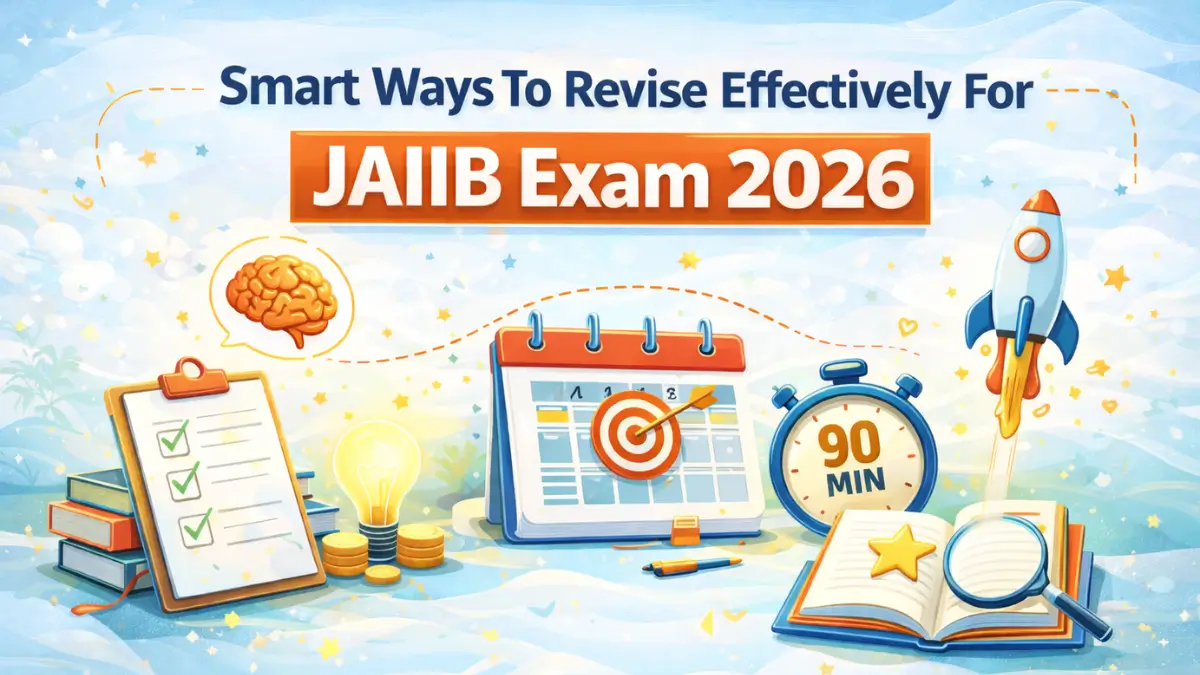
Preparing for JAIIB 2026 is not just about completing the syllabus, but about revising it in a way that ensures long-term retention and exam-day recall. Conducted by the Indian Institute of Banking and Finance, the exam demands clarity across all four subjects, along with the ability to apply concepts quickly. Many candidates study well but fail to revise effectively, which leads to confusion and loss of marks in the exam.
Smart Ways To Revise Effectively For JAIIB Exam 2026
The JAIIB exam includes Indian Economy & Indian Financial System, Principles & Practices of Banking, Accounting & Financial Management for Bankers, and Retail Banking & Wealth Management. Each subject is vast and concept-heavy, so random revision does not work effectively. Instead, candidates must adopt smart revision techniques that focus on retention, application, and consistency.
Why Revision is Crucial for JAIIB 2026
Revision is the bridge between preparation and performance, and without it, even well-studied topics can be forgotten during the exam.
- It helps in reinforcing concepts that you have already studied, ensuring that they stay fresh in your memory even after a gap of several days or weeks
- Regular revision reduces confusion between similar topics, especially in subjects like banking regulations and financial concepts
- It improves your ability to recall information quickly during the exam, which is essential due to time constraints
- Consistent revision boosts confidence and reduces exam anxiety, as you feel more prepared and in control of the syllabus
Make Short Notes for Quick Revision
Short notes act as your final revision toolkit and save a lot of time during the last few days before the exam.
- Create concise notes by summarizing large topics into key points, which helps in quick scanning and better understanding
- Highlight important formulas, definitions, and concepts so that they stand out during revision and are easy to remember
- Use diagrams, charts, and flow-based structures to simplify complex topics like financial systems and accounting processes
- Keep updating your notes regularly as you learn new concepts, so that everything is available in one place for revision
Follow the 3-Step Revision Technique
A structured revision cycle ensures that information moves from short-term memory to long-term memory.
Smart Revision Cycle:
- First Revision: Revise the topic within 24 hours of studying it to strengthen initial understanding and prevent forgetting
- Second Revision: Revisit the same topic after 3–4 days to reinforce concepts and identify gaps in understanding
- Final Revision: Revise again before the exam to ensure complete clarity and quick recall
Benefits:
- This method improves retention significantly and reduces the need to repeatedly study the same topic from scratch
- It helps in building a strong conceptual base, which is essential for solving application-based questions
- It saves time in the long run, as you won’t need to relearn topics multiple times
Practice Questions Along with Revision
Revision becomes effective only when it is combined with consistent practice and application.
What to Practice:
- Solve previous year questions to understand the type and pattern of questions asked in the exam
- Attempt chapter-wise quizzes after revising each topic to test your understanding immediately
- Practice case-based and conceptual questions, especially for subjects like PPB and RBWM
Why It Helps:
- Practising questions helps in applying theoretical knowledge to real exam scenarios, improving problem-solving ability
- It highlights your weak areas, allowing you to focus your revision more effectively
- Regular practice increases speed and accuracy, which are crucial for scoring high marks
Use Active Recall & Self-Testing for JAIIB Revision
Active recall is one of the most effective revision techniques and helps in strengthening memory. Effective Methods:
- After studying a topic, try to recall key points without looking at your notes, which strengthens memory retention
- Write answers to important questions on your own, instead of just reading them, to improve understanding
- Take small self-tests regularly to evaluate your preparation and identify areas that need improvement
Focus on Weak Areas First
Improving weak areas can have a direct impact on your overall score.
- Analyze your performance in mock tests to identify topics where you are scoring low
- Allocate extra time to these topics and revise them more frequently than others
- Break difficult topics into smaller parts and revise them step by step for better understanding
Revise Daily Current Updates (For IE & IFS)
Current affairs play an important role in the IE & IFS paper and require continuous revision.
- Focus on updates related to monetary policy, RBI guidelines, and economic developments
- Revise important reports, schemes, and financial sector news regularly
- Maintain a separate notebook for current affairs to make revision easier and more organized
Avoid Common JAIIB Revision Mistakes
Avoiding common mistakes can make your revision more efficient and effective.
- Start new topics during the final days, as it can create confusion and reduce confidence
- Use multiple study sources, which can lead to information overload and inconsistency
- Skip revision due to overconfidence, as even well-prepared topics need reinforcement
- Ignore practice, as revision without application is not effective
| Related Posts | |
| JAIIB Syllabus | |
| JAIIB Salary | JAIIB Exam Study Material |
| JAIIB Mock Test | JAIIB Online Coaching |






 PFRDA Grade A Admit Card 2026 Out, Downl...
 PFRDA Grade A Syllabus and Exam Pattern ...
 IMF Raises India’s FY27 GDP Growth For...