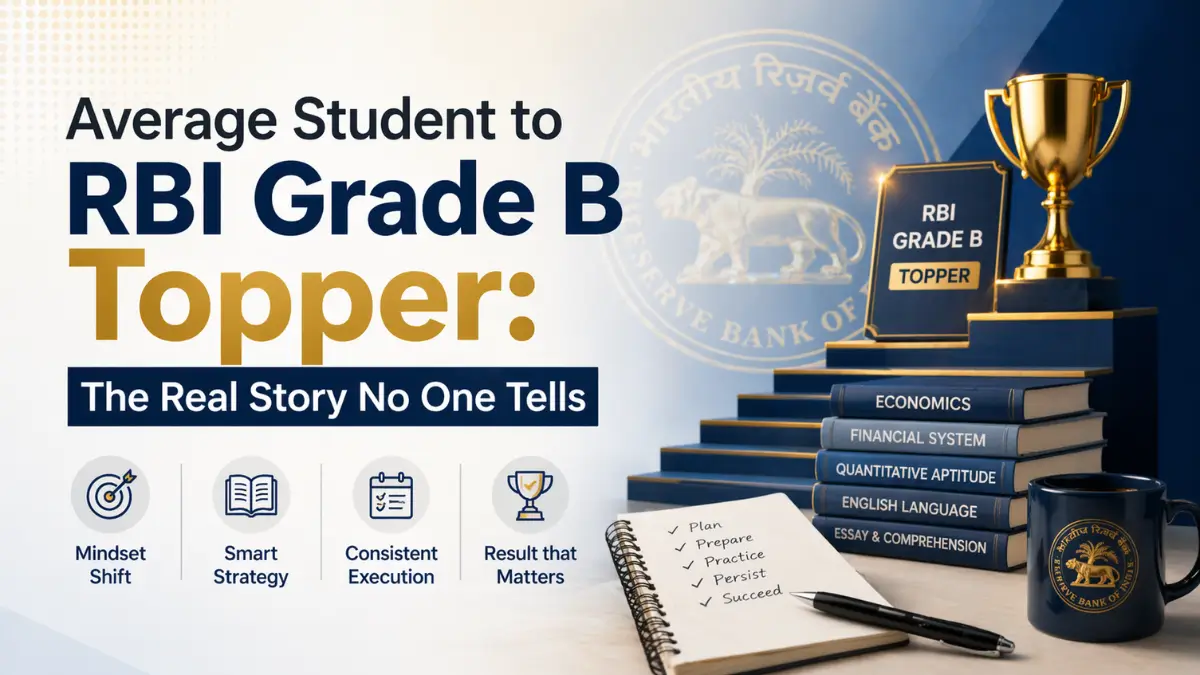
Most RBI Grade B success stories appear polished and linear, often giving the impression that toppers follow a flawless strategy from the beginning. However, the journey of Mr. Sumit, shared through Ritika Chawla Ma’am, reflects a far more realistic and relatable path. It is a story shaped by self-doubt, repeated failures, and gradual improvement rather than instant success. What makes this journey stand out is the honesty with which he accepted his limitations and worked consistently to overcome them.
Average Student to RBI Grade B Topper
Mr. Sumit always described himself as an average student, someone who did not possess exceptional grasping ability or quick understanding like others. Instead of letting this label hold him back, he used it as a foundation to build stronger preparation habits. He focused more on understanding concepts in depth rather than rushing through topics, and this approach helped him retain information better.
Redefining “Average” as a Strength, Not a Weakness
Over time, he realized that being average simply meant he needed more revision, more patience, and more discipline compared to others.
- He treated being average as a starting point for improvement rather than a limitation
- He focused on building conceptual clarity through repeated revision instead of speed learning
- He stayed consistent with his preparation even when progress felt slow
- He avoided comparing his journey with others and concentrated on self-growth
Failure as a Turning Point in the Journey
Before achieving success, Mr. Sumit faced multiple setbacks, including not performing well in earlier interviews. Instead of getting discouraged, he used these failures as learning opportunities to understand where he was lacking. He realized that clearing RBI Grade B requires not only knowledge but also the ability to apply that knowledge effectively under pressure.
| Stage of Preparation | What He Learned and Changed |
| Initial Attempts | Focus was more on completing syllabus rather than understanding application |
| After Failures | Began analyzing mistakes and identifying weak areas honestly |
| Strategy Shift | Focused on improving answer quality and conceptual depth |
| Final Attempt | Applied knowledge with better clarity and confidence |
Smart Preparation Strategy That Delivered Results
One of the most important aspects of his journey was his ability to simplify preparation. Instead of using multiple books and sources, he limited his resources and focused on revising them multiple times.
- He relied on a limited number of trusted resources to avoid confusion and distraction
- He revised the same content multiple times to strengthen retention and clarity
- He gave special attention to high-scoring Mains subjects like Finance and Management
- He ensured consistent daily practice of aptitude subjects to maintain speed and accuracy
The Habit That Transformed His Preparation: Reading The Hindu
Developing the habit of reading The Hindu played a crucial role in improving his preparation. In the beginning, he struggled to understand the language and identify relevant information, but he did not give up.
- He consistently read important sections like the economy, the editorial, and international news pages
- He developed the habit of making concise notes for quick revision before exams
- He improved his vocabulary and developed a better understanding of current issues
- This habit significantly helped in descriptive writing as well as interview discussions
Building Strong Descriptive Writing Skills
Descriptive writing was another area where consistent effort brought noticeable improvement. Although Mr. Sumit had prior blogging experience, he emphasized that writing is a skill that anyone can develop with regular practice.
- He practised writing regularly to improve clarity and flow of ideas
- He focused on organizing answers in a structured and logical manner
- He learned to expand ideas even when the content seemed limited
- He avoided using unnecessarily complex words and prioritized clarity
Interview Transformation: Becoming Natural and Confident
The interview stage was one of the most significant turning points in his journey. In earlier attempts, his responses sounded too formal and rehearsed, which made them appear unnatural.
- He shifted from memorized answers to a more natural and conversational speaking style
- He maintained a balance between professionalism and authenticity in communication
- He improved his body language, eye contact, and overall confidence during interviews
- He learned to accept when he did not know the answer instead of guessing incorrectly
Key Takeaways for RBI Grade B Aspirants
This journey highlights that success in RBI Grade B is not about being exceptionally talented but about being disciplined and self-aware.
- He proved that consistency and discipline are more important than natural talent
- He emphasized focusing on quality preparation instead of covering excessive material
- He showed that failures can become stepping stones when approached with the right mindset
- He demonstrated that gradual improvement leads to long-term success






 IBPS Clerk Prelims Expected Cut Off 2026...
 IBPS Clerk Prelims Exam Analysis 2026, 1...
 IBPS Clerk Prelims Memory Based Paper 20...