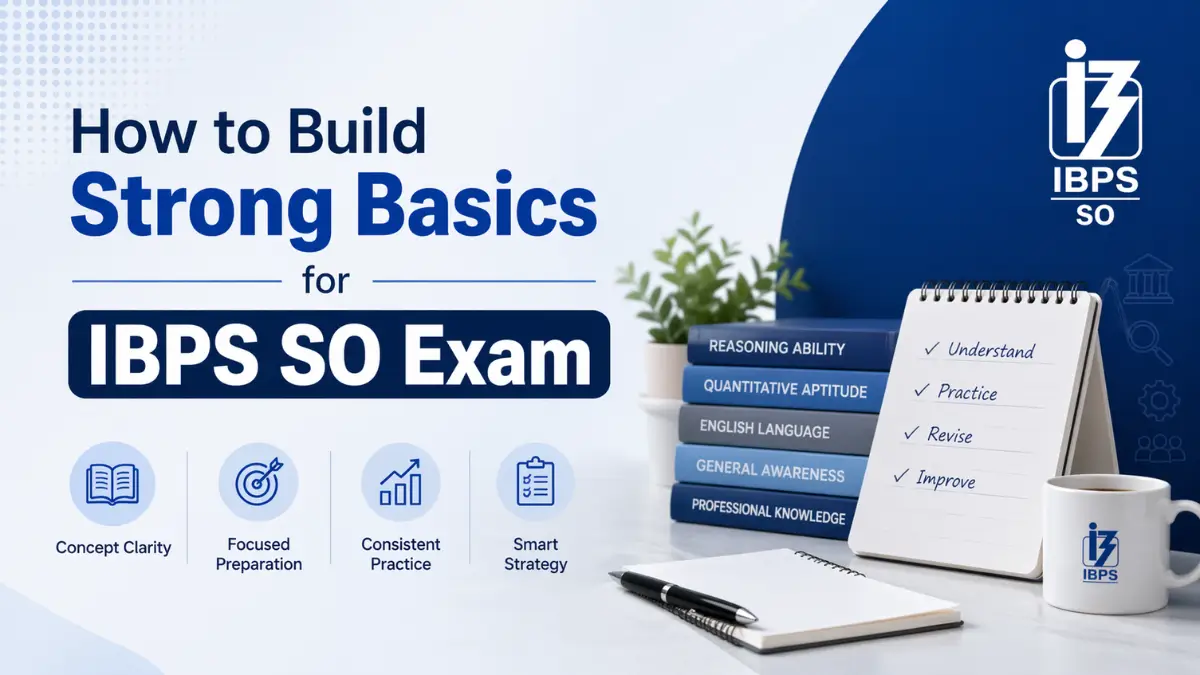
The IBPS Specialist Officer (SO) examination is one of the most sought-after recruitment drives in the Indian banking sector. Unlike generalist banking exams, IBPS SO tests both your professional domain knowledge and your core aptitude – making it essential to get your basics absolutely right before chasing advanced strategies. Whether you are appearing for the IT Officer, Agriculture Field Officer, HR/Personnel Officer, Marketing Officer, Law Officer, or Rajbhasha Adhikari post, the foundation-building phase is the same: strong, structured, and non-negotiable.
Why Basics Matter More in IBPS SO Than in Other Bank Exams: IBPS SO has two distinct layers — the Prelims tests Reasoning, English, and Quantitative Aptitude; the Mains tests your specialist Professional Knowledge (PK) paper. If your basics in either layer are shaky, advanced preparation will not save you. Most candidates who fail IBPS SO do so not because the exam was hard, but because they skipped the foundational stage.
Understanding the IBPS SO Exam Structure
Before building your basics, you must have total clarity on what you are preparing for. IBPS SO is a three-stage process, and each stage tests different skills.
Phase 1 — Preliminary Examination
The Prelims is common across most SO posts (except Rajbhasha Adhikari) and tests three subjects. The exam is online, objective-type, and carries a combined total of 150 marks with a 2-hour duration.
| Subject | Questions | Marks | Time |
| English Language | 50 | 25 | 40 minutes |
| Reasoning Ability | 50 | 50 | 40 minutes |
| Quantitative Aptitude | 50 | 50 | 40 minutes |
| Total | 150 | 125 | 120 minutes |
Phase 2 — Main Examination
The Mains consists of a Professional Knowledge (PK) paper specific to your chosen post. This is where most of the selection weight lies. The paper carries 60 questions for 60 marks and must be completed in 45 minutes. For Law Officer posts, the duration is extended to 30 minutes per paper.
Phase 3 — Interview
Candidates who clear both Prelims and Mains are called for a personal interview. The final merit list is prepared based on Mains + Interview scores in an 80:20 ratio.
Key Insight: There is no negative marking in IBPS SO Prelims from 2024 onwards (verify with the official IBPS notification for 2026 when released). However, each section has independent sectional cut-offs, so you cannot afford to ignore any one subject.
Building Basics for the English Language
English is the most beginner-friendly section in IBPS SO Prelims if approached correctly. The syllabus is predictable, and strong basics here can get you a near-perfect sectional score with consistent practice.
Core Topics to Master First
- Reading Comprehension (RC): This is the highest-weightage topic. At the basics stage, focus on reading for the main idea, identifying the author’s tone, and locating specific details quickly. Read one editorial from a national newspaper every day — The Hindu, Indian Express, or Mint work best.
- Cloze Test and Fill in the Blanks: These test your vocabulary in context. Build vocabulary not by memorising word lists, but by learning words in sentences. Maintain a vocabulary notebook with the word, its meaning, and an example sentence.
- Error Spotting and Sentence Correction: The foundation here is grammar. Start with subject-verb agreement, tenses, articles, prepositions, and conjunctions. These five grammar areas cover 80% of all error-spotting questions in IBPS SO.
- Para Jumbles: Practice identifying the opening sentence (it is usually the most general statement), the closing sentence, and mandatory pairs (two sentences that must follow each other). Solve at least 5 para jumble sets per day once you start this topic.
- Sentence Rearrangement and Connectors: A newer pattern that tests your understanding of logical flow in writing. The best way to improve here is to read well-structured paragraphs and observe how ideas connect.
Basic Study Routine for English
At the basics stage, spend 30–40 minutes daily on English. Split it as: 15 minutes of newspaper reading (active reading, not passive), 10 minutes of grammar practice, and 10 minutes of RC or cloze test. Do not start mock tests for English until you have spent at least 3 weeks on the basics.
Pro Tip: For RC, always read the questions before reading the passage. This trains your brain to locate relevant information actively rather than reading the entire passage and then searching for answers.
Building Basics for Reasoning Ability
Reasoning is the highest-marks section in IBPS SO Prelims (50 marks) and also the most logic-intensive. A strong foundation in reasoning separates aspirants who score 35+ from those who struggle to cross 20.
Core Topics to Master First
- Puzzles and Seating Arrangement: This single topic can account for 15–20 marks. At the basics stage, start with simple linear arrangements (left-right, north-facing), then move to circular, then to floor-based and composite puzzles. Do not skip levels — each type builds on the previous one.
- Syllogisms: Start with the Venn diagram method for basic syllogisms. Once comfortable, learn the rule-based approach for possibility questions. Practice 10 syllogism questions daily until you can solve a 5-question set in under 3 minutes.
- Inequalities: This is the quickest topic to master in reasoning. Learn the basic rules (>, <, =, ≥, ≤) and practice coding inequalities (where symbols replace the operators). With one week of daily practice, you can achieve near-perfect accuracy here.
- Blood Relations: Build a family-tree diagram for every question at the basics stage, even if it seems slow. Speed will come later; accuracy must come first. Practice coded blood relation questions once you are comfortable with direct ones.
- Direction Sense: Always draw a compass (N-S-E-W) before beginning. The most common mistake is flipping left and right when a person changes direction. Practice at least 5 direction sets per day in the first two weeks.
- Coding-Decoding: For new-pattern coding, map all statements to their codes before attempting any question. For old-pattern letter-coding, learn the A=1/Z=26 alphabet positions and practice until they are second nature.
- Alphanumeric Series: This is a predictable topic. Learn the three types — letter series, number series, and mixed series — and practice identifying the rule within the first two terms.
Basic Study Routine for Reasoning
Spend 45–60 minutes daily on reasoning during the basics phase. Dedicate the first 20 minutes to puzzles (the highest-weightage topic), the next 20 minutes to syllogisms and inequalities, and the remaining time to one other topic in rotation. Always time yourself — even at the basics stage, 8 minutes per puzzle set is a good benchmark to work toward.
Building Basics for Quantitative Aptitude
Quantitative Aptitude is where most IBPS SO aspirants stumble, especially those from non-mathematics backgrounds. The key insight is this: the exam does not test advanced mathematics. It tests speed and accuracy in arithmetic and data interpretation. With the right basics, this section becomes highly scoreable.
Arithmetic — The True Foundation
Before attempting any mock test or advanced problem, ensure you have absolute command of the following arithmetic building blocks:
- Tables up to 20, squares up to 30, cubes up to 15, square roots up to 25, and cube roots up to 10 — memorise all of these before anything else. These are not optional. Not knowing them adds 30–60 seconds per question.
- Percentage-Fraction equivalents: Know that 1/8 = 12.5%, 1/6 = 16.67%, 1/7 ≈ 14.3%, and so on up to 1/12. These speed up calculation in DI and arithmetic questions dramatically.
- Approximation and BODMAS: Practice solving questions by rounding numbers intelligently. Most IBPS SO QA options are spread far enough apart that approximation gives the correct answer faster than exact calculation.
Core Topics to Master First
- Simplification and Approximation: This is the easiest topic to score full marks on. Master BODMAS, surds, indices, and percentage calculations. Solve 20 simplification questions daily for the first two weeks.
- Number Series: Learn the six most common series types — arithmetic progression, geometric progression, difference series, square/cube series, mixed operation series, and two-tier arithmetic series. Practice identifying the pattern within 30 seconds.
- Data Interpretation (DI): DI is the highest-weightage topic in the QA section. At the basics stage, start with bar graphs and line charts (the simplest formats), then move to pie charts, tables, and mixed/caselet DI. Always read the scale and units before calculating.
- Percentage, Profit and Loss, Simple and Compound Interest: These three topics are deeply interconnected and together account for 8–10 marks. Master the formulas, then master the shortcuts. For CI, learn the two-year and three-year shortcut formulas.
- Ratio and Proportion, Mixtures and Allegations: Strong ratio skills accelerate your ability to solve partnership, age, and mixture problems. Practice until you can set up the ratio instantly without re-reading the question.
- Time, Speed and Distance; Time and Work: These are formula-heavy topics. Make a formula sheet, practise applying it daily, and learn the unitary method approach as a backup for complex variants.
Basic Study Routine for Quantitative Aptitude
Spend 50–60 minutes daily on QA at the basics stage. Begin every session with a 5-minute calculation drill (tables, squares, percentage-fraction conversion). Then spend 20 minutes on arithmetic topics and 20 minutes on DI. Do not attempt lengthy word problems until Week 3 — start with direct formula application to build confidence.
Pro Tip: Maintain a separate “Formula and Shortcut” notebook for QA. Review it every morning before your practice session. The difference between a 25-mark and a 40-mark score in QA is almost entirely about how quickly you recall and apply formulas under pressure.
Building Basics for Professional Knowledge
The Professional Knowledge paper is what makes IBPS SO unique — and what most candidates underestimate. This paper is post-specific, deep, and cannot be cracked by last-minute cramming. Here is a post-wise overview of what building basics means for each specialisation.
IT Officer (Scale I)
The IT PK paper covers Data Structures and Algorithms, DBMS, Operating Systems, Networking, Software Engineering, and Programming Concepts. At the basics stage, ensure you are comfortable with core computer science fundamentals — time complexity, SQL queries, OSI model layers, process scheduling, and object-oriented programming concepts. Standard textbooks like Forouzan for networking and Navathe for DBMS are the most reliable starting points.
Agriculture Field Officer (Scale I)
The AFO PK paper covers Agronomy, Horticulture, Plant Pathology, Soil Science, Animal Husbandry, Agricultural Engineering, and Agri-economics. At the basics stage, focus on NCERT Agriculture textbooks (Class 11 and 12) and standard state agriculture university texts. Understand crop seasons (Kharif, Rabi, Zaid), major crops by region, soil types, fertiliser basics, and government agricultural schemes thoroughly before advancing.
HR/Personnel Officer (Scale I)
The HR PK paper covers Human Resource Management, Industrial Relations, Labour Laws, and Organisational Behaviour. Basics here means knowing the core HR functions (recruitment, selection, training, performance appraisal, compensation), major labour legislations (Industrial Disputes Act, Factories Act, Payment of Wages Act, Minimum Wages Act), and foundational OB theories (Maslow, Herzberg, McGregor). A standard MBA-level HRM textbook (Dessler or Aswathappa) covers the basics comprehensively.
Marketing Officer (Scale I)
The Marketing PK paper covers Marketing Management, Banking and Financial Services Marketing, Consumer Behaviour, and Brand Management. At the basics stage, focus on the 4Ps and 7Ps of marketing, the consumer decision-making process, segmentation-targeting-positioning (STP), and banking-specific product marketing. Philip Kotler’s Marketing Management (relevant chapters) remains the benchmark resource.
Law Officer (Scale I)
The Law PK paper covers Constitutional Law, Banking Law, Contract Law, Negotiable Instruments Act, and Civil/Criminal Procedure. At the basics stage, begin with Constitutional fundamentals (fundamental rights, DPSPs, constitutional bodies), the Banking Regulation Act 1949, and the Negotiable Instruments Act 1881. A solid grounding in bare acts and landmark judgements is essential from the very beginning.
Important: For all PK papers, do not rely solely on bank exam-specific guides in the basics phase. These guides are useful for revision, but your conceptual foundation must come from standard textbooks or university-level study material. The IBPS SO Mains PK paper rewards depth of understanding, not surface-level familiarity.
A Realistic 10-Week Study Plan for IBPS SO Basics
Use this plan as a framework and adapt it based on your starting level and daily availability.
| Phase | Weeks | Prelims Focus | PK Focus |
|---|---|---|---|
| Foundation | Weeks 1–2 | Arithmetic basics, grammar rules, linear puzzles, inequalities, syllogisms | Core textbook reading — first 4 chapters of your PK subject |
| Topic Building | Weeks 3–4 | DI (bar/line), RC basics, composite puzzles, number series, blood relations | Next 4–5 chapters; begin making topic-wise notes |
| Consolidation | Weeks 5–6 | Advanced DI, para jumbles, coding, direction, time-speed-work topics | Complete textbook coverage; begin solving PK practice sets |
| Practice Phase | Weeks 7–8 | Topic-wise timed tests, sectional mocks for all 3 Prelims subjects | Previous year PK papers; topic-wise revision from notes |
| Mock & Revision | Weeks 9–10 | Full Prelims mock tests (3/week), error analysis, speed drills | Full Mains PK mocks; weak area targeted revision |
Daily Time Split (Recommended): Quantitative Aptitude — 60 minutes | Reasoning — 50 minutes | English — 35 minutes | Professional Knowledge — 60 minutes | Review and error log — 15 minutes. Total: approximately 3.5–4 hours per day.
Common Mistakes at the Basics Stage (and How to Fix Them)
Mistake 1 — Starting with mock tests before completing the basics
Attempting full mocks when your fundamentals are incomplete leads to demoralising scores, bad habits, and reinforced misconceptions.
Fix: Complete at least 4–5 weeks of structured topic-wise practice before attempting your first full mock. Use topic tests to check readiness instead.
Mistake 2 — Treating PK as a secondary priority
Many aspirants spend 80% of their time on Prelims aptitude and leave PK until the last 2–3 weeks. Since PK is the most specialised and depth-heavy paper, this is a critical error.
Fix: Dedicate equal daily time to PK from Day 1. The Prelims has a lower cut-off threshold than most aspirants fear — PK is where you create your actual margin.
Mistake 3 — Relying on a single resource for everything
No single book or app covers all of IBPS SO comprehensively. Using only one source creates blind spots.
Fix: Use a standard textbook for PK basics, a good aptitude book for Prelims concepts, and previous year papers for exam-specific question patterns. Minimum three sources, each serving a distinct purpose.
Mistake 4 — Skipping calculation drills for Quantitative Aptitude
Candidates attempt QA questions without strong mental calculation speed and then blame the exam for being “too calculation-heavy.”
Fix: Start every QA session with a 5-minute drill: tables, squares, cubes, and percentage-fraction conversion. After 3 weeks, this becomes automatic and your QA speed visibly improves.
Mistake 5 — Inconsistent preparation without an error log
Solving questions daily without tracking mistakes means you repeat the same errors week after week.
Fix: Maintain a daily error log. For every wrong answer, write: the topic, the mistake type (conceptual/careless/formula forgotten), and the correct method. Review this log every Sunday.
Mistake 6 — Ignoring English until close to the exam
English is treated as a filler subject by many aspirants, especially those from vernacular-medium backgrounds. Since it has a sectional cut-off, ignoring it can eliminate you regardless of your aptitude scores.
Fix: Read one English editorial daily and solve one RC passage and one grammar exercise daily without exception, starting from Day 1 of preparation.
Daily Habits That Accelerate Basics-Building
Beyond structured study, certain daily habits significantly accelerate the basics-building phase for IBPS SO.
- Start every session with a 5-minute warm-up. For QA, it is mental calculation drills. For reasoning, it is a quick inequality or syllogism set. For English, it is reading one short paragraph aloud. This primes your brain for focused work.
- Study the same subjects at the same time each day. Cognitive science consistently shows that fixed routines reduce decision fatigue and improve retention. If QA is your 8 AM subject, keep it there every day.
- Review before you sleep. Spend 10 minutes every night revisiting what you studied that day — formulas, shortcuts, concepts, error log entries. Sleep consolidates memory, and this brief review improves next-day retention by 40–60%.
- Take one full rest day per week. Preparation is a marathon, not a sprint. Scheduled rest prevents burnout and actually improves weekly performance by keeping motivation and focus high.
- Track your weekly progress quantitatively. At the end of each week, note how many questions you solved, your accuracy percentage by subject, and the new topics you completed. Concrete numbers make your preparation visible and motivating.
A Final Word: Why the Basics Phase Is Your Biggest Competitive Advantage
In a competitive exam like IBPS SO where lakhs of candidates appear, the difference between selection and rejection is rarely about who studied the most advanced content. It is almost always about who had the cleaner, more reliable fundamentals.
A candidate with perfect basics scores consistently across all sections, makes fewer careless errors, and recovers faster when they encounter an unfamiliar question type — because they understand the underlying principles, not just memorised tricks.
The aspirants who clear IBPS SO are not those who skipped the basics to chase shortcuts. They are the ones who respected the foundation-building phase, were patient during it, and then built exceptional speed and accuracy on top of it.
Start your basics today. Be methodical. Be consistent. The selection list has your name on it — but only if you do the work that most candidates are unwilling to do.
Your IBPS SO Basics Checklist — Start This Week:
① Confirm your post and download the official IBPS SO 2026 notification (when released) for the exact syllabus.
② Open your error log notebook — write the date and start tracking from your very first practice session.
③ Create your daily study timetable with fixed subject slots and start Day 1 immediately.
④ Subscribe to Bankersadda daily quizzes for free daily practice across all IBPS SO subjects.
| Related Posts | |
| IBPS SO Syllabus | IBPS SO Salary |
| IBPS SO Previous Year Papers | IBPS SO Eligibility |






 IBPS Clerk Prelims Expected Cut Off 2026...
 IBPS Clerk Prelims Exam Analysis 2026, 1...
 IBPS Clerk Prelims Memory Based Paper 20...