Daily Current Affairs and GK Updates (26th June, 2026)
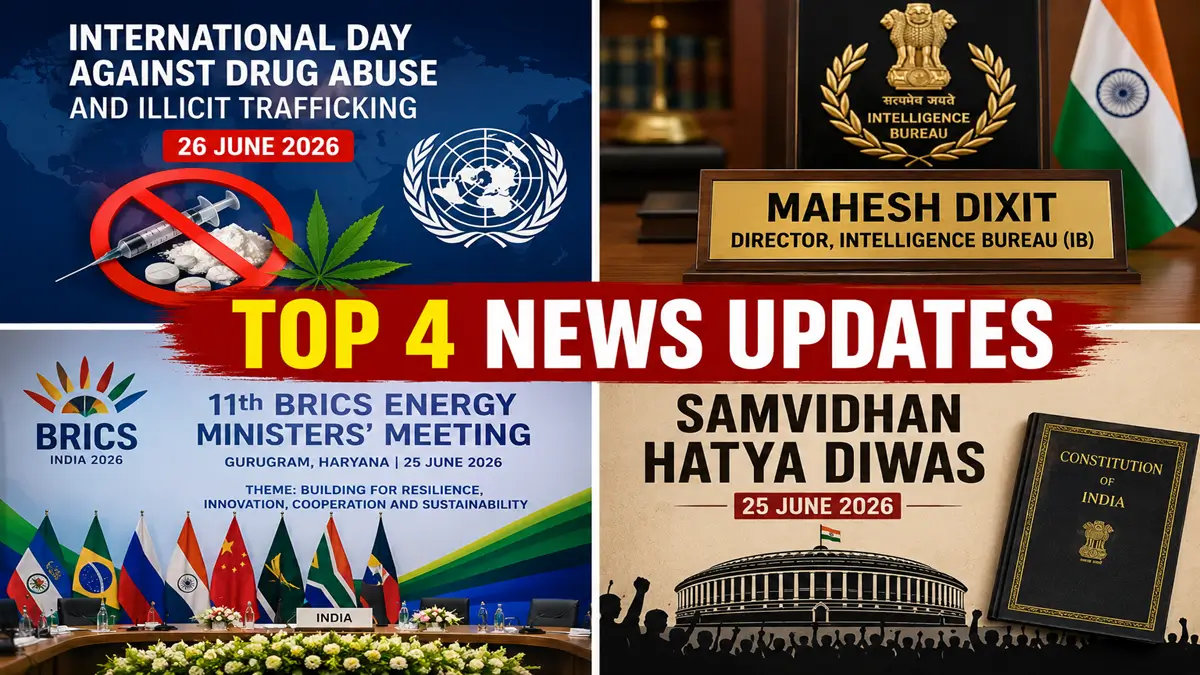
1. International Day Against Drug Abuse and Illicit Trafficking 2026
- Observed every year on 26 June to strengthen global efforts against drug abuse and illicit drug trafficking.
- Declared by the United Nations General Assembly through Resolution 42/112 on 7 December 1987.
- First observed in 1988.
- Coordinated by the United Nations Office on Drugs and Crime (UNODC).
- Aims to raise awareness about the harmful effects of drug abuse on individuals, families, and society.
- Promotes prevention, treatment, rehabilitation, and international cooperation to combat drug trafficking.
- Highlights growing concerns such as synthetic drugs, cocaine production, opioid abuse, organized crime, and money laundering.
- Encourages governments, NGOs, healthcare professionals, and communities to work together for a drug-free world.
- Key Fact: Observed annually on 26 June.
2. United Nations International Day in Support of Victims of Torture 2026
- Observed annually on 26 June to support victims of torture and promote human rights.
- Declared by the UN General Assembly through Resolution 52/149 on 12 December 1997.
- First observed in 1998.
- Marks the entry into force of the UN Convention Against Torture (CAT) on 26 June 1987.
- Coordinated by the United Nations and the Office of the High Commissioner for Human Rights (OHCHR).
- Focuses on justice, accountability, rehabilitation, and protection of torture survivors.
- Promotes awareness that torture is prohibited under international law without exception.
- Supports medical, psychological, legal, and social rehabilitation for survivors through the UN Voluntary Fund for Victims of Torture.
- Key Fact: 26 June also commemorates the enforcement of the Convention Against Torture.
3. Mahesh Dixit Appointed as Director of the Intelligence Bureau (IB)
- The Appointments Committee of the Cabinet (ACC) approved the appointment of Mahesh Dixit as the new Director of the Intelligence Bureau (IB).
- He is a 1993-batch IPS officer of the Andhra Pradesh cadre.
- Currently serving as the Special Director of the Intelligence Bureau.
- Will assume charge on 30 June 2026.
- Succeeds Tapan Kumar Deka, who served as IB Director since 2022.
- Appointed for a two-year tenure or until further orders.
- Has extensive experience in intelligence operations in Jammu & Kashmir, Ladakh, Northeast India, and anti-Naxal regions.
- Also headed the Subsidiary Intelligence Bureau (SIB), Srinagar, after the abrogation of Article 370.
- Key Fact: The Intelligence Bureau (IB) is India’s oldest internal intelligence agency and functions under the Ministry of Home Affairs (MHA).
4. SHATAYU Dashboard Launched
- The Ministry of Social Justice and Empowerment launched the SHATAYU Dashboard to improve elderly care services.
- SHATAYU stands for Senior Holistic Care Assistance and Training for Your Utility.
- The platform connects trained geriatric caregivers with senior citizens requiring professional care.
- Managed by the National Institute of Social Defence (NISD).
- Creates a centralized database of certified caregivers across India.
- Previously trained caregivers (2023–24 and earlier batches) have also been invited to register.
- Aims to improve accessibility, transparency, and quality of elderly care.
- Technical teams are continuously verifying registrations and improving data quality.
- Key Fact: NISD functions under the Ministry of Social Justice and Empowerment.
5. India Hosts 11th BRICS Energy Ministers’ Meeting
- India hosted the 11th BRICS Energy Ministers’ Meeting on 25 June 2026 in Gurugram, Haryana.
- Organized under India’s BRICS Chairship 2026.
- Theme: “Building for Resilience, Innovation, Cooperation and Sustainability.”
- Energy Track Theme: “सर्वेषां ऊर्जम् (Energy for All).”
- Participants included Energy Ministers of BRICS nations, ISA, Global Biofuels Alliance, and New Development Bank.
- Discussions focused on energy security, renewable energy, smart grids, hydrogen, AI, energy storage, and biofuels.
- India launched the BRICS Digital Centre of Excellence (DCoE) for Smart Grids and Energy Storage.
- BRICS countries adopted the Guiding Principles on Smart Grids and Energy Storage.
- The meeting concluded with the adoption of the 11th BRICS Energy Ministers’ Joint Communiqué.
- Key Fact: India highlighted that over 50% of its installed power capacity now comes from non-fossil fuel sources.
6. Samvidhan Hatya Diwas 2026
- The Ministry of Culture commemorated Samvidhan Hatya Diwas at the CCRT Campus, New Delhi.
- The event marked 50 years of the Emergency imposed in 1975.
- Chief Guest: Union Minister Gajendra Singh Shekhawat.
- Organized to create awareness about democracy, constitutional values, fundamental rights, and freedom of expression.
- Featured the “Long Live Democracy” exhibition showcasing the impact of the Emergency.
- Included the Digital District Repository (DDR) exhibition documenting India’s freedom movement.
- A documentary on Samvidhan Hatya Diwas and cultural performances by CCRT scholars were also presented.
- Veteran journalist Ram Bahadur Rai addressed the gathering and shared his experiences during the Emergency.
- Freedom fighters and contributors to the Digital District Repository were felicitated.
- Key Fact: The programme emphasized protecting democracy, constitutional governance, and citizens’ rights.
7. Book on Bhawaiya Folk Music Released by Vice President
- Vice President C. P. Radhakrishnan released the book “Sanskritir Ratna Bhandar: Bhaowaiyar Itibritto” at Uprashtrapati Bhavan, New Delhi.
- The book has been authored by Dr. Jayanta Kumar Roy and Ms. Sangita Roy.
- It documents the history, evolution, and cultural significance of Bhawaiya, a traditional folk music genre of North Bengal, Assam, and adjoining regions.
- The publication highlights the contribution of the Koch Rajbanshi community in preserving the Bhawaiya tradition.
- The Vice President described music as an important part of India’s civilizational heritage and referred to concepts like Sama Veda, Nada Brahma, Bhakti, and Sufism.
- He urged the younger generation to use modern technology to preserve regional languages, folk traditions, and cultural heritage.
- The book aims to promote awareness about India’s intangible cultural heritage.
- Key Fact: Bhawaiya is one of the oldest and most popular folk music traditions of eastern India.
8. Second Pax Silica Summit 2026
- The Second Pax Silica Summit was held on 25–26 June 2026 in Washington, D.C., USA.
- Representatives from 35 countries, including India, participated in the summit.
- Member countries adopted the Joint Statement on AI Opportunity.
- The summit focused on Artificial Intelligence (AI) governance, trusted AI ecosystems, resilient supply chains, and industrial cooperation.
- India was represented by S. Krishnan (Secretary, MeitY) and Nagraj Naidu (Additional Secretary, MEA).
- The Pax Silica Initiative was launched by the United States in December 2025, and India joined it in February 2026.
- A new platform called Pax Pass was introduced to facilitate the secure movement of AI-related technologies.
- The summit also announced the Stanford-led Foundry School, supported by a US$50 million commitment from the United States.
- Key Fact: India’s participation highlights its growing role in global AI governance and digital cooperation.
9. Hemis Festival 2026
- The Hemis Festival 2026 was celebrated on 24–25 June at Hemis Monastery, Leh, Ladakh.
- The festival commemorates the birth anniversary of Guru Padmasambhava (Guru Rinpoche), also known as the Second Buddha.
- It is the largest Buddhist festival celebrated in Ladakh.
- The festival is organized according to the Tibetan lunar calendar.
- The main attraction is the Cham Dance, performed by Buddhist monks wearing colorful masks and traditional robes.
- Devotees participate in prayers, rituals, traditional music, and religious ceremonies.
- The sacred Thangka of Guru Padmasambhava is displayed once every 12 years, attracting thousands of pilgrims.
- The 2026 celebrations were inaugurated by Lieutenant Governor V. K. Saxena.
- Key Fact: Hemis Monastery belongs to the Drukpa Kagyu school of Tibetan Buddhism.
10. Rajolibanda Diversion Scheme (RDS)
- The Rajolibanda Diversion Scheme (RDS) is an interstate irrigation project built across the Tungabhadra River, a tributary of the Krishna River.
- The project benefits Telangana, Karnataka, and Andhra Pradesh.
- It supplies irrigation water to drought-prone agricultural regions.
- Telangana has been allocated 17.9 TMCFT of water under the project.
- Telangana Chief Minister A. Revanth Reddy urged the Centre to resolve the long-pending water-sharing dispute.
- The issue was discussed during the inauguration of the new spillway crest gates at the Tungabhadra Dam.
- Challenges include sedimentation, canal maintenance, inadequate utilization of allocated water, and interstate disputes.
- Proposed measures include desilting reservoirs, improving canal infrastructure, and constructing a balancing reservoir at Navali.
- Key Fact: The Tungabhadra River is one of the major tributaries of the Krishna River.
11. Indian Passport Fee Hike 2026
- The Government of India has revised passport fees, effective from 1 July 2026.
- This is the first major revision since 2012.
- The revision applies to fresh passports, renewals, Tatkal services, replacement of lost/damaged passports, and passports for minors.
- The fee for a 36-page passport has increased from ₹1,500 to ₹2,500.
- The fee for a 60-page passport has increased from ₹2,000 to ₹3,500.
- Tatkal passport charges have also been increased.
- Replacement charges for lost or damaged passports have been revised upward.
- Passport validity remains unchanged (10 years for adults).
- The revision has been made under the Passport Rules, 1980.
- Key Fact: The fee hike reflects the increasing cost of passport processing and service delivery.
12. Memoir of Group Captain Shubhanshu Shukla Released
- Air Chief Marshal Amar Preet Singh released the memoir of Group Captain Shubhanshu Shukla in New Delhi.
- The memoir is titled “The Second Orbit: Belief of a Man… Dreams of 1.4 Billion Hearts.”
- The book chronicles Shukla’s journey from an Indian Air Force fighter pilot to an astronaut.
- It details his training and experiences during the Axiom-4 Mission to the International Space Station (ISS).
- The event marked the first anniversary of the Axiom-4 mission, launched on 25 June of the previous year.
- The memoir highlights India’s growing role in human spaceflight and international space missions.
- Students from various schools interacted with the astronaut during the launch event.
- The book aims to inspire young Indians to pursue careers in science, technology, and space exploration.
- Key Fact: The memoir celebrates India’s expanding contribution to global human spaceflight.









 Daily Current Affairs and GK Updates (13...
 Daily Current Affairs and GK Updates (12...
 Daily Current Affairs Quiz 12th October,...