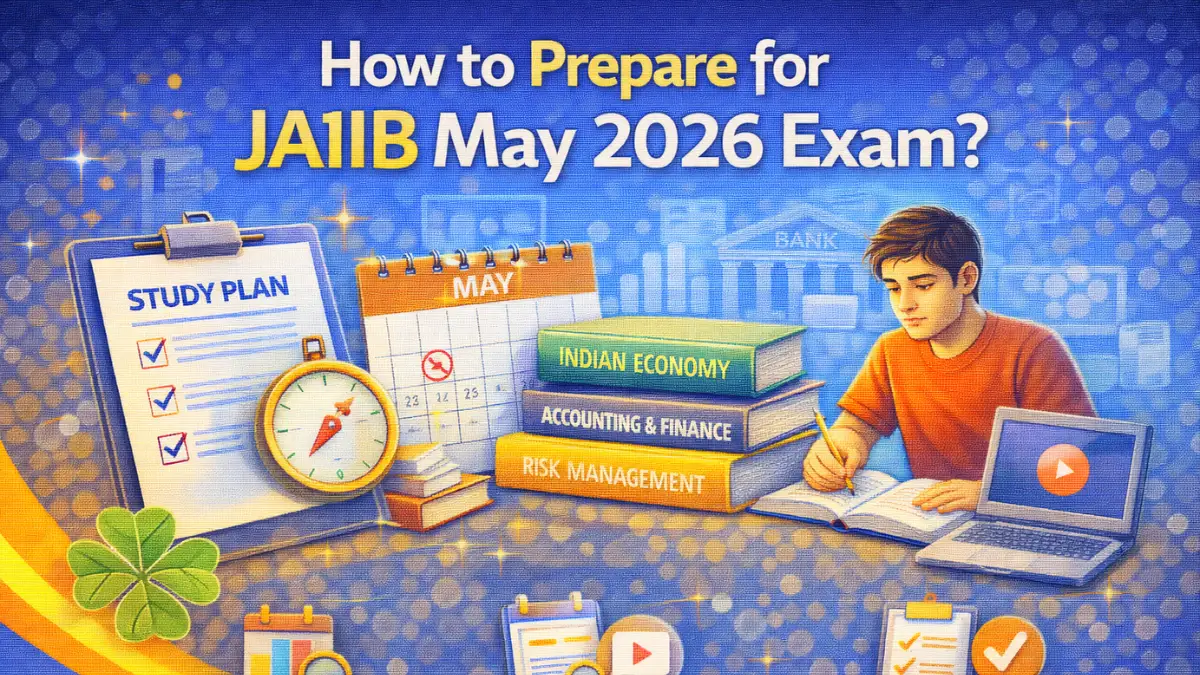
The JAIIB May 2026 exam is an important milestone for banking professionals aiming to strengthen their conceptual foundation and accelerate career growth. Conducted by the Indian Institute of Banking & Finance, JAIIB is not just an exam of memory but a test of applied understanding of banking operations, finance, and customer relations. Many candidates underestimate the exam initially and then struggle due to a lack of structured preparation.
How to Prepare for JAIIB May 2026 Exam?
Preparing for JAIIB alongside a full-time banking job can feel challenging, but it is absolutely manageable with the right strategy. The syllabus is practical in nature and closely linked to day-to-day banking work, which works in the candidate’s favour if studied correctly. Instead of rote learning, the focus should be on concept clarity, regular revision, and continuous practice of MCQs. With the May 2026 exam cycle in mind, aspirants still have sufficient time to prepare in a balanced and stress-free manner.
Know the JAIIB May 2026 Structure
JAIIB now has 4 compulsory papers under the revised syllabus:
- Indian Economy & Indian Finacial System (IE & IFS)
- Principles & Practices of Banking (PPB)
- Accounting & Financial Management for Bankers (AFM)
- Retail Banking & Wealth Management (RBWM)
Key Pattern Points:
- Mode: Online- MCQ Based
- Questions: 100 per paper
- Marks: 100 per paper
- Time: 2 hours per paper
- Passing: 50 marks in each paper
Step 1: Plan Backward From May 2026
You have limited time along with a full time bank job
- Keep at least 3 full months for serious preparation before the first paper
- Decide your attempt strategy: whether you will aim to clear 4 papers in one go or split across cycle (if work pressure is very high)
A simple planning idea:
- Till February-March: Concepts building and reading
- March-April: Practice questions and module-wise MCQs
- Late April-May: Ful mock tests, revision and numerical practice
Step 2: Understand Each Paper’s Demand
Each JAIIB paper has a different flavour. Treat them differently
- IE & IFS: Theory-heavy – covers economy basics, financial system, markets, regulations, RBI, etc. Needs concept clarity + regular reading.
- PPB: Core banking – deposits, advances, KYC, risk, ethics, customer service. Relates directly to your daily work; read and link with practical examples.
- AFM: Most feared – accounting concepts, ratios, balance sheet, costing, cash flow, etc. Needs practice with numerical questions.
- RBWM: Mix of retail products, loans, cross-selling, wealth management basics, investment products, and customer-centric topics.
Step 3: Make a Realistic Weekly Study Routine
Because you are working, focus on short, consistent slots instead of very long sessions.
On working days (Mon–Fri):
1–1.5 hours daily: pick one main subject per day. Example routine:
- Mon: IE & IFS
- Tue: PPB
- Wed: AFM
- Thu: RBWM
- Fri: Revision + small MCQs
On weekends (Sat–Sun): 2–4 hours in total:
- Detailed study of difficult modules (e.g., AFM numericals).
- Practice full-length subject-wise tests.
Step 4: Use the Official Syllabus and Pattern as Your Base
Always keep the official revised syllabus PDF and exam pattern as your primary guide.
- Download the JAIIB revised syllabus notification from IIBF website and mark modules for each subject.
- For each module, prepare a small checklist of topics and tick them as you complete.
- Note the marking pattern: 100 marks per paper with a mix of 0.5, 1, and 2-mark questions – so conceptual questions and case-study type MCQs are important.
Step 5: Build Concepts First, Then Practice MCQs
For JAIIB, both reading and practice are important.
Concept Phase
- Use standard JAIIB books or quality online classes that cover the updated syllabus.
- Read each module slowly, underline key points, write mini-notes or mark important lines.
- For AFM, focus extra on basics: journal, ledger, trial balance, P&L, balance sheet, ratio analysis, NPV/IRR basics, depreciation, etc.
Practice Phase
- After each chapter, solve topic-wise MCQs to test understanding.
- Try case-study-based questions, especially in PPB, RBWM, and IE & IFS.
- Use chapter-wise quizzes during weekdays and subject-wise tests on weekends.
Step 6: Special Strategy for AFM (Accounting & Finance)
AFM is the paper that worries most candidates, especially from non-commerce backgrounds.
- Start AFM early – do not leave it for the last month.
- Learn formulas and formats (P&L, balance sheet, cash flow, ratio formulae) and keep a small formula notebook for daily revision.
- Practice numericals daily: even 5–10 questions per day make a big difference.
- Focus more on frequently asked themes like ratios, break-even point, marginal costing, depreciation, and basic financial maths.
- Remember: understanding the logic behind formulas is more powerful than rote memorisation.
Step 7: Use Your Job Experience as a Strength
JAIIB is made for bankers, so your branch experience is a big plus.
- Link PPB concepts with your daily work: account opening, loans, NPA, KYC/AML, documentation, customer service, etc.
- For RBWM, relate topics to products you sell in branch – housing loans, personal loans, credit cards, mutual funds, insurance, etc.
- For IE & IFS, connect economy and financial system topics with RBI circulars, monetary policy, and financial market news you see as a banker.
Step 8: Attempt Full-Length Mocks Before the Exam
Mocks help you understand speed, pattern, and weak areas.
- Take at least 2–3 full subject-wise mocks for each paper in April–May 2026.
- After every mock, spend time on analysis: note which modules are weak, what type of questions you are missing.
- Revise those weak modules again and reattempt questions.
- Since passing marks are 50 per subject, your target score in mocks should be at least 60+ to stay safe.
Step 9: Make a Smart Revision Plan
Last 2–3 weeks are for revision and consolidation.
- Revise your short notes, underlined points, and formula notebook.
- Go through important RBI functions, banking terms, important committees, and laws again.
- Redo previously marked “wrong questions” from practice sets – they are your best teacher.
- Focus on high-yield modules (those from which more questions usually come as per recent papers).
| Related Posts | |
| JAIIB Salary | JAIIB Study Material |
| JAIIB Previous Year Papers | JAIIB Exam Preparation Tips |
| JAIIB Mock Test | JAIIB Online Course |

 JAIIB IE & IFS Memory Based Question...
 Crack the JAIIB Exam 2025 with These Imp...
 Bank of Maharashtra Promotion Exam 2024,...