
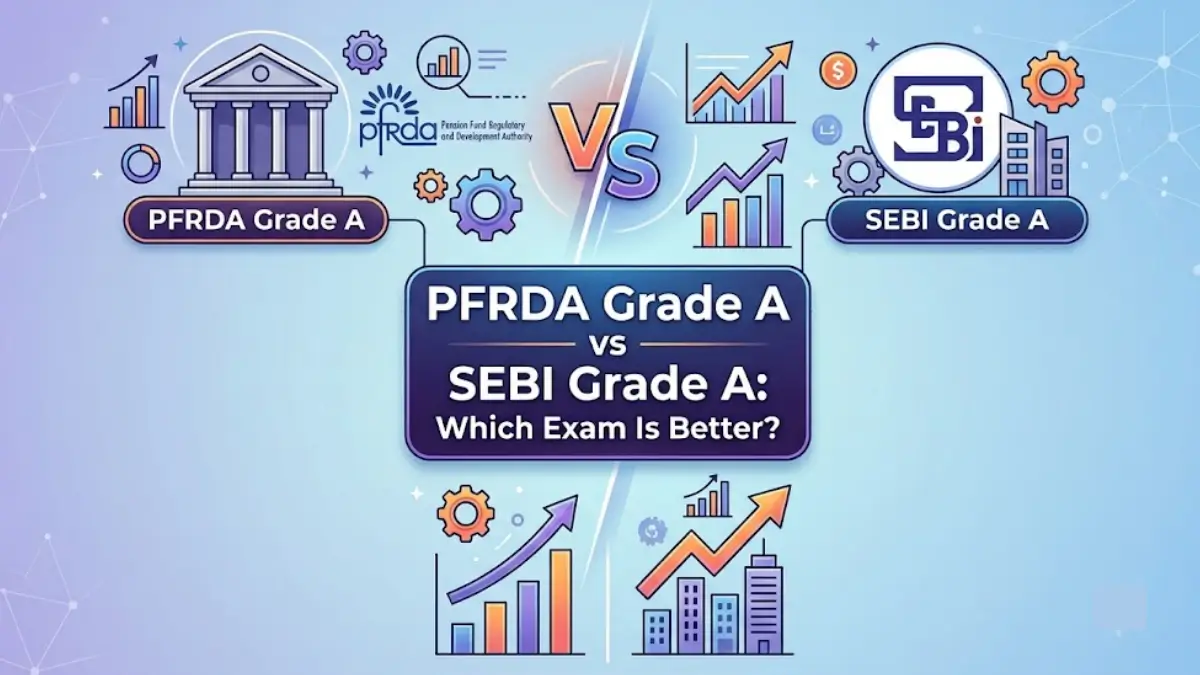
Choosing between PFRDA Grade A and SEBI Grade A means choosing between two flavors of the same dream job a regulatory career in India’s financial sector, with a good salary and real power over how money moves in the country. One is smaller and more intimate, the other larger and more competitive.
PFRDA Grade A vs SEBI Grade A: Which Exam Is Better?
Candidates often wonder which exam is better PFRDA Grade A vs. SEBI Grade A? The answer depends on factors such as salary, job profile, curriculum, competition, posting location, and personal career preferences. While both exams share many similarities, their regulatory responsibilities and career exposure are quite different.
| Parameter | PFRDA Grade A | SEBI Grade A |
| Regulates | Pension sector (NPS) | Securities & capital markets |
| Latest vacancies | 30 | Expected to Released Soon |
| Streams | General, Research, Actuary, Official Language | General, Legal, IT, Research, Engineering, Official Language |
| Basic pay | ₹62,500/month | ₹62,500/month |
| Gross monthly salary | ~₹2.05 lakh | ~₹1.43–1.84 lakh |
| Head office | Delhi | Mumbai (+ 4 regional offices) |
| Selection stages | Prelims → Mains → Interview | Prelims → Mains → Interview |
| Max age limit | 30 years | 30 years |
What Each Regulator Actually Does
- PFRDA (Pension Fund Regulatory and Development Authority) oversees India’s pension ecosystem the National Pension System, pension fund managers, and retirement savings for millions of subscribers.
- SEBI (Securities and Exchange Board of India) is the country’s capital markets watchdog, regulating stock exchanges, mutual funds, IPOs, brokers, and market fraud.
- Both are statutory bodies recruiting Assistant Managers under the “Grade A” title.
- Both run selection through Phase 1 (Prelims) → Phase 2 (Mains) → Interview.
Salary Comparison
- Both regulators recently revised pay, and both now start officers at the same basic pay of ₹62,500/month (up from ₹44,500).
- PFRDA’s gross salary (~₹2.05 lakh/month) currently comes out higher than SEBI’s (~₹1.43–1.84 lakh/month, depending on accommodation).
- SEBI officers, especially in Mumbai and its regional hubs, tend to get access to stronger long-term allowance structures.
Exam Pattern and Difficulty
- Both Prelims papers test Quant, Reasoning, English, and General/Financial Awareness.
- Both Mains papers are stream-specific and more technical.
- PFRDA’s Mains leans into pension economics, financial markets, and regulatory frameworks.
- SEBI’s Mains goes deeper into securities law, corporate finance, and capital market regulation arguably tougher for non-Finance/Legal graduates.
- Because PFRDA has so few seats, its cut-offs often run just as high as SEBI’s, sometimes higher.
Career Growth and Work Profile
- SEBI is the bigger, more visible institution, with officers getting frequent exposure to high-stakes market regulation, IPO scrutiny, and enforcement work.
- PFRDA is smaller and more specialised this can mean faster ownership of niche pension-sector projects, but a narrower overall canvas.
- Neither role involves the frequent transfers common in banking Grade A/B jobs a big plus for anyone who values stability.
Which One Should You Pick?
There’s no single “better” answer it depends on what matters most to you:
- Pick SEBI Grade A if: you want a bigger organisation, wider career visibility, and more vacancies to try your luck at.
- Pick PFRDA Grade A if: you want a leaner, high-paying regulatory role and don’t mind a smaller, more selective seat count.
- Best strategy either way: the syllabus overlap between the two is substantial, so most serious aspirants prepare for both together and let whichever notification and cut-off works out first decide the outcome.






 CWC Recruitment 2026 Notification Out fo...
 NICL Assistant Mains Admit Card 2026 Out...
 UIIC AO Prelims Expected Cut Off 2026, C...