
Directions (1-5): In these questions, relationship between different elements is show in the statements. The statements are followed by conclusions. Study the conclusions based on the given statements and select the appropriate answer:
(a) If only conclusion I follows.
(b) If only conclusion II follows.
(c) If either conclusion I or II follows
(d) If neither conclusion I nor II follows.
(e) If both conclusions I and II follow.
Q1. Statements: W≤R<T≥ S>X> B>F<K=M
Conclusion I: F≤T II: T>F
Q2. Statements: R≥P≥D=W≤Z= A>V=N
Conclusion I: R≥Z II: A>D
Q3. Statements: K=Q>E> G>J>Y≥D≤R<T
Conclusion I: K>T II: T≤K
Q4. Statements: I>P≤ Y≥T=M≥ W≥X<C=D
Conclusion I: Y>X II: X=Y
Q5. Statements: P<Q≤X=B≤ E=T>Y=U<L
Conclusion I: U<X II: X≤U
Directions (6-10): In these questions, relationship between different elements is show in the statements. The statements are followed by conclusions. Study the conclusions based on the given statements and select the appropriate answer:
(a) If only conclusion I follows.
(b) If only conclusion II follows.
(c) If either conclusion I or II follows
(d) If neither conclusion I nor II follows.
(e) If both conclusions I and II follow.
Q6. Statements: A>E<P≤V<D=W>T≥O>Q
Conclusion I: Q≤D II: W>E
Q7. Statements: Q<J≤O< D≤R>W=U>P
Conclusion I: R>Q II: D>U
Q8. Statements: Y=O≥E=W≥P<S≤G
Conclusion I: S>O II: P≤Y
Q9. Statements: H<T= R≤ X<V>Z≥S
Conclusion I: Z>T II: T≥Z
Q10. Statements: M≤ L=V=G>F=W<T≤R
Conclusion I: L>W II: G≥R
Directions (11-15): In these questions, relationship between different elements is shown in the statements. These statements are followed by two conclusions:
(a) If only conclusion I follows.
(b) If only conclusion II follows.
(c) If either conclusion I or II follows.
(d) If neither conclusion I nor II follows.
(e) If both conclusion I and II follow.
Q11. Statements: K ≤ M < B ≥ W < R ≥ S = T
Conclusion:
I. R > K
II. K ≤ R
Q12. Statements: R > L ≤ U < N > P = T > E
Conclusion:
I. N > L
II. P > E
Q13. Statement: W ≥ D = O ≥ T ≥ E ≥ S < R
Conclusions:
I. D > S
II. S = D
Q14. Statement: M ≤ N > Y = T > O ≥ P = Q
Conclusions:
I. N ≥ P
II. Q < Y
Q15. Statement: U ≤ V < W =X < Y ≥ T ≤ I
Conclusions:
I. Y > U
II. T > V
Practice More Questions of Reasoning for Competitive Exams:
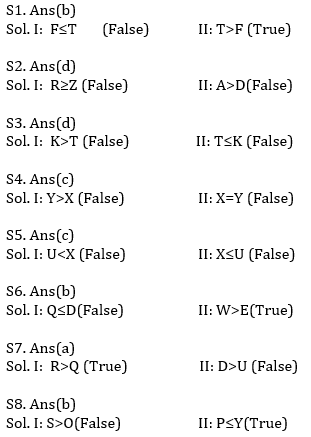
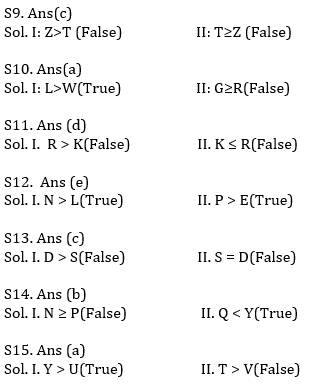
Solutions

Practice with Online Test Series for RBI Attendant 2021:
Click Here to Register for Bank Exams 2020 Preparation Material

 RBI Assistant 2026 Prelims: Last 15 Days...
 Daily Current Affairs and GK Updates (23...
 SBI Clerk Syllabus and Exam Pattern 2026...