
Directions (1-5): In these questions, relationship between different elements is show in the statements. The statements are followed by conclusions. Study the conclusions based on the given statements and select the appropriate answer:
(a) If only conclusion I follows.
(b) If only conclusion II follows.
(c) If either conclusion I or II follows
(d) If neither conclusion I nor II follows.
(e) If both conclusions I and II follow.
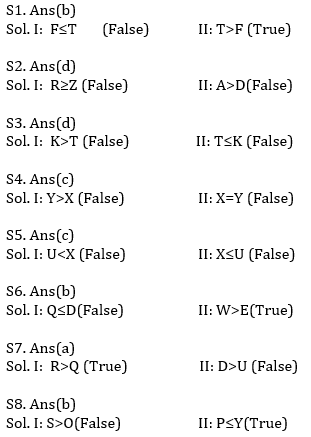
Q1. Statements: W≤R<T≥ S>X> B>F<K=M
Conclusion I: F≤T II: T>F
Q2. Statements: R≥P≥D=W≤Z= A>V=N
Conclusion I: R≥Z II: A>D
Q3. Statements: K=Q>E> G>J>Y≥D≤R<T
Conclusion I: K>T II: T≤K
Q4. Statements: I>P≤ Y≥T=M≥ W≥X<C=D
Conclusion I: Y>X II: X=Y
Q5. Statements: P<Q≤X=B≤ E=T>Y=U<L
Conclusion I: U<X II: X≤U
Directions (6-10): In these questions, relationship between different elements is show in the statements. The statements are followed by conclusions. Study the conclusions based on the given statements and select the appropriate answer:
(a) If only conclusion I follows.
(b) If only conclusion II follows.
(c) If either conclusion I or II follows
(d) If neither conclusion I nor II follows.
(e) If both conclusions I and II follow.
Q6. Statements: A>E<P≤V<D=W>T≥O>Q
Conclusion I: Q≤D II: W>E
Q7. Statements: Q<J≤O< D≤R>W=U>P
Conclusion I: R>Q II: D>U
Q8. Statements: Y=O≥E=W≥P<S≤G
Conclusion I: S>O II: P≤Y
Q9. Statements: H<T= R≤ X<V>Z≥S
Conclusion I: Z>T II: T≥Z
Q10. Statements: M≤ L=V=G>F=W<T≤R
Conclusion I: L>W II: G≥R
Directions (11-15): In these questions, relationship between different elements is shown in the statements. These statements are followed by two conclusions:
(a) If only conclusion I follows.
(b) If only conclusion II follows.
(c) If either conclusion I or II follows.
(d) If neither conclusion I nor II follows.
(e) If both conclusion I and II follow.
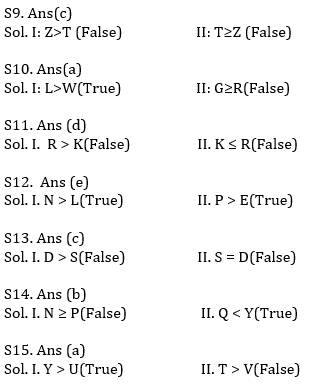
Q11. Statements: K ≤ M < B ≥ W < R ≥ S = T
Conclusion:
I. R > K
II. K ≤ R
Q12. Statements: R > L ≤ U < N > P = T > E
Conclusion:
I. N > L
II. P > E
Q13. Statement: W ≥ D = O ≥ T ≥ E ≥ S < R
Conclusions:
I. D > S
II. S = D
Q14. Statement: M ≤ N > Y = T > O ≥ P = Q
Conclusions:
I. N ≥ P
II. Q < Y
Q15. Statement: U ≤ V < W =X < Y ≥ T ≤ I
Conclusions:
I. Y > U
II. T > V
Practice More Questions of Reasoning for Competitive Exams:
Solutions

Practice with Online Test Series for RBI Attendant 2021:
Click Here to Register for Bank Exams 2020 Preparation Material









 80 Most Important General Awareness Ques...
 Daily Current Affairs and GK Updates (3r...
 IB ACIO Cut Off 2026, Check Previous Yea...