Preparing for IBPS SO and confused about what “Professional Knowledge” actually means? You are not alone. Professional Knowledge is the most misunderstood and most underestimated part of this exam.
What Is Professional Knowledge in IBPS SO?
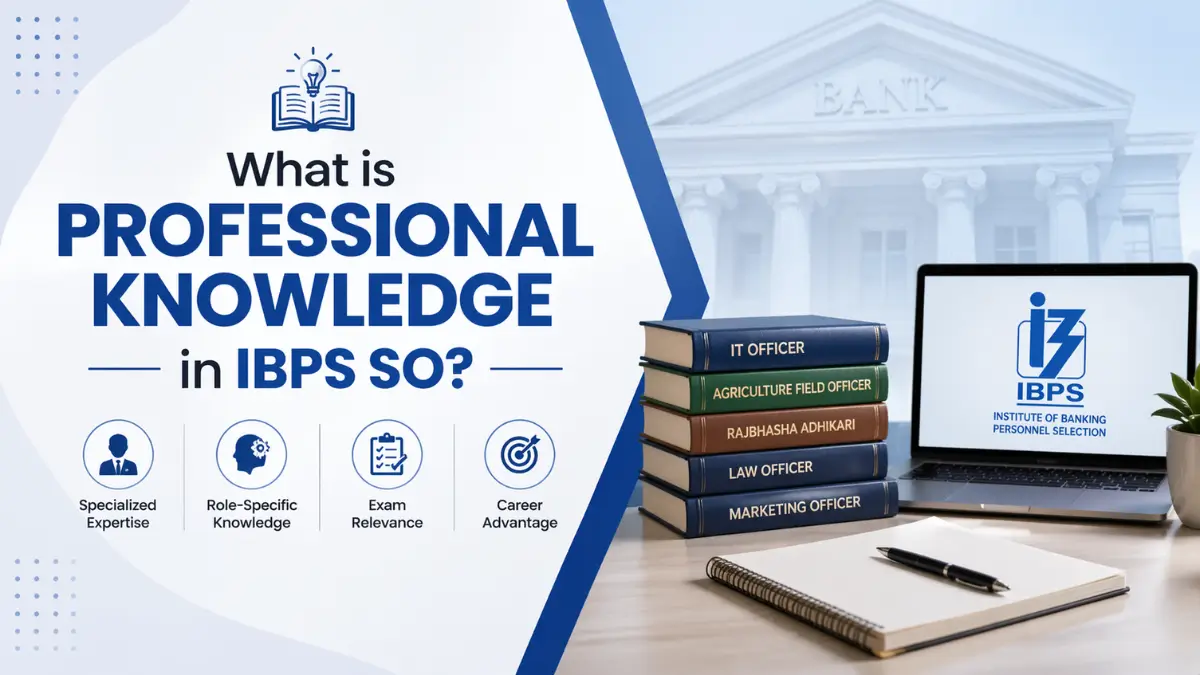
Professional Knowledge is the subject-specific Mains paper that tests your expertise in the domain of the post you are applying for- IT, Agriculture, HR, Marketing, Law, or Rajbhasha.
IBPS SO recruits officers for specialised roles in public sector banks. These are not general banking roles — they are domain-specific positions.
A Specialist Officer is hired to do a specific job:
- IT Officer → manages banking technology and cybersecurity
- Agriculture Field Officer → advises farmers on loans and schemes
- HR Officer → handles recruitment, labour law, and employee relations
- Marketing Officer → drives banking product campaigns and sales
- Law Officer → manages legal compliance and banking litigation
- Rajbhasha Adhikari → handles official Hindi language correspondence
To ensure candidates are genuinely qualified, IBPS tests them on their subject through the Professional Knowledge paper in Mains.
Structure of the Professional Knowledge Paper
The Professional Knowledge paper is part of the IBPS SO Main Examination. Key details at a glance:
- Total Questions: 60
- Total Marks: 60 (1 mark per question)
- Duration: 45 minutes
- Mode: Online, objective-type (MCQ)
- Negative Marking: 0.25 marks deducted per wrong answer
This structure is the same across all posts — IT Officer, AFO, HR Officer, Marketing Officer, Law Officer, and Rajbhasha Adhikari.
How Much Does Professional Knowledge Matter in Final Selection?
- Prelims score → used for shortlisting only, does NOT count in final merit
- Mains (Professional Knowledge paper) → 80% of final score
- Interview → 20% of final score
Bottom line: Your Professional Knowledge score is 80% of your selection. Most aspirants spend 80% of their time on Prelims. That is the single biggest strategic mistake in IBPS SO preparation.
Professional Knowledge Syllabus — Post by Post
IT Officer (Scale I)
Tests computer science and IT concepts at the undergraduate engineering level.
- Data Structures & Algorithms: Arrays, linked lists, stacks, queues, trees (BST, AVL), graphs, sorting (bubble, merge, quick, heap), Big O notation
- DBMS: Relational model, ER diagrams, normalisation (1NF–BCNF), SQL queries, ACID properties, indexing, concurrency control
- Computer Networks: OSI model (all 7 layers), TCP/IP, IP addressing, subnetting, routing protocols (RIP, OSPF, BGP), HTTP, DNS, DHCP
- Operating Systems: Process management, CPU scheduling (FCFS, SJF, Round Robin), memory management, paging, deadlock, file systems
- Software Engineering: SDLC models (Waterfall, Agile, Spiral), testing types (unit, integration, UAT), software metrics
- OOP Concepts: Encapsulation, inheritance, polymorphism, abstraction — conceptual understanding, no coding required
- Cybersecurity: Malware, phishing, DDoS, encryption (symmetric vs asymmetric), SSL/TLS, firewalls, digital signatures
- Banking Technology: Core Banking Solutions (CBS), RTGS, NEFT, IMPS, UPI, RBI IT guidelines, cybersecurity frameworks for banks
- Emerging Technologies: Cloud computing (IaaS, PaaS, SaaS), AI/ML in banking, blockchain in financial services, big data basics
Agriculture Field Officer (Scale I)
Broad coverage of agricultural sciences, rural credit, and government schemes.
- Agronomy: Kharif/Rabi/Zaid crops, cropping systems (intercropping, crop rotation), irrigation methods (drip, sprinkler, furrow), major crops by state
- Soil Science: Soil types in India, soil pH, NPK fertilisers, organic farming, soil erosion and conservation, soil testing
- Horticulture: Fruit and vegetable crops, floriculture, post-harvest management, protected cultivation (greenhouse farming)
- Plant Pathology & Entomology: Major crop diseases, common pests, integrated pest management (IPM), biological control methods
- Animal Husbandry: Major livestock breeds, dairy farming, animal nutrition, common diseases, poultry management, fisheries basics
- Agricultural Economics & Marketing: Kisan Credit Card, NABARD schemes, APMC, e-NAM, MSP, FPOs, PMFBY, cooperative societies
- Agricultural Engineering: Farm machinery (tractor, harvester, seed drill), irrigation infrastructure, post-harvest technology, cold chain
- Government Schemes: PM-KISAN, PMKVY, MNREGA, Soil Health Card, NFSM, RKVY, NABARD functions, rural infrastructure programmes
- Agricultural Research: Green Revolution, White Revolution, Blue Revolution, ICAR, IARI, NDRI, agri-biotechnology basics
HR/Personnel Officer (Scale I)
Tests HRM concepts, organisational behaviour, and Indian labour law.
- HRM Functions: HR planning, recruitment and selection, induction, training, performance appraisal, compensation, separation
- Training & Development: TNA process, training types (on-the-job, off-the-job, e-learning), Kirkpatrick model, succession planning
- Performance Management: 360-degree feedback, MBO, BARS, forced ranking, potential appraisal, career development
- Compensation: Job evaluation, wage theories, pay structure (basic, DA, PF, gratuity, bonus), CTC components, pay commissions
- Organisational Behaviour: Maslow, Herzberg, McGregor X&Y, Vroom’s expectancy, McClelland’s need theory, leadership styles, group dynamics, change management
- Key Labour Laws: Industrial Disputes Act 1947 | Factories Act 1948 | Minimum Wages Act 1948 | Payment of Wages Act 1936 | Payment of Bonus Act 1965 | EPF Act 1952 | Maternity Benefit Act 1961 | Payment of Gratuity Act 1972 | Contract Labour Act 1970 | Labour Codes 2020 (overview)
- HR in Banking: Public sector bank HR practices, IBA wage revisions, bipartite settlements, vigilance and disciplinary proceedings
Marketing Officer (Scale I)
Tests marketing management, consumer behaviour, and banking-specific marketing.
- Marketing Fundamentals: Marketing concepts and orientations, marketing mix (4Ps and 7Ps), SWOT analysis, Porter’s Five Forces
- Market Research & Consumer Behaviour: Research methods, consumer decision-making process, buying motives, STP framework (segmentation, targeting, positioning)
- Product & Brand Management: Product life cycle (PLC), new product development, brand equity, brand extensions, product mix decisions
- Pricing, Distribution & Promotion: Pricing strategies (penetration, skimming, cost-based, value-based), channel management, integrated marketing communications
- Banking Marketing: Marketing of deposits, loans, credit cards, insurance, mutual funds; retail vs corporate banking marketing; CRM; cross-selling and up-selling
- Sales Management: Sales force management, selling process, territory management, key account management, B2B vs B2C in financial services
- Digital Marketing: SEO, SEM, social media marketing, email marketing, content marketing, digital payment marketing, analytics basics
- Services Marketing: IHIP characteristics, SERVQUAL model, customer satisfaction, service recovery
Law Officer (Scale I)
Tests banking law, constitutional law, civil/criminal procedure, and commercial law.
- Constitutional Law: Fundamental Rights (Articles 12–35), Directive Principles (Articles 36–51), constitutional bodies (RBI, CAG, Finance Commission), judicial review
- Banking Laws: Banking Regulation Act 1949 | RBI Act 1934 | SARFAESI Act 2002 | Recovery of Debts and Bankruptcy Act 1993 | PMLA 2002
- Negotiable Instruments Act 1881: Types of NI (cheque, promissory note, bill of exchange), negotiation, endorsement, dishonour of cheques (Section 138), holder in due course, crossing
- Indian Contract Act 1872: Valid contract essentials, offer and acceptance, free consent, void vs voidable contracts, breach and remedies
- Transfer of Property Act 1882: Modes of transfer, types of mortgage, pledge, hypothecation, assignment, stamp duty
- CPC 1908 & CrPC 1973: Jurisdiction types, civil appeals, FIR, cognisable vs non-cognisable offences, bail procedures
- IPC 1860: Banking-relevant offences — cheating, forgery, criminal breach of trust, counterfeiting; IT Act 2000 cybercrime provisions
- Companies Act 2013 & IBC 2016: Company types, MOA and AOA, winding up, CIRP process, liquidation, personal insolvency
- Consumer Protection Act 2019 & RTI Act 2005: Consumer rights, Banking Ombudsman Scheme, RTI provisions for banks
Rajbhasha Adhikari (Scale I)
For candidates with a postgraduate degree in Hindi. Tests language, translation, and official language policy.
- Hindi Language & Literature: Grammar (syntax, sandhi, samas, karak), history of Hindi literature, major literary movements, prominent authors
- Translation: English-to-Hindi and Hindi-to-English of banking/official texts, technical Hindi vocabulary, translation of government circulars
- Official Language Policy: Constitutional provisions (Articles 343–351), Official Languages Act 1963, three-language formula, Rajbhasha Rules 1976
- Banking Terminology in Hindi: Standard Hindi equivalents of banking and finance terms, Hindi software tools for official use
How to Prepare for Professional Knowledge — Step by Step
Step 1 — Start with Textbooks, Not Exam Guides
- Exam guides are for revision — not for building concepts
- Professional Knowledge questions test depth, which only comes from proper subject textbooks
- Spend the first 4–5 weeks on textbook-based study before moving to practice sets
Step 2 — Map Syllabus to Topic Weightage
- Analyse previous year papers to identify high-frequency topics per post
- IT Officer → DBMS and Networks appear most often
- AFO → Agronomy and Government Schemes dominate
- HR Officer → Labour Laws and Motivation Theories are most tested
- Spend 60% of your time on high-frequency topics, 40% on the rest
Step 3 — Make One-Page Topic Notes
- After each chapter, prepare a one-page summary
- Include: key definitions, formulas or provisions, exceptions, exam-facing facts
- These notes become your only revision tool in the last 2–3 weeks before Mains
Step 4 — Solve PYQs Topic-Wise First
- Use IBPS SO Professional Knowledge papers from 2018–2024
- First pass: solve topic-wise to understand how each area is examined
- Second pass: solve as full timed mocks after completing the syllabus
Step 5 — Practise Application, Not Just Recall
- Professional Knowledge increasingly tests scenarios, not direct definitions
- Law: “Which section of the NI Act applies here?” — not “Define the NI Act”
- IT: “Which data structure works best for this problem?” — not “Define a linked list”
- Practise applying your knowledge to real banking situations
Daily Professional Knowledge Time Allocation:
Weeks 1–4 → 60 min: textbook reading and concept building
Weeks 5–8 → 45 min practice + 30 min notes revision
Final 2 weeks → 75–90 min: Professional Knowledge full mocks + error analysis
Common Professional Knowledge Mistakes — and How to Fix Them
Mistake 1 — Starting Professional Knowledge too late
- Professional Knowledge = 80% of final selection. Leaving it for the last 3–4 weeks before Mains is fatal.
- Fix: Start Professional Knowledge from Day 1 of your preparation, parallel to Prelims aptitude.
Mistake 2 — Relying only on shortcut guides
- Quick guides cannot build the depth needed for applied Professional Knowledge questions.
- Fix: Textbooks first (Weeks 1–6) → exam guides for revision (Weeks 7–8) → mocks from Week 5.
Mistake 3 — Ignoring the banking context of your subject
- Professional Knowledge tests your domain in a banking context — not as a pure academic paper.
- Fix: For every topic, ask: “How does this apply in a bank?” Always link subject knowledge to banking operations.
Mistake 4 — Practising without a timer
- 60 questions in 45 minutes = 45 seconds per question. Many candidates know the content but can’t finish in time.
- Fix: From Week 6, always practise Professional Knowledge under timed conditions. Track completion rate every session.
Mistake 5 — Skipping low-frequency sub-topics
- IBPS shifts topic focus occasionally. An ignored sub-topic can cost 5–8 marks.
- Fix: Cover the full syllabus. No topic left completely unread.
Professional Knowledge in the IBPS SO Interview
Professional Knowledge preparation does not end at the written exam. The interview panel includes senior bank officials and subject matter experts who probe your domain knowledge directly.
- Marketing Officer: “How would you design a campaign for a savings product targeting rural customers?”
- IT Officer: “What is your take on recent cybersecurity incidents in Indian banks?”
- AFO: “How effective has PM-KISAN been? What improvements would you suggest?”
- Law Officer: “Walk us through the SARFAESI Act enforcement process for an NPA account.”
To prepare for this, stay current throughout your preparation period:
- Follow RBI circulars and press releases
- Read financial news — Mint, Business Standard, Economic Times
- Track government policy updates relevant to your post
Interview Weightage: Mains : Interview = 80 : 20. The interview is not a formality — it can significantly shift your final rank. Strong Professional Knowledge in the interview is your competitive edge over equally-scoring written candidates.
Your Professional Knowledge Preparation Checklist — Start This Week:
① Confirm your post and check IBPS SO syllabus for your Professional Knowledge paper.
② Gather your 2–3 core textbooks for your specialisation before anything else.
③ Build a topic-wise Professional Knowledge study schedule running parallel to Prelims prep from Day 1.
④ Source IBPS SO Professional Knowledge previous year papers (2018–2025) — best guide to question style and weightage.
⑤ Start making one-page topic notes from Week 1 — your most valuable revision tool later.
| Related Posts | |
| How to Build Strong Basics for IBPS SO Exam |
|
| IBPS SO Syllabus | IBPS SO Salary |
| IBPS SO Previous Year Papers | IBPS SO Eligibility |








 IBPS Clerk Prelims Expected Cut Off 2026...
 IBPS Clerk Prelims Exam Analysis 2026, 1...
 IBPS Clerk Prelims Memory Based Paper 20...