
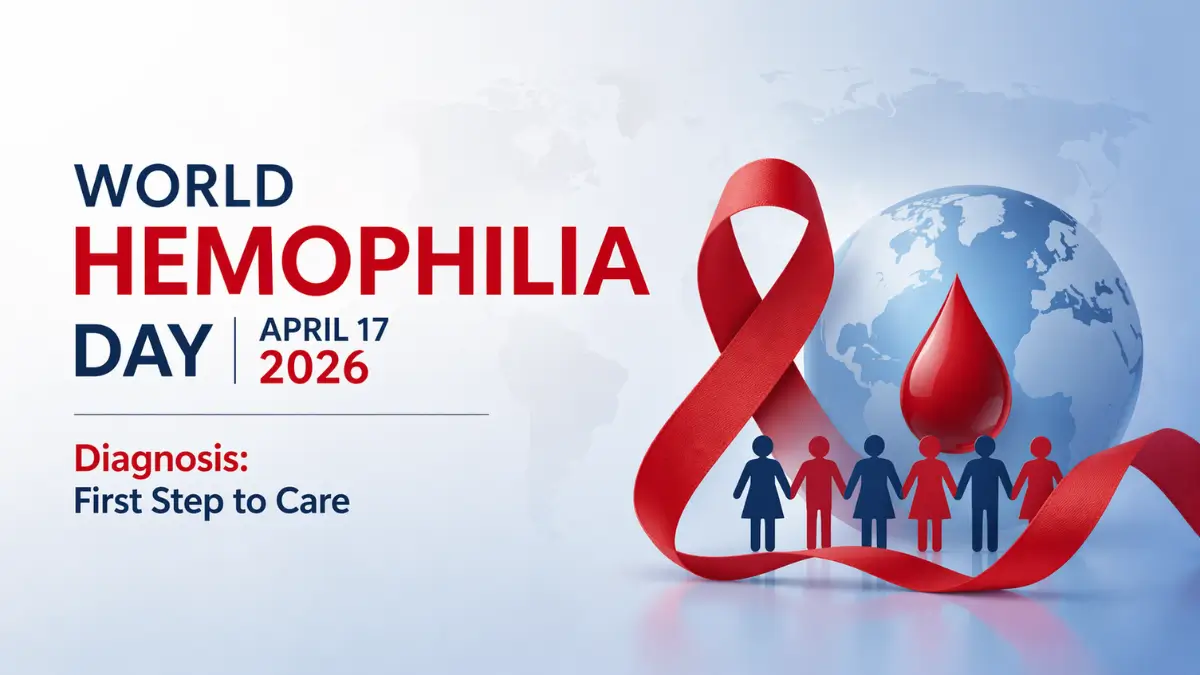
Every year on April 17, the global community unites to observe World Hemophilia Day, a pivotal occasion dedicated to raising awareness about hemophilia (or Haemophilia) and other inherited bleeding disorders. Established by the World Federation of Hemophilia (WFH), this day serves as a powerful platform for education, advocacy, and community building. As we approach World Hemophilia Day 2026, the focus shifts to a critical yet often overlooked aspect of care: the fundamental importance of diagnosis.
World Hemophilia Day 2026
World Hemophilia Day is an international awareness day dedicated to people living with bleeding disorders such as hemophilia, von Willebrand disease, and other rare conditions. It is led by the World Federation of Hemophilia, which works globally to improve diagnosis, treatment, and care.
- Observed every year on 17 April
- Focuses on hemophilia and other bleeding disorders
- Promotes awareness, education, and access to treatment
- Encourages global healthcare support and policy improvements
World Hemophilia Day 2026 Theme
“Diagnosis: First Step to Care”
This theme underscores a stark reality in global healthcare: accurate diagnosis is the essential gateway to treatment, yet it remains inaccessible to millions.
Why This Theme Matters
According to the WFH, over 75% of people with hemophilia worldwide remain undiagnosed, and an even more significant diagnostic gap exists for other bleeding disorders such as von Willebrand disease and rare bleeding conditions. This means hundreds of thousands of individuals continue to suffer without access to basic care, often experiencing preventable complications simply because their condition has not been identified.
History of World Hemophilia Day
World Hemophilia Day was first celebrated on April 17, 1989, established by the World Federation of Hemophilia. The date was deliberately chosen to honour the birthday of Frank Schnabel, the visionary founder of the WFH.
Frank Schnabel was a Canadian born with severe hemophilia A. Despite the significant challenges of living with this condition in an era with limited treatment options, he became a pioneering advocate for the bleeding disorders community.
The journey to understanding hemophilia spans centuries:
- 10th Century: The condition was first observed when people noticed that males disproportionately died from seemingly minor injuries. It was referred to as “abulcasis” at the time.
- 1803: Dr. John Conrad Otto of Philadelphia conducted groundbreaking research on “bleeders,” concluding that the disease was inherited from mothers to sons.
- 1926: Finnish physician Erik von Willebrand described a similar bleeding disorder affecting both men and women, later named von Willebrand disease in his honour.
- 1937: Hemophilia was officially classified into two types: Hemophilia A (Factor VIII deficiency) and Hemophilia B (Factor IX deficiency).
- 1957: Swedish researchers discovered that von Willebrand disease was caused by low levels of von Willebrand factor.
- 1989: The inaugural World Hemophilia Day brought global attention to these conditions.
Significance and Importance of World Hemophilia Day
World Hemophilia Day holds profound significance for multiple stakeholders:
- Raising Public Awareness: Many people remain unaware of hemophilia, leading to delayed diagnoses and preventable complications. This day helps dispel myths and foster a more informed, empathetic society.
- Advocacy for Equitable Access: The day serves as a powerful advocacy tool to push for better access to care, treatment, and support for individuals with bleeding disorders worldwide—regardless of their geographic location or economic status.
- Community Building: World Hemophilia Day brings together patients, families, healthcare professionals, researchers, and advocacy groups, strengthening the global bleeding disorders community and creating networks of support.
- Research and Innovation: By highlighting the challenges faced by those with bleeding disorders, this observance encourages continued investment in research and the development of innovative treatment options, including emerging gene therapies.
Understanding Hemophilia
Hemophilia is a rare, inherited bleeding disorder where the blood lacks sufficient clotting factors, proteins essential for stopping bleeding. People with hemophilia do not bleed faster than normal, but they bleed longer than usual.
Types of Hemophilia:
- Hemophilia A: Deficiency of Clotting Factor VIII
- Hemophilia B: Deficiency of Clotting Factor IX
- Hemophilia C: Deficiency of Clotting Factor XI
Symptoms and Causes of Hemophilia
Hemophilia is a genetic disorder that affects the body’s ability to clot blood. It is usually inherited and primarily affects males, although females can be carriers. The condition results from a deficiency of clotting factors in the blood.
Common Symptoms:
- Prolonged bleeding from cuts or injuries
- Frequent nosebleeds
- Joint pain and swelling
- Easy bruising
Causes:
- Genetic mutation affecting clotting factors
- Inherited from parents
- Rarely acquired due to medical conditions








 NICL Assistant Mains Exam Date 2026 Out ...
 SBI Data Leak Shock! 3.75 Lakh Customer ...
 UIIC AO Admit Card 2026 Out: Download Li...