
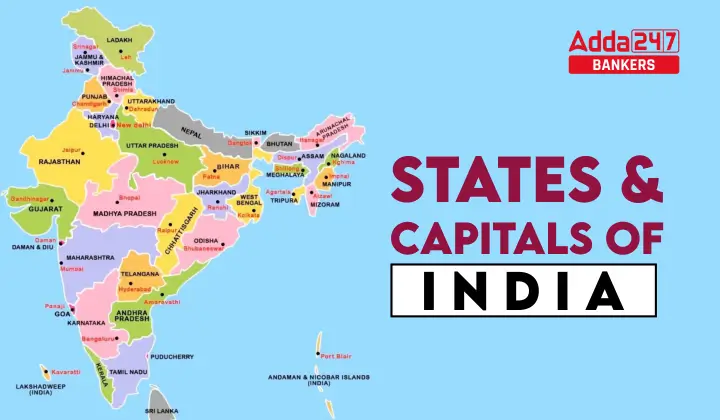
A clear understanding of the states and capitals of India as of 2026 is a fundamental component of Indian polity and general awareness. This topic holds significant weight in competitive exams such as banking, SSC, railways, and various government recruitment tests. As administrative details can evolve, it becomes crucial for aspirants to rely on the most recent and accurate information.
States and Capitals of India
India is a vast and diverse country composed of multiple states and union territories, each having its own administrative structure. Every state is governed from a specific capital city, which serves as the hub of political and administrative activities. In contrast, union territories are managed directly by the central government.
Having a clear understanding of all states and their respective capitals is an essential aspect of Indian polity and plays a key role in building strong general awareness for competitive examinations.
Key Points to Remember:
- India is divided into states and union territories for effective administration
- Each state and union territory has a capital city where government offices operate
- Some states have separate seasonal capitals for administrative convenience
- States and union territories are further divided into districts and sub-divisions
- This topic is commonly asked in banking, SSC, railways, and other competitive exams
List of States and Capitals Of India
India is divided into 28 states and 8 union territories. In 2019, a significant change occurred with the implementation of the Jammu and Kashmir Reorganisation Act. This led to the creation of two new union territories, Jammu & Kashmir and Ladakh, on 31st October, making this date an important milestone in the country’s history.
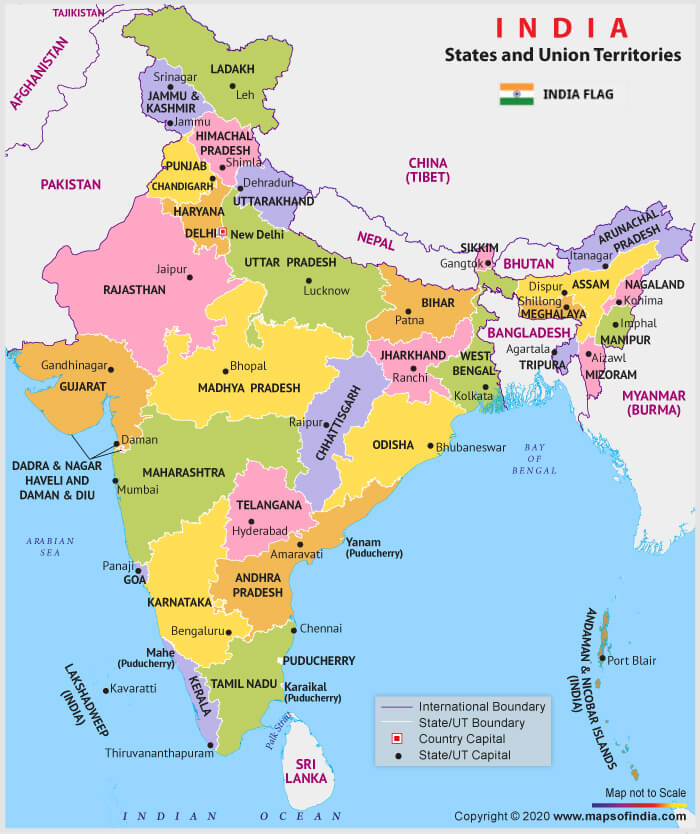
States of India and their Capitals
| S.No | States Name | Capital | Founded on |
|---|---|---|---|
| 1 | Andhra Pradesh | Amaravati | 1 Nov. 1956 |
| 2 | Arunachal Pradesh | Itanagar | 20 Feb. 1987 |
| 3 | Assam | Dispur | 26 Jan. 1950 |
| 4 | Bihar | Patna | 26 Jan. 1950 |
| 5 | Chhattisgarh | Raipur | 1 Nov. 2000 |
| 6 | Goa | Panaji | 30 May. 1987 |
| 7 | Gujarat | Gandhinagar | 1 May. 1960 |
| 8 | Haryana | Chandigarh | 1 Nov. 1966 |
| 9 | Himachal Pradesh | Shimla (summer) Dharmashala (winter) |
25 Jan. 1971 |
| 10 | Jharkhand | Ranchi | 15 Nov. 2000 |
| 11 | Karnataka | Bengaluru | 1 Nov. 1956 |
| 12 | Kerala | Thiruvananthapuram | 1 Nov. 1956 |
| 13 | Madhya Pradesh | Bhopal | 1 Nov. 1956 |
| 14 | Maharashtra | Mumbai | 1 May. 1960 |
| 15 | Manipur | Imphal | 21 Jan. 1972 |
| 16 | Meghalaya | Shillong | 21 Jan. 1972 |
| 17 | Mizoram | Aizawl | 20 Feb. 1987 |
| 18 | Nagaland | Kohima | 1 Dec. 1963 |
| 19 | Odisha | Bhubaneswar | 26 Jan. 1950 |
| 20 | Punjab | Chandigarh | 1 Nov. 1956 |
| 21 | Rajasthan | Jaipur | 1 Nov. 1956 |
| 22 | Sikkim | Gangtok | 16 May. 1975 |
| 23 | Tamil Nadu | Chennai | 26 Jan. 1950 |
| 24 | Telangana | Hyderabad | 2 Jun. 2014 |
| 25 | Tripura | Agartala | 21 Jan. 1972 |
| 26 | Uttar Pradesh | Lucknow | 26 Jan. 1950 |
| 27 | Uttarakhand | Dehradun (Winter) Gairsain (Summer) |
9 Nov. 2000 |
| 28 | West Bengal | Kolkata | 1 Nov. 1956 |
Union Territories of India and their Capitals
Union Territories are special administrative divisions that are governed directly by the Central Government of India. Unlike states, they do not enjoy the same level of legislative autonomy and are typically overseen by an Administrator or a Lieutenant Governor appointed by the President.
This arrangement allows the central authority to maintain closer control and ensures smooth administration in regions that hold strategic, political, or administrative significance.
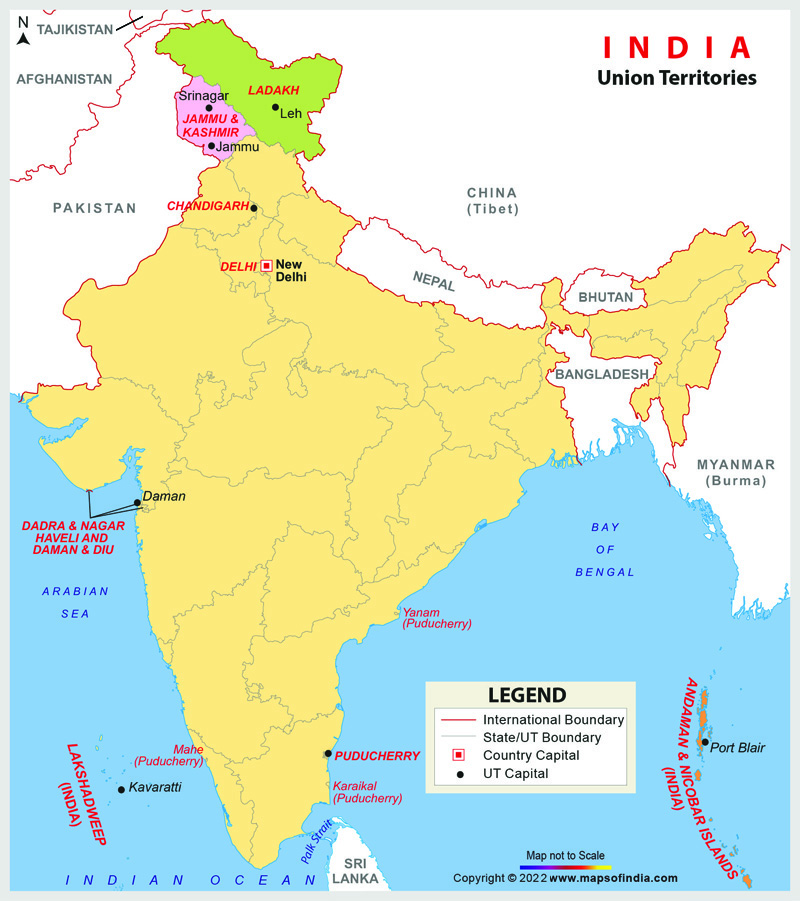
Important Points:
- India currently has 8 Union Territories
- Union Territories are directly governed by the Central Government
- Most UTs are administered by a Lieutenant Governor or Administrator
- Jammu & Kashmir and Ladakh became Union Territories after reorganisation in August 2020
- Each Union Territory has a designated capital for administrative functions
| Union Territories Names | Capital | Founded on |
|---|---|---|
| Andaman and Nicobar Islands | Sri Vijaya Puram | 1 Nov. 1956 |
| Chandigarh | Chandigarh | 1 Nov. 1966 |
| Dadra & Nagar Haveli and Daman & Diu | Daman | 26 Jan. 2020 |
| Delhi | New Delhi | 9 May. 1905 |
| Jammu and Kashmir | Srinagar (Summer) Jammu (Winter) |
31 Oct 2019 |
| Ladakh | Leh | 31 Oct 2019 |
| Lakshadweep | Kavaratti | 1 Nov. 1956 |
| Puducherry | Puducherry | 1 Nov. 1954 |
Delhi, Puducherry, and Jammu & Kashmir do not operate in the same manner as the other five Union Territories of India since they have partial statehood status and have their own elected legislative assemblies
About India
- India is officially known as the Republic of India
- It is located in South Asia
- India follows a federal constitutional system
- The country is governed under a parliamentary democracy
- India is the world’s largest democracy
- The total geographical area is about 3.28 million sq. km
- India is the second-most populous country in the world
- At present, India has 28 States and 8 Union Territories
- Article 370 was revoked, leading to the formation of Jammu & Kashmir and Ladakh as Union Territories
- Dadra & Nagar Haveli and Daman & Diu were merged into one Union Territory
- Each state and union territory has its own capital city
- Jammu & Kashmir and Ladakh share a common High Court
Types of Capitals in India
Capitals in India can be categorized based on the primary function they perform in governance. Understanding these distinctions helps in better clarity of administrative structure.
- Administrative Capital: This is the city where the executive branch of the government operates. It houses key government offices and departments responsible for day-to-day administration.
- Legislative Capital: The legislative capital is where the state legislature or assembly meets to discuss, draft, and pass laws.
- Judicial Capital: This refers to the city where the High Court of the state or territory is located, serving as the center for judicial proceedings.
Governance Structure of States and Union Territories
- All states in India, along with the Union Territories of Puducherry and the National Capital Territory of Delhi, have elected governments and legislative assemblies.
- These regions are led by a Chief Minister, who is elected for a term of five years.
- The remaining Union Territories are governed directly by the Central Government.
- Each Union Territory has an appointed representative, such as an Administrator or Lieutenant Governor, acting on behalf of the President of India.
Reorganisation of States
- The structure of Indian states was significantly shaped by the States Reorganisation Act, 1956.
- This act reorganized state boundaries primarily on the basis of linguistic factors, ensuring administrative convenience and cultural coherence.
Capital of India
New Delhi is the capital of India. The foundation stone of New Delhi was laid by Emperor George V during the Delhi Durbar of 1911. British architects Sir Edwin Lutyens and Sir Herbert Baker designed it. Finally, Viceroy and Governor-General of India Lord Irwin inaugurated it on 13 February 1931.
Financial Capital of India
Mumbai has long been known as the financial, commercial, and entertainment capital of India. It plays a big role in the country’s economy by contributing around 25% of industrial output, 5% of India’s GDP, and handling nearly 70% of capital market transactions. Important financial institutions like the Reserve Bank of India (RBI), the Bombay Stock Exchange (BSE), and the head offices of many top Indian companies are also located in Mumbai.
Difference Between States and Union Territories
The table below highlights detailed information about the difference between the states and Union Territories of India.
| State | Union Territory |
| A state is the division of a nation that has its own legislative assembly. | A Union Territory doesn’t have a legislative assembly ( Delhi, Puducherry, and Jammu & Kashmir) |
| Chief Minister is the real head. | The lieutenant is the real head. |
| The executive head is the Governor. | The executive head is the President. |
| Administered by the Chief Minister. | Administered by the Administrator, appointed by the President. |
| States have Autonomous Power. | UTs do not have it. |
States and Capitals of India: Articles in the Constitution
Under Part 1 of the Constitution, Articles 1 to 4 describe India and its territories.
- Article 1 describes India as the “Union of States” and not “Federation of States” The names of states and their territories are mentioned in the first schedule of the Constitution.
- Article 2 allows the parliament to ‘admit into the Union of India or establish new states on such terms as it thinks or finds fit.’ Hence, it gives power to parliament to establish new states.
- Article 3 permits the parliament to
a) form a new state by the separation of the existing territory
b) increase the area of the state as seems fit
c) diminish the area of any state as seems fit
d) alter the boundary of any state as seems fit
e) alter the name of any state as seems fit
Specialities Of Different Indian States
India is a land of diversity, where each state holds its own unique charm and attractions. From the bustling metropolises of Maharashtra to the serene backwaters of Kerala, every state showcases a distinctive cultural, historical, and geographical identity. Here in this table, we have tried to cover in a minute way the rich diversity of our country.
| Indian State | Specialization |
| Andhra Pradesh | Spicy cuisine, ancient temples, rich cultural heritage |
| Arunachal Pradesh | Scenic mountains, tribal diversity, Tawang Monastery |
| Assam | Tea gardens, Kaziranga National Park, Bihu festival |
| Bihar | Buddhist heritage, ancient universities, Madhubani painting |
| Chhattisgarh | Tribal traditions, mineral wealth, Chitrakote Falls |
| Goa | Beaches, tourism, Portuguese influence, seafood |
| Gujarat | Industrial growth, Rann of Kutch, Garba dance |
| Haryana | Agriculture, sports excellence, industrial hubs |
| Himachal Pradesh | Hill stations, apple farming, adventure tourism |
| Jharkhand | Mineral resources, forests, tribal culture |
| Karnataka | IT industry, historical monuments, classical arts |
| Kerala | Backwaters, Ayurveda, high literacy, natural beauty |
| Madhya Pradesh | Wildlife sanctuaries, heritage temples, central location |
| Maharashtra | Financial capital, Bollywood, historical forts |
| Manipur | Classical dance, Loktak Lake, cultural festivals |
| Meghalaya | Living root bridges, heavy rainfall, scenic landscapes |
| Mizoram | Bamboo products, peaceful society, hilly terrain |
| Nagaland | Hornbill Festival, tribal customs, handloom crafts |
| Odisha | Ancient temples, Odissi dance, coastline |
| Punjab | Agriculture, Sikh heritage, vibrant culture |
| Rajasthan |
Forts and palaces, desert landscape, folk traditions
|
| Sikkim |
Organic farming, Himalayan views, monasteries
|
| Tamil Nadu |
Dravidian temples, Bharatanatyam, ancient history
|
| Telangana |
IT growth, Charminar, cultural heritage
|
| Tripura |
Handicrafts, palaces, tribal influence
|
| Uttar Pradesh |
Taj Mahal, religious centres, historical cities
|
| Uttarakhand |
Char Dham pilgrimage, yoga, Himalayan terrain
|
| West Bengal |
Literature, arts, Durga Puja, cultural legacy
|
List of the Indian States and their Languages
In India, every state has its own language, and our country is also well known because of its culture, languages and religion. The table below shows the language of each state.
| Sl.No. | States | Language |
| 1 | Andhra Pradesh | Telugu and Urdu |
| 2 | Arunachal Pradesh | Miji, Apotanji, Merdukpen, Tagin |
| 3 | Assam | Assamese |
| 4 | Bihar | Hindi |
| 5 | Chattisgarh | Hindi |
| 6 | Goa | Marathi and Konkani |
| 7 | Gujarat | Gujarati |
| 8 | Haryana | Hindi |
| 9 | Himachal Pradesh | Hindi and Pahari |
| 10 | Mizoram | Mizo and English |
| 11 | Jammu & Kashmir | Kashmiri, Dogiri, Urdu, Ladakki, Pahari, Panjabi and Dadri |
| 12 | Jharkhand | Hindi |
| 13 | Karnataka | Kannada |
| 14 | Kerala | Malayalam |
| 15 | Madhya Pradesh | Hindi |
| 16 | Maharashtra | Marathi |
| 17 | Manipur | Manipuri |
| 18 | Meghalaya | Khashi, Jaintia and Garo |
| 19 | Nagaland | Ao, Konyak, Angami, Sema and Lotha |
| 20 | Odisha | Oriya |
| 21 | Punjab | Punjabi |
| 22 | Rajasthan | Rajasthani and Hindi |
| 23 | Sikkim | Bhutia, Hindi, Nepali, Lepcha, Limbu |
| 24 | Tamil Nadu | Tamil |
| 25 | Tripura | Bengali, Tripuri, Manipuri, Kakborak |
| 26 | Telangana | Telugu |
| 27 | Uttar Pradesh | Hindi |
| 28 | Uttrakhand | Hindi |
| 29 | West Bengal | Bengali |
Delhi, Puducherry, J & K are different from other Union Territories
Not all Union Territories (UTs) in India follow the same administrative pattern. While most are directly governed by the Central Government, a few have been granted a unique structure that allows limited self-governance.
Union Territories with Legislative Powers
- Delhi (National Capital Territory), Puducherry, and Jammu & Kashmir stand apart from other UTs.
- These regions have their own legislative assemblies and elected governments, similar to states.
- Each is headed by a Chief Minister, supported by a Council of Ministers.
Partial Statehood Features
- These three UTs enjoy a form of partial statehood, meaning they can make laws on certain subjects from the State List.
- However, key areas such as public order, police, and land (especially in Delhi) remain under the control of the Central Government.
Other Union Territories
- India currently has eight Union Territories in total.
- The remaining UTs do not have elected legislatures and are administered directly by the Centre through an Administrator or Lieutenant Governor.
Why This Distinction Exists
This dual system ensures administrative flexibility, allowing strategic or politically sensitive regions to have local representation while still maintaining central oversight.





 IFFCO AGT Notification 2026 Out, Apply O...
 IBPS Clerk Admit Card 2026 Out @ibps.in,...
 Daily Current Affairs and GK Updates (1s...