
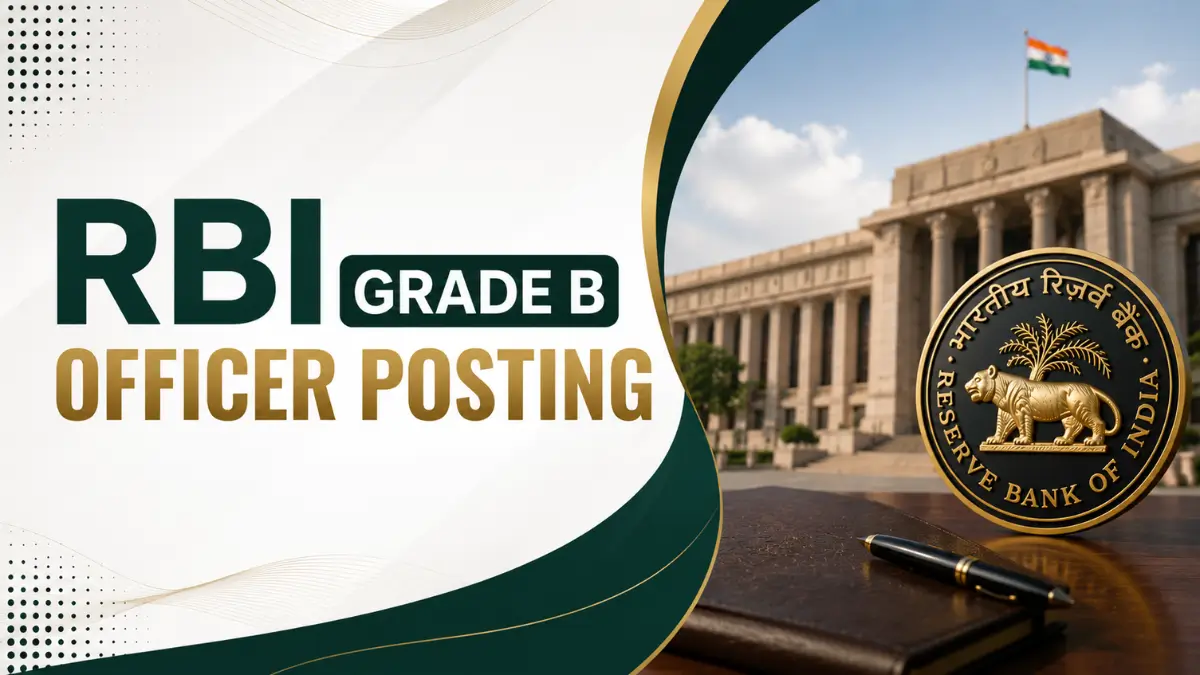
In one of the most competitive cycles to date, the Reserve Bank of India (RBI) has released the official notification for the recruitment of Officers in Grade ‘B’ (Direct Recruit-DR) for the panel year 2026. As the central bank of the world’s fifth-largest economy, an RBI Grade B officer enjoys a unique position that blends policy-level influence with operational responsibility.
RBI Grade B Officer Posting 2026
More than just a job, it is a career that offers intellectual stimulation, national importance, and a lifestyle of unparalleled prestige in the public sector. For the 2026 recruitment cycle, the Board has announced a total of 60 vacancies, with applications scheduled to open till 20 May 2026.
RBI Grade B: Selection, Probation, and Training
Your journey as an RBI Grade B officer does not begin at a dusty desk in a regional office. It begins with a transformative phase at the Reserve Bank Staff College (RBSC) in Chennai. To reach this stage, candidates must first clear a rigorous three-tier selection process.
- Induction: Selected candidates must undergo mandatory induction training at RBSC, Chennai (359, Anna Salai, Teynampet). This foundational program lasts approximately 6 to 10 weeks full-time.
- Duration: Total structured training across the 2-year probation period (extendable up to 4 years) amounts to roughly 15 weeks, supplemented by department-specific sessions. Officers posted to the Supervision Department may split their training between RBSC Chennai and the RBI headquarters in Mumbai.
RBI Grade B Posting Locations 2026
The RBI maintains its Central Office/Headquarters in Mumbai, which is the nerve center for monetary policy formulation. Additionally, the Bank operates through 31 regional offices spread across metropolitan and major state capitals. For the 2026 batch, officers are typically allocated to urban financial hubs based on cadre and operational requirements.
Primary Posting Cities (Metros and State Capitals):
The majority of postings for General cadre officers occur in the following centres:
- Mumbai (Headquarters – highest share of postings)
- Delhi (New Delhi)
- Kolkata
- Chennai
- Bengaluru
- Hyderabad
- Ahmedabad
- Lucknow
- Nagpur
- Pune
- Chandigarh
RBI Grade B Transfer Policy
Unlike static government jobs, the RBI actively rotates its officers to provide diverse exposure across India’s financial landscape.
- Frequency: RBI Grade B officers are usually transferred every 3 to 5 years. The rotation depends on organizational requirements.
- Exemptions: While Mumbai is the headquarters, transfers are generally periodic. However, officers posted in non-Mumbai centers may face transfers more frequently (every 3-5 years), whereas tenures in Mumbai can sometimes extend to 10 years.
- Home State Allocation: While the RBI considers merit and availability, there is no guarantee of a “home posting,” especially in the initial years. Transfers are designed to ensure equitable distribution of manpower and prevent regional bias.
RBI Grade B Career Progression: The Promotion Hierarchy
This is where the RBI Grade B role distinguishes itself from other regulatory bodies. The hierarchy is steep, linear, and offers a genuine path to the very top of the Indian financial system (Deputy Governor/Governor).
| Grade Level | Designation |
Approximate Timeline (Post-Joining)
|
| Grade B | Manager (Entry Level) | 2 years (Probation) |
| Grade C | Manager |
After ~5-7 years (Based on performance review)
|
| Grade D | Asst. General Manager (AGM) | After ~4-5 years |
| Grade E | Deputy General Manager (DGM) | After ~4-5 years (Senior mgmt entry) |
| Grade F | General Manager (GM) | After ~4-5 years (Executive role) |
| Grade G/H | Chief General Manager (CGM) | Variable (Top executive) |
| – | Executive Director (ED) | Merit-based selection |
| – | Deputy Governor (DG) | Appointed by the Government |
| – | Governor | Appointed by the Government |

RBI Grade B Officer’s Job Profile
An RBI officer is not a “banker”; they are a central banker. Their role is macro-level, dealing with the stability of the entire financial system rather than individual customers.
- Monetary Policy Department (MPD): Formulating rates (Repo rate, CRR) to control inflation.
- Department of Banking Supervision (DoS): Auditing and regulating commercial banks to ensure solvency.
- Financial Markets Department (FMD): Managing the government’s borrowing and open market operations.
- Currency Management: Overseeing the printing, distribution, and detection of counterfeit currency.
- Forex Department (FED): Stabilizing the Rupee and managing Foreign Exchange Management Act (FEMA) violations.










 RBI Grade B Preparation Strategy 2027 Wi...
 NABARD Development Assistant Cut Off 202...
 NABARD Development Assistant Scorecard 2...