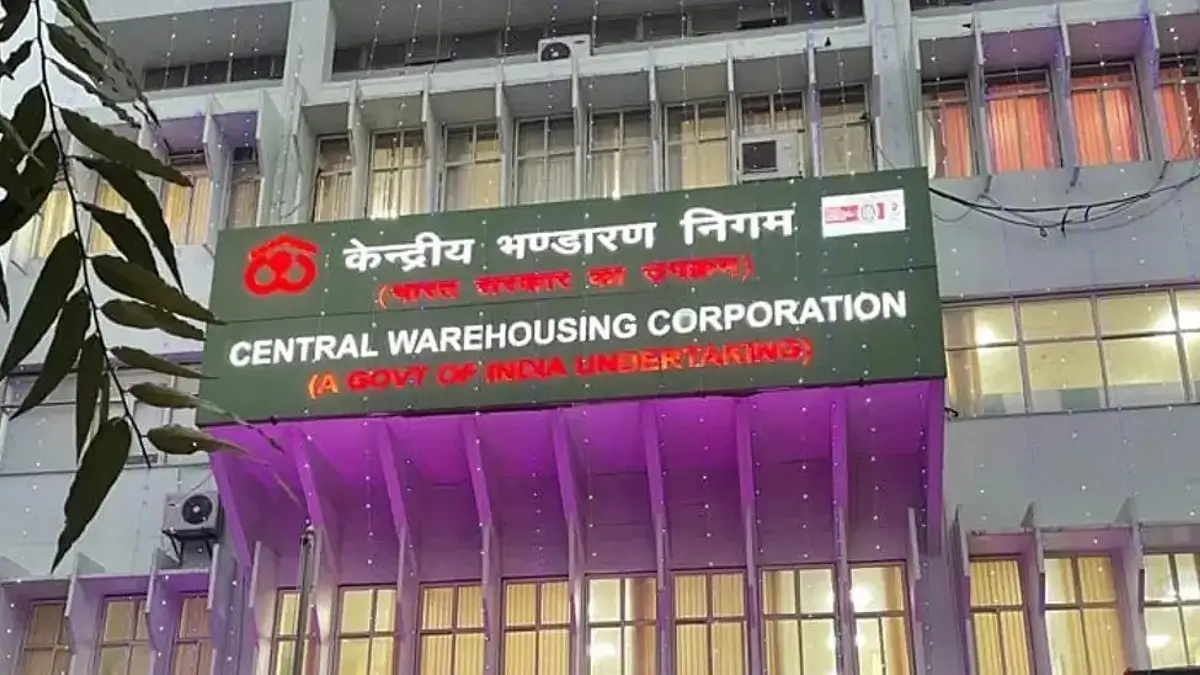
CWC Recruitment 2026 Notification Out for 327 Posts, Apply Online Starts on 17 October

The Central Warehousing Corporation (CWC) is conducting recruitment process for 327 vacancies across Assistant Manager and Junior Executive posts. The recruitment offers opportunities for candidates with diverse educational qualifications, including postgraduate degrees, commerce, agriculture, science, technology and engineering.

CWC Recruitment 2026 Notification Out

The CWC Recruitment 2026 drive covers various roles under the Assistant Manager and Junior Executive categories across different fields. Candidates should check the post-wise educational requirements, age limit, salary structure and selection procedure to identify suitable opportunities and confirm their eligibility before applying.

Central Warehousing Corporation Recruitment 2026: Overview

Applicants should review the post-wise eligibility criteria and experience requirements carefully before submitting their applications. Candidates can check the key details of CWC Recruitment 2026 in the table below.

Particulars Details
Organisation
Central Warehousing Corporation (CWC)
Advertisement Number
CWC/I-Manpower/DR/Rectt/2026/01
Recruitment Name CWC Recruitment 2026
Total Vacancies 327
Posts
Assistant Manager and Junior Executive
Application Mode Online
Selection Process
Online Examination, Document Verification and Interview, wherever applicable
Official Website cewacor.nic.in

CWC Recruitment 2026 Notification PDF

Interested candidates can submit their applications online has been started and will active till 15 November 2026 after reviewing the prescribed eligibility requirements. The detailed advertisement provides all the recruitment-related information, while the schedule for the online examination is yet to be released by the corporation.

CWC Recruitment 2026: Notification PDF

CWC Recruitment Important Dates

The online registration and fee payment window will remain open for approximately one month. Candidates should complete the process before the closing date.

Event Date
Notification Date 16 October 2026
Online Registration Begins 17 October 2026
Online Application Closes 15 November 2026
Fee Payment Last Date 15 November 2026
Examination Call Letter
Around 21 days before the examination
Online Examination To be announced
Interview/Document Verification To be announced

CWC Vacancy 2026

CWC has announced 327 vacancies for eight posts under the recruitment drive. The vacancies are distributed between Assistant Manager positions in different disciplines and Junior Executive positions.

Post Name Vacancies
Assistant Manager (General) 70
Assistant Manager (Technical) 60
Assistant Manager (Finance) 10
Assistant Manager (Engineering) – Civil 22
Assistant Manager (Engineering) – Electrical 5
Assistant Manager (Engineering) – Mechanical 4
Junior Executive (General) 78
Junior Executive (Technical) 78
Total 327

CWC Recruitment 2026 Apply Online Link

The CWC Recruitment 2026 online application link is available on the official recruitment portal. Eligible candidates can complete the registration process and submit their application forms from 17 October to 15 November 2026. Applicants should ensure that all details are entered correctly before submitting the form.

CWC Recruitment 2026 Apply Online Link

How to Apply Online for CWC Recruitment 2026

Eligible candidates can apply through the official Central Warehousing Corporation website once the registration window opens on 17 October 2026.

  • Visit the official website: cewacor.nic.in.
  • Open the recruitment or careers section and select the CWC Recruitment 2026 notification.
  • Read the detailed advertisement and verify the eligibility criteria for the post.
  • Register using the required personal and contact details.
  • Complete the online application form with accurate educational, category and other information.
  • Upload the required documents, photograph and signature in the prescribed format.
  • Pay the applicable application fee online, if required.
  • Review the form carefully before final submission.
  • Submit the application and save or print the confirmation page for future reference.

Documents Required for CWC Recruitment 2026 Apply Online

Candidates applying for CWC Recruitment 2026 should keep the following documents and details ready before filling out the online application form, as specified in the official notification PDF.

  • Recent photograph: Scanned passport-size photograph measuring 4.5 cm × 3.5 cm.
  • Signature: Scanned signature made with black ink. Signatures in capital letters will not be accepted.
  • Left thumb impression: Scanned impression on white paper using black or blue ink. Candidates without a left thumb may use their right thumb.
  • Handwritten declaration: A declaration written by the candidate in English using black ink on white paper.

The text is:

“I, _____________ (Name of the candidate), hereby declare that all the information submitted by me in the application form is correct, true and valid. I will present the supporting documents as and when required.”

  • Valid email ID and mobile number: These must remain active throughout the recruitment process.
  • Online payment details: Keep the necessary details ready to pay the applicable application fee and intimation charges.

CWC Syllabus 2026

CWC Online Registration 2026: Important Instructions

Candidates should keep the following points in mind while applying:

  • Check eligibility first: Ensure that you meet the educational qualification, age limit and experience requirements for the selected post.
  • Use correct personal details: The candidate’s name and the names of the father or husband, wherever applicable, should match the details in the Class 10 certificate or marksheet.
  • Choose the correct category: Category changes will not be permitted after the application is submitted.
  • Check uploads carefully: Incomplete applications or applications with missing or unsuitable photographs/signatures may be rejected.
  • Keep contact details active: CWC may send registration details and examination-related communications through email and SMS.
  • Verify payment status: A successful transaction should generate an e-receipt. If it is not generated, the payment may have failed; candidates should log in again using their registration credentials and follow the prescribed payment procedure.
  • Do not wait until the deadline: Apply well before 15 November 2026 to avoid website congestion or payment delays.
  • Retain proof of submission: Save the application form, payment receipt, registration number and password.
  • No corrections after final submission: The notification states that changes to submitted particulars will not be entertained.

CWC Eligibility Criteria 2026

Candidates must satisfy the prescribed educational qualification, age limit and other eligibility conditions as of 15 November 2026, the last date for submitting the application.

Educational Qualification

The required qualification depends on the post. Candidates must possess the relevant degree or qualification by the closing date. Candidates appearing in the final year or final semester are not eligible.

Post Required Educational Qualification Experience
Assistant Manager (General) Two-year postgraduate degree or postgraduate diploma in any discipline Not required
Assistant Manager (Technical) B.Tech./B.E. in Agriculture, Food Technology, Food Science, Food Science and Technology, Food Technology Management or Biotechnology Not required
Assistant Manager (Finance) Graduation in Commerce with three years of post-qualification experience in Finance and Accounting, or graduation in any discipline with CA Intermediate/CMA Intermediate
3 years for the Commerce graduate route
Assistant Manager (Engineering) – Civil B.E./B.Tech. in Civil Engineering Not required
Assistant Manager (Engineering) – Electrical B.E./B.Tech. in Electrical Engineering or Electrical and Electronics Engineering Not required
Assistant Manager (Engineering) – Mechanical B.E./B.Tech. in Mechanical Engineering Not required
Junior Executive (General) Graduation in any discipline with working knowledge of computer applications and MS Office Not required
Junior Executive (Technical) B.Sc. in Agriculture, Botany, Zoology, Biotechnology, Microbiology, Biochemistry, Food Science or Chemistry, with working knowledge of computer applications and MS Office Not required

Age Limit

The minimum age for all posts is 18 years, while the upper age limit for the advertised posts is generally 28 years for Unreserved candidates, calculated as of 15 November 2026. Upper Age Relaxation:

  • SC/ST: 5 years
  • OBC (Non-Creamy Layer): 3 years
  • Persons with Benchmark Disabilities (PwBD): 10 years
  • Eligible Ex-Servicemen/commissioned officers: As specified in the notification
  • Persons affected by the 1984 riots: 5 years

Is Work Experience Required for CWC Recruitment?

Most CWC posts do not require prior work experience. However, Assistant Manager (Finance) applicants applying through the Commerce graduate route must have three years of relevant experience in Finance and Accounting.

CWC Application Fee 2026

Candidates should pay the applicable fee online during the registration period. The fee amount should be checked in the official application portal before payment.

Category of Candidates Application Fee Intimation Charges Total
SC, ST, PwBD, Ex-Servicemen and Women candidates Nil ₹500 ₹500
Other candidates belonging to UR, EWS and OBC categories ₹850 ₹500 ₹1,350

CWC Recruitment 2026 Selection Process

The selection process for CWC Recruitment 2026 varies depending on the post applied for. Candidates must qualify at each stage applicable to their respective posts to be considered for final selection.

Assistant Manager (All Disciplines): Candidates will be shortlisted through an Online Examination, followed by Document Verification and an Interview, wherever applicable.

Junior Executive (General/Technical): The selection process includes an Online Examination followed by Document Verification.

CWC Exam Pattern 2026

The online examination comprises objective tests and a descriptive test. Each test is separately timed, and the pattern varies by post.

Assistant Manager (General)

Test Questions Marks Time
Reasoning and Computer Aptitude 60 60 50 minutes
English Language 40 40 25 minutes
Data Analysis & Interpretation and Quantitative Aptitude 60 60 50 minutes
General Awareness 40 40 25 minutes
Language & Comprehension Abilities – Descriptive Test 2 30 30 minutes
Total 202 230 3 hours

Assistant Manager (Technical, Finance and Engineering)

Test Questions Marks Time
Professional/Subject Knowledge 60 60 55 minutes
General Awareness 40 40 20 minutes
English Language 40 40 25 minutes
Reasoning and Computer Aptitude 30 30 25 minutes
Data Analysis & Interpretation and Quantitative Aptitude 30 30 25 minutes
Language & Comprehension Abilities – Descriptive Test 2 30 30 minutes
Total 202 230 3 hours

Junior Executive (Technical)

Test Questions Maximum Marks Time
Subject Knowledge 65 65 55 minutes
Reasoning and Computer Aptitude 40 40 25 minutes
Data Analysis & Interpretation and Quantitative Aptitude 40 40 30 minutes
General Awareness 20 20 15 minutes
English Language 35 35 25 minutes
Language & Comprehension Abilities – Descriptive Test 2 30 30 minutes
Total 202 230 3 hours

Junior Executive (General)

Test Questions Maximum Marks Time
Reasoning and Computer Aptitude 50 50 45 minutes
Data Analysis & Interpretation and Quantitative Aptitude 50 50 45 minutes
General Awareness 50 50 25 minutes
English Language 50 50 35 minutes
Language & Comprehension Abilities – Descriptive Test 2 30 30 minutes
Total 202 230 3 hours

CWC Recruitment 2026: Post-Wise Eligibility and Suitable Candidates

The Central Warehousing Corporation (CWC) has announced 327 vacancies for Assistant Manager and Junior Executive posts. Candidates can select a suitable position based on their educational qualifications, specialisation, and work experience, wherever required.

  • Assistant Manager (General): Candidates with a two-year postgraduate degree or postgraduate diploma in any discipline can apply.
  • Assistant Manager (Technical): Suitable for candidates with a B.E./B.Tech. degree in specified disciplines such as Agriculture, Food Technology, Food Science, or Biotechnology.
  • Assistant Manager (Finance): Open to Commerce graduates with three years of relevant Finance and Accounting experience or graduates meeting the prescribed CA Intermediate/CMA Intermediate requirements.
  • Assistant Manager (Engineering): Candidates with a B.E./B.Tech. in Civil, Electrical, or Mechanical Engineering can apply for the corresponding post.
  • Junior Executive (General): Graduates from any discipline with working knowledge of computer applications and MS Office are eligible, subject to the prescribed criteria.
  • Junior Executive (Technical): Candidates with a B.Sc. in an eligible subject, including Agriculture, Botany, Zoology, Biotechnology, Microbiology, Biochemistry, Food Science, or Chemistry, can apply if they meet the computer knowledge requirements.

CWC Salary 2026

The pay scales for the advertised posts are given below. In addition to basic pay and Industrial Dearness Allowance (IDA), eligible employees may receive other allowances, perks and benefits under CWC policies.

Post IDA Pay Scale Pay Grade
Assistant Manager (all disciplines) ₹40,000–₹1,40,000 E-1
Junior Executive (General/Technical) ₹29,000–₹93,000 S-V


NICL Assistant Mains Admit Card 2026 Out @nationalinsurance.nic.co.in, Direct Link To Download Call Letter

The NICL Assistant Mains Admit Card 2026 is now available for candidates shortlisted after the preliminary examination. Released on 22 October 2026 the NICL Assistant Mains Call Letter can be accessed through the official website at nationalinsurance.nic.co.in. The NICL Assistant Mains exam will take place on 30 October 2026 for recruitment to 500 Assistant (Class III) posts.

NICL Assistant Mains Admit Card 2026 Out

The NICL Assistant Mains Admit Card is an important document for entry to the examination centre. It contains essential information such as the candidate’s details, exam date, reporting time, venue and exam-day instructions. Candidates should verify all information printed on the hall ticket and make arrangements to reach the allotted centre on time.

NICL Assistant Mains 2026: Overview

Candidates should download their admit cards in advance and check all the instructions mentioned on them to avoid any last-minute issues on exam day. The key details regarding the NICL Assistant Mains Admit Card 2026 and the Phase II examination are provided below.

Particulars Details
Organization
National Insurance Company Limited (NICL)
Post Name Assistant (Class III)
Total Vacancies 500
Admit Card Release Date 22 October 2026
Mains Exam Date 30 October 2026
Login Credentials Registration/Roll Number
Password/Date of Birth
Exam Stage Phase II – Mains
Exam Mode Online
Selection Process
Prelims, Mains and Regional Language Test
Official Website www.nationalinsurance.nic.co.in

NICL Assistant Mains Admit Card 2026 Download Link

Candidates who have qualified for the NICL Assistant Mains Exam 2026 can download their admit card from the official website of National Insurance Company Limited. To access the call letter, candidates should keep their registration number or roll number and password or date of birth ready. After logging in, they can view and download the admit card and take a printout for the examination day.

Are you appearing for the NICL Assistant Mains Exam 2026?

NICL Assistant Mains Information Handout (English)

NICL Assistant Mains Information Handout (Hindi)

How to Download NICL Assistant Mains Admit Card 2026

Candidates can follow these steps to download their hall ticket after the link becomes available.

  • Visit the official NICL website at nationalinsurance.nic.co.in.
  • Open the Recruitment section on the homepage.
  • Find the notification for Recruitment of 500 Assistants (Class III) 2026–27.
  • Click the link for downloading the Phase II (Mains) Examination Call Letter.
  • Enter the required login credentials, such as registration number or roll number and password or date of birth, as requested on the portal.
  • Submit the details to view the admit card.
  • Download the hall ticket and print a copy for the examination.

Details Mentioned on NICL Assistant Mains Hall Ticket 2026

After downloading the admit card, candidates should carefully check the information printed on it. The hall ticket generally contains the following details:

  • Candidate’s name
  • Roll number or registration number
  • Photograph and signature
  • Name of the examination
  • Examination date and reporting time
  • Examination centre name and address
  • Instructions for the examination
  • Documents or identification proof required at the centre

Documents to Carry to the NICL Assistant Mains Exam Centre

Candidates should prepare the required documents before exam day to avoid problems at the entry gate.

  • Printed admit card: Carry a clear printout of the NICL Assistant Mains Call Letter 2026.
  • Valid photo identity proof: Carry an original identity document accepted under the official instructions.
  • Photograph: Keep a recent passport-size photograph ready if required by the call letter instructions.
  • Additional documents: Carry any other documents specifically mentioned in the admit card or official examination notice.

Important Instructions for NICL Assistant Mains Exam Day

Candidates should follow these precautions before leaving for the examination centre:

  • Download and print the admit card well before 30 October.
  • Check the examination centre address, reporting time and entry deadline.
  • Carry the required original photo identity proof and other documents specified in the call letter.
  • Do not carry prohibited items such as mobile phones, smartwatches, calculators or unauthorised study material.
  • Follow the instructions given by examination-centre staff.
  • Read the complete admit card instructions before the examination day.

Last Week NICL Assistant Mains Strategy

Make the final week before the NICL Assistant Mains Exam on 30 October count with focused revision, mock analysis, and smart time management.

  • Revise Key Topics: Focus on high-weightage topics and important concepts from each section.
  • Attempt Mock Tests: Practise full-length mocks under exam-like conditions.
  • Analyse Mistakes: Identify weak areas, accuracy issues, and time-consuming questions.
  • Practise Current Affairs: Revise important banking, insurance, and general awareness updates.
  • Strengthen Computer Knowledge: Review basic computer concepts, terminology, and frequently tested topics.
  • Avoid New Topics: Prioritise revision of familiar topics instead of starting lengthy chapters.
  • Improve Time Management: Practise selecting questions based on difficulty, accuracy, and time required.
  • Revise Short Notes: Review formulas, shortcuts, important facts, and frequently forgotten concepts.
  • Maintain Accuracy: Avoid blind guessing and follow the prescribed marking scheme.
  • Stay Exam-Ready: Keep your admit card and required documents ready, get adequate sleep, and remain calm.
Related Posts
NICL Assistant Syllabus NICL Assistant Salary
NICL Assistant Previous Year Paper

UIIC AO Prelims Exam Analysis 2026, 1st Shift, 22 October, Check Difficulty Level & Good Attempts

The UIIC AO Prelims Exam 2026 was scheduled for 22 October 2026, with the examination conducted in multiple shifts. Candidates can go through the detailed analysis of the 1st Shift to get an idea of the questions asked, the difficulty level of each section, and the important topics featured in the exam. The UIIC AO Exam Analysis 2026 also provides an estimate of good attempts and highlights time-consuming questions, allowing candidates to evaluate their performance and understand the overall exam trend.

UIIC AO Prelims Exam Analysis 2026, 1st Shift, 22 October

Based on the feedback shared by candidates, the UIIC AO Prelims Shift 1 Analysis 2026 outlines the key aspects of the question paper and the types of questions encountered during the test. The review examines the Reasoning Ability, Quantitative Aptitude, and English Language sections separately, offering insights into the topics that received attention.

Sequence: English → Reasoning Ability → Quantitative Aptitude

UIIC AO Prelims Exam Analysis 2026, Difficulty Level & Good Attempts

The UIIC AO Prelims Exam Analysis 2026 for Shift 1 indicates that the overall difficulty level of the exam was Easy to Moderate, based on candidates’ feedback. The table below provides a quick overview of the section-wise difficulty levels and estimated good attempts for the exam held on 22 October 2026.

Sections Difficulty Level Good Attempts
English Language Easy to Moderate 24-27
Quantitative Aptitude Moderate 18-22
Reasoning Ability Easy to Moderate 26-31
Overall Easy to Moderate 62-70

UIIC AO Prelims Exam Analysis 2026, 1st Shift Section Wise Analysis

The section-wise analysis of the UIIC AO Prelims Exam 2026, 1st Shift, covers the topics asked in each section. English Language and Reasoning Ability were Easy to Moderate, while Quantitative Aptitude was Moderate with Arithmetic and Caselet DI questions leaning slightly towards the moderate side.

UIIC AO Prelims Exam Analysis 2026: Reasoning Ability

The Reasoning Ability section in the UIIC AO Prelims Exam Analysis 2026 had an Easy difficulty level. Candidates could attempt questions from topics such as puzzles, seating arrangements, syllogism, inequalities, and coding.

IBPS Clerk Prelims Exam Analysis 2026, Reasoning Ability
Topics No. of Questions
Circular Row Puzzle (6 Persons) 5
Month Based Puzzle (8 Persons, 8 Months) 5
Parallel Row 5
Uncertain Linear Row 3
Chinese Coding 5
Syllogism 3
Inequities 3
Blood Relation 3
Word and Number Pairing 2
Number Opration 1
Total 35

Numerical Ability

The Numerical Ability section in the UIIC AO Prelims Exam Analysis 2026 was Moderate and Lengthy. Candidates found the calculations time-consuming, making time management important to attempt the questions accurately.

IBPS Clerk Prelims Exam Analysis 2026: Numerical Ability
Topics No. of Questions
Approximatino 4
Wrong Number 4
Q1 Q2 3
Caselet DI 5
Line Graph DI 5
Table DI 6
Arithmetic 8
Total 35

English Language

The English Language section in the UIIC AO Prelims Exam Analysis 2026 was Easy to Moderate in difficulty. Most questions were manageable for candidates with good reading comprehension, grammar, and vocabulary skills.

IBPS Clerk Prelims Exam Analysis 2026, English Language
Topics No. of Questions
Reading Comprehension (North Korea Based) 8
Error Detection 5
Cloze Test 5
Word Swap 3
Sentence Improvement 3
Phrase Replacement 3
Sentence Rearrangement 3
Total 30

UIIC AO Prelims Exam Analysis 2026: Which Section Was Time-Consuming and Most Scoring?

The UIIC AO Prelims Exam 2026, 1st Shift, had different levels of difficulty across sections. Based on the reported analysis, candidates can identify the sections that required more time and those that offered relatively easier scoring opportunities.

  • Most Time-Consuming: Quantitative Aptitude, particularly Arithmetic and Caselet DI, as these questions were slightly moderate in difficulty.
  • Most Scoring: English Language, with an Easy to Moderate difficulty level.
  • Reasoning Ability: Easy to Moderate, with puzzles and other questions requiring careful solving.
  • Time Management Tip: Candidates who prioritised easier questions and avoided spending too long on lengthy calculations could manage their attempts more effectively.

UIIC AO Cutoff 2026

UIIC AO Prelims Exam Pattern 2026

The UIIC AO Prelims Exam Pattern 2026 includes three sections: English Language, Reasoning Ability, and Quantitative Aptitude. Candidates must attempt 100 questions carrying 100 marks within 60 minutes, with a separate 20-minute time limit for each section. A penalty of 0.25 marks applies to every incorrect answer.

Section No. of Questions Maximum Marks Duration
Quantitative Aptitude 35 35 20 minutes
Reasoning Ability 35 35 20 minutes
English Language 30 30 20 minutes
Total 100 100 60 minutes

UIIC AO Prelims Exam 2026: Important Topics for Upcoming Exams

Candidates preparing for upcoming banking and insurance exams can use the UIIC AO Prelims Exam Analysis 2026 to prioritise important topics and improve their preparation strategy.

  • Reasoning Ability: Puzzles, seating arrangements, syllogism, inequalities, and Chinese coding.
  • Quantitative Aptitude: Arithmetic, caselet DI, line graph DI, table DI, approximation, and number series.
  • English Language: Reading comprehension, error detection, cloze test, word swap, and sentence rearrangement.

What After UIIC AO Prelims Exam 2026?

After the UIIC AO Prelims Exam 2026, candidates should focus on the next stage of the selection process while keeping track of the official result and cut-off updates. Aspirants can follow these steps to prepare for the upcoming stage:

  • Check the Prelims Result: Visit the official UIIC website to check the result and qualifying status.
  • Prepare for Mains: Revise the syllabus and practise questions regularly to strengthen subject knowledge.
  • Attempt Mock Tests: Take full-length and sectional tests to improve speed, accuracy, and time management.
  • Revise Important Topics: Focus on Reasoning, Quantitative Aptitude, English Language, and other subjects included in the Mains pattern.
  • Track Official Updates: Keep checking the Mains exam date, admit card, and other recruitment announcements.

CCI Result 2026 Out, Download PDF

The CCI Result 2026 has been released on 23 October 2026 by the Cotton Corporation of India (CCI) in the form of a post-wise provisional shortlist. A total of 146 candidates have been shortlisted across seven post codes for various posts, including Assistant Manager, Management Trainee, Junior Commercial Executive and Junior Assistant.

CCI Result 2026 Out, Download PDF

The Computer-Based Test (CBT) was conducted on 1 September 2026. Candidates can download the result PDF to check their names and registration numbers in the relevant post-wise list. Provisionally shortlisted candidates should also check their registered email IDs for further instructions from CCI.

CCI Result 2026 Out, Download PDF

Post-Wise Number of Candidates Shortlisted

Post Code Post Name Candidates Shortlisted
101 Assistant Manager (Official Language) 1
102 Assistant Manager (Information Technology) 1
103 Management Trainee (Marketing) 8
104 Management Trainee (Accounts) 6
105 Junior Commercial Executive 50
106 Junior Assistant (Accounts) 50
107 Junior Assistant (General) 30
Total 146

How to Download CCI Result 2026 PDF?

Candidates can follow these steps to access the Cotton Corporation of India Result 2026 and check their shortlisting status:

  1. Visit the official website of the Cotton Corporation of India at cotcorp.org.in.
  2. Navigate to the Recruitment or Notices section.
  3. Look for the CCI recruitment result or provisional shortlist dated 23 October 2026.
  4. Open the relevant PDF for Recruitment Advertisement No. DR/CCI/2026.
  5. Check the post code and corresponding list of shortlisted candidates.
  6. Press Ctrl + F on your computer to search for your registration number or name.
  7. Verify your details and download the PDF for future reference.

Details Mentioned in the CCI Result 2026 PDF

The provisional merit list contains the following details:

  • Recruitment advertisement number
  • Date of the Computer-Based Test
  • Post code and post name
  • Serial number of the shortlisted candidate
  • Registration number
  • Name of the candidate
  • Instructions for provisionally shortlisted candidates

What After the CCI Result 2026?

  • Candidates whose names appear in the provisional shortlist should check their registered email IDs for further instructions from the Cotton Corporation of India. The official notice specifically advises all shortlisted candidates to check their email for additional information.
  • Candidates should follow the instructions communicated by CCI regarding the subsequent recruitment formalities. They should also monitor the official website regularly for further announcements and updates.
  • Important: Inclusion in this list indicates provisional shortlisting. Candidates should not treat it as a final appointment or selection confirmation unless CCI issues the relevant official communication.

RBI Grade A Syllabus & Exam Pattern 2026, Check Detailed Syllabus

The RBI Grade A Syllabus & Exam Pattern 2026 is an important resource for candidates preparing for officer-level recruitment at the Reserve Bank of India (RBI). It helps aspirants understand the subjects, important topics, examination structure and selection process required to plan their preparation effectively. However, as of 23 October 2026, RBI has not released the official syllabus or exam pattern for Officers in Grade A (DR) – General for the 2026 cycle.

RBI Grade A Syllabus & Exam Pattern 2026

According to the RBI Recruitment Calendar 2027, the notification for Officers in Grade A (DR) – General is scheduled for July 2027, with a single-phase written examination planned for September 2027. The detailed syllabus, marks distribution, examination duration and marking scheme will be confirmed through the official notification. Until then, candidates can use the existing Grade A specialist examination patterns and the RBI Grade B syllabus as reference points for preparation.

RBI Grade A Syllabus & Exam Pattern 2026: Latest Update

The RBI Grade A recruitment process requires candidates to prepare according to the requirements of their respective posts. The General stream syllabus and examination pattern for the upcoming recruitment cycle have not been officially announced. The following table summarises the current position:

Particulars Details
Exam Name RBI Grade A Exam
Conducting Body Reserve Bank of India
Post Officers in Grade A (DR) – General
2026 General Stream Syllabus Not officially released
2026 General Stream Exam Pattern Not officially released
Latest Recruitment Calendar Panel Year 2027
 Notification July 2027
Written Exam September 2027
Expected Selection Stages Single-phase written exam followed by an interview, based on the calendar and historical RBI recruitment practice
Official Website opportunities.rbi.org.in

RBI Grade A Selection Process

The selection process for RBI Grade A depends on the post and recruitment notification. The RBI recruitment calendar lists a single-phase written examination for Officers in Grade A (DR) – General for Panel Year 2027. An interview is also a reasonable stage to prepare for, based on previous RBI officer recruitment cycles, although the exact selection procedure for the General stream must be confirmed in the detailed notification. For reference, the existing Grade A specialist recruitment patterns include the following stages:

  1. Online Written Examination: Candidates appear for the prescribed objective and, where applicable, descriptive papers.
  2. Interview: Candidates who satisfy the applicable written examination requirements are considered for the interview.
  3. Final Merit: The final selection for specialist posts is based on written examination and interview marks, subject to the prescribed qualifying requirements.

RBI Grade A Exam Pattern 2026: What Candidates Should Know

RBI has not announced the examination pattern for Officers in Grade A (DR) – General for the 2026 cycle. However, the existing Grade A specialist patterns and the Grade B examination provide useful reference points.

1. Assistant Manager (Rajbhasha), Grade A: Confirmed Reference Pattern

The Rajbhasha examination consists of an objective Paper I and a descriptive Paper II.

Paper Subject Marks Duration
Paper I Reasoning 35 30 minutes
Paper I English Language 35 30 minutes
Paper I General Awareness 35 20 minutes
Paper I Professional Knowledge 45 40 minutes
Paper II Official Language 50 60 minutes
Total 200 180 minutes

2. Assistant Manager (Protocol & Security), Grade A: Confirmed Reference Pattern

Subject Questions Marks Duration
Reasoning 50 50 35 minutes
English Language 50 25 35 minutes
General Awareness 50 50 20 minutes
Professional Knowledge 50 75 30 minutes
Total 200 200 120 minutes

3. RBI Grade B Exam Pattern: Reference for General Stream Preparation

The RBI Grade B examination is another useful reference because it includes general aptitude, economic and social issues, finance and management. The established Grade B structure includes:

Stage Subjects Marks
Phase I General Awareness, Reasoning, Quantitative Aptitude and English Language 200
Phase II Economic and Social Issues, English Writing Skills, Finance and Management 300
Interview Personality assessment 75

RBI Grade A Syllabus 2026: Detailed Subject-Wise Syllabus

Until RBI publishes the official syllabus for Officers in Grade A (DR) – General, candidates can begin with the overlapping areas found in existing RBI officer examinations. The topics below are preparation references, not a confirmed official syllabus for the General stream.

1. Reasoning Ability

Reasoning Ability evaluates logical thinking, analytical skills and the ability to solve problems accurately within a limited time. Important topics include:

  • Seating Arrangement
  • Floor-Based Puzzles
  • Scheduling Puzzles
  • Syllogism
  • Inequality
  • Coding-Decoding
  • Blood Relations
  • Direction and Distance
  • Ranking and Order
  • Statement and Conclusion
  • Data Sufficiency
  • Input-Output
  • Alphanumeric and Number Series
  • Logical and Analytical Reasoning

2. English Language

English preparation should cover reading comprehension, grammar, vocabulary and sentence structure. Candidates should also develop the ability to understand complex passages and identify errors quickly. Important topics include:

  • Reading Comprehension
  • Error Detection
  • Sentence Correction
  • Sentence Improvement
  • Fill in the Blanks
  • Cloze Test
  • Para Jumbles
  • Sentence Rearrangement
  • Synonyms and Antonyms
  • Word Usage
  • Vocabulary
  • Grammar Rules

3. Quantitative Aptitude

Quantitative Aptitude is an important area to prepare if RBI includes it in the General stream examination. Important topics include:

  • Simplification and Approximation
  • Number Series
  • Quadratic Equations
  • Percentage
  • Ratio and Proportion
  • Average
  • Profit and Loss
  • Simple and Compound Interest
  • Time and Work
  • Time, Speed and Distance
  • Mixture and Alligation
  • Permutation and Combination
  • Probability
  • Data Interpretation
  • Data Sufficiency

Data Interpretation practice should include tables, bar graphs, line graphs, pie charts, caselets and missing-data sets. Candidates should build their calculation speed and learn to identify questions that can be solved quickly without compromising accuracy.

4. General Awareness

General Awareness is particularly relevant to RBI officer examinations because of their focus on banking, finance and the Indian economy. Banking Awareness

  • Structure of the Indian Banking System
  • Types of Banks
  • Non-Performing Assets (NPAs)
  • Basel Norms
  • Financial Inclusion
  • Digital Banking
  • Banking Regulations

Reserve Bank of India

  • History and Functions of RBI
  • Monetary Policy
  • Monetary Policy Committee
  • Repo Rate and Related Policy Rates
  • Cash Reserve Ratio (CRR)
  • Statutory Liquidity Ratio (SLR)
  • Standing Deposit Facility (SDF)
  • RBI Regulatory Directions

Indian Economy

  • Gross Domestic Product (GDP)
  • Inflation
  • Fiscal Policy
  • Monetary Policy
  • Union Budget
  • Economic Survey
  • Economic Reforms
  • Government Welfare Schemes
  • Agriculture, Industry and Infrastructure

Reports and Publications

  • RBI Annual Report
  • Monetary Policy Report
  • Financial Stability Report
  • Important Government Reports

Current Affairs

  • National and International Events
  • Banking and Financial Developments
  • RBI Announcements
  • Government Schemes
  • Economic and Regulatory Updates

5. Economic and Social Issues (ESI): Reference Syllabus

Economic and Social Issues is a major component of the RBI Grade B Phase II examination. It is also a possible preparation area for Grade A General, but its inclusion has not been confirmed. Important topics include:

Growth and Development

  • Economic Growth and Development
  • GDP and GNP
  • Human Development Index
  • Measurement of Economic Growth
  • Sustainable Development Goals

Macroeconomics

  • Inflation: CPI and WPI
  • Monetary Policy
  • Fiscal Policy
  • Balance of Payments
  • International Trade

Indian Economy

  • Economic Reforms
  • Agriculture and Rural Development
  • Industrial Development
  • Infrastructure
  • External Sector

Social Issues

  • Poverty
  • Unemployment
  • Income Inequality
  • Education
  • Healthcare
  • Demographic Trends
  • Social Development

Current Economic Developments

  • Union Budget
  • Economic Survey
  • RBI Reports
  • Government Economic Initiatives
  • Recent Social and Economic Developments

6. Finance and Management (FM): Reference Syllabus

Finance and Management is another important component of the RBI Grade B Phase II examination. It can be considered a supplementary preparation area for RBI Grade A General until the official syllabus is available.

Finance

  • Indian Financial System
  • Financial Markets
  • Money Market and Capital Market
  • Role of RBI, SEBI and IRDAI
  • Banking System
  • Non-Performing Assets
  • Basel Norms
  • Credit Risk
  • Market Risk
  • Operational Risk
  • Corporate Finance Fundamentals

Management

  • Principles of Management
  • Leadership Theories
  • Motivation Theories
  • Maslow’s Hierarchy of Needs
  • Herzberg’s Two-Factor Theory
  • Organisational Behaviour
  • Communication
  • Conflict Management
  • Decision-Making
  • Corporate Governance

7. English Descriptive Writing: Possible Preparation Area

If RBI includes a descriptive English paper in the General stream examination, candidates may need to demonstrate their writing and comprehension skills. Useful areas to practise include:

  • Essay Writing
  • Précis Writing
  • Reading Comprehension
  • Analytical Writing
  • Opinion-Based Answers
  • Structured Responses on Economic and Financial Issues

RBI Grade A Marking Scheme 2026

The official marking scheme for the General stream is not available yet. Candidates should avoid assuming that the negative marking rules, sectional timings or qualifying requirements of another RBI recruitment will automatically apply. The following points are useful for preparation:

  • Negative marking: One-fourth negative marking applies in the existing objective examinations for the Grade A specialist posts discussed above. Its application to Grade A General must be confirmed.
  • Qualifying marks: RBI may prescribe minimum qualifying marks for individual tests or papers. The exact requirements for Grade A General are not yet known.
  • Sectional timings: The Grade A specialist examinations have prescribed timings for individual sections. The General stream’s timing structure has not been released.
  • Interview marks: Existing Grade A specialist recruitments use a 35-mark interview. The interview marks for Grade A General are unconfirmed.
  • Final merit: The method for calculating final merit in Grade A General will be specified in the official notification.

RBI Grade A Syllabus 2026: Important Points to Remember

  • RBI has not released the official syllabus and exam pattern for Officers in Grade A (DR) – General for the 2026 cycle.
  • The RBI Annual Recruitment Calendar for Panel Year 2027 lists July 2027 as the notification month and September 2027 for the single-phase written examination.
  • The syllabus listed in this article is a preparation guide based on existing RBI Grade A specialist patterns and the RBI Grade B examination.
  • ESI, Finance and Management, Quantitative Aptitude and descriptive writing should not be treated as confirmed Grade A General components.
  • Candidates should check the official RBI recruitment website for the detailed notification and final examination instructions.

RBI Grade B Preparation Strategy 2027 With Step by Step Guide

Preparing for RBI Grade B 2027 requires a focused strategy, consistent revision and regular mock-test practice. With the RBI Grade B Recruitment calendar indicating Phase I in April 2027 and Phase II in May/June 2027, aspirants should use the available time to strengthen their concepts, cover the syllabus and improve their performance through practice.

RBI Grade B Preparation Strategy 2027

The best approach is to prepare for Phase I and Phase II together instead of waiting for the preliminary examination to finish. Build a strong foundation first, practise objective questions daily and gradually increase your focus on Economic and Social Issues (ESI), Finance and Management (FM), and descriptive English.

RBI Calendar 2027

How to Start RBI Grade B Preparation 2027

Before starting your preparation, go through the syllabus and divide the subjects into manageable topics. Avoid collecting too many books and study materials, as switching between multiple sources can waste valuable time. Follow these steps to build your preparation strategy:

  1. Understand the syllabus: List all the topics for Phase I and Phase II and identify the areas that require the most attention.
  2. Set daily targets: Assign specific topics to each study session instead of setting vague goals such as studying Quantitative Aptitude for two hours.
  3. Build conceptual clarity: Complete the basics of each subject before moving to advanced questions and timed practice.
  4. Prepare for both phases: Study ESI, FM and descriptive English alongside Phase I subjects.
  5. Revise regularly: Keep dedicated time for revisiting formulas, current affairs, important reports and previously studied concepts.
  6. Track your progress: Use mock tests and topic-wise quizzes to identify weak areas and adjust your timetable.

RBI Grade B Phase I Preparation Strategy

Phase I preparation requires a balance between conceptual understanding, speed and accuracy. Under the 2027 examination pattern, the paper included General Awareness, Reasoning Ability, English Language and Quantitative Aptitude. Aspirants should use this structure as a preparation reference until the 2027 notification confirms the final pattern.

1. General Awareness

General Awareness is an important part of RBI Grade B preparation because it tests knowledge of current events, banking, the economy and other relevant developments. Preparation strategy:

  • Read daily current affairs with special attention to banking, finance, monetary policy and the Indian economy.
  • Cover important RBI announcements, government schemes, economic reports, committees and financial developments.
  • Prepare monthly current affairs notes instead of relying entirely on daily reading.
  • Revise important facts, figures, reports and appointments at regular intervals.
  • Practise topic-wise quizzes and previous-year questions to assess retention.

Practical tip: Maintain a separate notebook or digital document for RBI-related updates. Revise it weekly so that important information does not get lost among general current affairs.

2. Quantitative Aptitude

Quantitative Aptitude requires conceptual clarity, calculation speed and the ability to select an efficient solving method. Start with fundamental concepts before moving to questions that require multiple steps. Preparation strategy:

  • Strengthen arithmetic topics such as percentages, ratios, averages, profit and loss, time and work, and time, speed and distance.
  • Practise data interpretation sets regularly.
  • Revise number series, quadratic equations and other relevant topics according to the syllabus and previous-year papers.
  • Learn calculation shortcuts only after understanding the underlying concepts.
  • Solve timed question sets to improve speed without compromising accuracy.

Practical tip: Maintain an error notebook for questions you solve incorrectly or take too long to complete. Record why you made the mistake and solve those questions again during revision.

3. Reasoning Ability

Reasoning preparation should focus on logical thinking, pattern recognition and efficient question selection. Puzzles and seating arrangements need consistent practice rather than last-minute preparation. Preparation strategy:

  • Build your basics in syllogism, inequalities, coding-decoding, direction sense and blood relations.
  • Practise puzzles and seating arrangements of varying difficulty levels.
  • Solve a small set of questions daily to maintain consistency.
  • Analyse the questions that consume too much time and identify better solving approaches.
  • Practise mixed-topic quizzes to improve your ability to switch between question types.

Practical tip: During mock tests, do not spend excessive time on one difficult puzzle. Identify manageable questions first and return to lengthy sets if time permits.

4. English Language

English preparation should develop reading comprehension, vocabulary, grammar and the ability to understand written arguments. Preparation strategy:

  • Read editorials and articles on economic, financial and social issues.
  • Practise reading comprehension and identify the central argument of each passage.
  • Revise grammar rules through error detection and sentence-based exercises.
  • Learn vocabulary in context rather than memorising isolated word lists.
  • Practise cloze tests, sentence rearrangement and other relevant question types.

Practical tip: After reading an editorial, summarise its main argument in three to five sentences. This habit can improve comprehension and also support descriptive English preparation for Phase II.

RBI Grade B Phase II Preparation Strategy

Phase II preparation should begin early because ESI, Finance and Management, and English Writing Skills require different approaches. Alongside learning the syllabus, aspirants need regular revision and answer-writing practice.

1. Economic and Social Issues (ESI)

ESI preparation requires a combination of static concepts and current economic and social developments. Preparation strategy:

  • Study the core concepts of the Indian economy, economic growth, development, poverty, employment and related social issues.
  • Cover government schemes and major initiatives connected with economic and social development.
  • Read important economic reports and understand their key findings, objectives and implications.
  • Connect current affairs with static syllabus topics.
  • Practise writing structured answers on relevant economic and social issues.

Practical tip: For each major topic, prepare short notes covering its meaning, key facts, government initiatives, challenges and possible solutions. These notes will be useful for revision and descriptive answers.

2. Finance and Management (FM)

Finance and Management preparation requires conceptual understanding rather than memorising definitions without context. Preparation strategy:

  • Study financial-system concepts, banking, financial markets, risk management and other topics listed in the official syllabus.
  • Understand the role of RBI, monetary policy and important financial institutions.
  • Prepare Management topics such as leadership, motivation, communication, organisational behaviour and related concepts.
  • Create concise notes for definitions, theories, important terms and comparisons.
  • Practise objective questions and descriptive answers to test both recall and application.

Practical tip: Explain each major concept in your own words after studying it. If you cannot explain it clearly without referring to your notes, revisit the concept before moving forward.

3. English Writing Skills

English Writing Skills requires regular writing practice, clear arguments and well-organised answers. Reading alone is not enough to develop these skills.

 Preparation strategy:

  • Practise essays on economic, financial, social and contemporary issues.
  • Write summaries of longer passages to improve precision and comprehension.
  • Practise organising answers into an introduction, main discussion and conclusion.
  • Use simple, formal language and avoid unnecessary repetition.
  • Review grammar, sentence structure, coherence and word choice after every writing exercise.

Practical tip: Set aside dedicated writing time several days a week. Review your answers for clarity and relevance, not just vocabulary. A well-structured answer is more useful than one filled with complicated words.

How to Use Mock Tests Effectively

Mock tests are useful only when you analyse your performance after attempting them. Taking multiple tests without reviewing mistakes may cause the same problems to recur. Follow this process after every mock test:

  1. Check your accuracy: Identify the subjects and question types where incorrect answers are frequent.
  2. Analyse time spent: Find out which questions or sections consume more time than necessary.
  3. Classify mistakes: Separate conceptual gaps, calculation errors, misreading and poor question selection.
  4. Revise weak topics: Return to the relevant concepts and solve additional questions before attempting another test.
  5. Track improvement: Compare your accuracy, attempts and time management across tests rather than judging progress from a single score.

Daily Study Routine for RBI Grade B 2027

A timetable should be realistic enough to follow consistently. The sample below is an illustrative six-hour schedule for aspirants who can dedicate that amount of time daily.

Study session Time Focus
Session 1 1 hour General Awareness and current affairs
Session 2 1.5 hours Quantitative Aptitude or Reasoning
Session 3 1 hour English Language and reading practice
Session 4 1.5 hours ESI or Finance and Management
Session 5 30 minutes Descriptive English writing
Session 6 30 minutes Revision, quizzes or error-notebook practice

Common Mistakes to Avoid During RBI Grade B Preparation

  • Ignoring Phase II until Phase I is over: This can leave insufficient time for ESI, FM and descriptive English.
  • Collecting too many resources: Use a limited set of reliable materials and revise them repeatedly.
  • Studying current affairs without revision: Regular recall and quizzes help improve retention.
  • Taking mock tests without analysis: Identify the reason behind every repeated mistake.
  • Memorising without understanding: Conceptual clarity helps with both objective questions and descriptive answers.
  • Neglecting answer writing: Practise expressing ideas clearly, logically and within the required word limit.
  • Following an inflexible timetable: Review your progress every week and allocate more time to weak areas.
Related Posts
RBI Grade B Salary RBI Grade B Selection Process
RBI Grade B Eligibility RBI Grade B Previous Year Papers
RBI Grade B Cut Off RBI Grade B Mock Test

NABARD Development Assistant Cut Off 2026 Out, Check Prelims & Mains Category-Wise Marks

The NABARD Development Assistant Cut Off 2026 has been released along with the Prelims and Mains results. Candidates can check the cut-off marks to understand the minimum scores required to qualify for the respective stages of the selection process. The cut-off varies by state and category, depending on factors such as exam difficulty, the number of vacancies, and candidates’ performance.

NABARD Development Assistant Cut Off 2026 Out

Candidates can now access the NABARD Development Assistant Scorecard 2026 along with the Prelims and Mains Cut Off on the official website. The scorecard allows candidates to review their marks, while the cut-off helps them assess the qualifying scores for their respective state and category.

NABARD Development Assistant Prelims Cut Off 2026: Region-Wise

The following table presents the Phase I cut-off marks out of 100 for different Regional Offices and categories.

Regional Office SC ST OBC EWS UR
Andaman and Nicobar – – – – 60.50*
Andhra Pradesh 82 – 84.25 – 86
Assam – – – 68.5 84.25
Bihar – – 82.5 – –
Chhattisgarh – 68.75 – 62.25 85
Goa – – – – 78.75
Gujarat – 66.75 75 74 82.25
Haryana 76.5 – – 71 87
Himachal Pradesh 78 – 78 – 86
Jammu & Kashmir – – 69.75 68.25* 85.5
Jharkhand – – – – 84.5
Karnataka 75 – 77 – 82
Kerala – – – – 87
Ladakh – 40.00* – – 56.25*
Madhya Pradesh 76.25 71.5 83.25 – 87
Maharashtra (HO Mumbai) 80 70.75 83 78.75 85.25
Manipur – 73.5 – – 82.75
Meghalaya – 70 – – –
New Delhi – 69 81.25 – 89.25
Odisha – 66 81.5 – 84.25
Punjab – – 72 – 86
Rajasthan – 76.25 84.5 80 88
Tamil Nadu 78.75 – 85 67.75 86.75
Uttar Pradesh 81.5 – 84.75 86 89.75
West Bengal 79.5 – 80.75 76.5 88.75

NABARD Development Assistant Prelims Sectional Cut Off 2026

Category English Language (40) Numerical Ability (30) Reasoning Ability (30)
SC, ST, OBC, PWBD, EXS & DISEXS 11.5 13 11.25
EWS, UR 15.75 17.5 16

NABARD Development Assistant Mains Cut Off 2026

NABARD has also released the Development Assistant Mains Cut Off 2026. The Phase II cut-off marks are provided separately for the Select List and Wait List, depending on the Regional Office and candidate category. Candidates can refer to the following tables to check the official cut-off marks.

NABARD Development Assistant Mains Cut Off 2026: Select List

Regional Office SC ST OBC EWS UR
Andaman and Nicobar – – – – 132
Andhra Pradesh % – 135.25 – 143
Assam – – – 133.25 136
Bihar – – 137.25 – –
Chhattisgarh – 113.75 – 126 147
Goa – – – – 154
Gujarat – 133.25 137.5 132.5 141.25
Haryana 131.75 – – 133 %
Himachal Pradesh 121 – 139 – 146
Jammu & Kashmir – – 133.75 122.5 137
Jharkhand – – – – 133.25
Karnataka 129 – 137 – 141
Kerala – – – – 140.5
Ladakh – # – – 129.25
Madhya Pradesh 131.5 118.75 % – 152
Maharashtra (HO Mumbai) 132 113 144 135.5 144.25
Manipur – 99 – – 130.5
Meghalaya – 128.25 – – –
New Delhi – 111.75 % – %
Odisha – 113.5 % – 142.75
Punjab – – 134 – %
Rajasthan – 140.75 % 136 %
Tamil Nadu 130.25 – 158.75 133.75 136
Uttar Pradesh 126 – % 144.75 %
West Bengal 128.5 – 139.75 138.25 145.75

NABARD Development Assistant Mains Cut Off 2026: Wait List

Regional Office SC ST OBC EWS UR
Andaman and Nicobar – – – – 118
Andhra Pradesh $ – 128.5 – 136.5
Assam – – – 122.5 131
Bihar – – 123 – –
Chhattisgarh – 107.25 – 118 141
Goa – – – – 136.5
Gujarat – 106.75 130 128.75 140.75
Haryana 122.25 – – 114 $
Himachal Pradesh 119 – 128 – 137
Jammu & Kashmir – – 121 100.75* 134.75
Jharkhand – – – – 128.5
Karnataka 116 – 135 – 139
Kerala – – – – 133.25
Ladakh – # – – 99.25*
Madhya Pradesh 126.5 111.5 $ – 148
Maharashtra (HO Mumbai) 127 109.75 140 133 139.25
Manipur – 88.50* – – 121.75
Meghalaya – 108 – – –
New Delhi – 102 $ – $
Odisha – 102 $ – 140
Punjab – – 119 – $
Rajasthan – 115.25 $ 127 $
Tamil Nadu 120 – 139.5 126.75 134
Uttar Pradesh 116.5 – $ 136 $
West Bengal 119.75 – 133.5 120.75 142.75

Note: The official notice also includes cut-off marks for Category A, Category B, Category C, D&E, EXS and DIS-EXS, along with the sectional cut-offs for the Mains objective test. The symbols %, $ and # have been retained as shown in the official document. For their meanings and the special-category cut-offs, refer to the official NABARD cut-off notice.

What is the difference between the NABARD Development Assistant Mains Select List and Wait List cut-offs?

The Select List cut-off represents the marks applied to candidates included in the Select List, while the Wait List cut-off represents the marks applied to candidates included in the Wait List. NABARD publishes separate cut-off marks for both lists.

NABARD Development Assistant Previous Year Cut Off

Candidates preparing for the NABARD Development Assistant Exam should familiarize themselves with the NABARD DA Previous Year cut-off marks. This will give them insights into the difficulty level of the paper and the level of competition aspirants can expect. Here, we have presented the NABARD DA Previous Year Cut off for reference.

NABARD Development Assistant Prelims Cut Off 2022-23

Below is the table displaying the regional office-wise and category-wise cut-off marks applied to the total marks, 100 for the NABARD Development Assistant Preliminary Examination conducted on 06 November 2022.

NABARD DA Cut Off 2022-23 For Prelims Exam
Regional Office SC ST OBC EWS UR
Andhra Pradesh 70.75 – 73.75 – 78.50
Assam – – 65.50 – 78.75
Bihar – – 76.25 – 82.75
Chhattisgarh – 60.75 – – 77.50
Goa – – – – 59.00
Gujarat – – 64.25 65.50 76.25
Haryana 66.00 – 70.50 – 79.00
Karnataka – – 66.75 – 77.00
Madhya Pradesh 70.00 59.75 – 74.25 79.50
Maharashtra 70.75 61.50 69.25 68.75 76.00
Manipur – – – – 71.50
Nagaland – – – – 65.00
New Delhi – – 73.00 – 84.00
Odisha – 60.50 – – 80.75
Punjab 68.50 – 70.25 – 80.25
Rajasthan 68.50 66.75 75.00 – 80.25
Tamil Nadu – – 74.75 43.50* 78.25
Telangana 70.50 67.25 72.25 68.50 78.50
Uttar Pradesh 71.75 – 76.75 78.75 83.00
Uttarakhand 69.25 – – 69.75 82.00
West Bengal 71.25 59.00 70.25 72.25 82.25

NABARD Development Assistant Prelims Sectional Cut Off 2022-23

To qualify for the prelims exam, aspirants also have to clear the sectional NABARD DA Cut Off. The given table comprises the NABARD Development Assistant Sectional Cut Off 2022-23.

NABARD DA Sectional Cut Off 2022-23 For Prelims Exam
Category T1 Cut Off(EL) T2 Cut Off(NA) T3 Cut Off(RE)
SC/ST/OBC/PWBD/EXS 6.50 5.25 6.25
EWS/UR 11.00 9.50 10.75

NABARD DA Cut Off 2022-23 For Prelims Exam Download PDF

NABARD Development Assistant Mains Sectional Cut Off 2022-23

The sectional cut off for the NABARD Development Assistant Mains Exam 2022-23 is described in the below table for all the 4 papers.

NABARD DA Sectional Cut Off 2022-23 For Mains Exam
Category T1(RE) T2(QA) T3(GA) T4(CK)
SC/ST/OBC/PWBD/EXS 19.75 14.00 1.00 9.75
EWS/UR 21.50 15.75 1.75 12.50

NABARD DA Cut Off 2022-23 For Mains Exam Download PDF

NABARD Development Assistant Prelims Cut Off 2018

In the table below, we have mentioned the state-wise and category-wise NABARD Development Assistant Cut Off Marks for the preliminary examination held in 2018.

NABARD DA Cut Off 2018 For Prelims Exam
State & UT SC ST OBC EWS UR
Andhra Pradesh 72.75 82.00
Arunachal Pradesh 63.50
Bihar 80.00
Chattisgarh 61.25 56.25 75.00
Gujarat 61.00 76.50
Haryana 79.25
Himachal Pradesh 62.50 77.50
Jammu & Kashmir 35.75 75.75
Jharkhand 62.00 63.75 79.25
Karnataka 66.25 76.25
Kerala 83.00
Madhya Pradesh 67.50 58.75 79.00
Maharashtra (HO-Mumbai) 73.25 62.75 74.75 72.00 77.50
Manipur 66.75
Meghalaya 72.75
New Delhi 83.25
Odisha 66.50 72.75 80.25
Punjab 71.00 83.00
Rajasthan 74.50 81.25
Sikkim 47.00
Tamilnadu 70.00 79.25
Telanagana 73.50 78.50
Uttar Pradesh 73.25 83.00
Uttarakhand 65.00 69.00 78.75

NABARD Development Assistant Prelims Sectional Cut Off 2018

In addition to the overall cut-off, the sectional cut-off is also significant for candidates preparing for the NABARD Development Assistant exam. In 2018, the exam consisted of three sections, each carrying a weightage of 100 marks. To provide candidates with complete information, we have presented the category-wise sectional cut-off marks in the table below.

NABARD DA Sectional Cut Off 2018 For Prelims Exam
Category English Language (40) Numerical Ability (30) Reasoning (30)
SC/ST/OBC/PWBD/EXS 6.25 4.75 5.25
EWS/UR 11.00 8.50 9.75

NABARD Development Assistant Mains Cut Off 2018

During the year 2018, the preliminary exam for NABARD Development Assistant was qualifying in nature, with the final merit was determined on the basis of marks obtained in the mains examination. The phase 2 exam consisted of five sections, including one section dedicated to descriptive writing. With a total of 200 marks, candidates can refer to the table below to find the previous year’s cut-off marks for the NABARD Development Assistant mains examination.

NABARD DA Cut Off 2018 For Mains Exam
State & UT SC ST OBC EWS UR
Andhra Pradesh- Hyderabad 127.25 130.75
Arunachal Pradesh 121.75
Bihar
Chattisgarh 112.5 91.50 131.50
Gujarat 122.50 134.25
Haryana 148.25
Himachal Pradesh 120.25 135.00
Jammu & Kashmir 98.00
Jharkhand 110.00 104.25 136.00
Karnataka 140.75 142.75
Kerala
Madhya Pradesh 124 104 137.25
Maharashtra (HO-Mumbai) 126 101.25 129.25 126.25 135.75
Manipur 119.50
Meghalaya 133.25
New Delhi
Odisha 116.25 123.75 142.50
Punjab 108.50 124.25
Rajasthan 121.50 129.50
Sikkim 124.00
Tamilnadu 108 142.75
Telanagana 116.25 124.50
Uttar Pradesh 119.50 134.00
Uttarakhand 101.75 124.75

NABARD Development Assistant Mains Sectional Cut Off 2018

In the given table, we have discussed the NABARD Development Assistant Mains Sectional Cut Off 2018.

Category Reasoning (30) Quantitative Aptitude (30) General Awareness (50) Computer Knowledge (40)
SC/ ST/ OBC/ PWBD/ EXS 14.75 11.50 8.50 16.75
EWS/ UR 17.75 14.00 12 19.75


Related Posts
NABARD Development Assistant Salary NABARD Development Assistant Syllabus

NABARD Development Assistant Scorecard 2026 Out, Download Prelims/Mains Marks Now

The NABARD Development Assistant Scorecard 2026 is Out for the candidates to check their examination marks through the official scorecard login portal. The National Bank for Agriculture and Rural Development (NABARD) has provided a facility to access score details for the Development Assistant and Development Assistant (Hindi) recruitment. Candidates can log in using their Registration Number/Roll Number, Password or Date of Birth, and the captcha displayed on the screen.

NABARD Development Assistant Scorecard 2026

Candidates can use the scorecard portal to check their marks by selecting the relevant examination stage, either Preliminary Exam or Main Exam. The scorecard page displays the login facility and important dates, with the commencement of the result shown as 29 September 2026. Candidates should access the official portal to check their marks and save a copy of the scorecard for future reference.

NABARD Development Assistant Scorecard 2026: Overview

Candidates can check the important details related to the NABARD Development Assistant Scorecard 2026 in the table below.

Particulars Details
Organisation National Bank for Agriculture and Rural Development (NABARD)
Post Name Development Assistant / Development Assistant (Hindi)
Exam Name NABARD Development Assistant Exam 2026
Scorecard Status Available on the scorecard portal
Scorecard Commencement Date 29 September 2026
Scorecard Mode Online
Login Credentials Registration Number/Roll Number and Password/Date of Birth
Examination Stages on Portal Preliminary Exam and Main Exam
Official Website www.nabard.org

NABARD Development Assistant Scorecard 2026 Direct Link

Candidates can access the scorecard login page to check their marks. They must select the relevant examination stage and enter their login credentials along with the captcha to proceed.

NABARD Development Assistant Scorecard 2026 Direct Link

NABARD DA Cutoff 2026

How to Download NABARD DA Scorecard 2026?

Candidates can follow the steps given below to check and download the NABARD Development Assistant Scorecard 2026.

  1. Visit the official website of NABARD at www.nabard.org.
  2. Open the Careers Notices or recruitment section.
  3. Find the relevant link for the Development Assistant / Development Assistant (Hindi) recruitment and scorecard.
  4. Select either Preliminary Exam or Main Exam, as applicable.
  5. Enter your Registration Number or Roll Number in the required field.
  6. Enter your Password or Date of Birth in the prescribed format.
  7. Enter the captcha displayed on the screen.
  8. Click on the Login button to access your scorecard.
  9. Check your marks and download or save a copy for future reference.

Details Mentioned on NABARD Development Assistant Scorecard 2026

After accessing the scorecard, candidates should carefully review the details displayed on the page. The scorecard may provide the following information, depending on the examination stage and the information released by NABARD:

  • Candidate’s name and roll number
  • Registration number
  • Examination name and stage
  • Marks obtained in the examination
  • Section-wise marks, wherever provided
  • Overall score
  • Cut-off marks, wherever published
  • Qualifying status, if displayed

What After Downloading the NABARD DA Scorecard 2026?

After downloading the NABARD Development Assistant Scorecard 2026, candidates should compare their marks with the applicable cut-off marks, if available, and check their qualifying status. Those who have qualified for the next stage should follow the instructions issued by NABARD regarding the subsequent examination or selection process.

Candidates should also regularly visit the official website for further recruitment updates, including examination notices, cut-off marks, and other instructions. The marks obtained in the Preliminary Examination should not be confused with the final selection score, as the final merit list is prepared according to the recruitment rules specified by NABARD.

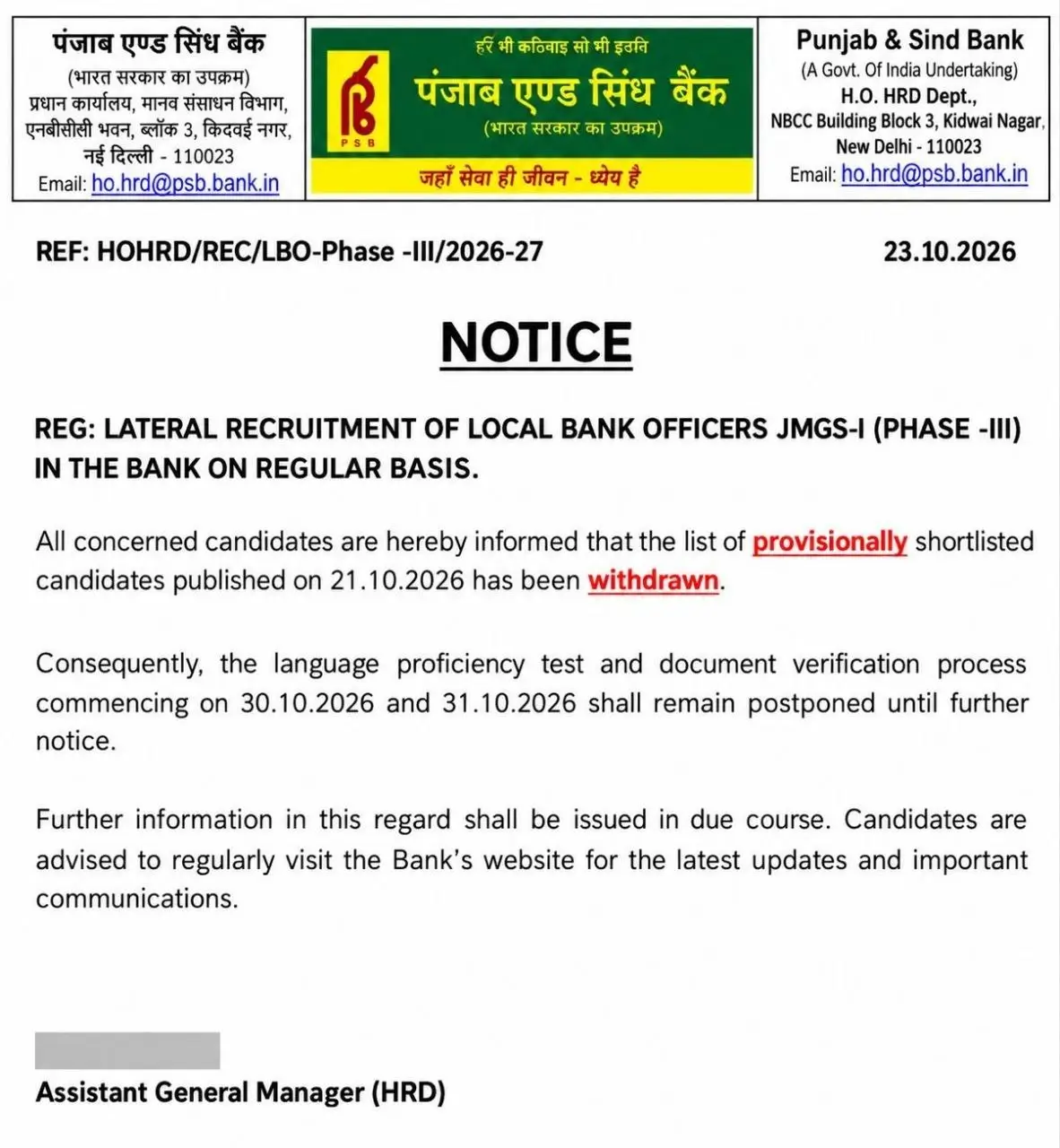
Punjab & Sind LBO Final Result 2026 Withdrawn, Download Notice PDF

Punjab & Sind Bank has withdrawn the provisional shortlist released on 21 October 2026 for the recruitment of Local Bank Officers (LBO) under Phase III. According to the latest notice dated 23 October 2026, the list of provisionally shortlisted candidates has been withdrawn, and the Language Proficiency Test (LPT) and document verification scheduled for 30 and 31 October 2026 have been postponed until further notice. Candidates who participated in the selection process should check the latest official updates before making further arrangements.

Punjab & Sind LBO Final Result 2026 Out

The Punjab & Sind LBO Final Result 2026 is provisional and is not the final merit list. The final merit list will be prepared after the Language Proficiency Test (LPT) of eligible candidates and document verification, subject to the eligibility conditions and further joining formalities. Shortlisted candidates will be contacted separately through their registered email IDs regarding the further selection process.

Punjab & Sind LBO Final Result 2026, Provisional Shortlist Withdrawn

Punjab & Sind LBO Final Result 2026 Overview

Particulars Details
Organisation Punjab & Sind Bank
Post Name Local Bank Officer (LBO)
Scale JMGS-I
Recruitment Phase Phase III
Recruitment Type Regular basis
Previous Shortlist Date 21 October 2026
Latest Notice Date 23 October 2026
Previous Shortlist Status Withdrawn
Language Proficiency Test Postponed until further notice
Document Verification Postponed until further notice
Earlier Scheduled Dates 30 and 31 October 2026
Revised Dates Not announced
Official Website www.punjabandsind.bank.in

What Has Changed in Punjab & Sind LBO Final Result 2026

Particulars Earlier Status Latest Update
Provisional shortlist Released on 21 October 2026 Withdrawn on 23 October 2026
Language Proficiency Test Scheduled for 30 October 2026 Postponed
Document verification Scheduled for 31 October 2026 Postponed
Revised schedule Earlier dates announced Awaiting further notice
Further communication To be provided to shortlisted candidates Candidates should monitor official updates

What After Punjab & Sind LBO Final Result 2026 Out

Candidates who participated in the Local Bank Officer Phase III recruitment should follow the latest instructions issued by the bank.

  • Check the official website: Visit the Punjab & Sind Bank website regularly for updates regarding the shortlist and recruitment schedule.
  • Wait for revised dates: The LPT and document verification have been postponed, and no fresh dates have been announced.
  • Monitor registered email: Check your registered email for further communication from the bank.
  • Keep documents ready: Organise your educational certificates, identity proof, experience documents and other relevant records required under the recruitment notification.
  • Follow the revised notice: Proceed with the remaining selection formalities only according to the bank’s latest instructions.

Last 7 Days Preparations Strategy for SBI Clerk Mains 2026

With the SBI Clerk Backlog Mains Exam 2026 approaching, candidates should use their remaining preparation time wisely. Instead of covering unfamiliar topics, prioritise revising important concepts, solving practice questions, and improving speed and accuracy. A focused 7-day revision plan can help candidates strengthen their preparation and enter the examination with greater confidence.

Last 7 Days Preparations Strategy for SBI Clerk Mains

With the SBI Clerk Backlog Mains Exam 2026 scheduled for 29 October 2026, candidates should use the remaining days to sharpen their exam strategy and revise important topics. Focus on key concepts and shortcuts in Reasoning, Quantitative Aptitude, and English, while taking timed mock tests to assess performance and correct mistakes. Also, revise recent current affairs, banking updates, and static General Awareness to strengthen your preparation for the Mains examination.

Tips And Strategy For Last Week of SBI Clerk Mains

Keep your strategy balanced prioritize accuracy, maintain time discipline, and avoid unnecessary guesswork. Lastly, stay calm, rest well, and keep your confidence high to perform your best on exam day.

Day 1–2: Focus on Strong Areas

  • Revise the topics you’re confident in Reasoning puzzles, DI sets, Grammar rules, or Banking Awareness.
  • Practice sectional tests to ensure accuracy and time management.
  • Analyze your previous mock test results to identify improvement zones.

Day 3–4: Work on Weak Sections

  • Dedicate these two days to the topics you often find tricky.
  • Revise formulas, shortcut techniques, and commonly asked question types.
  • Solve previous year’s questions to get familiar with the pattern.

Day 5: Take a Full-Length Mock Test

  • Attempt one full mock under exam conditions to assess your readiness.
  • Review your performance and note recurring mistakes.
  • Focus on time allocation per section and accuracy improvement.

Day 6: Revise General/Financial Awareness

  • Go through the last 4–6 months of current affairs, focusing on banking, economy, and static GK.
  • Revise important government schemes, RBI updates, and financial news.
  • Use short notes or daily capsules for faster recall.

Day 7: Light Revision & Relaxation

  • Avoid heavy study. Just skim through formulas, GK notes, and vocabulary lists.
  • Get proper rest and a good night’s sleep.
  • Stay calm, confident, and mentally prepared for exam day.

SBI Clerk Mains Section-Wise Strategy

To crack the SBI Clerk Mains Exam you need a targeted approach for each section. Since the exam tests both speed and accuracy, understanding what to prioritize in every subject is key. Here’s the section-wise strategy to maximize your score:

1. Quantitative Aptitude

Focus Areas: Data Interpretation (caselet, missing DI), Arithmetic Word Problems, Quadratic Equations.

Strategy:

  • Solve 3 to 5 DI sets daily with strict time limits.
  • Revise formulas, percentage/ratio, speed-distance, simple-interest/compound-interest.
  • Avoid attempting very tough calculations; accuracy is more important than quantity.
  • Do quick revision of shortcut tricks for simplification and approximations.

2. Reasoning Ability & Computer Aptitude

Focus Areas: Puzzles, Seating Arrangements, Syllogisms, Input-Output, Coding-Decoding. Computer basics (MS Office, shortcuts, networking, recent tech).

Strategy:

  • Solve 1–2 puzzles daily to keep logical thinking sharp.
  • Revise all formulas, flowcharts, coding-decoding patterns.
  • Practice previous years’ computer questions; no need to learn new topics.
  • Skip overly time-consuming questions in exam; come back only if time permits.

3. English Language

Focus Areas: Reading Comprehension (RC), Error Detection, Para Jumbles, Cloze Test.

Strategy:

  • Solve 3+ RC and grammar exercise daily.
  • Revise grammar rules, tenses, prepositions, articles, commonly confused words.
  • Do light vocabulary revision, focus on understanding context rather than memorizing.

4. General/Financial Awareness

Focus Areas: Current Affairs (last 6 months), Banking & RBI updates, Government schemes, Economic terms, Static GK.

Strategy:

  • Revise short notes or flashcards for quick recall.
  • Focus on banking & financial news, budget highlights, policy changes.
  • Do last 2–3 months current affairs quizzes daily for revision.
  • Avoid reading new articles; focus only on revision.

General Awareness Tips for Last Week

  • Do maximum full-length mock test every alternate day as you can; analyze mistakes quickly.
  • No heavy learning, focus on revision, accuracy, and speed.
  • Sleep well and avoid over-practice; mental freshness is key for exam day.
  • Keep short notes handy for last-minute revision of formulas, tricks, and key GK points.
Related Posts
SBI PO Salary
SBI PO Syllabus SBI PO Previous Year Papers
SBI PO Cut Off SBI PO preparation strategy